Facing Identity Crisis

It was one of those periods when time fails to work properly to keep major events spaced out.  We had three major economic events hit us simultaneously and unexpectedly.  Two of them required financing and yet a third involved the government and trying to get our taxes filed.  In any case, I tend to need chronological space to keep these things discrete and make sure I can pay them.  After all of this was done I realized that “secure” information is being collected by all kinds of places these days.  The thing that really got me was that two of them, including the federal government, involved facial recognition software.  In order to confirm my identity I had to hold up my phone and smile pretty for the camera.  Since I can’t speak for the experience of others, I had to wonder if maybe this was because I filed a report of a major scam last year.

I don’t trust AI at all (sorry Al), and governments that collect facial recognition data scare me.  I couldn’t complete my taxes without doing it, though.  A few years ago when I was volunteering for an organization (I can’t recall which one) I had to have my fingerprints put on record.  I thought that was pretty invasive.  I’ve never committed a crime (at least that I’m aware of) and I’ve never been arrested.  Having your fingerprints on record, and your face imprinted in databases certainly makes it feel like it.  Especially since doppelgängers do exist.  On my first visit to Kentucky in the 1980s to help a friend move, the local people all insisted that I was John’s son, a spitting image.  Would Al know the difference?

Once, at Nashotah House, during an accrediting team visit, I was struck by the fact that one of the assessors was a near-perfect doppelgänger of myself.  So much so that when I showed my young daughter a picture I found of him on the nascent web and asked her “Who’s that?” she replied without hesitation “Daddy.”  The facial recognition capacity of kids is pretty keen.  I don’t put a ton of trust in technology.  Of course, the software is probably measuring things like pore depth and nostril hairs.  In neither case did I have the chance to comb my hair and make sure nothing green was stuck in my teeth.  Besides, my face is in a number of spots on this blog.  It doesn’t get as many hits as our finances took in that period when time broke down, but I guess my face is now officially recognized.

Doppelgängers

Maybe this has happened to you.  Two names get stuck and mixed up in your mind until you consistently can’t tell them apart.  Jeff Bridges and Jeff Daniels are two very different actors.  About five years apart in age, they’re both white men, but they play very different roles from each other.  What’s worse, I’m a real fan of a Jeff Daniels movie or two (ahem), and one I watch every year.  When it’s over I inevitably think it was a Jeff Bridges movie.  I’d let this pass as aging gray matter but for one thing—I recently read a book on movies where the author made the same error.  So I tried to exegete it.  Why such a mistake?  They’re not exactly doppelgängers, after all.

Okay, so they’re about the same age.  They don’t look alike and their movie personae are very different.  I tend to think it’s the euphony of the names.  Jeff, followed by a two-syllable last name that ends in s.  As I was talking this through, I said “Both last names begin with a bilabial.”  My daughter corrected me, “D isn’t a bilabial,” she rightly pointed out.  Okay, well, they occur near each other in the alphabet—they’re both in the first four.  What I’m struggling with here is how at least three of us (I had this conversation with someone else years ago who also admitted to confusing the two), have this issue.  And it’s not just the Jeffs.

Back in seminary, the song “Bruce” got a lot of airplay.  By Rick Springfield, it was a lament that he was mistaken for Bruce Springsteen.  The two both play rock (duh) and they were both born in 1949.  Their last names begin with “Spring,” but “steen” and “field” are quite different.  Not to mention Rick and Bruce.  I sometimes think fame is just a mosh of pop culture that gets stuck in our heads and thoughts go around and around like a washing machine until those we don’t really pay attention to end up blending.  And also, famous white guys about the same age with somewhat similar names, have to put up with imperfect doppelgängers.  (Or is it doppelgängeren?)  Academia.edu seems to confuse me with the Steven Wiggins who is an Economics professor at Texas A & M. Or is it the Steve Wiggins, Agricultural Economist at the UK Overseas Development Institute? Since I can only guess from their photo, we seem about the same age.  None of us is famous, but that doesn’t prevent doppelgängers from finding you.


APB

It’s disconcerting. Being mistaken for somebody else. I suspect I’m not alone in having shown up somewhere I’ve never been before only to have people mistake me for a local. It’s happened to me a couple of times, and what with the recent Steve Wiggins incident in Tennessee, it’s enough to make me question my uniqueness. I’ve also had the unfortunate experience of undergoing identity theft some years back, and floating myself out here on the internet is something the wisdom of which I sometimes question. If I’ve got enough doppelgängers running around out there, perhaps I should be careful of revealing too much online. Such problems my grandparents never had.

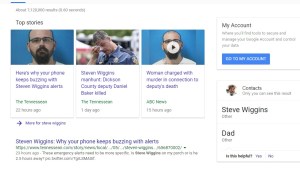
A long time ago I turned off the warning alerts on my phone. It’s not that I don’t care, but rather it’s that I keep odd hours. Without revealing too much, I think I can say that I’m awoken somewhat often by those who don’t go to bed so early, or who don’t think about timezone changes before hitting “send.” We here in the American orient awake earlier than others. So I switched off my alerts. Then I started reading that other people were getting “Steve Wiggins alerts.” Was fame passing me by in the night? While this wasn’t the kind of fame I’d hoped to attain, a few stray visitors to this blog couldn’t hurt. When I searched Google for information on “Steve Wiggins” I found myself listed in the Google box on the right as “other.”

Some people who’ve written only two books are listed as “author” on Google. In my case it seems Google can’t figure out why anybody would be searching for me. “Other.” They say Google knows everything. It certainly knows how to flatter the self-seeker, at least most of the time. What does it mean to be an “other?” The unclassifiable? My work, indeed, falls into the “other” column, like that of many people who’ve made plans only to run into the cold reality that fate has laid out for them. Not being a professor any longer is a source of constant confusion to me. Books I read state that x or y knows about a subject because university z or w has hired them. There are those kinds of experts, then there are the “others.” And because of recent events, there are those instantly famous for killing another man and running away. Who am I? I’m not legend; I am other. What exactly that means I still haven’t sorted out.