Dreaming

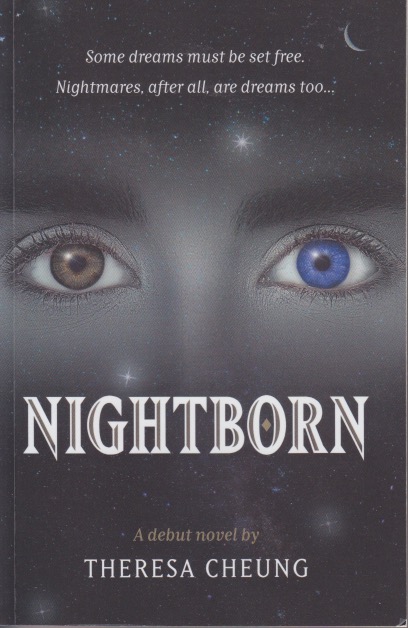
To be honest, I’m not quite sure what to make of NightBorn.  It’s not a bad novel but some of the action isn’t explained enough, leading to a little confusion as to what’s going on.  This is pretty minor, however.  I was enjoying Theresa Cheung’s debut novel but I kept thinking of Dream Scenario and how the premise, at least at first, is so similar.  I was very impressed by the movie Dream Scenario, and wondered if this was going to play out in the same way.  The basic idea is that Alice Sinclair, a professor of psychology, begins appearing in people’s dreams.  The dreams of people who don’t know her.  Then the dreams start to become scary.  If you’ve seen Dream Scenario you’ll recognize the many touchpoints: professor, appearing in strangers’ dreams, dreams becoming nightmares.  Back in the novel, Alice joins forces with her psychic boyfriend, two psychic friends of his, and her dog, to explore why this is happening.

Alice discovers that her absentee father, whom she’s never met, is also a psychology professor and he’s been experimenting with a technology that makes a person go viral in other people’s dreams.  He randomly chose her, not ever knowing Alice as his daughter, or knowing her at all.  The novel deals with synchronicities, and this is one of them.  Her father, who is rather a slime-bag, is working for the government where an unpopular president (this is a novel of its time) is paying to have himself interjected into people’s dreams to get reelected.  Alice was simply a test case to see if it was possible to, well, do a Dream Scenario.  In the movie, of course, a company has been developing the technology for profit, so that advertising can be interjected into dreams.  Another synchronicity.

I won’t spoil the ending of the story.  The ethical concerns of the author come through clearly.  In many ways this is a Trump book—that category of books that, had this particular individual not been elected (or reelected) would likely never have been written.  It’s more, however, about the power of dreams than it is about the power of potentates.  The publisher, 6th Books, prefers paranormal plots, so expect a bit of that when you pick this one up.  Dreams not only feature Alice, they also guide the plot.  In the end, the scenario isn’t the same as that in Dream Scenario, but the vehicle is quite similar.  It may, if viewed from a certain angle, be considered dark academia.

Dangerous Dreams

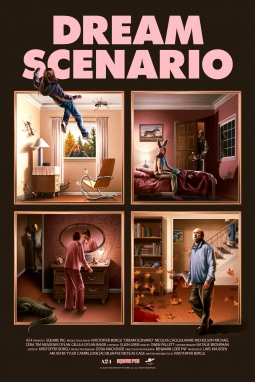
A friend wondered what I might make of Dream Scenario.  As much as I like movies I can’t keep up, what with a 9-2-5 job and writing my own books.  I’m really glad, however, that I learned about it.  It’s one of those movies with a difficult to define genre.  IMDb tags it as “comedy,” “drama,” and “fantasy.”  Rotten Tomatoes goes this route: “Comedy/ Drama/ Mystery & Thriller/ Horror.”  Is there anything this movie is not?  There are definitely some horror cues here, but it doesn’t feel especially like horror.  Except when it does.  Ari Aster, one of the producers, is associated with “art horror” films—think Hereditary.  Think Midsommar.  And it’s an A24 movie, but I’ve read that they’re moving a bit away from horror (the only kind of movie for which I know them).  So what is Dream Scenario?

In brief, it is the best I’ve seen from Nicholas Cage.  I’ve liked some of his films, but this one is incredible.  Certainly the story helps.  Paul Matthews (Cage) is an unremarkable biology professor who suddenly begins appearing in people’s dreams.  Nobody can figure out why, but when the story gets on social media he becomes famous.  Everyone loves him.  Then something happens.  The dreams become nightmares and everyone turns on him.  That summary doesn’t do justice to the film, but it’s essentially what goes on.  The telling of the tale, however, is masterful.  The nightmares, which are briefly shown, are what make this any kind of horror.  There’s no lingering over the fear.  It’s just part of Paul’s new life.

The closest I’ve come to encountering this idea is the novels by Hank Green: An Absolutely Remarkable Thing and A Beautifully Foolish Endeavor.  Of course, Green knows what fame is like—something few accomplish.  The movie explores how fickle it can be and how swiftly and viciously it can turn on those who find it.  In that regard Dream Scenario is also an exploration of life in the internet era.  It’s a time when the kids have to be asked to put down their phones for family time over a meal.  When the result of constant connection is “trauma.”  Unlike fame in the last millennium, “going viral” is just a matter of waiting until someone comes along with something that the net likes better.  And the commentary about how to merch shared dreams takes this in quite a different direction from Inception.  Dreams are strange, and remain poorly understood.  This is a movie that will make you ponder how much they are like the internet, and the results can sometimes be a nightmare.