Detoxing God

There’s some pretty weird stuff in the Bible. Those who are only familiar with all the “thou shalt not”s are missing a great deal. Some of the material is strange enough to rival Alice’s tumble down the rabbit-hole (Charles Dodgson was, after all, a deacon). Anyone who’s read Ezekiel, or Daniel, or Revelation, knows the feeling of having been slipped into some kind of alternate state of consciousness. As students of the Bible have been saying for decades, “What was Ezekiel on?” I’ve always tried to put these unusual writings into context for my students. Nevertheless, some scholars still explore the possibilities that something more than revelation was going on in the desert. A friend of mine pointed out the website Time Wheel, which has a story about Moses and his experience of the burning bush. Time Wheel is an artistic collective, and the story about Moses is richly illustrated. The title, however, is the attention-grabber: “The Bible’s Moses Was On DMT Says Hebrew Professor.”

The article explores the thesis of Benny Shanon, who suggests Moses may have found DMT in the natural store of psychedelics available in nature. As the piece suggests, you have to accept a literal Moses for this to make any sense. Nevertheless, it does raise an interesting question: did ancient people use hallucinogens for religious purposes? We do know that cultures throughout the world have found alternate states of consciousness to be religious in nature. Before the days of controlled substances certain plants and fungi were known to distort reality. Alcohol was one of the earliest inventions of civilization, or perhaps even predating it. When other views of the world are available, it is possible to say that one is by default the true one? It’s a question we face every morning, to some degree. The dream, another biblical favorite for alternate realities, can be just as real as waking.

Controlled substances are dangerous in large groups of people. Not only have modern scientific techniques refined the active ingredients, but we live very close to one another and erratic behavior, perhaps fine isolated in the desert with a cognizant adult, can lead to problems when other people live right next door. Anthropologists assure us that the use of natural “drugs” is/was not uncommon among many peoples who don’t fall under the rubric of powerful centralized government. But was Moses among them? To me, the burning bush hardly seems fantastic enough to require a chemical explanation. In fact, detailed study of even such books as Ezekiel and Revelation often reveal a much more mundane reality behind the writing. Still, imagination is often the key to unveiling realities left hidden to more prosaic minds. So why not see what might happen when the religious are left to their own devices in the desert? The results could change the world.


278px-William_Blake_-_Moses_Receiving_the_Law_-_Google_Art_Project


Caledonia Dreamin’

“Edinburgh is a mad god’s dream.” So penned poet Hugh MacDiarmid with sentiments that could’ve been composed by H. P. Lovecraft. My association with Edinburgh seems accidental, but there is little in my life that compares to this mad god’s dream. The Gnostics used to believe that there was nothing in divinity that precluded a kind of divine madness. Philosophers, back when they still considered god a postulate, argued about whether the deity was good or evil. If they’d come to Edinburgh, I suspect, the debate would’ve taken on a whole new cast. In his poem “Edinburgh,” MacDiarmid captures the untamed nature of a city that has never been given the accolades of Paris, London, or New York, but is just as edgy and twice as beautiful.

Dreaming gods, of course, are nothing new. Vishnu, according to some strains of Hinduism, is the god whose dream is the universe. In the Ugaritic Baal Cycle, it is a dream that reveals to the ancient god El that Baal has returned from the land of death. And, of course, Cthulhu lies dead but dreaming in the city of R’lyeh. To me, Edinburgh is a wonderful alchemy of divine dreams. I was a young man, still so very naive when I moved here. Looking back at those old photos, I see a much younger face from the past, telling the camera that yes, he’d found paradise, the very place of God’s dreaming. Our human politics, however, trump divine dreams every time. Although I never wanted to leave, I was not permitted to remain. Yes, the camera does, at times, capture the soul.

DSCN3490

I am on the train that will take me from Edinburgh, having seen it anew through my daughter’s eyes. I came here penniless some twenty-four years ago, but with a head full of dreams. Life has taught me the cost of dreams since that time, and I have had to pay with wrecked careers and uncertain futures, trusting that the god who is dreaming all this is mad indeed. Nevertheless, like the gods, I refuse to stop dreaming. As much as Hugh MacDiarmid captures the spirit of Edinburgh, as I sit here, with a wee bit of mist in my eyes, my mind is on the words of another poet, Baroness Nairne. To her I will have to leave the last words, from this south-bound train. “Fareweel, Edinburgh, where happy we hae been.”


Heavenly Visitors

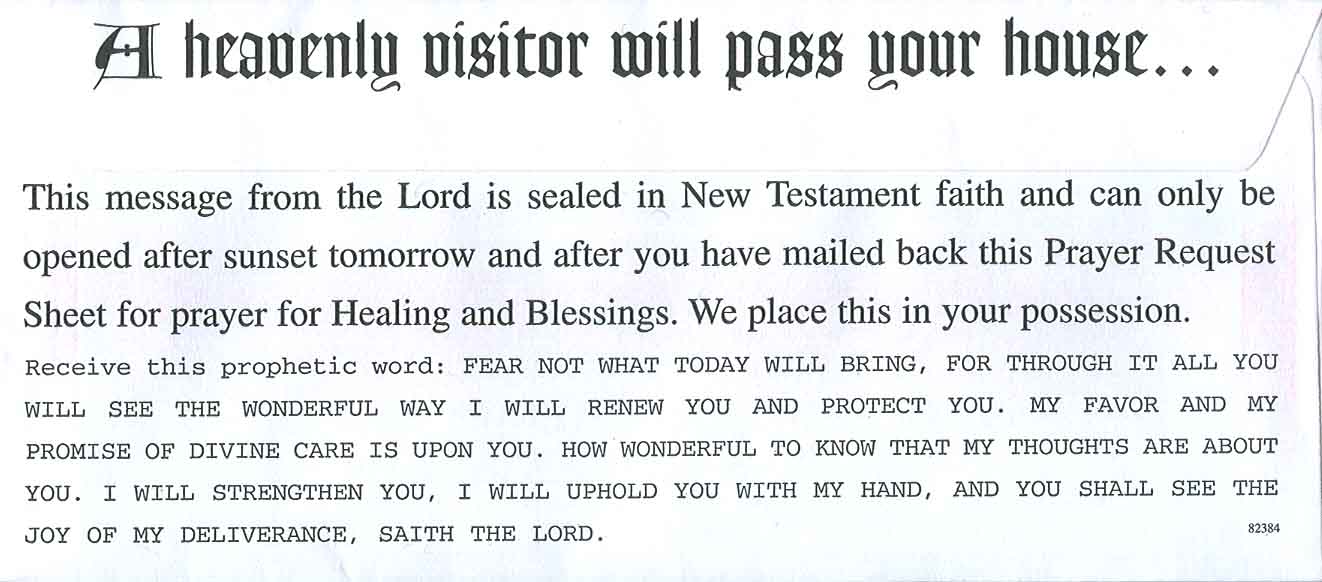
With Passover hard upon us, I was a little disturbed to receive a letter on Friday that read, “A heavenly visitor will pass your house…” Having been raised on the sturdy fare of Exodus, I knew that heavenly visitors more often take the form of marauding angels than of jocular Santa Clauses. It seemed an ominous warning. Of course, it came from the Saint Matthew’s Churches that sent me such good wishes of divine promises of prosperity some months back, so I had to assume it was a purely coincidental biblical reference. The folks at Saint Matthew’s Churches are, after all, Bible believers.

Perhaps because of that fateful letter, I dreamed, in good Genesis style, a dream two nights ago. I dreamed that I found a dollar coin on the ground at a family outing. A few feet away lay another. And another. Wherever we went in that Morpheus-bewitched town there were silver dollars unclaimed on the ground. My trousers were being dragged down with the weight of the lucre in my pockets. I couldn’t believe my good fortune! Then I awoke, still employed only part-time, still worrying every minute about whether we can meet all the bills. Perhaps the dream was a message? Should the Saint Matthew’s’ folks be right, prosperity was headed my way. Saturday’s powerball jackpot was in the double-digit millions. I very rarely play the lottery, but since state education in New Jersey needs all the help it can get, I offered up a dollar to see if Saint Matthew’s’ prosperity was at hand.

No. Not even one number came close. Perhaps there is a secret clause in the prosperity gospel contract. Perhaps those who prosper must hold certain conservative views on social issues. The views, say, my mother holds. Yet she lives in a trailer on a severely circumscribed income. That doesn’t seem to be it either. Last night I awaited another dream. Instead, the next-door neighbors were holding a loud party until 3 a.m. Perhaps celebrating Palm Sunday? Or perhaps that was the heavenly visitor passing over for Passover a couple of days early? Either way, I didn’t sleep well last night knowing that something was just outside my window.