Not Trembling

Tremors is one of those monster movies I just plain missed.  Of course, it was released while I was working on my doctorate in Edinburgh, and although we saw some movies we couldn’t afford many.  We certainly didn’t go to any creature features.  I only found out about it because DVD extras on Alfred Hitchcock’s The Birds had a little debate as to whether that film was a monster movie.  They interviewed Rob Underwood, the director of Tremors, for his opinion.  A short clip was included, so I knew I’d need to see it eventually.  It took a few years, but now I can stake my claim.  Tremors is one of those quasi-funny horror movies, maybe edging into comedy-horror, but not quite.  Although not recalled as an inspiration, the story has some resemblance to Frank Herbert’s Dune.  At least as far as the monsters go.
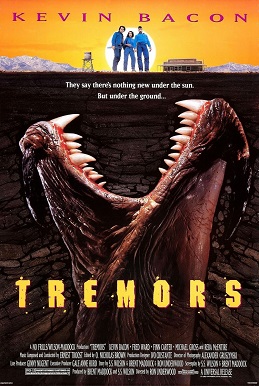
In the remote Nevada town of Perfection, two handymen, Val and Earl, are ready to leave the population of 14 for bigger things.  But then strange deaths begin to occur.  A local seismologist has been noting unusual readings as locals find a dead creature that appears to be some kind of snake.  They want to go for help but find themselves trapped.  The seismologist and handymen try to unravel the mystery of this creature, which the handymen kill.  She (the seismologist) informs them that there are three more.  Warning their fellow citizens of the danger, the underground creatures begin attacking.  As in Dune, they “hear” people walking and use that information to hunt them.  A couple of survivalists manage to kill one of the sand worms, but the surviving townies know they have to escape to the mountains.

One of the final two monsters is dispatched with a homemade bomb, but I’ll let you watch to figure out how the last one is handled.  The movie starts out with folksy humor and nothing too serious.  When the monsters begin to attack, however, they prove relentless and give some scare to the affair.  Although the film didn’t perform especially well at the box office, it led to a franchise with sequels and a prequel (the origin of the monsters is never explained).  Filmed in bright desert sunlight, the movie isn’t typical of horror.  At the same time, it’s built around monsters, so there’s no doubt that it fits.  It probably won’t scare anyone these days, but it has become part of the repertoire, and it remains good fun on a rainy afternoon.

More than Sand

My sci-fi roots may be showing, but when John W. Morehouse posted a story on TheoFantastique’s Facebook page about Dune, I had to follow up.  The story was from Wired magazine, and the title asks “Should There Be a Religion Based on ‘Dune’?  Although I grew up on Poe, science fiction was my favorite genre as a kid.  Frank Herbert’s classic was published when I was only three, but it was experiencing a resurgence before the movie came out.  Dune was  complex world building.  It was immersive, and compelling.  The movie, I felt, didn’t do it justice.  I’m not surprised that people are now wondering if it shouldn’t become a religion.  Other sci-fi-based religions do exist.  Star Wars and Avatar have both developed fan bases that consider the films their religion.

Movies have a way of becoming part of our reality.  The other day I was reflecting on how much my frame of reference for life is based on movies.  I quote from them frequently.  I draw wisdom, and sometimes just plain inanity from them.  But I remember them.  I spend a lot more time reading than I do watching movies.  If a book is engaging I’ll remember it well, but it isn’t unusual to forget—although I hope it’s still there somewhere in deep storage—a book that failed to make much of an impact.  I suppose that’s true of movies too, but I recall my first viewing of The Jungle Book in theaters.  How those hypnotic snake eyes scared me!  And there was a film whose title I can’t recall, but I remember it was vignettes of Hans Christian Andersen stories, I believe.  One was called “The Tinderbox.”  I still remember it well although I was probably about five when I saw it and I never watched it again.

This staying power of movies suggests their religious potential.  People today, I suspect, are less concerned with the antiquity or bona fides of a religion than they are with the practical issue of whether or not it works for them.  Does it bring them near some sense of transcendence?  While the Wired article doesn’t seriously suggest a religion based on Dune, I sometimes ponder how the wisdom of ancient religions is often entombed in forms and structures that “true believers” mistake for the actual essence of the religion itself.  Sci-fi based religions reach for the newly created realms of transcendence.  They are filled with wonder.  But it will only be a matter of time before that awe fades into arguments about which canonical version is literally true.  It’s happened before.


Foundation and Empire

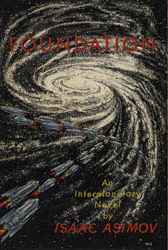
Foundation_gnomeIn a childhood full of science fiction I’m sure I read much material that was too sophisticated for me. After all, I grew up in a working-class family where politics amounted to lambasting the incumbent because things still weren’t getting any better. Even the conservative super-hero Ronald Reagan was mostly remembered for the government-issue cheese we received for free. We called it “Reagan Cheese.” In that setting much of Isaac Asimov’s Foundation trilogy must have been far beyond me. Still, I dutifully plowed through all three volumes as any budding science-fiction nerd was expected to. It was a required piece of the curriculum along with Frank Herbert’s Dune. Heinlein’s Stranger in a Strange Land would have to wait until adulthood. I remember rooting for the cosmic empire—the symbol of law and order—unaware that similar systems would eventually find me as a fifty-something, educated man unemployable for years at a time. Science fiction doesn’t bestow the ability to see the future.

Then I read a recent issue of Books and Culture, the bi-monthly publication review by Christian Century. An article by Philip Jenkins, reviewing a book I’ve not read, started off with a reference to Asimov’s trilogy. Suddenly I found myself transported hundreds of miles and two-score years from Midtown Manhattan to rural western Pennsylvania in barely adequate housing, holding Foundation and Empire close to my face. Jenkins, a noted historian of religion, was pointing out that Asimov often drew from Gibbon’s Decline and Fall of the Roman Empire and based his character of the Mule—those of you who’ve read the trilogy remember him, I’m sure—on Mohammed. The thought had never occurred to me that the science-oriented mind of Asimov would ever delve into religion for inspiration. Still, with the little I recall of the story, it does seem to add up.

In fact, much of science fiction is deeply dependent on religion. Science fiction dares to dream of the future, and no matter how technical that future becomes, the religious are still there. Last century bold claims were made that we’d be living in the twilight years of religion by now. Mid-term elections fueled by religious fervor prove the pundits wrong yet again. Organized religion, fledgling or fully adult, is a political animal. Religion and politics are both about how we interact with one another as a society. It may seem that the concepts behind religious thought are unsubstantiated myths that transcend the mechanistic world in which we live. Even so, they continue to drive revolutions large and small. And somewhere in the attic I still have my copy of the Foundation trilogy ready to be seen by grown-up eyes. Or better yet, through the credulous eyes of a child.