Grotesque and Arabesque

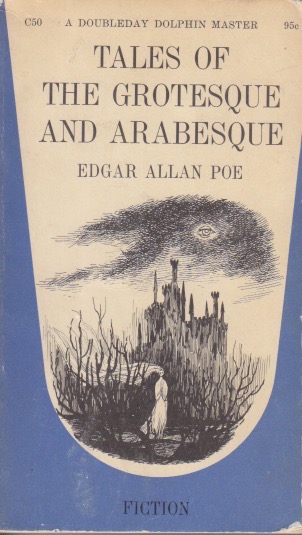
My last post about Edgar Allan Poe’s Tales of the Grotesque and Arabesque led a couple of readers pointing me to places where the missing tale (“The Visionary”) could be read online.  That fact is beside the point.  I have sitting next to me an omnibus edition that contains, in print form, all of Poe’s tales and poems.  Poe deserves to be read in print.  No, the point of that previous post was that I wanted to read a print version of Tales of the Grotesque and Arabesque through so that I could observe a couple of things: the stories Poe thought his best at the time, and to read several Poe stories I never had.  Also, it was an exercise of ratiocination.  So I found a used copy online that contains the full contents, unaltered, of the original printing.  Such a book may be still in print, but given the constraints mentioned in my previous post, it cannot easily be found.  So on to the stories.

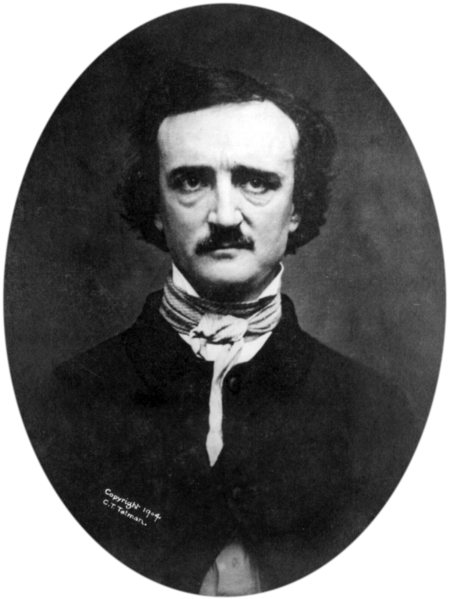
A great number of the stories contained herein are funny.  Poe was quite capable of humorous writing.  Some of the stories verge on science fiction.  Others demonstrate his incredible breadth of reading.  He wrote smartly about ancient history—fictionalized, of course—and about astronomy.  He wrote a story about the end of the world, which adheres, in some measure, to the “biblical” account known even in his day.  The stories are erudite and often obscure.  They are seldom read, or at least discussed among Poe’s horror tales.  I’ve been pondering horror as a category quite a lot as of late.  It’s clear that during his lifetime Poe was not a “horror writer” as we know such authors today.  He was a brilliant, and imaginative interrogator of the world in which he lived.  Reading this book all the way through was an epiphany.

Poe’s writings are in the public domain.  There are websites, easily found, where all of his stories may be located for free.  There are some writers, however, that I believe have earned the honor of being read as they were published—on paper.  Until recently I had only a couple of editions of paperbacks of Poe’s stories.  They were mostly tales I had read multiple times, here and there.  I even break out the omnibus edition now and again when I want to read one of his stories that aren’t in the other collections.  Tales of the Grotesque and Arabesque has expanded my view, which often happens when I read Poe.  And that is a high compliment to any author, just like reading them in paper form.


Finding Poe

A gift a friend gave me started me on an adventure.  The gift was a nice edition of Poe stories.  It’s divided up according to different collections, one being Tales of the Grotesque and Arabesque.  This was originally the title of a collection of 25 stories selected by Poe himself in 1840.  I realized that much of my exposure to Poe was through collections selected by others such as Tales of Mystery and Terror, never published by Poe in that form.  I was curious to see what Poe himself saw as belonging together.  I write short stories and I’ve sent collections off several times, but with no success at getting them published.  I know, however, what it feels like to compile my own work and the impact that I hope it might have (if it ever gets published).  Now finding a complete edition of  Tales of the Grotesque and Arabesque turned out to be more difficult than expected.

Amazon has copies, of course.  They are apparently all printed from a master PDF somewhere since they’re all missing one of the stories.  The second-to-last tale, “The Visionary,” is missing.  I searched many editions, using the “read sample” feature on Amazon.  They all default to the Kindle edition with the missing tale.  I even looked elsewhere (gasp!) and found that an edition published in 1980 contained all the stories.  I put its ISBN in Amazon’s system and the “read sample” button pulled up the same faulty PDF.  Considerable searching led me to a website that actually listed the full contents of the 1980 edition I’d searched out, and I discovered that, contrary to Amazon, the missing piece was there.  I tried to use ratiocination to figure it out.

I suspect that someone, back when ebooks became easy to make, hurried put together a copy of Tales of the Grotesque and Arabesque.  They missed a piece, never stopping to count because Poe’s preface says “25” tales are included, but there were only 24.  Other hawkers (anyone may print and sell material in the public domain, and even AI can do it) simply made copies of the original faulty file and sold their own editions.  Amazon, assuming that the same title by the same author will have the same contents, and wishing to drive everyone to ebooks (specifically Kindle), offers its own version of what it thinks is the full content of the book.  This is more than buyer beware.  This is a snapshot of what our future looks like when AI takes over.  I ordered a used print copy of the original edition with the missing story.  At least when the AI apocalypse takes place I’ll have something to read.


The Cycle

The last of the Roger Corman Poe cycle was The Tomb of Ligeia.  I haven’t seen all eight films in the set, at least I don’t think I have.  A couple don’t sound familiar to me but I didn’t keep track of all the movies I watched growing up.  Although critics were, well, critical of a number of the films, at least three of them weren’t bad.  In that number I would count Ligeia.  The usual problem with making Poe films is that Poe wrote short stories.  Getting them to the length necessary for a feature required padding, sometimes by borrowing against some other Poe tales.  Ligeia isn’t too far off from Poe’s original and although Corman reportedly didn’t want Vincent Price in the star role, because of his age, he pulls off what seems to me a winner.  Atmospheric, and well-acted, the story is a touch slow, but manages to bring in some solid horror themes.

I’ve been pondering Poe as a horror writer lately.  I suspect that the master himself would’ve been surprised, and probably not pleased with the characterization.  Yes, he wrote stories that would become horror hallmarks, but his fiction output included detective stories (a genre he invented), something akin to science fiction, drama, and comedy.  Some of his funny stories retain their humor today.  I suspect that one reason he became remembered as a horror author was H. P. Lovecraft’s adoration of him.  Lovecraft wrote mostly what we consider horror today, although there’s variation there too.  But since Lovecraft saw the horror, so did others.  When Corman began shooting movies he soon fell into the horror trend and, known for that genre, incorporated Poe.  By the end of the sixties, Poe was a horror writer.

What makes The Tomb of Ligeia work is Price’s tormented performance of Verden Fell.  His Byronic character is caught in the realm between death and life.  Unable to free himself from Ligeia, and she, unwilling to renounce her will, they are caught in a belief that a local declares blasphemy while Verden calls it “benediction.”  The theme of resurrection—presented mostly in the form of Egyptian artifacts—is an inherently religious one.  The setting in a ruined abbey—original to Poe—also plays into the sublimated resurrection theme.  Critics didn’t care for the movie, but separating Corman’s Poe cycle out over time allows a viewer to consider each piece separately.  In this light, this appears to be one of the best three.  Of course, I haven’t seen all of them yet.


A Touch of Poe

One of the more somber aspects of our staycation in the Poconos occurred on our search for Tanners Falls.  It brought to mind a story by Edgar Allan Poe.  Here’s why:  Tanners Falls is not well signposted.  This is quite a rural area.  We were following our GPS when the signal died right after she said “arrived.”  The problem was there were no signs and although we tried a couple of tick-trails that ended up at a stream, nothing like a cataract was anywhere near.  Finally we realized that a tiny sign reading “Tanners Falls” was posted on a “Road Closed” barricade.  Since to road was actually open to the Falls, my wife brought the car but I wanted the exercise and went by foot. Walking along the way I found a roadside shrine and noted that in addition to the name Laura Lynne Ronning was a small plaque stating “Murdered July 27, 1991.”  Now, there was no signal out here, and I was alone on the road.  And I had no desire to bring my family down so I kept it to myself.

At the hotel (with wifi) I learned that Laura Ronning’s murder was never solved.  She was a counselor at a nearby camp walking to the waterfall on her day off when she was raped and shot and thrown into the woods.  The only suspect was a mentally unstable man (now since deceased) and the evidence was all circumstantial.  He was, unlike some known criminals of high profile, found not guilty.  The Ronning family moved out of the state, not wanting to be where someone could literally get away with murdering an innocent young woman.  This is where Poe came in.  His “The Mystery of Marie Rogêt” is the first detective fiction based on a true case—Poe was often, figuratively, first on the scene.  The murder of Mary Cecilia Rogers, whose body was found in the Hudson, was never solved.  Poe tried his hand at the by then famous unsolved case.

The murder of a young woman was a tragedy that Poe felt deeply, I suspect.  I took some academic flak for including Poe’s observation that the death of a beautiful woman was the most poetic theme in Nightmares with the Bible.  I realize this is a masculinist thing to write, but the fact is that some men feel very protective of women.  I know there’s a psychological name for this, but it isn’t chauvinism.  It is a sense of sadness, for what Goethe tried to express by writing “Girls we love for what they are; young men for what they promise to be.”  On staycations I try to look for literary angles, even when they are, from time to time, sad.


The Movie Maker

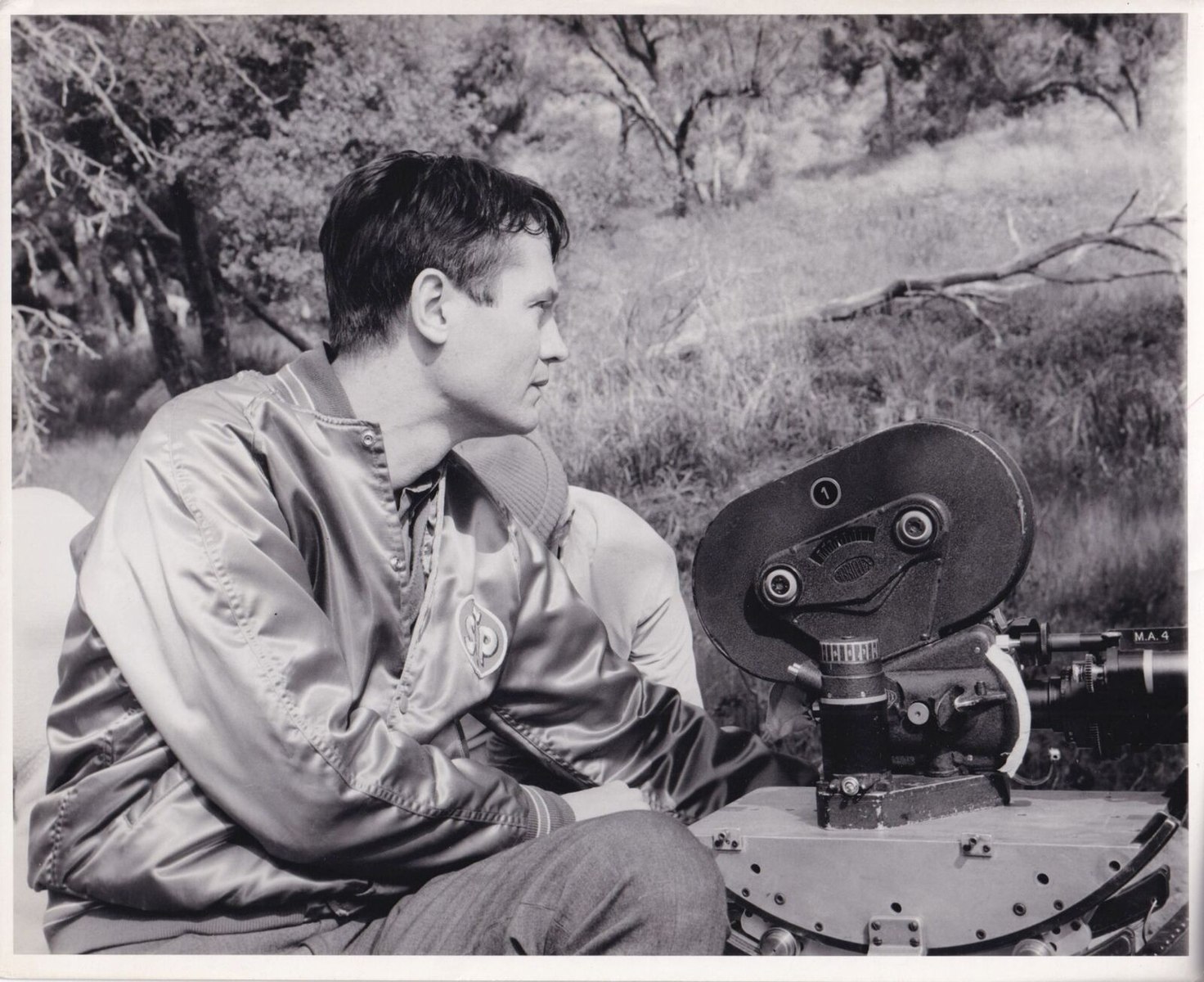
Roger Corman has died.  So passes an era.  I’ve always had an appreciation for the speculative films of the fifties and sixties.  Many of these involved low budgets and content intended to shock.  Or at least excite youngsters.  And Roger Corman was a huge name among directors, producers, and promoters of such schlock.  He entered the realm of horror in 1955 with Day the World Ended.   Attack of the Crab Monsters a couple years later put the focus firmly on monsters.  Producing and directing three or more movies a year, he built a reputation for being cheap and quick, but that didn’t prevent him from creating some good movies.  A film’s producer is the one responsible for overseeing the production.  Often they come up with the ideas of what to film.

Roger Corman, publicity still; public domain via Wikimedia Commons

As the sixties were dawning, Corman produced several films “based on” work by Edgar Allan Poe.  I remember seeing some as a young person and wondering what they had to do with the Poe I’d been reading.  Still, he managed to grace cinema with House of Usher and The Masque of the Red Death.  These are good films, despite limitations.  At the same time, Corman was still producing creature features as well, wracking up an impressive list of nearly 400 produced films.  As an established player in cinema he also took on the role of distributor from time to time.  When The Wicker Man was being ignored in Britain, Corman undertook the role of US distributor, likely saving the movie from total obscurity.

Circling back to Day the World Ended, we’ve become accustomed to believe that some kind of divine or human ending is in the offing.  These ideas get embellished over time, as I suggested in my new piece on Horror Homeroom.  Corman knew that this putative end would get the attention, whether or not there was any truth to it.  Perhaps that was the genius of his work—he knew how to attract attention.  And he wasn’t afraid to do so.  The business of cinema is one of attracting viewers.  Telling stories we want to hear.  We remember reading Poe, and even if the movies differ from the stories he penned, they are nevertheless reminders, reminiscent of what we’ve read.  If there are monsters they are somehow perhaps even more effective for not really being believable.  In short, Corman was a showman.  He made a living doing what he loved.  And he influenced many lives along the way.


Poe’s Novel

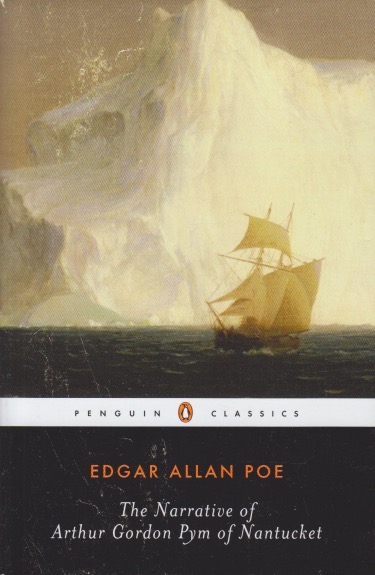
Certain authors, some great among them, excel at short stories.  I know from personal experience that trying to publish a book of such stories is a very hard sell.  For a writer like Edgar Allan Poe, who was trying to live on his words, it often led to periods of poverty.  Thinking of him as a short-story author, I had never read his only novel, The Narrative of Arthur Gordon Pym of Nantucket.  Hailed by fellow brief-tale writer Jorge Luis Borges as Poe’s best, I figured I’d better give it a try.  I’m glad I did.  I had, however, no idea what to expect.  Those who write on Poe seldom pay it much mind.  He was famous for his poems and stories, and this gothic, sea-faring novel was, according to the introduction, suggested to him by those who felt his making a living as a writer might improve if he used long form.

Concerning the edition: the novel is in the public domain.  Penguin Classics, however, often contain nice introductions.  Indeed, the intro by Richard Kopley in this edition is excellent.  A few of his observations stood out to me—this novel was, in some measure, about Poe’s family.  Both the protagonist and the author have five-syllable names with the same cadence, ending on a three-letter surname beginning with P.  Also, as both the introduction and notes make clear, Poe was deeply steeped in the Bible.  You seldom read about Poe and religion.  Writers from America’s first generation, however, were uniquely brewed in it.  I’d never considered that about Poe before.  There are many editions of Pym available, but I recommend this one because of its introduction.

The story ends without resolution, just so you know.  Pym, talked into an adventure by a somewhat devil-may-care friend, goes out on the ocean on a boat after a night of drinking.  And herein hangs the tale.  Well, actually, the friend convinces the young man with a taste for the sea to stow away on a whaler that his father captains.  A mutiny, however, leaves Pym “buried alive” onboard.  A shipwreck leads to near starvation and a boon companion survivor.  Picked up by an explorer headed south, they discover a surprisingly temperate Antarctic circle where a native tribe turns treacherous because of their fear of the color white.  It does seem that there’s a race narrative taking place here too.  I enjoyed the story although the chapters about longitude and latitude don’t quite rise to the level of Melville’s maritime writing.  It’s a tale worth the read, however, but find one with a good introduction and it will be smoother sailing.


Playing Authors

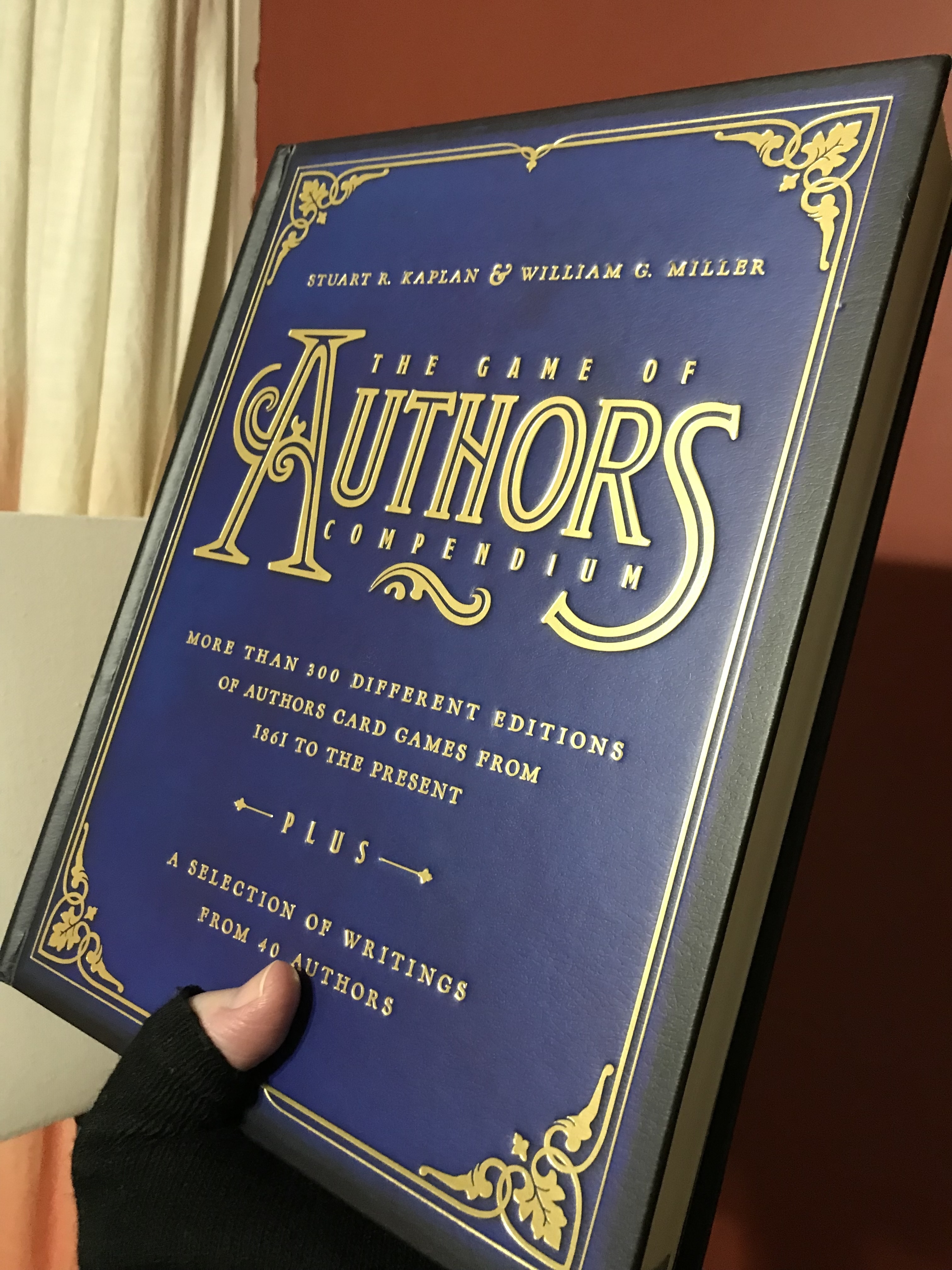
My family looked at me funnily, but not for the first time.  With a holiday gift card I’d ordered a book on the card game Authors that I’d blogged about recently.  You see, there’s not a ton of information on it on the web, and it was a formative influence in my life and I wanted to know more.  I suppose it’s typical for someone raised as a fundamentalist not to immediately think of evolution, but Authors has evolved over the years.  And quite a lot.  For one thing, you can’t copyright an idea and other game-producing companies made their own versions of the original game.  And what I’d assumed had been the original (since it was the one I had as a child) was only one of many versions.  The book even documents the Bible Authors game I’d mentioned.  My real interests included that age-old question—did it ever include Edgar Allan Poe?

Today is Poe’s birthday.  It’s fair to say that he’s one of the most recognizable authors in the world now.  He also had a tough time being accepted.  This book, which I haven’t read through—it’s more of a reference book, in any case—points out that Poe was indeed included in more than one edition of the game.  He isn’t one of the strongly recurring authors (which include several of whom I’d never heard).  This is the fate of writers.  Reading about Dickens lately, I came to realize that even after several best-selling novels (at numbers that would make any modern publisher gloat), he was effectively living off debt until well into his forties.  And he died at 58.  He was famous, but until his final years not what you could consider wealthy.  

Another realization dawned.  Writing for a wider readership means getting away from academic publishers.  I had an agent interested in my current book project for a couple of months before he decided it wasn’t for him.  I’ve also come to see that several authors I respect, and whose books are priced below $20, have published with presses that aren’t part of the Big Five.  And they earn some profit from their efforts (unlike academic publishing).  In other words, becoming an author of either fiction or non, often involves book sense that I’ve been slow to gain.  At the Easton Book Festival a few years back I met several local writers who were putting additions onto their houses with the royalties they earned.  I’d published three books at that point and was turning my pockets inside out hoping for forgotten spare change.  Authors is a game.  Those who are included are those who figured out how it’s played.


Movies, Paused

Technology breaks the world into bits.  It’s not just pixels, or 1s and 0s, it’s culture.  And we let it happen.  I was thinking this when I should’ve been watching a movie.  I don’t have much time for films, nor do I have money to see everything in a theater.  Or even to pay on a streaming service so that I can watch without commercials.  So like any zombie, I just let it happen.  Recently I was watching a movie—it’s here on this blog someplace—that was uncommonly unified by mood.  Edgar Allan Poe was of the opinion, and I think he was right, that short stories should be brief enough to finish in a single sitting.  Poe opined that such a reading allowed for the continuation of a mood set by the writer.  He was a master at doing this himself.  Breaking up movies with commercials reminds us of his wisdom.

Photo by Ramon Kagie on Unsplash

So I was watching a film where the dread builds up slowly.  The shadows, the music, the unspooling plot—try this new toothpaste!  Here’s a silly television show that you can watch on our network!  What was the mood I was in?  It was shattered by people pushing stuff I’ll never buy.  (I’ve got sensitive teeth, Mr. Commercial, and my dentist has recommended a brand that keeps me from gnawing my tongue off.  And that television show, Ms. Commercial, has no appeal to me.  I won’t watch it.)  Back to the mood you were trying to enjoy.  This isn’t anything new, of course.  I grew up watching Saturday afternoon monster movies and they were constantly interrupted by commercials.  You have to endure the sermon if you want the fun of coffee hour.  But still, but still…

Yes, I know the rules.  Subscribe to a service (I use two) and you can watch what we’ve got.  Only some of it will be interrupted by commercials.  Companies as large as ours didn’t get this way by accident, you know.  We had to show the average person what market research indicates they want—whiter teeth, more entertainment.  Forget what you’re watching at the moment.  Isn’t that mood just a little intense?  Don’t you need a little break just about now?  I don’t know how you see these posts, but I pay extra not to have advertising on my website.  I do hope that’s the case, if you see it from a device other than mine.  Besides


Ushering In the New

I’m not at all certain I’ll finish it, but at my daughter’s suggestion I watched the first episode of Netflix’s new series, The Fall of the House of Usher.  This isn’t set in Poe’s day.  The action is in the present and it opens with a funeral for three of Roderick Usher’s children.  What’s particularly striking about this funeral is that the priest’s homily is composed of lines from Poe.  I think we all know that Poe is undergoing a great surge of popularity these days, but this series seems not content just to name characters and companies after Poe’s names, but it also weaves his thought deeply into the fabric.  It uses his images in literal ways that add depth to the plot.  I’m not sure that I can spare the time to watch it the whole way through, but I’m sorely tempted to do so.

With C. August Dupin as the Assistant District Attorney, the series ties Poe’s ratiocination stories in with his horror tales.  Like most recent media efforts, the cast reflects diversity in many ways.  This diversity isn’t the reason the house of Usher is falling, but it’s because of disloyalty.  The family owns an unscrupulous company that has shown disregard for the suffering it causes, buying its way out of legal difficulties.  (This part is quite realistic and one can’t help but to think of Trump and others like him who simply buy injustice.)  But someone in the Usher family has decided to speak out.  Dupin won’t reveal who it is, so Roderick and Madeline Usher put the family up to the task of rooting out, and killing, the informant.

Perhaps with some time off over the holidays I’ll be able to catch more of the series.  It intrigues me, however, that Poe is being used essentially as scripture.  Literally.  The priest’s homily fades into the background as the surviving family members check in on each other, but his words are drawn from a variety of Poe’s writings.  I’ve long felt that our canon of scripture is too small.  Inspired literature did not cease to be written in the second century.  As someone who has listened, and still listens to sermons, it’s clear that the Bible alone isn’t a source for knowledge.  I haven’t read all of Poe—he left a massive paper trail through his life—but what I’ve read sticks with me and hearing him as sermon material makes me think I need to try to find time in coming weeks to pick up another episode or two.


Author! Author!

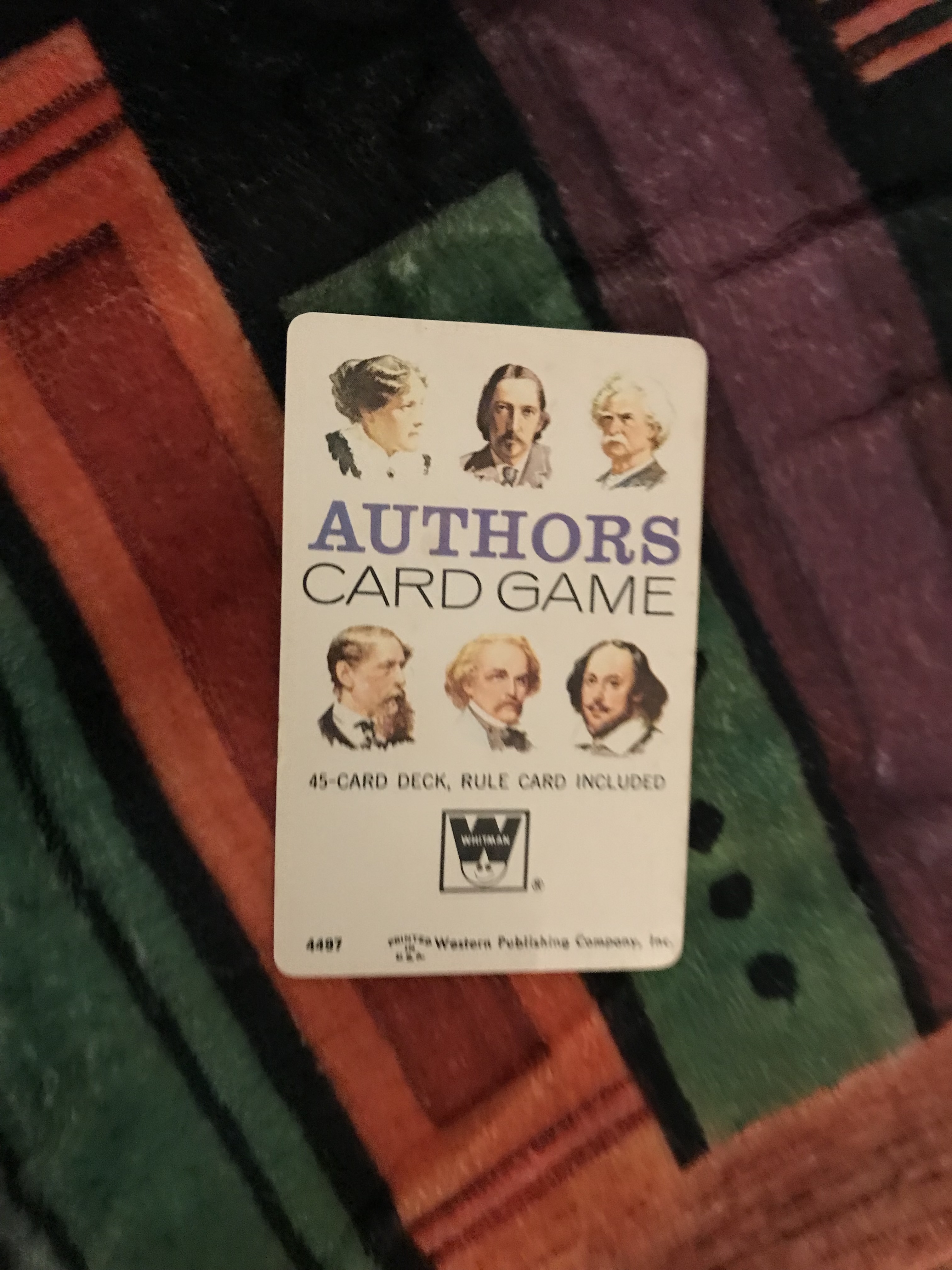
It happened in Salem.  In 1861.  The classic American card game, Authors, was published.  G. M. Whipple and A. A. Smith devised the game, which has remained available ever since then.  It’s one of the few games I remember having as a kid.  We, of course, had the Bible Authors game as well, which I’m kind of nostalgic for, but not enough to see if it’s on eBay.  The object of Authors, an early form of “Go Fish,” is to collect sets of four cards for each author.  Each card lists a different work.  Poets are represented by poems, of course, but prose authors mostly by books.  I have to confess to having eBayed this some time back and having beetlebrowed my family into playing it with me.  I noticed, however, a few curious omissions.

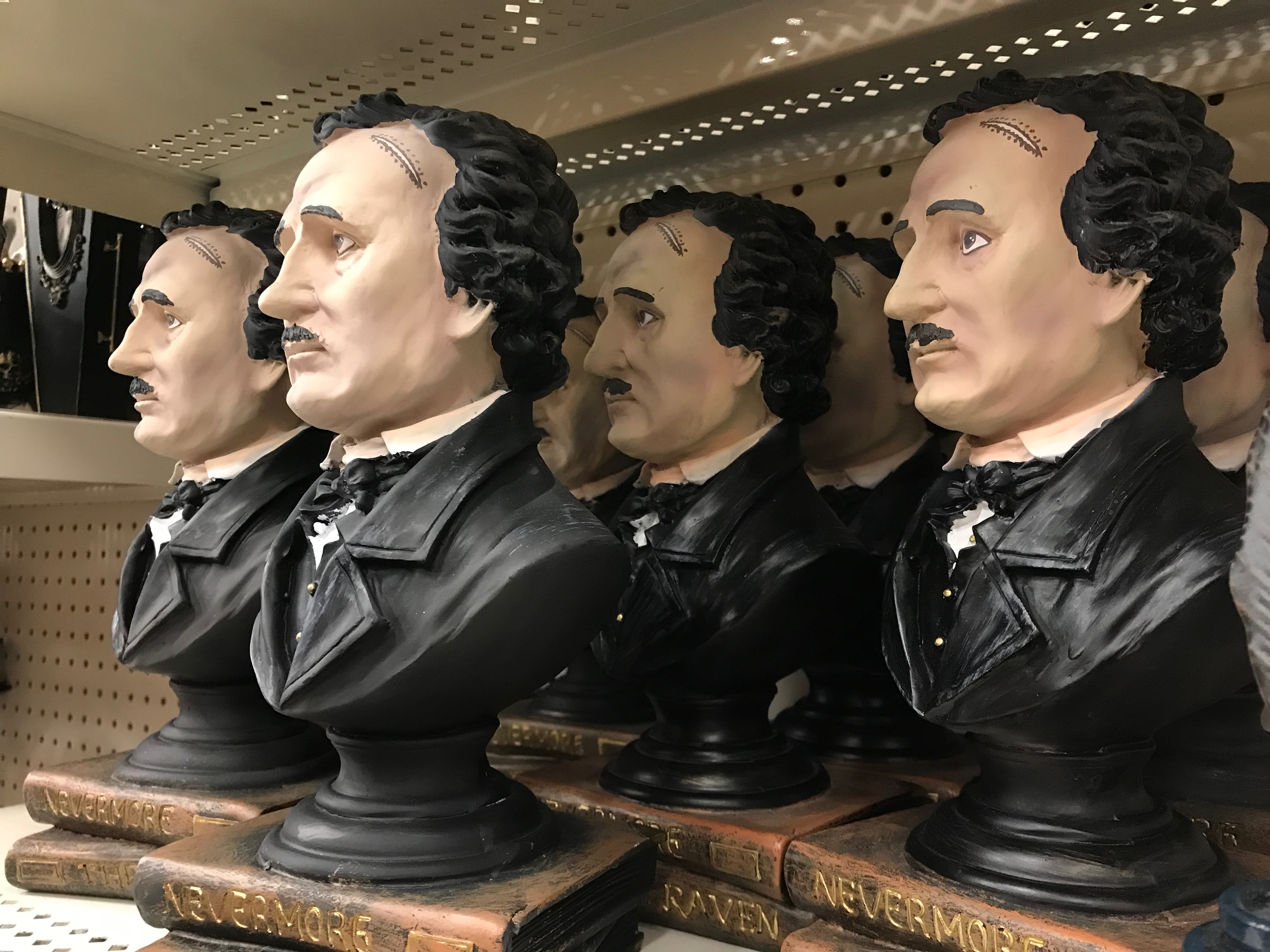
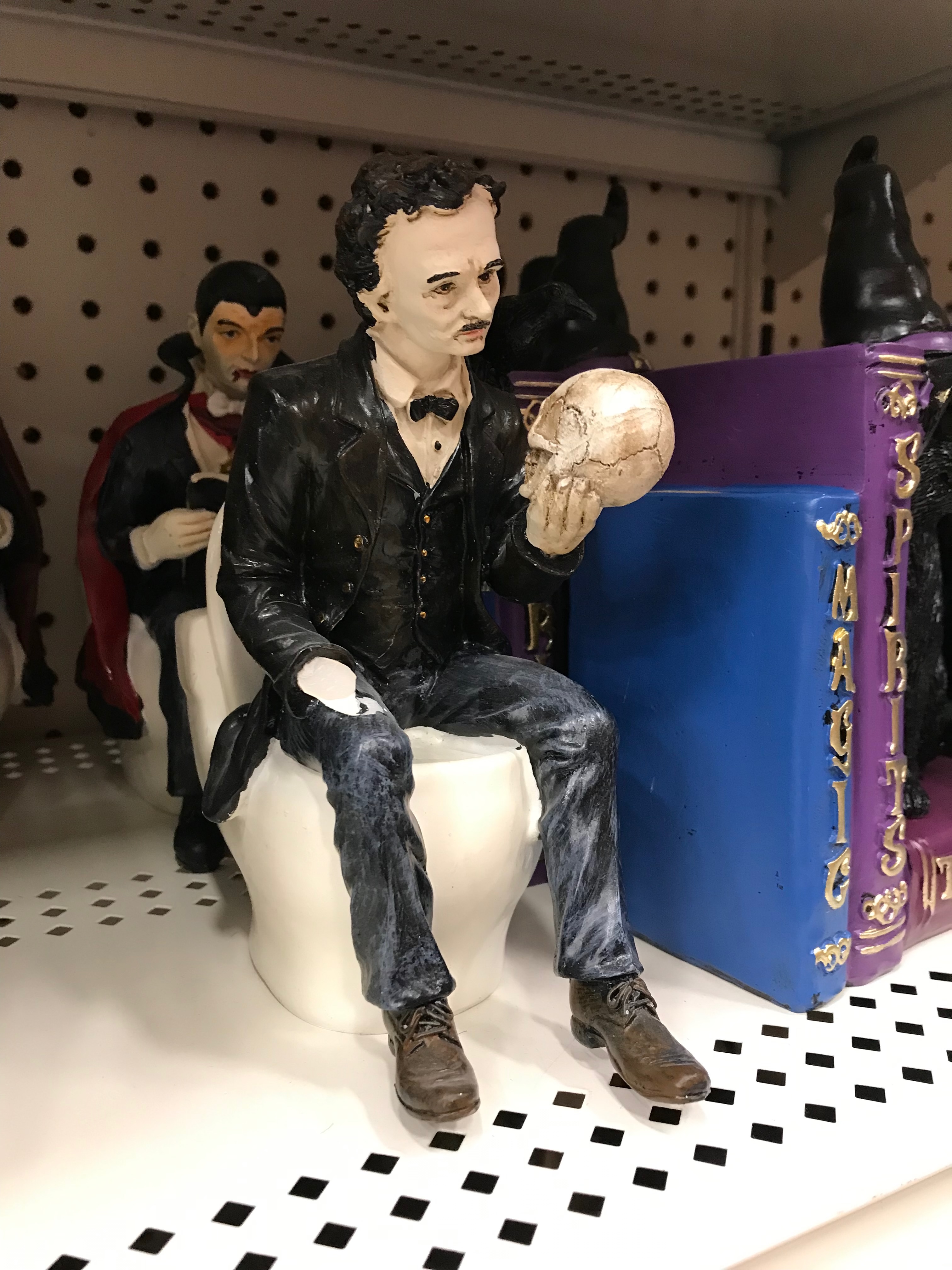
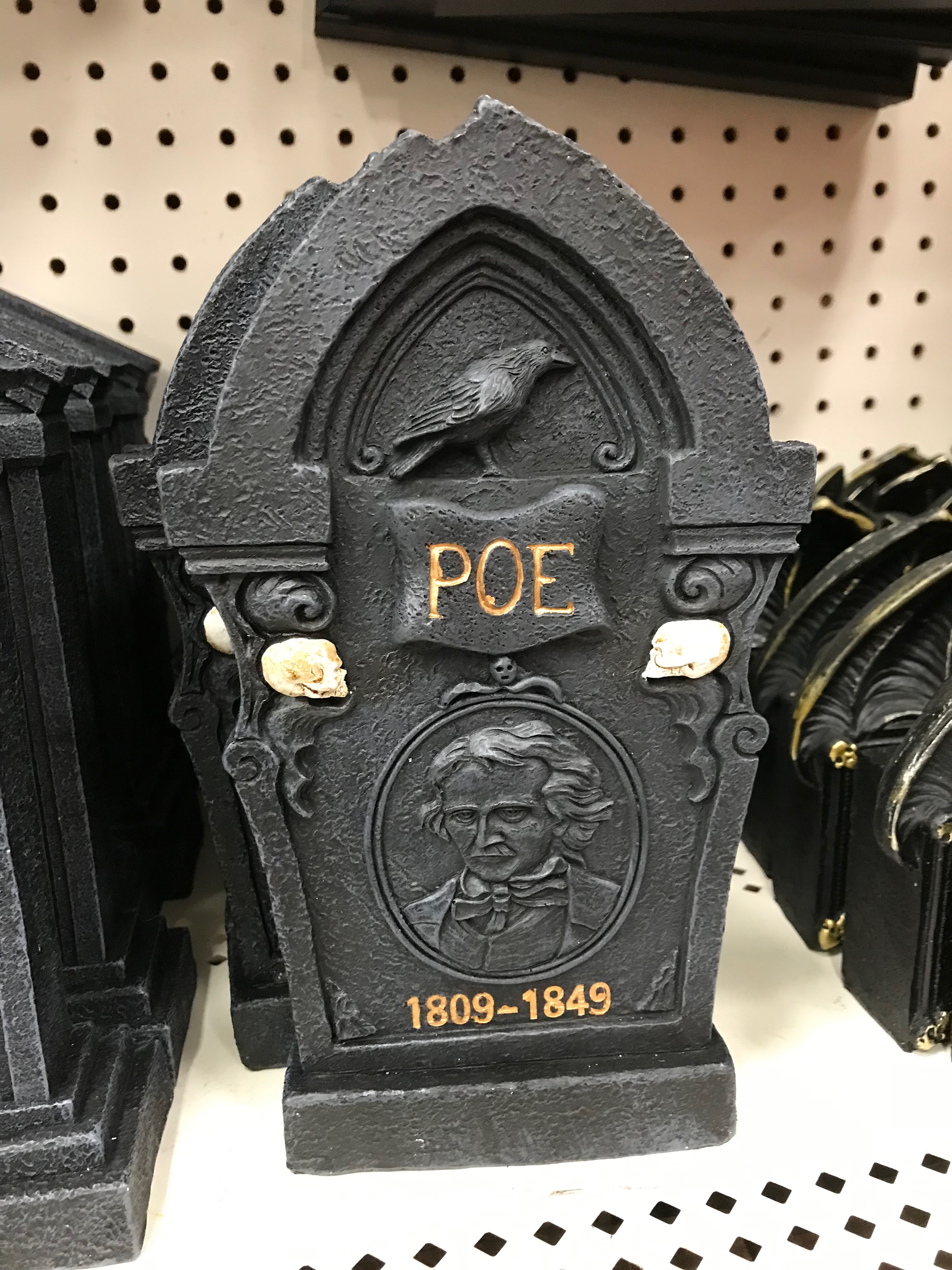
Edgar Allan Poe isn’t among their number.  Neither is Herman Melville.  Rather strangely, they included Shakespeare—centuries earlier than the others—and Alfred, Lord Tennyson.  The only female is Louisa May Alcott when there were perfectly acceptable Brontës in the room, as well as Jane Austin.  The game reflects its time.  A couple years back I was in Michaels—you know, the arts and crafts supplies store.  In fact, Michaels is one of those places for family outings, for families like mine.  (We tend to be creative types.)  While I’ve never been into scrapbooking, I walked down that aisle and found a set of stickers labeled “Literature.”  Two authors were represented: Shakespeare and Poe.  People smarter than me have argued that worldwide Poe is probably the best recognized American author.  I think it’s safe to say Shakespeare occupies a similar role in Britain.

Poe had fallen afoul of many in America because of an intentionally damning obituary by Rufus Wilmot Griswold, whom Poe had named his literary executor.  If it weren’t for Poe nobody would likely know Griswold’s name today.  In 1861, when Whipple and Smith were inventing their game, Poe wasn’t really considered worthy of emulation, largely because of Griswold.  He wasn’t the kind of guy you’d want your kids to be too curious about as you tried to teach them about literature.  Authors has gone through over 300 editions over the years.  I’ve never seen any of them (apart from Bible Authors) other than the Whitman edition from my childhood.  Each time I pick it up, smell the cards (go ahead—try smelling your Kindle), and thumb through the authors I feel like I’m missing something.  Go fish.


What Poe Saw

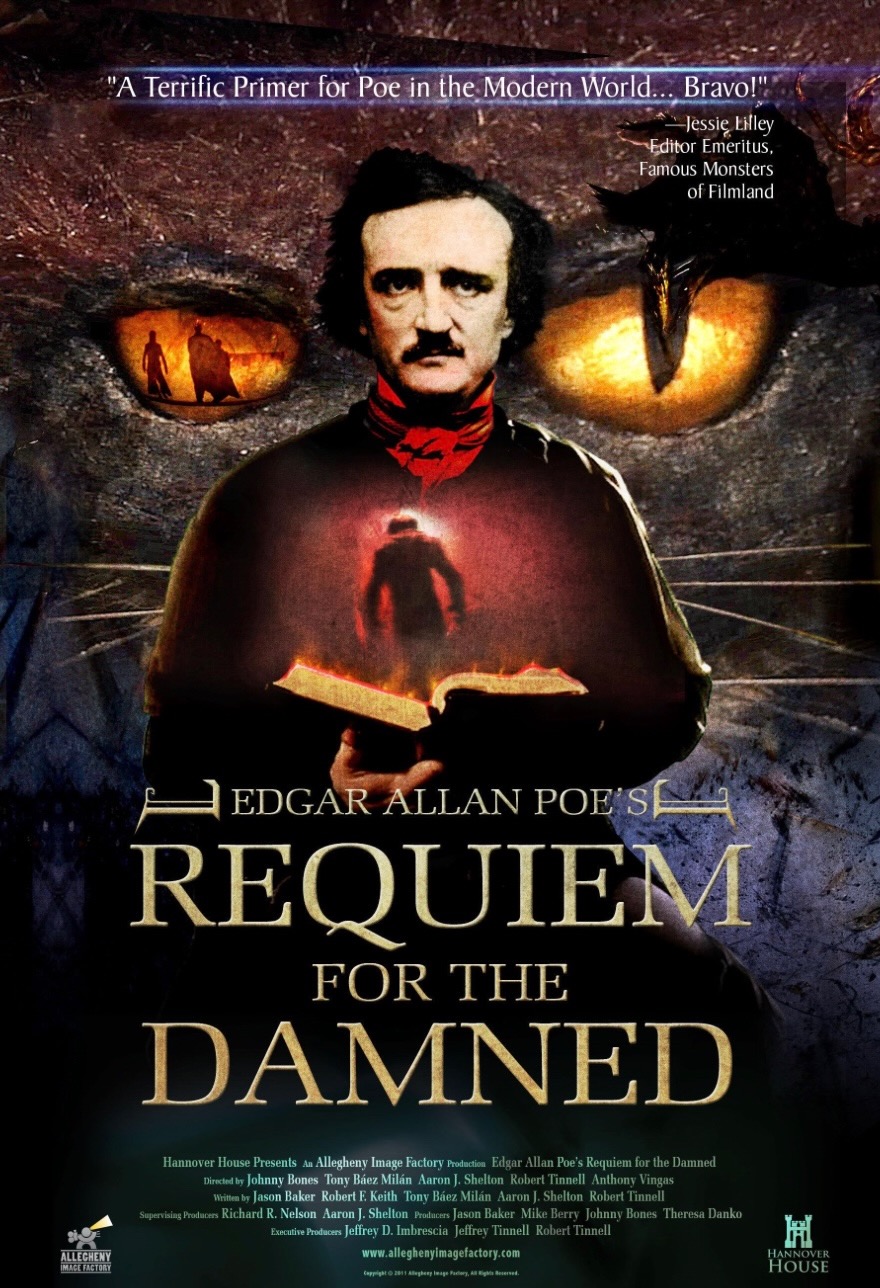
It must be quite a draw, making a film based on Edgar Allan Poe.  The psychology of his tales of terror is compelling and modern filmmaking offers endless possibilities.  I wasn’t looking for anything too heavy, so I watched Requiem for the Damned.  Vignette movies are like a box of chocolates (I’m sure you know how the rest of it goes).  This particular feature doesn’t seem to have had a theatrical release, perhaps because it is an independent film made by students and faculty at the Douglas Education Center.  The opening credits cite the Allegheny Image Factory, and when I think of Pittsburgh and horror my mind eventually wanders to George Romero.  The Douglas Education Center began as a business school south of Pittsburgh and it offers training in filmmaking.  And that seems to explain this particular film.

Five vignettes are taken from Poe’s “Fall of the House of Usher,” “The Tell-Tale Heart,” “The Black Cat,” “Murders in the Rue Morgue,” and “The Pit and the Pendulum.”  Only “The Black Cat” is set in Poe’s period and it is heavily CGI.  The rest are modernized versions of ideas inspired by Poe rather than following his plots.  “Usher” uses Poe’s characters and an introduced illegitimate son, to present the Usher curse—the unfeeling business practices that brought the Ushers wealth have made theirs a haunted estate. “Tell-Tale” has a modern urban legend feel as a guy starts seeing his ex-girlfriend’s broken heart everywhere he goes.  “Rue Morgue” is a lesbian revenge story involving an improvised gorilla suit.  “Pit” is a post-apocalyptic vision with almost no dialogue and a somewhat confusing resolution.

Horror anthologies seldom work.  Like edited volumes in the book world, they lack coherence.  Poe insisted that short stories should be single-sitting forms so that mood could be maintained.  Putting five together, each with different directors, writers, and styles, makes for a disjointed viewing experience.  A couple of the segments, “Black Cat,” and “Pit,” seemed to drag a bit.  The former because you already know the story and the CGI was so abstract that it interfered with the telling and the latter because you really don’t know what’s going on.  The visuals are impressive, but story seems to have been sacrificed.  I was looking for something not too heavy and I did find that.  I also learned about a place where filmmaking is taught and you don’t have to have connections to get in.  Who knows?  Perhaps in another life I might’ve gone that direction.  I tend to follow Poe.


Black Bird

Although we prefer typecasting—it’s so much easier!—Edgar Allan Poe had both depth and width as a writer.  He penned funny as well as scary, love poems and detective stories, even something like a scientific treatise.  One thing I’m sure he didn’t anticipate was his name being suborned for cheap horror movies.  Roger Corman is a Hollywood legend—a good example of a guy making it in the film industry on his own terms.  He paired Vincent Price with a number of Poe titles that had little to do with the actual works of the writer.  One that oddly stayed with me since childhood is The Raven.  This was well before I’d read the poem.  It’s funny how very specific things will stick in your mind.  I remembered the strange hat Price wore.  And I remembered—misremembered, actually—Price using a spinning magical device with sparklers.  Misremembered because that was Peter Lorre’s character, not Price.

That was it.  I didn’t remember that Boris Karloff was also in the film.  I was too young (as was he) to recognize Jack Nicholson as well.  Although I watched The Twilight Zone, I didn’t realize the script was by Richard Matheson.  This film was loaded with talent, but it really was goofy.  I recollected Price was a magician, but I didn’t know this was a rather silly battle to become chief magician.  Lorre’s ad libbed lines were surprisingly funny, even after all these years (I was about one when the film came out).  Surprisingly, the movie did well at the box office, despite its taking a sophomoric approach to perhaps Poe’s most serious poem.  

I’d avoided watching it again for all these years because of that sparkler scene.  I’m not sure why that particular moment wedged itself so firmly in my young brain.  It seemed so not Poe that I couldn’t get back to the movie, apparently.  With Price and Lorre camping it up—Karloff was, by all accounts, most professional as an actor—and Nicholson uncharacteristically timid, the cheap special effects, it’s obvious that viewers enjoyed a good laugh at this one.  It’s not true to Poe, of course.  It’s true to Roger Corman, however, a filmmaker who knew how to deliver cheaply and quickly and still earn some money at it.  I’d last seen The Raven about half a century ago.  I may be tempted to watch it again, after having seen it as an adult, but if I wait too long I’ll need to leave that duty to someone who’s read this and who isn’t afraid of sparklers. 


Mystery of Poe

I’ve read my fair share of books on Edgar Allan Poe, but I have to say that Mark Dawidziak’s A Mystery of Mystery: The Death and Life of Edgar Allan Poe is perhaps the best.  Like Dawidziak, I realize that writers, as well as other historical figures, come to be who we need them to be.  This book, which pinwheels around the unsolved cause of Poe’s death, is probing of his life as well.  His younger years and his likely psychological profile as a child who never felt he received the love and affirmation that he required, really spoke loudly.  This explains much of his behavior, which was often contradictory and didn’t serve his own best interests.  Today Poe is an icon of horror, but as this wonderful book explains, Poe was so much more.

People are often typecast.  We have limited time and our own lives are so crowded with stuff we have to do that, as a matter of survival, we need to “profile” others.  I’m constantly reminded of this when I spend time with people (which is not often), particularly those I know well.  I leave realizing that I don’t know them as well as I think I do.  I’ve only seen the surface, or just below, if I managed to engage with any depth.  My own involvement with Poe goes beyond memory.  As in a dream, I don’t know when I was first exposed to him or his writing.  Still, I know that I’ve had a lifelong “parasocial relationship” with him.  I suspect that many of us who appreciate his writing do.  Well, back to the book.

A Mystery of Mysteries begins near Poe’s death, setting the stage.  The chapters then alternate, going back to a chronological treatment of his early life, and then picking up the narrative of his death.  Along the way, a compelling portrait is painted.  Like the majority of us who write, Poe didn’t find much recognition in his own lifetime.  Of course, he died young, but his lifestyle might well have created that situation, regardless.  Jealous of others who received more attention, Poe knew he had a special intelligence that was unappreciated.  It still is.  Yes, Poe has many, many fans, but many, I suspect, don’t have a good idea of who he was as a human being.  For as much as he wrote, Poe didn’t really give us reliable details of his own life.  Dawidziak ends with some well-reasoned speculation of Poe’s cause of death.  But I won’t tell you what he suggests because I want you to read this excellent book.


With Spiders

It gets October right, but Cobweb leaves quite a few unanswered questions.  One of the queries I always bring to movies is “where did it happen?”.  This isn’t, of course, the same thing as where it’s filmed.  Cobweb was filmed in Bulgaria—that certainly gives it an atmospheric feel.  It’s set, however, somewhere in the United States.  License plates aren’t shown long enough to really help, but a refrigerator magnet in the shape of Pennsylvania may be a hint.  In any case, the story’s a bit of a stretch, and it has some continuity issues, but I may come back to it in a future October.  The acting is pretty good, but the direction could be tighter.  So what’s it all about?  (There will be spoilers.)

A young boy, Peter, is bullied at school.  His parents are odd and they never believe Peter when he hears noises at night.  Or so they say.  As with much horror, things are not what they seem.  Peter’s parents had a somewhat Poesque solution to what turns out to be Peter’s older sister.  Born deformed, they made a pit in the basement to house her.  She gets out into the walls of the house, and talks to Peter at night.  We all know you should never listen to creepy voices in the dark, but she tells her brother he should defend himself from bullies.  And when he gets expelled from school for doing so, she suggests he give his parents the “We Have Always Lived in the Castle” treatment.  In support of this, she points out where he can find the body his parents buried in the back yard.  Now, there are many pumpkin-sized holes in the plot, but for a movie embodying October, I’m willing to let it pass.  Spooky rather than outright scary, the film does have some fairly tense moments.

Rescue comes at the hands of a teacher—and this is always a heartening development.  The name, “Miss Devine,” awoke hopes that maybe some traditional religious elements might appear, but no.  It seems to have been from the lineage of Miss Honey from Matilda.  She does read Poe’s “The Raven” to her class, though.  Overall she’s a teacher who has her students’ best interests at heart, particularly those who are sad.  The message is a little more difficult to discern.  Other than Peter and Miss Devine, pretty much everybody else is unlikeable.  Parents are murderers, sister a manipulative monster (even if made so by said parents), and all the other kids pick on Peter.  A good October effort, Cobweb is a story that needs some direction.


Learning too Late

Threads of this, crumbs of that.  My life has been a grasping at small bits.  I know the things I like, but which circumstances keep me from.  Nobody is paid to read only, and writing brings in so very little money.  I’ve read Edgar Allan Poe since I was a child, but I haven’t read all of his written works.  (The same is true of the many other writers I admire.)  When I wrote Nightmares with the Bible, I tried to tie the theme of demons to Poe.  I began a chapter with an epigram from “The Raven”—“And his eyes have all the seeming of a demon’s that is dreaming.”  At this point in my life I had not read, or if I had I’d forgotten, “Alone.”  Not published in his lifetime, Poe wrote the poem at 21.  It ends with words that would’ve been appropriate for my Nightmares venture:

From the lightning in the sky

As it pass’d me flying by—

From the thunder, and the storm—

And the cloud that took the form

(When the rest of Heaven was blue)

Of a demon in my view—

Some printed editions end the poem with a period.  The ambiguity of that final em-dash, however, would’ve made particularly well the point I was struggling to convey.  Demons are not what we think they are.  As I continue to read about The Exorcist and its impact, it becomes clear that media mediates reality.  That view of demons has become canonical, but many, from Poe both backward and forward, have wrestled with them.  Not every entity with which we struggle through the night ends up blessing us in the morning, disjointed hip or not.  “Demon” is a very slippery word.  And concept.  In a materialistic world we boldly claim there are no such things.  As Poe wrote, “Of a demon in my view—”

There’s more going on beneath the surface than most people would be able to guess.  This is perhaps why I have a penchant for staring at the ocean.  Misunderstood, certainly.  But never, I hope, shallow.  There are great depths to be explored, but as the ocean teaches us, humans can’t stand the immense pressure at the bottom of the sea.  No, our lives are more like the bits and pieces of seashells plucked from beaches.  We don’t have the whole picture.  All writing reflects a stage on a journey.  Those who embark must earn their keep as they go.  And finding validation after the fact is one of the small joys of life that keep the traveler moving forward.