Oxford Haunts

IMG_2007

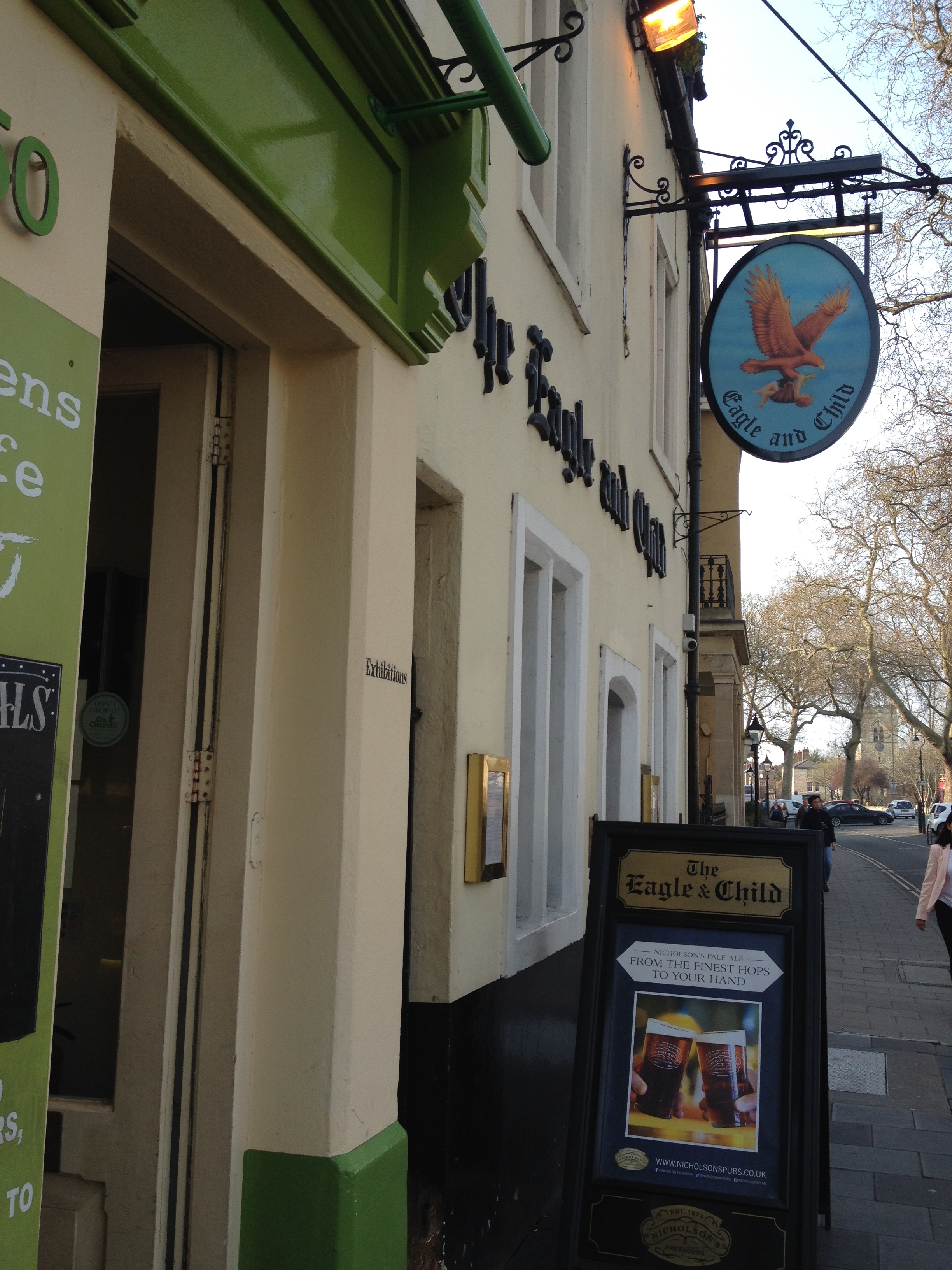
When I travel, when I have time to plan, I like to visit the haunts of literary figures. It would be difficult to think of two more influential (or abbreviation-ridden) English writers than J. R. R. Tolkien and C. S. Lewis. Both Oxford men, they liked to drink, I believe, at the Lamb and Flag. I stopped by to see, but just in case it was actually the Eagle and Child, I back-tracked to see it as well. Post-war Oxford was a place for an academic to write, and C. S. Lewis has influenced an entire generation of evangelical fans who overlook his penchant for drinking, and J. R. R. Tolkien seems to have invented the perfect fodder for CGI animators. Perhaps there was something in the air. Although no less of a literary talent, it may be less common to hear Thomas Hardy’s name. He is rumored to have written Jude the Obscure, appropriately, mostly in this pub. Good to know there’s someone else so obscure, by definition. It’s hard not to feel scholarly in Oxford.
IMG_2038

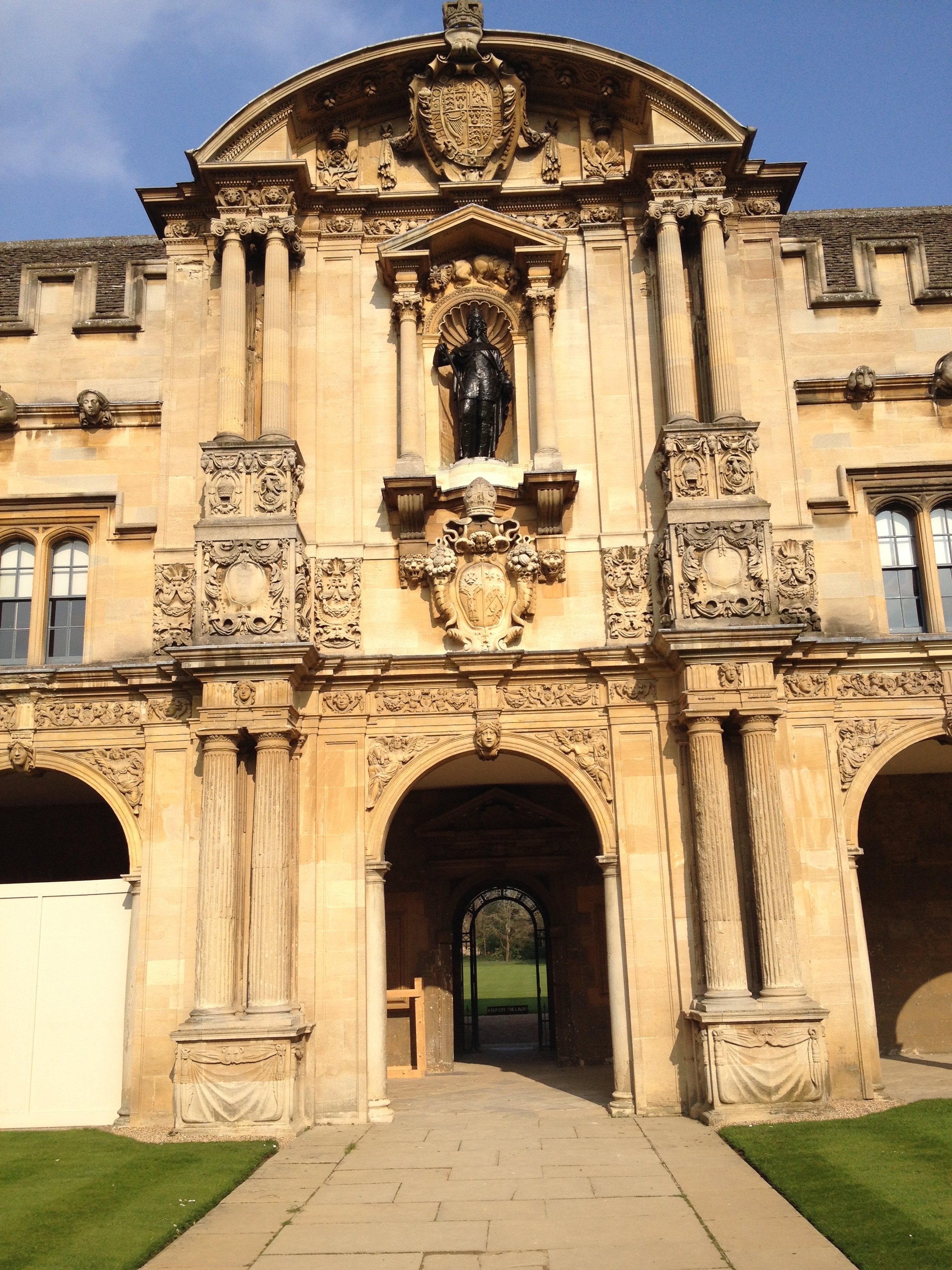
I have to confess, I dressed the part. I wore my Harris Tweed jacket and my Edinburgh school tie. It was a beautiful spring day, the like of which were extremely rare in Scotland some two decades ago. Not knowing that my business trip would offer the opportunities to explore the city a little, I hadn’t done much homework. A colleague suggested I stop into St. John’s College to look at the gardens. They’re only open from 1 to 5, and I timed it right to get there shortly before closing. Students wandering out in jeans, staring at their smartphones, could have been students at any number of universities I’ve known. The setting was, however, quite beautiful. There seems to be evidence that they don’t walk on the lawn. Tradition is treated with considerable respect here. Although, upon closer look, graffiti does make an appearance now and again.
IMG_2010

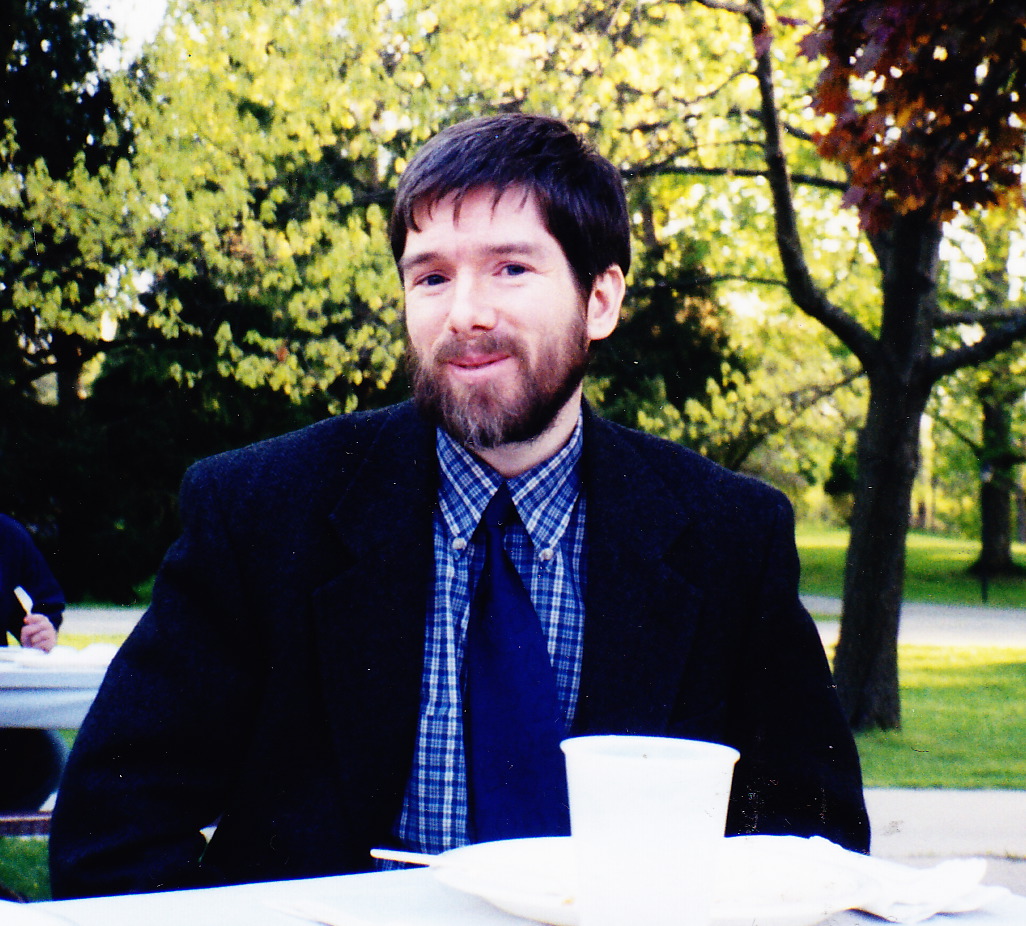
As I was stepping out the door of St. John’s, a family from eastern Asia was coming in. It was near closing time. The father asked me if this was Oxford University. I explained that it was part of Oxford University, but that the university was quite large and was all around the town. As he pressed me for more information, I wondered why he was asking an American who’d only been to Oxford once before about the place; I hadn’t done my homework, after all. Then it occurred to me. I was dressed rather like a prototypical professor. The tweed, the beard, the glasses, the consistently confused look on my face—I’d been mistaken for an university professor. I stepped outside and looked around. In a different time, perhaps it would have been true. And maybe Tolkien and Lewis would have lifted a warm pint in a cold pub and we all might have learned something.
Holy Trilogy

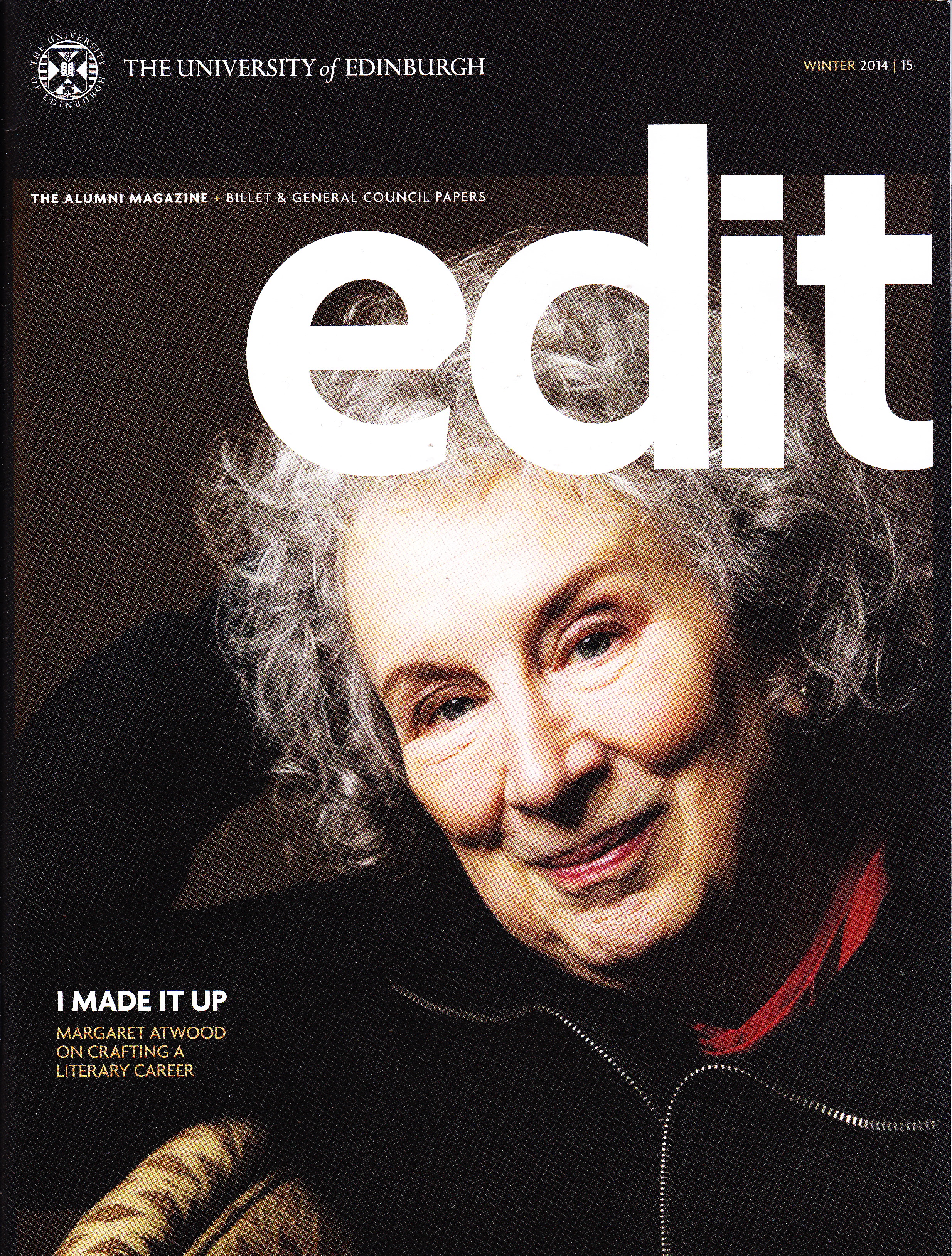
AtwoodAlumni magazines, thinly disguised appeals for money that they are, seldom merit much time. This doesn’t stop me, in any case, from sending notices of my new publications or blog, since I, like most fellow alumni, have never been cited as notable. One of the thousands who graduated and amounted to nothing. Once in a great while, however, I feel a slight twinge of pride when one of my three mothers does something of which I’m particularly proud. Most often this is Edinburgh University, although once in a while Boston University also catches my attention. A recent copy of Edit—an alumni mag that began some time after I graduated, American-style—has a familiar face on the cover. Well, not familiar in that I know her, but familiar in that I’ve read several of her books and feel like I know her. Margaret Atwood was given an honorary degree by my old school, and I am pleased to be a, albeit lesser, co-alum.

Over the holidays I picked up a copy of MaddAddam, the third and long-awaited conclusion of the trilogy of the same name. As my regular readers know, I have a soft spot for dystopias. In spite of attempts by many writers to paint a brighter future, it seems that given how far we’ve let things go, collapse before reform feels inevitable. The apathy I find when we read about the vastly disproportionate disparity between haves and have-nots, and the surging of deep, animalistic, primate, rage at injustice doesn’t seem to me a healthy mix. Atwood, although I can’t yet speak for MaddAddam, envisions collapse before florescence. The same may be declared about A Handmaid’s Tale. Complacency, it seems to me, is the real enemy.

And universities continue to send me alumni magazines that instead of inspiring me, rub my face in my own mediocrity. I spent thousands of dollars and thousands of hours on my education and I am paid less than most janitors at most colleges. Not that I was ever in it for the money. I did, however, envision a hopeful future where I’d be teaching, perhaps at a small college somewhere, writing my thoughts in books rather than blogs, and having a modest impact on the world for good. Instead, I have found myself living in a dystopia. As I roll over and see that 3 in first position on my bedside clock on a table with the legs broken off, I know it is time to face the cold of a drafty apartment so I can await the bus to pay for another day’s privilege. My comfort is that Margaret Atwood made an impression on Edinburgh University, and will soon be making another impression on me.


Doodle Dandy

Deep in the stacks of the New College library at Edinburgh University, I came upon a book in the open shelves with a date of 1611. Once the staff had been notified, this book, which had simply aged in place over the centuries, was quickly moved to special collections. It is the dilemma of many a writer that books seldom see the light of library reading lamps. This episode came to mind as a friend shared an interesting story about doodles. Historian Erik Kwakkel has one of the most enjoyable jobs in history (seems appropriate). His research takes him to old books, and by “old” I mean handwritten, to look for pen trials—how pens were tried out before serious writing began. A lot may be learned from not just the words, but how they were formed. A different friend I knew was working on the forensic study of the order of stylus strokes in cuneiform writing. It was completely fascinating. With the right tools, you can find out in just what order strokes were made in clay, their depth, and a host of other information such as the right- or left-handedness of the scribe. Writing reveals the writer. In any case, Kwakkel has a great excuse for looking at doodles.

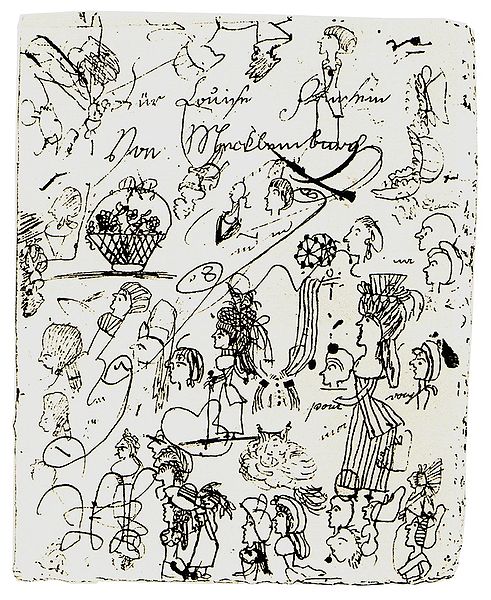
491px-Luise_KritzelzeichnungOne point in this fun story, however, struck a serious note with me. Scribes were, in final copy, expected to be completely anonymous. Their labor was to go unremarked through history. We owe them some of our greatest treasures, and in a bizarre back-formation, modern scholars give these anonymous scriveners names such as “the tremulous hand of Worcester,” in a vain attempt to recover them. In rare instances we are given the names of scribes. Some may have been creators as well. Most will remain forever nameless. Those who love books may be excluded from them by their very love.

There once was a joke that went around that asked “what do you call a writer who actually has a job?” The answer? “An editor.” In the old days, anyway. Now you can earn university degrees in publishing and editors very quickly vanish into the background, like the ninjas of literacy. Like those ancient scribes who, perhaps bored by the rote task of copying out somebody else’s words, left little doodles behind in the margins as their own attempt at immortality. In many ways this blog is my chance to offer a few doodles to the world. I used to be (and still hope to be) a content producer, but now I understand that content has no room for doodles. The serious business of publishing is all about showcasing the author whose ideas are worth spreading. Oh, there’s a subtext here, all right. A palimpsest, one might say. However, like the anonymous doodlers of history, many of us scribble away awaiting future discovery, long after our names are irrecoverable.


Vive la compagnie

I’m cleaning out the closet at work. I doubt that either J. C. L. Gibson or Nicolas Wyatt envisioned my future thus. Edinburgh University was exotic and optimistic, designed to make my curriculum vitae stand out. More like standing out in the rain. “We have to ask what’s best for the company,” I’m told. I’m not a proud person, but earning a Ph.D. to take out the trash seems like a strange allocation of resources to me. “Take one for the team,” we’re told, since we’re part of a company and when the company prospers, we prosper. On a pro-rated scale, of course. It’s not that taking out the trash is beneath me. I willingly do it at home; my first career aspiration was to be a janitor. Only now I’m dressed in work clothes for the City. And I spent nine years in higher education to get here.

Lately I’ve been pondering how this “for the company” trope is a one-way street. Knowing in advance that Nashotah House could be a Hindenburg career for a liberal, I gave it the old college try. Writing about 90 pages of class notes a week for my first year of teaching, attending mandatory chapel twice a day, I tried not to step on any toes. Even though the theology over which I was forced to chew smelled a bit like this garbage I am now carrying, I made no fuss. Don’t rock the boat, especially if it’s a garbage scow. Take one for the team. After fourteen years of not making a fuss, I was summarily dismissed. I found out, literally, how hard it is to get a job as a garbage man.

Portrait of a livelihood about to end.

Portrait of a livelihood about to end.

Eventually I landed a job at Gorgias Press. Neither prestigious nor lucrative, it was a job and I had already proven I could take one for the team. Positions evaporate around here like dribbles from a spilled cup of coffee. So I found myself at Routledge, jetting around the country, spending long hours on the bus, being told to think what was best for the company. Only don’t expect the company to do the same for you. Stoking egos, I tried to get people with qualifications I could match to write a book for me. At Nashotah House I played on the football team (don’t laugh, it’s true). We had only one game a year, against our rival—the now defunct Seabury-Western in Chicago. During practice one day, one of my students blocked me with a forearm to the chin that left me on my back, seeing stars. I can take one for the team. But sometimes the company needs someone to take out the garbage. Ask the guy with a doctorate in rubbish removal. He always thinks about the company.


31 Flavors

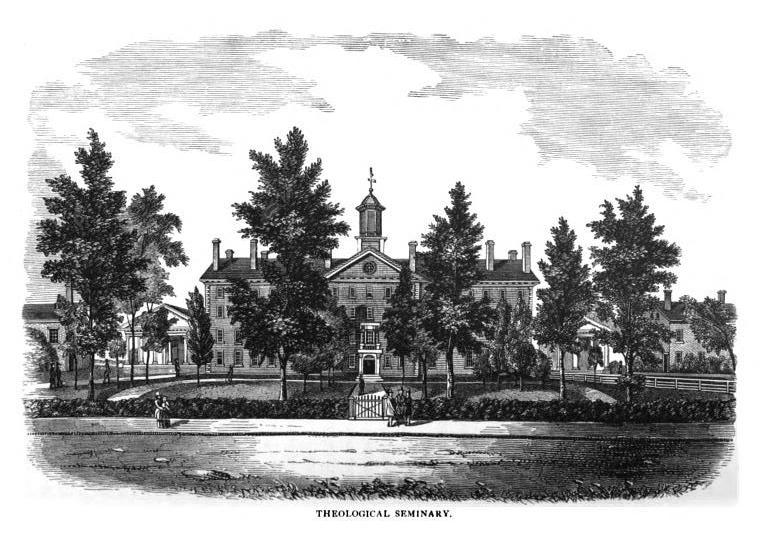
Princeton Theological Seminary, nestled next to its Ivy League sibling university, has never welcomed my advances. Although I’ve long ceased keeping the myriad rejection letters I’ve received over the years and now prefer to throw them in the recycle bin unopened, in my recollection I’ve applied to Princeton Seminary more times than any other school. Given the historic connection between the seminary and my alma mater of Edinburgh University, I often wondered why I never even merited an interview. After all, I live less than 20 miles away and they wouldn’t even have to pay for gas. So it was that I found a recent reference to “Princeton Theology” so interesting. Not every seminary gets to name its own brand of poison.

Princeton_Theological_Seminary

Princeton Theology refers to a movement that helped establish the culture that would give us the dubious gift of Fundamentalism. I have never been a Presbyterian, but I have attended their institutions, and one of the characteristics I’d often noted is that Calvin’s thought, in particular, often left me chilled to the theological bones. Assured of his own place in heaven, his theology seemed designed to keep others out. People, being what they are, naturally want to be on the winning team, especially in the eternity game. Reformed thought, therefore, was often perceived as cold and somewhat unfeeling. Predestination is, after all, determinism. Princeton Theology, beginning in the early nineteenth century, was intended to try to introduce a somewhat cozier evangelicalism to the sternness of Presbyterian theology. You may be condemned to Hell, but there’s no reason you shouldn’t feel good about it. After all, the divine plan trumps human need every time.

The approach of the twentieth century saw an increase in evangelical fervor throughout the United States. The growing number of flavors of Christianity led many to wonder what the true vanilla was. The answer, self-proclaimed, to be sure, was Fundamentalism. If you’ve never attended a gathering of theologians, you might not shudder as much as I do while typing these words, for such a conventicle has enormous power. Indeed, the Niagara Bible Conference was able to do what the Council of Nicaea was not—distill the essence of true Christianity that could be accepted by all believers. Unless, of course, one was raised in a Catholic or Orthodox tradition. Princeton Theological Seminary is not a Fundamentalist institution, but even a well-meaning attempt to make Christianity more palatable might lead to too much vanilla. In a world of 31 flavors, perhaps paradise tastes different to everyone, depending on the formula.


Bonnie the Brave

As a preemptive warning to my regular readers (am I’m sure you both know who you are), I am off today for a stint in my old haunt of Scotland. Before you get out your congratulations, be advised that this trip is for work. The Society of Biblical Literature, in addition to the big meeting about which I sometimes post, holds an international meeting every year. Since my employers frequently want me out of the office, I am being sent to the fair city of St Andrews in the kingdom of Fife for a week. Although I studied across the Firth of Forth in the wondrous town of Edinburgh, I ventured to St Andrews a time or two during my postgraduate days. By that time anyone in tune with popular culture had seen Chariots of Fire, and it was almost a requirement of credibility to visit the famous beach on the North Sea where the actors iconically ran as the movie began. And as in Chariots of Fire, I’m not sure that wifi access will be readily available. Should I find access, I shall gladly update my blog with my customary observations. If I fall silent, you’ll know why.

Scotland had a tremendous draw for me as I was contemplating where to complete my studies of religion (as if one ever can). Not that I was Presbyterian, and not that I have Scottish ancestry (although Celtic is represented in the Irish stowaway on my father’s side a few generations back)—it was the antiquity that drew me. One of the mysteries, to me, of new religious movements, is how people can believe in a religion that recently began. Should there be a supernatural, I’ve always supposed, and should that supernatural be concerned that humans have the truth, why wait so late in the story to start? It was such thinking that drew me from Methodism to its estranged parent, the Episcopal Church. Among the Episcopalians are many who argue for a continuity with the Catholic tradition, separated, literally, only by a matter of divorce. And Catholics go back to Jesus himself, a member of a religion so old that even the Romans grudgingly respected it (Judaism). I guess I’m guilty of old-school bias.

Kim Traynor's Edinburgh, from Wikicommons

Kim Traynor’s Edinburgh, from Wikicommons

So it was that I came to spend some years among the Presbyterians at Edinburgh University. The Ph.D. that I earned there translated to an unfortunately brief career doing what I’m best at—teaching. My tenure at Nashotah House never offered the opportunity to travel back to Scotland, or even England with its Anglicans. And as I prepare to board a plane across the Atlantic, although strictly for work, I can’t help but to reflect on those years of intensive learning, hoping to do my Scottish alma mater proud. And returning to the States to have my career shipwrecked on the rocks of unforgiving religious dogma. It may be that once I’m back among the heather and thistles, I may cast my laptop aside and try to claim religious asylum in a past that I can only see through rose-coloured glasses.


Lower Education

Many people have asked me, as a former professor, why universities are so expensive. Ironically, many of these people are in flourishing businesses where the story ought to be as tired as the excuse that’s usually trotted out: faculty are paid too much, mismanagement, etc., etc. The truth is much more insidious and it begins with governments and corporate executives who can’t handle the sharp sting of criticism. I have experienced this firsthand, and unlike many academics, I have an authentic blue-collar background so that my perspective is unclouded by generations of privilege. I recently found this post on The Homeless Adjunct, and I was glad that someone is actually willing to write the truth. The high cost of higher education is because a subtle series of changes—often deliberate—that have been instituted since the 1970s to change colleges and universities into engines to power capitalistic ventures rather than to educate potential critics. Those who have a hard time accepting conspiracy theories may be disturbed by how well documented this development is.

I realize that I am a mere proverbial voice crying out in an even more proverbial wilderness. The fact is, this change in higher education, implemented since the era of protest that was the 1960s, goes on without the knowledge of by far the majority of university faculty. They still tell their promising students to continue on to graduate school, that the bottleneck that has been holding up new, or even replacement, jobs is bound to burst. Things will get better. Not. As the Homeless Adjunct points out, corporate interests now run the universities, sucking up their prestige like bloated vampires, while endorsing their own manipulative interests. How can “educated” people believe global warming is a myth? Get corporations who “oppose” global warming to fund science programs and see what happens. The truth becomes quite malleable when lucre is involved.

Even more chilling, as our brave adjunct reveals, this model has begun to filter into high school, and down to Kindergarten. The way that educational decisions are made is based only, always, and ever on the bottom line. Not for our children, but for corporations that decide what our children can, and more importantly, can’t do. Their future is being undermined.

catalog

As a former adjunct who went blindly through the system, ending up with a doctorate from a major European research institution only to fall afoul of a thickly entrepreneurial administration, the clouds were wiped clean out of my eyes. I believe in higher education. And I believe that those of us with any moral sense are obligated to take it back. We will likely be destroyed in the process, since money is the only value our society recognizes, but if we want a world where our children can thrive, education must be true education.


Suit Yourself

I guess I’m going to have to sue myself. In this litigious society I have few options left. Instead of understanding and forgiveness (some of the positive motivations that religions have encouraged) our culture is controlled by those parsing out the finest particles of the law, seeking violations, and making somebody else pay for their mistakes. Money makes everything better. It is like the new God. I have to sue someone for this coffee I spilled on myself.

You see, I’m an early riser. I’m not really a coffee addict—I have a cup first thing in the morning, something I’ve been doing since college, and that’s generally it. Still, that first jolt is helpful in the waking process. I shlep around in my Edinburgh University sweatshirt for a pajama top. I like to be reminded of my post-graduate days in Scotland, and I appreciate the irony that my PhD never got me anything but this comfy shirt. This morning, laptop humming on my, well, lap, I baubled my coffee and spilled it all down my Edinburgh sweatshirt. It seared my skin, but I couldn’t jump up because of the laptop and any sudden moves would only slosh more of the hot liquid onto my burning chest. My mind immediately went to Liebeck v. McDonald’s, where the fast food giant was sued for selling hot coffee. I don’t know about you, but I’d almost rather suffer a burn than to drink tepid coffee. But somebody has to be sued, right? The question is: whom? Mr. Coffee for making my morning cup so hot? JSW for making my Edinburgh sweatshirt so absorbent? The unnamed pottery house in England that made the mug that wobbled in my sleepy fingers? Or maybe God for making the morning so early? If there’s anyone to blame, it’s me. Oops—I’ve admitted culpability, so I’ll have to sue myself.

800px-SCOTUSbuilding_1st_Street_SE

For a society in love with the Bible, we’re far bigger on lawyers than forgiveness. Of course, the Bible is a pretty legalistic book. You can’t get very far in the Pentateuch without figuring that out. Only with the Bible it often isn’t a matter of suing; the stakes are considerably higher. Disrespecting parents can get you the death penalty, and mixing plant and animal fibers can get you expelled. Thumbing through my concordance I don’t see anything about coffee. I do see that I might be unclean for a day, but that’s okay because the Sabbath’s nigh. In any case, I’m too busy dreaming about what I’m going to do with all of that money.


Down Will Come Baby

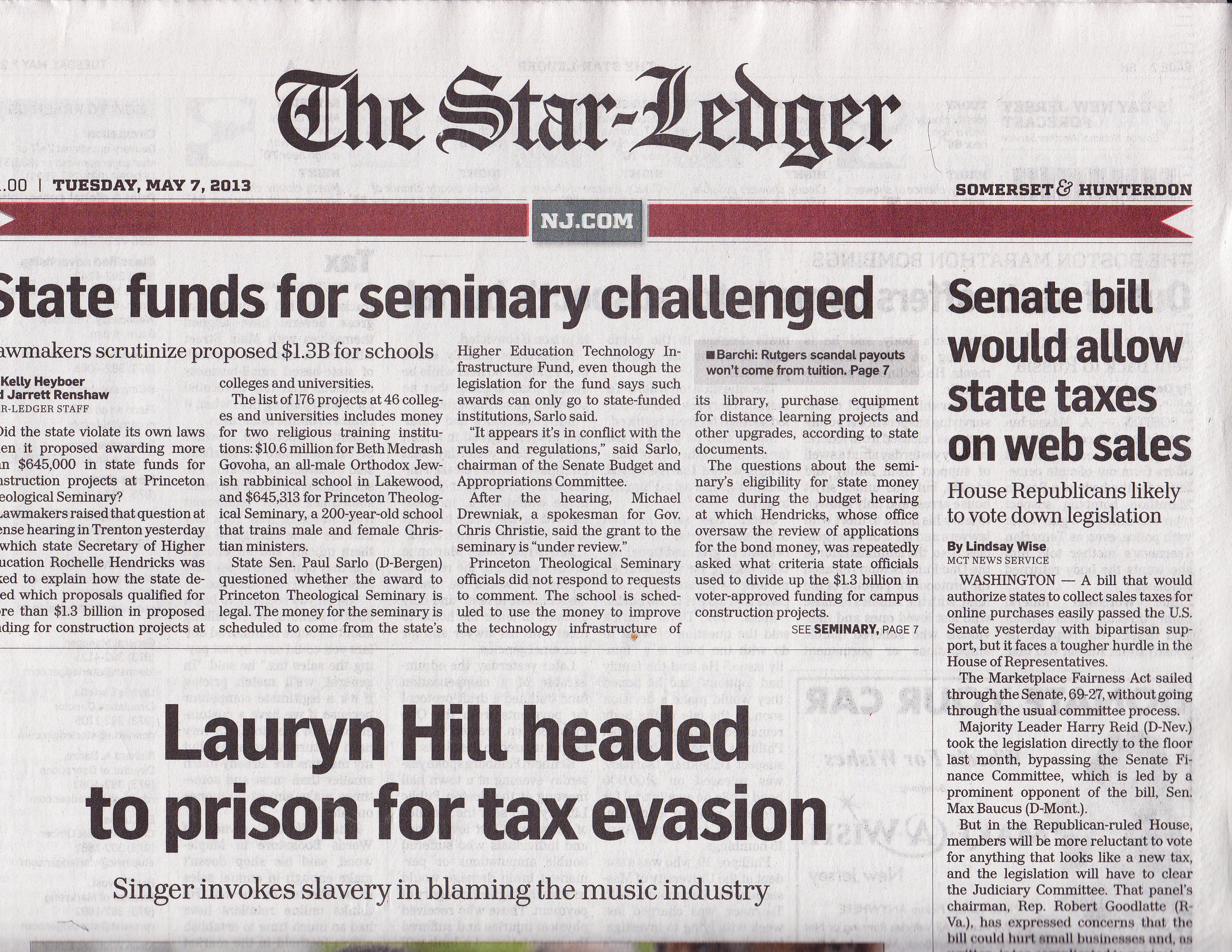
Princeton Theological Seminary is a school with a history. Unofficially allied with my alma mater, Edinburgh University, PTS is one of the powerhouses for supplying educated clergy to the Presbyterian tradition. And others as well, of course. And not a few PhDs into the ranks of the perpetually unemployed. Seminaries do offer all these services. Despite failing to be considered worthy of even an interview in what I count as five separate applications to the school, I still sympathize with its need to update its technology. I suspect that is what is behind its application for a half-million-plus-dollar New Jersey Higher Education Technology Infrastructure Fund grant. Education and technology surely go together as much as old-school loyalty and fairness, do they not? A front-page story in Tuesday’s New Jersey Star-Ledger proclaims the gnat that remains in the camel juice: state funds are being requested by a fully religious organization. The application for these state pork-bellies is also shared by Beth Medrash Govoha, a male-only Jewish seminary in Lakewood. Desperate times in higher education. What would Christie do?

PTS

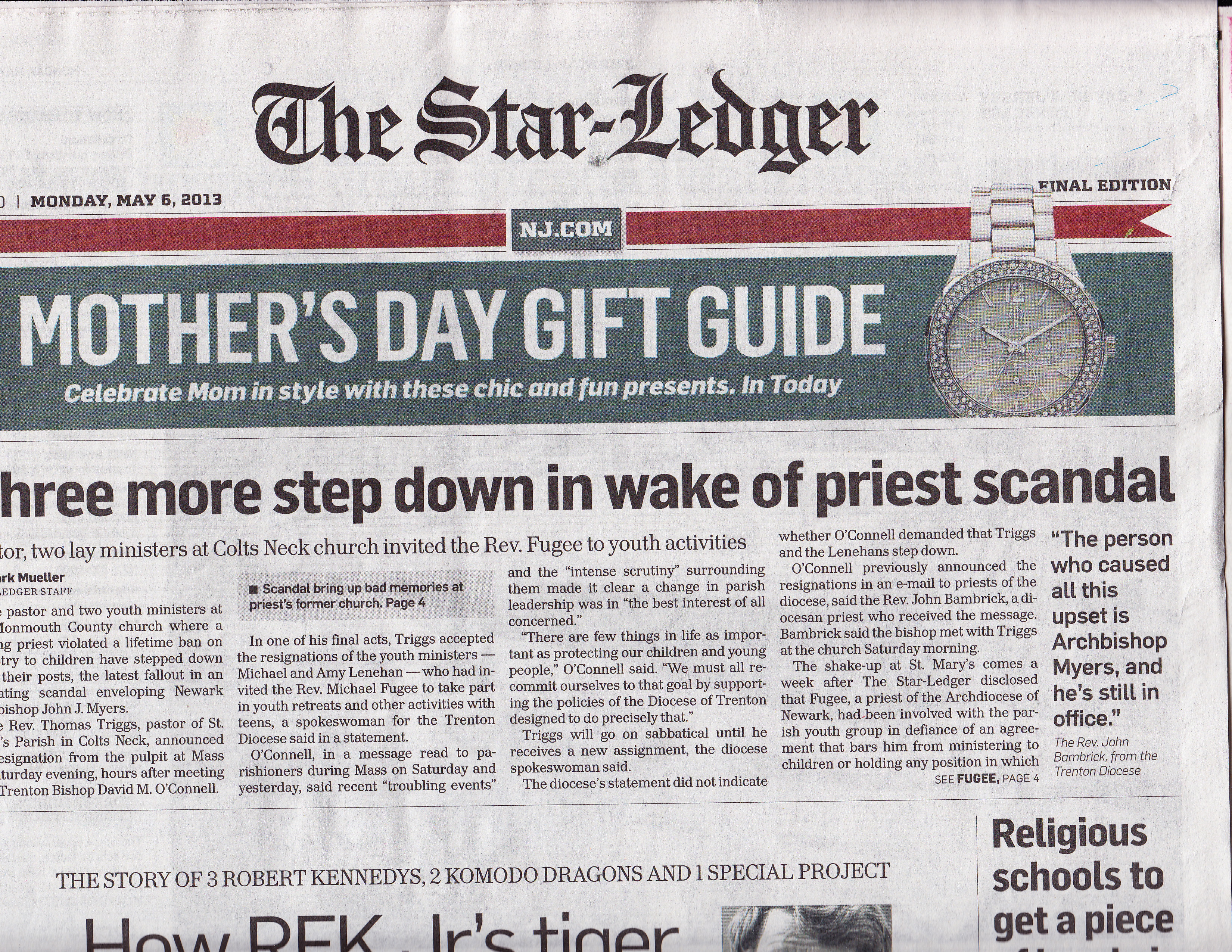
Turning the clock back twenty-four hours, another front page newspaper story places religion squarely in the public face. “Three more step down in wake of priest scandal” hit my bleary eyes on a Monday morning. This is the saga of Fr. Fugee, banned from interactions with children after a molestation case some time back. As seems to be par for this unholy course, such clergy are shifted around rather than defrocked—being seminary fodder myself I can honestly ask, what else would they do? Society has little enough use for those of us who worked our way through seminary for honest means and toward what seemed at the time noble ends. How much more so for those who mask deeply rooted neuroses under the sanctity of ordination?

Fugee_0001

Seeing religious news on the front page of the paper is nearly always cause to shudder. We will occasionally see a new Pope or maybe a genuine act of Christian (or any other religious) charity, but mostly we are served the seedy and sad and downright tawdry. Religion, although in the ascendent, is seeking hard to justify its existence. Or is it just the vaunted liberal media bias showing through? As primates we all like to watch the haughty topple. It’s even in the Bible—Isaiah got a thrill out of tall ships tipping over. Perhaps it is because religion presents itself as the unadulterated good that we like to see it stumble. I always felt a tad uncomfortable reading Goofus and Gallant while waiting for a doctor’s shot or the dentist’s chair. Yes, Goofus screwed up big time once in a while, but that confident little eagle-scout-in-waiting Gallant could do no wrong. I knew who I was supposed to emulate, but life’s just not that simple. Maybe that’s why religion makes the front page. Maybe Gallant is a myth after all.


Just You Wait, Professor Higgs

They finally found him. Peering deep into the invisible world of the sub-atomic universe, his hiding place has practically been discovered. I knew that when it happened my alma mater, Edinburgh University, would be part of the equation. That’s just the kind of thing you know deep down in your sub-atomic parts. Scientists are now coming very close to announcing definitive proof of the “God particle,” or Higgs boson. Named for theoretical physicist Peter Higgs, who predicted the particle, this elusive piece of physics has been nicknamed the “God particle” by journalists who want to express just how great its explanatory value is. The average citizen knows very little about the inner workings of science—thus we have Creationists and Tea Partiers—so we require striking neologisms to help us comprehend that this is not only important, but really, really important. For explaining the way the universe works, the Higgs boson has been likened to Newton’s discovery of gravity, although apples had always fallen from trees even before he learned why.

I have always found it curious that when we need a superlative we dash back to the biblical worldview. As John Heilprin and Seth Borenstein of the Associated Press make clear, “God particle” is not utilized by physicists (although coined by one), but is used “more as an explanation for how the subatomic universe works than how it all started.” To get us to read about science they have to use mythology. The more we understand about science and the way our minds work, the more perplexing it becomes. Humans are meaning-seeking creatures and we often find story more meaningful than fact. Facts, however, determine what actually happens or what actually is. The Higgs boson is getting close to facticity. We whimsically call it the “God particle.”

Could the great gulf between science and religion, I sometimes wonder, be bridged by good, liberal arts education? The liberal arts, particularly the humanities, are all about understanding what it is that makes us, well, human. They aren’t precise like science, or profitable, like business. At the end of the day, however, in those few quiet moments, don’t we dwell among the realm of humanity? When we stop posturing for our co-workers, the media, or our neighbors, when we are who we truly are—then we are engaging in the humanities. Education can be in the service of becoming human as well as becoming rich. In one of its latest triumphs, it has produced physicists who have discovered the footprints of the Higgs boson, potentially revolutionizing the universe as we know it. And many of us would have never even heard if they hadn’t called it the “God particle.”

Like atoms over our heads


Who Knows?

While I have nothing less than respect (and just slightly less than utter awe) for my alma mater of Edinburgh, I cannot help being bemused at times by the alumni magazine. Between my wife and I, when we fail to cover our tracks adequately, we receive almost as many alumni magazines as exclusive credit card offers. Anybody intelligent enough to graduate realizes that these magazines are attempts to raise money, but they maintain the illusion of giving actual news. Thus it was I found myself facing a pithy piece stating in no uncertain terms that “Near-death events are ‘tricks of mind.’” The rationale given is that psychologists at both Edinburgh and Cambridge have decided it is so.

Now, I’ve never had a near-death experience, nor do I really ever want to. I don’t know what to make of the stories of those who claim to have “crossed over.” The problem is, there can be no winner to the argument of authentic experience versus mind trick. Those who know, by definition, can’t tell. Each side has good points to make. Some religions, particularly those of western orientation, tend to offer an afterlife anyway, so when someone appears to have slipped over the edge and claims they saw a great light, well, why not? Scientists often make the equally valid point that the rapid images that occur in the brain may seem to stretch on into minutes or hours and may incorporate images that our culture lends us of what to expect when the darkness falls. The near-death experience is, they say, final jolts of electrical “noise” just before brain activity ceases.

Some things we just can’t know, even if we attended Edinburgh. “Near-death experiences are not paranormal but are triggered by a change in normal brain function, according to researchers.” So the article says. There seems nothing paranormal about death—it is as natural an event as exists. It is common to us all, including pets and pests. The “paranormal” is the idea that something continues after death. If that something includes a deity or two, it becomes “religious” rather than “paranormal.” Whether religious, psychological, or paranormal, intelligent people continue to debate what is actually happening to those who have been briefly dead and have the medical records to prove it. For my part, if there’s something on the other side, I hope it’s a lot like Edinburgh. Maybe with a few less alumni magazines, however.

Life, and then this.


The Body Apocalyptic

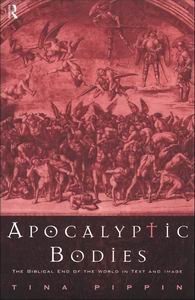
We are all products of our upbringing. Our early assumptions, although sometimes challenged and overcome, are generally with us for life. So it was that my progression of education led me to a small, conservative college to major in religion. Compared to what I learned at Grove City, the historical criticism firmly in place at Boston University sounded downright sinful. Nevertheless, it made sense, so I followed reason. At Edinburgh we were way beyond historical criticism in that wonderful, European way. Somehow in the midst of all the excitement, I missed Post-Modernism. “Po-Mo” has, like most recent movements, been quickly added to the pile of the passé, but I find it refreshing. I just finished reading Tina Pippin’s Apocalyptic Bodies (Routledge, 1999). This may have been one of the first truly Post-Modern biblical critiques I have read, and it was fascinating. Pippin is taking on especially the book of Revelation. If more people had read her book there would have been less panic back around May 21.

I find feminine readings of the Bible enlightening. As a member of the gender largely responsible for a book filled with sex and violence, it is often difficult to see how the other half of the human race might read that same text. Having grown up with a literal understanding of Revelation, I never questioned whether it was a good or a bad thing. The end of the world must be God’s will, therefore, by definition, good. One of the beauties of a Post-Modern interpretation is that everything is thrown open to question. Pippin does just that. Noting the ennui associated with eternity, she asks a question that always lurked in my mind—isn’t too much of anything eventually a problem? Eternity itself becomes problematic. Where do we go from here?

Perhaps the most striking comment Pippin makes is in the context of her chapter on the monsters of the apocalypse, “Apocalyptic Horror.” She compares Revelation to horror movies and demonstrates how all the elements are there in the Bible. She notes, “There are many monsters in the Apocalypse, but the real bad ass monster sits on the heavenly throne.” Pippin explains that God, in Revelation, joys in killing off humankind. As many of us have come to learn, people are generally good; at least most people have done nothing to deserve the heinous punishments gleefully doled out in Revelation. That, of course, raises the sticky question of ethics as applied to the divine. Here the book of Job comes to mind where our hapless hero declares that even though he is innocent, God still can count him guilty. It is the human situation. And Job was a good guy. Pippin’s little book challenged many of the assumptions with which I’d grown. Anyone who can read such a book and not worry about being a good parent is more Po-Mo than me.


Disconnect

Religion has a bad name among many intellectuals. Hailing from the misty period of superstition in a “demon haunted world,” religion seems to be a quaint hold-over from less enlightened times. Academics, for whom respectability is everything, generally keep a decorous distance from religion as the intellectually suspect field indulged in by the weak-minded. Then something enormous happens; terrorists, fueled by religious fervor, decide to kill many innocent victims. Or a religious guru leads followers into the jungle where they all commit ritual suicide. Or a group of zealots purchase heavy armaments and stockpile them in a Texas hideout to await the Second Coming. The next autumn the university want ads are filled with openings for specialists in this or that religion. Until the next budget crunch comes along.

An unfortunate aspect of this situation is that many deans and administrators make the equation of the study of religion with the promotion of a religion. Why populate a university faculty with superstitious religious sorts when a good secular economist will bring in more practical, if less transcendent, rewards? How often do administrators survey their religious studies faculty to ensure that level-headed, academic treatment of the subject matter is offered? How can we expect to move ahead if those empowered to assure an educated student clientele continually apply the brakes in religious studies departments?

I am no economist. This much is evident by my pay scale. Nevertheless, each year when I return to the multiple campuses that are my temporary homes, I notice the details. New furniture in classrooms and libraries, freshly painted and redecorated facilities. Often, entirely new buildings that were not there the semester before. There was a day when such things were known as window-dressing. I attended Edinburgh University for my doctorate. There were campus buildings that dated from the late middle ages. Classrooms often had mismatched furniture and blackboards rather than fancy projectors and smart-ports. And the educational experience was authentic. The religion faculty was thriving and universally well regarded. I’m no economist, but with fundamentalists already holding a match to the fuse about to light up a Quran, I have a feeling already of what I’ll be seeing in the want ads of next year’s university hiring season.


Everything’s Better at Harvard (Except Religion)

My wife pointed me to an important article in Newsweek on the plight of religious studies at Harvard. Now, I have to admit to a couple of bunches of sour grapes right up front. I was accepted at Harvard but elected not to go. Only after I had completed my doctorate at Edinburgh University after a lifetime of the study of religion and found that no jobs were available did I realize my mistake. I met colleagues who had jobs while attending academic conferences. All of those well settled in respectable positions had graduated from Harvard. A similar phenomenon exists in Great Britain. Those who actually find satisfactory positions hold doctorates from Oxford. Problem is, neither Harvard nor Oxford corner the market on good education (oh, the heresy!). People, however, are simplistically impressed by lineage.

In any case, this article by Lisa Miller points out the high drama of academic discord at the Shangri-La of American institutions. The famous linguist, Steven Pinker, who personally believes religion to be a severely faulty means of seeking enlightenment, has worked to prevent a required course in religion at the famed secular university on the grounds that faith and reason do not share the same status. Miller goes on to express how small colleges and state universities are picking up on the slack. My limited experience at Rutgers bears out her observations. In this large, rambling, decidedly secular school, my classes in the religion department are always full and I have to turn students away. Yet the university refuses to allow for a full-time hire. Secular America is deep in a state of denial. Because many academics reject religion personally, they simply can’t see how vital it is to understand it. I personally believe no one should be allowed to hold public office without having completed a course in Bible and its political abuse.

Meanwhile, Harvard still holds back. Its reticence will not prevent misinformed people from using their religion as a means of power and destruction. Pretending that since religion is not personally important it is not important at all has deadly consequences. To me it seems obvious that it is not the school you attend that is important, but what you learn while you are there.


Into the Great Beyond

It is a sobering moment when one of your advisors shuffles off the mortal coil. Just a year after my master’s degree, Harrell Beck, my program advisor passed away amid a flurry of unusual happenings. Just a few years back, Simon Parker, his colleague and an Ugaritologist who befriended me, also slipped into the netherworld. I just received the obituary of John C. L. Gibson, my doctoral advisor from Edinburgh, reminding me that my obvious concerns with death and religion in this blog have a very practical application. We all have to face it sometime, and hopefully our legacy will be a good one.

Professor Gibson was best known for his revision of outdated but valuable reference materials. His work as a Semitic linguist was highly regarded, but he didn’t wander too far from convention. As a clergyman in the Scottish Kirk, he had natural constraints. He also had a clever way of turning a phrase. Late in my time at Edinburgh University, I started to keep a list of his aphorisms. If I’d started earlier I might have some more nuggets to lay out here, but I thought it a fitting tribute to a fine gentleman scholar who always took a dram with his breakfast to pass along a few of his choice quotes in this post. You’ll have to do your best to imagine the Scottish burr —

“Don’t lead with your chin” (this was in the context of taking on academic debate).

“Skullduggery is just around the corner in archaeology.”

“Archaeologists and epigraphers shoot each other on sight” (this was in reference to Ebla).

“In Job the daring word is often the right one.”

“If you want to stand against him, do so. But get your armor on first!” (This remark came after I challenged a time-honored thesis by the late James Barr, while he was still early.)

“Every word in Arabic refers to a part of a camel as well as something else.”

“Inscriptions like Ajrud, they’re a nuisance; they shouldn’t be there.” (Kuntillet Ajrud is the site of one of the famous “Yahweh and his Asherah” inscriptions.)

“Who is Asherah and what is she doing here with Yahweh?” (In the same conversation as the previous comment.)

“Turning pages is a major activity of scholarship.”

There were, of course, many more. Professor Gibson will always remain a large part of my Edinburgh experience. Sitting in his pipe-smoke during one of my sessions, I noticed he had no computer. “Ach, aye, they offered me one, but I wouldna used it,” he explained. He didn’t even own a typewriter. In my mind, his passing is like the passing of old school scholarship itself.

J. C. L. Gibson, a cipher, and Nicolas Wyatt

J. C. L. Gibson, a cipher, and Nicolas Wyatt