Eschew Stupidity

Dietrich Bonhoeffer was a certified evangelical Christian.  His theology often feels a bit pat to some of us who work in religious studies, but there’s no doubt that Bonhoeffer was a brilliant man.   Bonhoeffer believed in Jesus but resisted Hitler.  In fact, that resistance cost him his life.  My brother recently sent me a Facebook Reels video on Bonhoeffer’s observations about stupidity, which Bonhoeffer believed was far more dangerous than evil.  I shared that video in my feed on Facebook yesterday, and it is well worth listening to.  Stupidity isn’t a badge most people would wear proudly.  We all do wear it from time to time since we’re only human.  The real problem, according to Bonhoeffer, is when crowds start becoming stupid.  We’ve seen it time and again.  We’re living in such a time right now.  The antics coming out of DC right now have thinking people everywhere wondering how this is even possible.  Listen to Bonhoeffer.

Photo source: Bundesarchiv, Bild 183-R0211-316 / CC-BY-SA 3.0, Wikimedia Commons

I don’t take Bonhoeffer uncritically.  Some of us—generally without tons of friends—think critically by default.  (The women in college all broke up with me because “You’re too intense.”  I credit my wife with sticking with me, although she tells me they were right.)  Anyone can learn critical thinking.  The problem is, keeping the skill is hard work.  And the internet doesn’t help.  Whenever anyone makes a claim, personally, my default response is “How do they know?”  Yes, I do look up references.  With my particular brand of neurodivergence, I seldom trust other people to know something unless they’re experts.  (This is something the current administration is a bit shy on.)  I even question experts if their conclusions look suspect.  “Nullius in verba” is written in my academic notebooks.  Something, however, is obviously clear.  Bonhoeffer was right about stupidity.

I’m not sure what an unfluencer like myself hopes to gain by discussing this.  I do hope that folks will listen to Bonhoeffer if they have concerns about my thought process.  My deeper concern is that the church often encourages stupidity.  Unquestioning adherence to something the facts expose as untrue is often lauded.  It makes some people saints.  Churches require followers and often distrust critical thinkers.  That once cost me my job, sending my career into a tailspin.  This was well pre-Trump, but some in authority didn’t appreciate critical thinking on the part of faculty.  (Ahem, that’s what we’re paid to do).  I’m not anti-belief.  Anyone who really knows me knows that I believe very deeply in the immaterial world.  And I know that Bonhoeffer did too, right up to the gallows.

Paranormal Religion

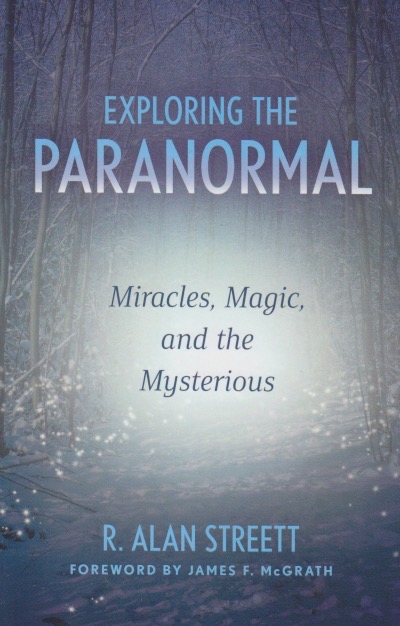
I remember well what it was like to be an evangelical.  Measuring everything by what I thought the Bible said, fearing those things that seemed to come from outside.  Being very concerned with salvation and its opposite.  At the same time, I was fascinated by the paranormal.  As I child I was teased for these interests and subsequently buried them.  Then I had a slow, protracted, and continuing waking from dogmatic slumber.  So it is natural that I would want to read R. Alan Streett’s Exploring the Paranormal: Miracles, Magic, and the Mysterious.  I didn’t know how he would approach the subject, and I didn’t know where on the evangelical spectrum he fell.  Still, I’m always interested to see how others handle what we all know—strange stuff happens and there is no real explanation for it.  Scientific method may one day be able to address some of it, but at the moment it generally falls outside the bounds.

Streett’s book is somewhat autobiographical, from his non-religious childhood, believing in parapsychology, through seminary and having an evangelical awakening, to the point that he stopped supposing such things were demonic, and on to where he stands at the moment—thinking that most such things can be explained by brain science and alternative states of consciousness.  There are a number of interesting situations and concepts described in this book; I learned quite a bit when he discussed different brain states.  I understand his theological rejection of potential realities behind the phenomena he discusses (mostly mediumship, but also reincarnation and faith healing) but don’t always agree with the conclusions.  There is much in the world that theology can’t explain.

Something that is perhaps overt between the covers, is that the paranormal is something that happens to evangelical, liberal, Muslim, Jew, Hindu, Buddhist, atheist, agnostic, and none alike.  What differs is the interpretation, based on various faith traditions and their tolerance for that which is outside.  Evangelicalism is a worldview, perhaps more so than it is a theological position.  Non-divine miracles, or whatever you want to call paranormal occurrences, don’t fit comfortably into that worldview.  Other interpreters, also raised in Christian traditions (Catholicism, for example, is quite open to mystical happenings that can fall into the paranormal category), might approach the question in a different way.  Dialogue is important, however, and trying to make sense of this world we live in, in my humble opinion, has to reach outside the reductionistic view that brains alone account for human experience.  Streett’s account offers a reasonable perspective on the issue from an evangelical outlook.


Squeaky Clean?

A New York Times story, apart from the expected misunderstanding of actual Evangelicals, made me sad.  The article points out that, especially since 2016, “Evangelicals” have taken to soft-core porn, cussing, drinking, and premarital sex.  In other words, Trump has given them license to behave like secular folks while still claiming the name “Evangelical.”  Why should this make me sad?  I lament the loss of place for those who grew up, like me, striving for clean living.  It’s an image—a mirage—rather than a reality, of course.  But still, if conviction holds, you can get pretty close to the ideal.  That vision of life has been occluded by a guy who runs for President because he cares only for himself.  Jesus, on the other hand, was all about caring for others.  Going as far as, if the Gospels are to be believed, sacrificing his own life.

Like fiscal conservatives, such legitimate Evangelicals now have no public voice.  One of only two political parties has become identified with an individual rather than ideals—what used to be called a platform.  I have Republican friends.  I grew up identifying as a Republican.  I also grew up as an Evangelical.  I studiously avoided things like bad language, sex, tobacco, and alcohol.  Even at Evangelical Grove City College I was a bit of an outlier for how seriously I took all these things.  Of course, studying history can be dangerous, particularly for ideologues.  Still, “clean living” had its own virtues.  Those who continue to try to live that way are swimming into a rip tide, it seems.  For some Trump seems like the Second Coming, sans the white horse.  And this, above all, is sad.

There are those who claim, often loudly, that religion is bad.  I agree that when a religion tries to force others to obey its standards it can quickly become evil.  Still, the baby should be left behind when the bathwater’s discarded.  Religion has led to much good in the world.  Hospitals, charities, and yes, “clean living.”  These things, along with retirement homes and affordable apartments for low-earners in their autumn years, are necessary to pick up the slack that the government leaves.  It is cause for sadness that the clean living camp has succumbed to Trump-style hypocrisy.  Heck, religion gave us the word “hypocrisy.”  The standards of classical Evangelicalism are often impossibly high.  If we look at current Evangelical leaders we find many, many skeletons in a house with many closets.  And a wagging finger warning the young, “Do as I say, not as I do.”


Devil Talk

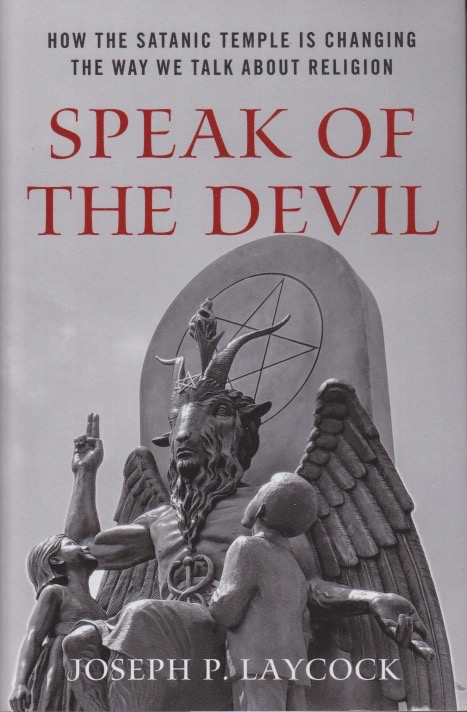
Around here, an after-school Satanic Temple club, prompted by an after-school evangelical club, led to a lawsuit where our tax dollars are being wasted.  Many local people wondered what was going on and I knew I had a book on my shelf that would help to answer that but I had to find the time to read it.  Joseph P. Laycock has been writing fascinating books for a few years now.  I picked up his Speak of the Devil: How the Satanic Temple Is Changing the Way We Talk about Religion just after it was published, but it always takes some time for me to get to books that I know I’ll have to spend time with.  I was right about spending time—there’s a lot packed in here that requires some thought.  I was vaguely aware of what the Satanic Temple is but had difficulty distinguishing it from the Church of Satan.  (I have a book on the latter, but it’s quite big and I haven’t found the time for it yet either.)  Laycock spells it out clearly.

The book begins by discussing how the Satanic Temple entered public consciousness in 2013.  Yes, it’s only been about a decade.  If you think it’s more than that, you may be confusing it with Anton LaVey’s Church of Satan.  They are different organizations.  One thing they have in common is that neither promotes belief in a literal Satan.  Both also rely on shock tactics to get their point across.  The Satanic Temple is a socially conscious organization that reacts to provocations of conservative Christian groups to try to establish their brand of Christianity as the officially sanctioned state religion.  And the evangelical groups have been making in-roads for years.  Playing the innocence card, “We’re just mainstream America saying what everyone’s thinking,” they put religious monuments in public spaces, start public meetings with Christian prayers, and receive state funding for their programs.  Often unchallenged.

Laycock’s not discussing evangelicals, but rather how the Satanic Temple arose in response to efforts to establish one form of Christianity as state sponsored.  There’s a ton of information in this book.  Among the many takeaways for me was the discussion of how good and evil are determined.  This is obviously directly relevant when Satan is involved, especially since the Devil is a post-biblical development.  The Satanic Temple, which doesn’t teach that there’s a literal Devil, attempts to counter the standard narrative by doing good deeds in the name of humanism.  You might be able to guess the conservative Christian response to that.  If you can’t, this book will help to spell it out for you.


Clearly Conspiracy

What an odd place to find ourselves in.  Some evangelical Christians, who used to be guardians of decency and moral human behavior, now have to have their clergy explain to them why Trump wasn’t the messiah he’d been touted as for the last four years.  A piece in the Los Angeles Times recently described the struggles of one such minister with his congregation that had fully bought into the conspiracy theories Trump promulgated in order to mask his own lack of care for his country and its citizens.  Conspiracy theories have become big business in academia with faculty from many departments exploring them.  I haven’t seen much in the way of religion departments participating in the discussion, but I think they should.  Why?  Religions are all about getting people to believe and act in prescribed ways.

Image credit: Johann Lund, Wikimedia Commons

Not that religions alone can explain this.  Psychologists and sociologists must have some important insights as well.  I used to tell my students that not all religions are about beliefs.  Some have to do with behaviors—acting in a certain way, regardless of belief, is to be part of it.  Certainly that explains part of the membership in the cult of Trump.  Many who follow it must know in their consciences that a man who defrauds the government he “governs,” who actively womanizes, and who displays overt racism can’t be the ideal evangelical.  Ah, but the conspiracy theories explain it!  Pay no attention to the man behind the curtain, right?  You can sure get away with a lot that way.

Religions have a lot to teach us about both strange behaviors and strange actions.  Many years ago someone pointed out to me as I was enumerating what I considered odd beliefs of a New Religious Movement just how odd Christianity looks from the outside.  When I stopped to think about it, this made sense.  The unconventional aspects of the faith had become naturalized because I’d been taught all my life that they were true—unlike all other religious beliefs.  Not only that, but I had been taught that accepting them without question was the only way to avoid Hell.  Over the years the strangeness became normal.  Trump and his conspiracy theories had their way smoothed by an evangelical narrative of unquestioning belief instead of an examined faith.  Now many ministers, awaking sober, are having to try to convince their flocks that they’d accepted lies for truths.  It’s an uphill battle, unfortunately.  Religions, after all, have been about getting followers to believe without questioning, or, apparently, considering the source.


Building on Water

I try to keep up.  Really, I do.  Although my specialization is in ancient religions, at heart I’m an historian of ideas and I try to keep up with the origins of the many Christian denominations.  You see, with so many competing versions of the one correct way to please God it pays to hedge your bets.  Thing is, there’s so many options and some seem to spring out of nowhere, like toadstools after the rain.  The other day I attended a local community event.  One of those kinds of affairs where local organizations set up tents and sometimes sell food.  Many of the tents were for churches.  As supporters of community values (mostly) this isn’t unusual, even with the declining numbers in the mainstream.  Then I heard a voice.

“Do you read?” the man asked.  I confess to having a bookish look, so I admitted I do.  “We want you to have a free book,” he said, handing me a plastic bag (warning sign one) containing a small paperback and several fliers.  Now, I was here to look around and maybe get a bite to eat, so I thanked him, tucked the bag under my arm and walked on.  Only on the way home did my wife look at the contents.  The church—for it had to be a church giving such things away—was one of which I’d never heard.  This would’ve been disorienting if it weren’t for the fact that ever since college—where I learned quite a lot about denominations—I’ve been noticing new varieties of Christianities, cropping up somewhat frequently.  Each seems to believe it has found the answers, despite the threadbare denominations that have been around for centuries.

I make fun on nobody’s search for meaning, or the truth.  It is, after all, a lifelong quest.  I am suspicious of those who claim to have already gotten there, however.  For those traditions that declare they’ve found the answer centuries ago, the passing years with their constant changes have worn on them.  Especially if they’re awaiting a divine cataclysmic ending to it all that’s been delayed for a couple of millennia now.  Others are, apparently, wanting to pump some fresh air into these tired lungs.  This group featured a website “the famous one [all one word].com.”  I was surprised and a touch saddened to see Jesus relegated to the role of a media celebrity.  But then again, I can’t keep up like I used to.


When Like Rome

Among the constant topics of discussion, both in the academy and in its publishing ancillaries, is the loss of interest in religion.  After a period of growth early in the new millennium, as measured by college majors, interest has dropped off and Nones are set to replace evangelical Christians as the largest religious group in America.  The corresponding lack of interest in religion is extremely dangerous.  I’ve often posted on the necessity of looking back to see where we might be going, and the further back we go the more we understand how essential religion is to the human psyche.  My own academic goals were to get back to the origins of religion itself—something I continue to try to do—and I discovered that they rest in the bosom of fear.  I’m not the first to notice that, nor have others been shy about using it to their advantage.

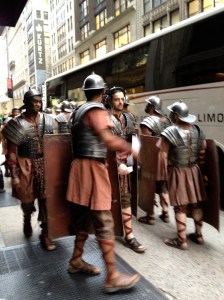
Lack of classical education, by which I mean reading the classics, has led us to an extremely tenuous place.  More interested in the Bible, I followed the track to another ancient system of thought, but as I find out more about the religion of classical Greece and Rome, the more I tremble.  You see, ancient Roman writers (especially) were extremely conscious of the fact that fear motivated people.  In order to construct a steady state, they infused it with a religion based on fear and supported by said state.  An overly simplified view would suggest that the Jews and Christians took their religion too seriously and refused to play the Roman game.  When they wouldn’t worship the emperor (who surely knew he wasn’t a god) they threatened the empire.  The response?  A good, old-fashioned dose of fear.  Crucifixion oughta cure ‘em.

See what I mean?

The thing is, our American form of government, buoyed up by an intentional courting of evangelical Christians as a voting bloc, manipulates that fear even more stealthily than the Romans did.  People ask me why I “like” horror.  I don’t so much like it as I see its role as a key.  It is a key to understanding religion and it has long turned the tumblers of the state.  Ancient societies kept religion under state control—something the Republican Party has been advocating as of late.  Why?  Religion, based on fear, ensures the continuance of power.  Those of us who watch horror are doing more than indulging in a lowbrow pastime.  We are probing the very origins of religion.  And we are bringing to light the machinations with deus.  Let those who read understand.


Ezekiel’s Nightmare

I’m still thinking about Ruby Ridge. It’s not unusual for me to be a bit late catching up on yesteryear’s news, but being alive during Trumpocalypse has made me think of the 1990s as the good old days. Jess Walter’s book on the topic, on which I posted a few days ago (just scroll down), ends with a kind of optimism that seemed possible even when George W. Bush was president—the number of white supremacist groups was shrinking radically. Americans didn’t put up with that kind of backward thinking any more. The future was ahead. Now, just about a decade-and-a-half after the book was reissued, we’ve got not only a racist commandant-in-chief, but a Republican congress who goes along with everything he says. Strangely enough, I just read a newspaper article with a Jewish Republican saying “diversity is crap” (his words). No question we’re going backwards.

It’s easy enough to dismiss extremists unless you know some. I attended a conservative Christian college in the early 1980s. There were survivalists on the faculty. These are evangelical Christians who hoard guns and supplies, generally because they believe the end of the world is coming. Ironically, their belief in the rapture doesn’t seem to assure them that they’ll be “taken up” before the trouble starts. Or maybe they just want to hang around for a piece of the action—shooting infidels must earn points with the big white guy upstairs. Most of my classmates were as appalled as I was. We agreed that if these were the kind of people who were going to be around after the smoke cleared, we didn’t want to be.

The most disturbing development since November 2016 is the move of the GOP to follow a blind leader. History will bear me out on this. It doesn’t take a prophet to see it. 45 had no plan for winning the race. Once he did, however, he knew that sheep will follow any shepherd, no matter how incompetent. All you need to do is spout racist rhetoric and the fringe will become the center. But the GOP? They are among the most sheepish of all ungulates. A “leader of the free world” who has nothing but praise for dictators and autocrats around the world? The Republican has proven to be the perfect unquestioning follower. The wool is in their heads rather than on their backs. Less than two decades ago Timothy McVeigh was executed. Today there’s no doubt he’d be under consideration for a cabinet post. I think my watch just stopped.


Evangelical Angst

Unless you know what it’s like to face life with no real prospects beyond making it to Heaven when you die, you can’t understand evangelical angst. That last phrase might seem odd to you. Aren’t evangelicals uber-smiley, happy people angry over the way society’s going? Yes and no. Many of them were raised (or converted into) a faith that holds out no hope for this world and that constantly reinforces the idea that what we like is bad. Having grown up in that world, I knew what it was like to be hoodwinked by an evangelist. I can’t remember the guy’s name, but he was famous. He came to my small town and packed a local Methodist Church. During his rambling, long sermon, he had us afraid for Hell burning under our feet. Grateful that we’d just managed to avoid it, he announced there would be three collections that night: the first was your normal tithe. The second time the plates came around you were to empty your pockets and purses of all change. The third time, you were to contribute to his private jet. If you gave over a thousand dollars your name would be inscribed on a plaque inside.

Almost as if nothing has changed in the decades since then, a Washington Post story expresses amazement that evangelist Jesse Duplantis is asking his followers for a fourth private jet. Uncomprehending, the world doesn’t show much curiosity as to why otherwise intelligent people would give to what is so obviously a scam. Or why such people would vote for Trump. The academic world doesn’t understand evangelical angst. As I sat in that audience that night, a poor kid from a poverty-level family, I fervently wished I had more money to give. Until he asked for his plane. My young doubts crept in, for I had more angst than most other evangelicals I knew. Was this really the Gospel?

Later I saw him on television. His personal mansion had literal streets of gold. Jesus, he said, wanted us to get ready for Heaven right here on earth. Did this turn his followers against him? Decidedly not. In fact, he may have believed it himself. You see, neuroscientists have learned that our brains have the evolved capacity to hold and dismiss reason simultaneously, for strong emotional stimuli. Sex, for example, or music. Or religion. These can motivate people beyond the realm of logic, and they often do. Evangelical angst says you’re not buying a scam artist a jet to spread the Gospel, it says your trying to avoid Hell. Rational or not. And that, it seems to me, is more than adequate ground for evangelical angst.


Defining Evangelicals

Like most Americans I have trouble getting over the button-down image of Evangelicals that has now become so distinctive. In reality Evangelicalism has nothing to do with Jesus, but it comes down to basically two things: a conservative haircut and belief in the superiority of males. The latter point is made by Rodney Hessinger and Kristen Toby in an opinion piece on Cleveland.com. Asking the question that’s on all logical minds—how can Evangelicals stand by a president who credibly cheated on his wife just after their child was born?—they come to the conclusion that patriarchy trumps all forms of righteousness. I know this from sad personal experience. The Bible, Evangelicals claim, gives men the headship of the household. They may sin, yes, but even with that their lordship must remain intact. That is the non-negotiable fact of Evangelicalism.

I was a teenage Evangelical. I grew up in a household where my mother refused to divorce her alcoholic husband because it was against Evangelical teaching. Sexual sins were well nigh unforgivable. In fact, adultery, of which 45 has credibly been accused, was a death-penalty offense according to the Good Book. About the only thing worse than sexual sins way lying. I can’t believe I’m getting old school on Evangelicalism, but I have to say Fundamentalism isn’t what it used to be. In college I knew people who believed we should reinstitute stoning for adultery. Instead we now use it as an excuse to elect unqualified presidents. And yes, we’d like to keep the brand, thank you. Commandments have now become negotiable.

Our society is very sick. Unlike the narrative Evangelicals weave, the illness is within them. Divorce rates are higher among Evangelicals than among atheists. Evangelicals are more likely to own guns than Unitarians. Evangelicals will lie more readily than any agnostic. Some of the more extreme want to reintroduce slavery. Through it all they claim to follow the Bible. Their support of Trump has given the lie to what they claim as a religious faith. Even Jesus, meek and mild, had harsh words to say about adultery. This is something you just don’t do. Promise your faith to one woman until a porn star comes to play at your resort—I don’t recall that being in Scripture anywhere. Evangelicalism hasn’t lost its soul, it’s lost its mind. Given what they’re doing in his name, Jesus must be rolling over in his grave.


Ashy Valentines Day

It’s been 73 years since it’s happened. Happy Valentines Day! And depressing Ash Wednesday. This is more of a popular culture conundrum than a sacerdotal one. I noticed in my many years at Nashotah House that Saint Valentine doesn’t make the liturgical calendar. This struck me as odd, but perhaps it shouldn’t have. The church has always had a difficult time with love. At least when it starts to get physical. Even if Valentine was a saint—and nobody knows for sure which Valentine it was—he surely didn’t become beatified because of his amorous inclinations. Nothing helps to put you out of the mood like being told “You are dust, and to dust you shall return.”

As a society we’ve been living in an Ash Wednesday that has been prolonged for over a year now. A government of St. Narcissus, for the only love there is love of self. Yet when I thumb through the liturgical calendar Valentine’s still not there. Ironically evangelicals—the name now belongs to those who support Trump—dismiss love as having anything to do with Christianity. This isn’t about love. It’s about showing hatred to the poor and stranger, the kicking out of those in need. It’s about military parades and “Sieg Heils” and law makers who vote themselves even more power with our tax dollars to fund their insidious schemes. There’s no need to gerrymander around the church—it’s on your side. Is it Ash Wednesday or is it Valentine’s Day? Surely it can’t be both.

Love is valued only in so far as it can be commodified. If you can get people to spend money on cards and chocolates and condoms then you’ve got a holiday worth celebrating. Otherwise you might as well join old Job sitting on his ash heap. The last time these holidays coincided the world was at war. The President had set up safety nets to catch those who were the victims of the greed that led to the Great Depression that is now all but forgotten. Nazis were a bad thing then. Now all we have to do is blubber about “fake news” and declare the truth a lie. Christians prefer Ash Wednesday to Valentine’s Day anyway. I admit to feeling a bit conflicted about this. Patriots and lovers used to be compatible concepts. We’ve been told that America is being made great again, but they called that Depression great too. From where I sit it looks an awful lot like Ash Wednesday to me.


Investment Advice

One of the more obvious transitions to adulthood involves Christmas becoming less of a holiday for receiving gifts. As we get older we learn that very few things in life are actually free, and that gifts often have some kinds of obligations involved. My favorite gifts have always been books and movies. Each comes with a required investment of time. That doesn’t mean I’m not grateful, or that I don’t want these things—quite the opposite! It simply means that time is required to enjoy them. Or benefit from them. In the workaday world, time is the rarest gift of all. The gifts I received fell mostly into these genres, so I’ll be sharing a number of these books and movies with you over the next few months.

A knowing relative gave me a refrigerator magnet. Our fridge is covered in these, mostly from places we’ve visited. We do have one of the more colorful iceboxes around. This magnet is red and reads “Make America Read Again.” If anything can combat the evil spewing from our nation’s capital, reading can. Those who’ve decided that rhetoric from documented lying lips is more Christian than compassion for the poor need to learn to read again. The election of Trump has ushered in an era of attempted murder of the truth. The tactic of calling any news you don’t like “fake news” so that your own distorted version of reality rules is among the most dangerous in the toolbox of autocracy. Sacrificing truth on the altar of expediency seems like a very strange means of promoting the evangelical message, at least in my opinion. If people would read, they’d know when they were being lied to.

Reading forces you to confront the mind of another. This exercise is unique among human beings, as far as we know. It’s a kind of telepathy, involving the considered contents of another person’s thoughts coming directly to you. Lying is a possibility, of course. Even liars write books. The more widely you read, however, the greater likelihood of discovering the truth. Reading requires investment. It takes time and mental energy. Other activities must be laid aside. The potential benefits, however, are beyond measure. If we could make America read again, the results would be the greatest gift anyone could hope to find under any tree. It’s time to begin reading through the books that made their way to me this holiday season. This is a gift whose costs I gladly accept. It’s an investment in the future. Even Christmas trees require daily watering.


Horror Divine

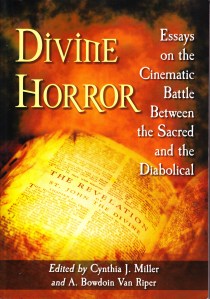
There’s a validation about finding something you figured out written in a book. For me that happened just about this season, some years back. At the Society of Biblical Literature annual meeting I found Sacred Terror by Douglas Cowan—the first book I’d discovered that discussed religion and horror films. Not only discussed them, but made the case that they have considerable common ground. Divine Horror: Essays on the Cinematic Battle Between the Sacred and the Diabolical, edited by Cynthia J. Miller and A. Bowdoin Van Riper, addresses the same theme but in more detail. Some of the essays in this volume get to the heart of the relationship between the sacred and the scary. As I mentioned, there’s a validation here for those of us who find horror movies fascinating. Others have noticed.

Genre fiction, as many fans know, comes with a subtle sense of shame. Low brow. Unsophisticated. Garish. Those with more refined tastes prefer subtlety and muted colors. Horror appeals to more basic instincts—but it’s also a form of expression that allows for the safe exploration of fear. There’s good horror and there’s bad horror. The eighteen essays in this book explore a bit of both. One conclusion that is unavoidable, however, is that religion—particularly Judeo-Christian religion—thrives in the context of horror cinema. The surprising part is that they often affirm the same message, but you need to look for it. Those who seek the origins of religion itself peer into the realms of awe and fear.

My own forthcoming book looks at similar territory. I don’t mind being classified as low brow. Raised in a blue collar world, that’s a fair assessment. What’s more, life confirms the reality of the connection between fear and religion. Consider the political moment in which we find ourselves. Much of the horror coming out of DC originates in religious “think tanks” trying to make evangelical Christianity the default faith stance of all our legislation. It means death and suffering to many, but the view of heaven for some becomes the tax haven for all. I know low brow when I see it. Horror comes in many forms—some lurid and some insidiously sneaky. Miller and Van Riper have pulled together a collection for our times here. The movies their authors discuss are part of a culture that is prominently religious and very afraid. If we want to understand what’s happening around us, we have to be willing to be scared.