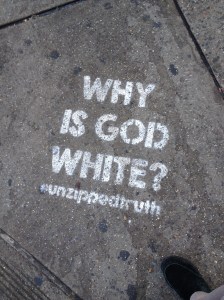
Ask an Evangelical

News stories this year have plowed up a frequently repeated question: what’s an Evangelical? This was the subtext to a Washington Post story that declared “Half of evangelicals support Israel because they believe it is important for fulfilling end-times prophecy,” as if it’s news. The media’s a little shy, I get it. Those of us who grew up Evangelical could have told them that at least 40 years ago. As a child I knew that Israel had to be fully restored for Jesus to return. Politics, we thought, were holding God hostage. You see, if the Bible says something, and it’s infallible, then even the Almighty has to obey it. And some parts seem to indicate that Israel has to be restored—interpreted a certain way—before Jesus gets his invitation back.

This Evangelical support isn’t because they love the Jews. No, no. Let’s not get personal about this. It’s because the second coming isn’t coming until the pieces are laid out in order. The Bible’s like a crystal ball, only it’s holy. It can predict the future with great precision. You can be sure someone like Trump is in there someplace, maybe in the passage where an ass speaks. In the 1970s it was Nixon. The wonderful thing about prophecy is that it’s made with interchangeable parts. As Millenniarians know, if you get your year wrong never apologize. Simply recalculate and keep preaching as if nothing happened. The Almighty is a forgiving God. At least to those He likes.

Intellectuals seem to think Evangelicalism is contagious. Well, to be fair, historically it has been. That was the whole point of camp meetings. Most Evangelicals aren’t too shy to tell you what they believe. In fact, their reading of the Bible sort of insists that they do. If you’re too bashful, many of those in the academy (or even formerly so) started out in their ranks. Rare is the biblical scholar who decided on that field of study purely based on intellectual curiosity. There was likely a method to their madness. Yes, of course Evangelicals support any politician who moves the embassy to Jerusalem. Tis a consummation devoutly to be wished. The divine heels have been dragging for a couple of millennia now, so it’s time to get this show on the road. All you have to do is ask an Evangelical. They’re not hard to find; in fact, they seem to be everywhere these days.
Belly Fires

A friend recently sent me a story from Smithsonian.com about how Evangelicalism arose partially in reaction to protests against the Vietnam War. Not that they were protesting it, but rather other mainline Protestants protesting drove evangelicals further to the right. Having grown up evangelical, I think I understand their strange reasoning fairly well. It was illustrated, for example, in a meeting of the Nashotah House board of trustees. Now, confidentiality rules—which I support—prevent me from providing details, but as you can imagine board meetings involved differences of opinion. I was a faculty representative (voice, but no vote), and I had a point to make. Being Episcopalian I politely and calmly raised my hand. At the same table one of the student representatives (voice, but no vote) was waving his arm like he had to find the nearest restroom, and quick. The chair called on him, ignoring my learned gesture. “He has a fire in the belly,” the chair said, “let’s listen to him.”

A fire in the belly. Not exactly an empirical—or even rational—reason to select one comment above another in my opinion. It was outward and dramatic gesticulation that caught the chair’s attention. Cooler considerations could be easily ignored. Nashotah House wasn’t exactly Evangelical. It was conservative, to be sure. What this episode taught me, however, is that society responds to those with bellies strangely warmed. Mainstream Protestants, for the most part, want comfortable faith experiences. Reason, after all, suggests decorum. Over 90 percent of the many, many mainline sermons I’ve witnessed have been staid and calm. Back in John Wesley’s day enthusiasm was an actionable offense in ecclesiastical eyes. Was the fire in the heart, or in the belly?

A little to the right…
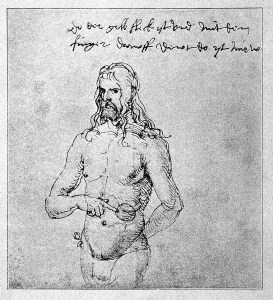
L0006082 Self Portrait of Albrecht Durer
Credit: Wellcome Library, London. Wellcome Images
images@wellcome.ac.uk
http://wellcomeimages.org
Self Portrait of Albrecht Durer.
Finger pointing to left side of torso.
By: Albrecht DurerPublished: –
Copyrighted work available under Creative Commons Attribution only licence CC BY 4.0 http://creativecommons.org/licenses/by/4.0/

So, what does this have to do with the Smithsonian story? Evangelicalism is driven not by the head but by the midriff. John Wesley’s conversion account was famous for his statement that his heart was “strangely warmed.” An inveterate doubter of his own salvation, Wesley needed to be certain. His thermo-cardiac episode helped to comfort him in the face of the lapping waves of the lake of fire at his feet. Having been evangelical once upon a time, I think I understand this constant Wesleyan concern. The fear of Hell is never easily overcome. The Greek word for strong emotion can be translated “to feel it in the bowels.” Examined more rationally, we know what moving bowels lead to. We see it every day as Evangelicals drive all three branches of government. The fire in the belly wins over cooler heads every time.


Call It What You Will

I didn’t even know the House of Representatives had a chaplain. Then Paul Ryan fired him. I wondered once again if evangelicals were interested in religion at all. We all have labels we’d like to claim but lack of legitimacy prevents us from keeping them. My secret wannabe title is rock star, but given that I can’t sing and can’t play any instruments, I have trouble retaining it. Evangelicals, however, have no challengers. They are so flexible they’d make Proteus blush. Such theological promiscuity, traditional religion teaches, will have its comeuppance. If 45 has accomplished nothing else, he’s forced the religious right to show its true, secular colors. Of all the great ironies of the situation none is greater than the fact that “nones” of whatever description hold up the weightier matters of morality better than those most vocal about their faith. Evangelicals, however, control the narrative and claim to do so with God’s own authority. They have few challengers.

Source: Beinecke Rare Book & Manuscript Library, Yale University via Wikimedia Commons

Then, mere days latter, Rev. Patrick J. Conroy was reinstated by the whiplash GOP. Did somebody warn the religious right that “religious” was part of their name? “Hypocrisy” comes from a Greek root meaning to play a theatrical part. As my stepfather used to tell us, “do as I say, not as I do.” He was a secular man, so his hypocrisy could be overlooked. Noble, even, at times. When those who stake their entire identity on WWJD promote, vocally and enthusiastically, an unrepentant candidate for sinner of the year, you’ve got to wonder if even hypocrisy has lost its punch. How can you reason with people who refuse to reason? We used to lock them away in asylums. Now we throw them into the swamp.

Double standards are the new normal, I guess. Nobody really paid any heed when the fall of the towering televangelists showed, decades ago, that the idol they proclaimed as true religion was rotten to the core. Oh, they made the headlines for a while, but their tumble did nothing to dissuade their true followers. Evangelicals control their own narrative. For many decades now higher education and the media have pretty much ignored religion as a force for social change. Once upon a time Evangelicalism meant change based on ideals that more or less fit the recorded words of the carpenter from Nazareth. Now that its inspiration is the ninth circle below, those who have access to the funds of higher education prefer to put their money elsewhere. Why study something that threatens democracy on a daily basis? Why bother trying to understand Evangelicals? Call it what you will—there’s no way to object to anyone claiming whatever name they want. I should know; I’m a rock star, after all.


Situation Norman

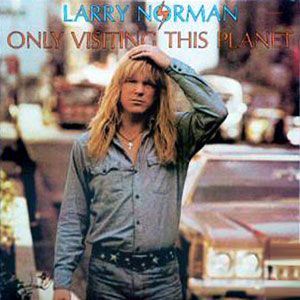
It was in a locker room. I couldn’t believe I was here. First of all, at Gordon College—that bastion of conservative Christianity. Second of all, in the same room as him. A friend had offered to drive me up here from Boston, where we were both in seminary. I was a little saddened to see less than 200 chairs set up on the gym floor, carefully arranged on a tarp so as not to mar the shining wood beneath. Larry Norman came onto stage to great applause, and was remarkably intimate with his fans. He’d been a big name in the 1970s, almost single-handedly starting the Christian rock genre. After the concert was over, my friend said “Do you want to meet him?” Here he was, in the locker room, taking the time to speak with fans, individually. He refused to sign autographs, preferring to give the glory to the Lord. But he listened, he responded, and, it was clear, he loved.

While the sections of the brain that process religion and music may not be the same, we know that our gray matter is intricately interconnected. Analysts have noted that the most famous religious leaders of modern times have quite often been deeply affected by music. Religious services without some form of music are in the minority for a reason. And it really doesn’t matter what style said music takes, it moves people. Instead of apologizing for my own musical tastes, I’ll simply note that I was exposed to Larry Norman at a young age. Although his religious perspective and mine had parted ways before I had the chance to meet him, I’ve never disparaged his music. It is authentic, innovative, and above all, sincere.

Gregory Alan Thornbury has just published a biography of Larry Norman. I will surely read it. Although Christian rock has grown insipid and cloying since it began, it is still a remarkably lucrative business. Evangelicals will pay good money to get those rock rhythms with unthreatening words and praise of Jesus thrown in. Norman’s songs, however, were complex and nuanced. Equal parts love and social justice, they might not even mention Jesus. Or when they did, they might suggest he was a UFO. Unconventional. Blasphemous to some. As the ‘70s faded into the ‘80s, Larry Norman was considered old news. He had, however, started something that was bringing other people lots of money. And he looked me directly in the eyes late one night in the locker room of a conservative Christian college, and told me to keep on believing. Obscurity, he showed by his life, is no measure of a person’s actual importance. And music and religion can never be separated.


Hope for the Future

I’m standing in a haunted place. There was an act of violence here this week. Gun violence. A man died in this restaurant where I sat with my wife and had lunch just a couple of months ago. I’m in Princeton for a rally organized by a teenager. We’re here to tell the government we the people want sensible gun control laws. The website said they were expecting 500. Five thousand turned out instead. Princeton’s not the kind of town where you expect gun violence. Affluent and privileged, it’s the kind of place many of us go to get away from real life for a while—they’ve got the best bookstore around and you can still find DVDs at the Princeton Record Exchange. You don’t expect people to be shot dead here.

America’s perverse affair with firearms goes hand-in-hand with its refusal to ensure adequate treatment for the mentally ill. We give them firearms and wonder what could possibly go wrong. We elect the mentally deficient to highest office in the land and instead of reining him in, the GOP reigns with terror. They have shown time and again that they prefer NRA money to our children. They have sold out. And the word appropriately used to describe such a party good manners prevent me from inscribing on this blog. Republicans, true republicans, need a new party. Instead they refuse to call this aberration in Washington what it truly is. Thousands took to the streets yet again this weekend. This was my fourth rally or march since January of last year, and hey, government—they keep getting bigger.

“Woe to the inhabiters of the earth and of the sea! for the devil is come down unto you, having great wrath, because he knoweth that he hath but a short time.” So saith the Good Book. It’s a book the Republican Party has forgotten how to read. Especially the “evangelicals” who’ve betrayed their saintly name. While I’m here in Princeton, a few hours away in the sullied capitol of this once reasonable nation, half a million are on the march. And just as women led the way last January we’re being shown the truth that anyone can lead better then old white men. And the fact that the organizers of these protests are high schoolers, I am inclined to leave the last words to the prophet Isaiah, whom, for any Republicans who might be reading, is in the Bible: “The wolf also shall dwell with the lamb, and the leopard shall lie down with the kid; and the calf and the young lion and the fatling together; and a little child shall lead them.”


Signs of the Times

America’s phallic affair with guns should give us pause to wonder what the true motivation is. My wife sent me an NPR story on the World Peace and Unification Sanctuary in Newfoundland, Pennsylvania. Congregants gathered carrying AR-15s, saying that the Bible’s rod of iron was really a semi-automatic. Did I say it was a phallic affair? According to the story by Scott Neuman, some of the faithful had substituted the crown of thorns for a crown of bullets. Literally. That man dying on the cross because of government overreach, I suspect, wishes he had his hands free so he could rub his eyes. He’s hanging here dying with the title prince of peace only to have grenade grannies praising his name with high explosives. This is what passes for Christianity these days.

Photo credit: Isabelle Grosjean ZA, Wikipedia

Sensible evangelicals have been in full retreat since November 2016. Stripped of their label by extremists who somehow mistake the lamb of God for Rambo, they no longer have a name of their own. Like worms on the sidewalk in the rain, there’s nowhere left to go. The same is true of rank and file Republicans. They wonder what has become of the (God help us!) party of Nixon. Watergate seems like a mere indiscretion compared to this. I’m sorry, were you waiting for Armageddon? Don’t worry, those who move the hands of the doomsday clock have shifted it closer to midnight than it’s ever been before. You’ll have your end times soon enough.

Among the ironies witnessed by the crucified one from his vantage point high on the cross is that it was his zealous followers who started all this. Religious experts tell us that all world religions depart significantly from the teachings of their founders within one generation. If you’ve read Paul’s letters you know this to be true. I grew up as a Fundamentalist. Even though for my career I specialized in the Hebrew Bible, my upbringing was focused on the red letter words of the other testament. Over and over and over again I read them. Think of others before yourself. Turn the other cheek. Walk the extra mile. Give away everything you own. The ones I don’t recall internalizing were: arm yourself with deadly force. Give your grannie an assault rifle. If someone slaps you on the cheek, blow him away. It is more blessed to destroy than to forgive. We sit beneath a giant clock with a commander in chief with an itchy nuclear button finger. Even a clock can be a crucifix, if you look at it in a certain way.


Just As I Was

It was kind of a game. A game to teach us about important people, living or dead. The fact that we were playing it in high school history class, taught by one of my favorite teachers, made it even better. Everyone wrote a name on an index card—a person in the news or somebody from American history in the past. A student sat facing the class while the teacher selected a card and held it over the student’s head, so we could all read who it was, all except the chosen one. Then s/he would ask questions to guess whose name was written. I remember very well when the teacher picked up my card and read it. He said “that’s really a good choice!” The name led to a bit of joshing. “Is he alive or dead?” the student asked. “How can you tell?” joked our teacher. It was the one name the selected student couldn’t pin down, no matter how many questions she asked.

It’s fair to say that Billy Graham had a profound influence in my life. As a curious—and very frightened—child, whenever his crusades were on television I would watch, transfixed. I responded to his altar calls at home. Multiple times. My emotions were overwrought and I’d awake the next day feeling redeemed, for a while. I had no real mentors in my Fundamentalism. Ministers preached, but they didn’t explain things. Not to children (what was Sunday School for, after all?). All I knew was that when the rhetoric reached Hell, and the possibility I would die that very night, repentance seemed like the only logical option. The reality of the choice—a black and white one, no less—could not be denied. Either you were or you weren’t.

Source: Beinecke Rare Book & Manuscript Library, Yale University via Wikimedia Commons

As my point of view eventually shifted around to that of my high school teacher—I was in college at the time—I began to realize that Graham’s version of Christianity wasn’t as monolithic as it claimed to be. Once you experience other people’s experience of religion, if you’re willing to listen to them, it’s pretty hard to hold up the blackness and whiteness of any one perspective. Over the years Graham tainted his pristine image in my eyes by his political choices. His son now stands as one of Trump’s biggest supporters. Now that Billy Graham has gone to his reward, I do hope that the Almighty doesn’t hold his mistakes against him. He had no way of knowing that his sermons were terrorizing a little boy in western Pennsylvania into a career track that would never pan out. Largely because other followers of Graham’s so decided. It’s kind of like a game.


Apologizing for Whatever

Maybe you’ve felt it too. The insecurity of liking something other people don’t. Having grown up an Evangelical, I had to try to explain myself at multiple points for liking scary stuff. I love Halloween. I spent my young Saturday afternoons watching monster movies on our black-and-white television. After losing a long-term job at a decidedly gothic seminary, I began consoling myself with horror films. I don’t know why. I also don’t know why other people shun those of us with this particular habit. It’s not like I’m going to make you sit down and watch them with me if you don’t want to. You don’t even need to buy my book, and if you do (thank you!) you don’t have to read it.

One of the issues I’ve often grappled with is why “Christians” dislike horror. Reading the accounts of the martyrs is way worse than almost anything I’ve seen on screen. Revelation, let’s face it, is a horror show of Schadenfreude and ultra-violence. The Calvinistic idea that God would create the vast majority of people to burn in an eternal Hell of fire for reasons best kept to himself (yup, he’s a guy) is hardly charitable. So why do Christians say you shouldn’t watch horror? One of the observations from this lowbrow viewer is that the message behind horror is often good. Moral. Ethical even. We have trouble getting around the form of the message to see its substance.

I seldom talk about horror movies. Maybe that’s why I write about them so much. But the fear of judgment remains strong, even with maturity. The lurking Evangelical fear is that watching horror will entice the young to become interested in evil. I think it’s fair to say that all Christians are somewhat fascinated by evil—where does it come from? Why doesn’t God stop it? Horror films seldom glorify the monster. The protagonists, often flawed, fight evil and sometimes succeed. Do I really need to justify this interest at all? It’s no exaggeration to say that, although no longer an Evangelical I still feel the weight of both their stares and those of others who can’t understand why a nice guy watches such unbecoming things. My book doesn’t answer those kinds of questions, but it may contain implicit answers within. Of course, you’ll only know that if you read it. Not that I’m asking you to do so—it doesn’t even have a title yet.


A Concept

Pardon me for being perplexed in public. You see, things aren’t as clear cut as they used to be. In the world in which I grew up Evangelicalism was good and Satanism was bad. Very bad. It still has the ability to scare people straight. A recent NBC story my wife sent me titled “Satanic Temple challenges Missouri’s abortion law on religious grounds,” by Corky Siemaszko, shows how the GOP has turned the tables on this equation. The Christian Right has utterly aligned itself with the pro-life camp. Most people would agree, I suspect, that abortion shouldn’t be the first choice of birth control options, but life comes with many unpredictable circumstances. There are times abortion is the most humane option and the burden falls almost entirely upon women. It’s not an issue on which men are competent to decide.

The evangelical posturing on the issue—which has, by the way, changed in recent years—has placed the weight fully on women. A rutting male, like a bull elephant in musth, can hardly be responsible, so the thinking goes. Or, to put it more politely, boys will be boys. Women suffer on the tusks of this tautology; it’s no wonder Satan has horns. Only women conceive, so men can make the laws and feel empowered by a male god who, you know, understands where they’re coming from. Missouri Satanists are striking back. The problem is the state requires women to be presented with indoctrination that says life begins at conception before electing for an abortion. Does life begin at conception? The Bible says “no.”

Biblical science was primitive. Ancients understood there was a connection between sex and pregnancy, but infant mortality rates ran very high. Life, in the biblical view, started at first breath. Spirit, breath—the very word for “soul” in the Bible—was the marker of life’s origin. The Bible may not advocate abortion, but in a world where few children made it past five, there was a shortage of surviving progeny. So it turns out that in Missouri Satanists are actually advocating the biblical view while the Evangelicals are violating the constitution by misreading it. Life begins at conception isn’t a scientific premise, it’s a theological one. A theological one on which Christians disagree. And Satanists. In their efforts to keep men on top of women, the Christian Right has no support from the Good Book on the matter of conception. Of course, why read the Bible when you can get what you want by quoting only your favorite verses? After all, God, they say, is a “he.”


Ancient Perspectives

Around the holiday season, on social media, stories relating to the Bible tend to pop up. When my wife mentioned a New York Times story about “Gabriel’s Revelation” on the second day of Christmas, I was suspicious. The story, which was nearly a decade old—the internet keeps things in circulation far longer than those old library tomes consisting of physical newspapers bound together—describes the unprovenanced inscription as predicting a messiah will rise after being dead for three days. I assumed this meant evangelicals would be overjoyed, but it turns out that the artifact, if authentic, predates the New Testament. That means that it can’t be traditionally ascribed as a prophecy, since it’s not in the Bible, and therefore it becomes a threat because it suggests Jesus’ story isn’t unique.

Image credit: The Telegraph, from Wikimedia Commons

This is an interesting dynamic. A potentially important ancient artifact can only have value if it’s in the Bible or proves the Bible “true.” When that happens the faithful crow about how the evangelical position was right all along. If such a document implies that the gospels were borrowing from widespread cultural assumptions, however, it becomes just another unimportant bit of junk from days gone by. Confirmation bias, of course, is something in which we all indulge. Nobody likes being wrong. The difference is that the scholar is obliged to admit when the evidence overthrows his or her position. New options have to be considered.

Since I was between jobs in 2008 when the inscription was announced, it escaped my notice. Now that nine years have settled the dust a bit, there seems to be no sustained case for declaring Gabriel’s Revelation a forgery. Neither does it appear to have changed Christianity at all. The period known as that of Second Temple Judaism has shown itself to have been rich in messianic expectations. We know little, historically speaking, of Jesus of Nazareth. We know from the Dead Sea Scrolls that some were expecting a messiah along the lines of what Jesus was said to have been. But those documents aren’t part of the magical book that contains the truth, the whole truth, and nothing but the truth. In as far as they back the Bible up, they are celebrated. When they call the Good Book into question, they are rejected. I have no idea whether Gabriel’s Revelation is authentic or not. It seems pretty clear, however, that a faith that’s based on one unquestioned source might be more fragile than even other artifacts that have managed to survive, somehow, from ancient times.


Honest Doubt

Kurt Vonnegut was never required reading in my high school English classes. I read Slaughterhouse-Five when I was in seminary, and picked up a few of his other titles in the dearly departed Boston Book Annex. A couple of these used books have been waiting patiently over the decades, and so I selected Cat’s Cradle to be perhaps the last book I finish this year. As far as I can recollect, the Vonnegut books I purchased while in seminary had no particular order or reason. A friend had recommended The Sirens of Titan, but Cat’s Cradle was what would now be called an “impulse buy.” Reading it, I rediscovered why I like Vonnegut so much. I also found out the book revolves around religion.

Regular readers know that I tend to find religious themes in secular books. It’s partially human radar and partially an unfortunate occupational hazard. Occasionally I’m pretty certain the author had no intention of including or developing the themes I discover. Cat’s Cradle, however, places religion front and center. The story involves a journalist on the trail of one of the developers of the atomic bomb. He unintentionally coverts to Bokononism, a religion made up by a castaway on the island of San Lorenzo. The religion, based on the teachings of a still-living sage, revolves around the idea that all its sacred writings are lies. Think about that a moment.

Lies, in which we’ve all had a crash course since January, are among the most insidious of human accomplishments. We value and crave the truth. We all believe that we believe it, but there are differing opinions as to what it is. Some opinions are backed with evidence, and others with flimsy fabrications. To declare a religion based on lies is, of course, to undermine the whole enterprise. Vonnegut was a noted iconoclast, but there’s a brilliance in declaring a religion to be knowingly based on falsehood. In fact, we’re seeing it happen before our very eyes. The religion formerly known as Christianity, once upon a time, took into account the teachings of Jesus of Nazareth, as recorded in the gospels. Modern Christianity—Evangelicalism—has completely thrown Jesus out of the equation in all but name. Branding, after all, is everything. This modern faux religion suggests hating your fellow creature, taking advantage of the poor, and believing falsehoods to be the most sincere of truths. It’s alive and released on the earth even now. And it is far more scary than even ice-nine.


Who Can You Call?

They’re scratching their heads. The media, I mean. In this distorted world of Trumpism, newspapers have rediscovered religion. Some say Trump is the altar boy of the evangelical right with people like Franklin Graham wetting himself over the president. Others say evangelicals want to change their name to distance themselves from Trump. Everybody seems to want to know who evangelicals are, but they’re afraid to ask. The weird, or perhaps expected, thing is universities decline to help. For years now they’ve been cutting positions in religion, a topic no longer relevant or of any interest. Academics aren’t always good at seeing what’s right in front of them, of course. So it is that the media’s scratching its collective head. Is he or isn’t he? What can you say about a man who’s so clearly heathen and yet a sparkling example of Christ-like compassion and values?

It’s doubtful whether any university administrator or televangelist could finger Jesus of Nazareth in a police line-up. They have no idea of who he was or what he taught. All that matters is he was God and he protects unborn babies so that he can arm them with automatic rifles when they’re of age. Oh, and he’s definitely not a woman. Or gay. Is that about it? Just in the past week major media outlets have run stories about the evangelical relationship to the commander-in-thief who’s told more lies in his first year than all other presidents combined. Who said Jesus of Nazareth was honest? He just stood for the right causes.

Having grown up evangelical, studied religion with evangelicals, and having been fired by evangelicals, I know them well. They have a mental capacity for biblicism that’s nearly incomprehensible. The Bible is so sacred that no other book should be placed atop it. It should never be set on the floor. Memorizing chapter and verse is more important than knowing what they might mean or how to live by them. This is old-school blind faith. And proudly so. Trump doesn’t know the Bible but he says he does. His actions resemble the carpenter from Nazareth’s about as much as Joseph Stalin’s. He was a good Christian, too, wasn’t he? After all, the Bible says Russia is our ally. Reagan—another evangelical—may’ve said they were our worst enemy, but one thing we know for sure about the Good Book: it never lies. For that it takes evangelicals and politicians.


Dominus Flevit

I couldn’t believe I was actually there. Ever since I was a child I’d read about this place. The city conquered by David and visited by Jesus. The city around which most of the Bible rotated. Jerusalem the golden. One of the perks of working on an archaeological dig was the opportunity for weekend travel, and here I was, amid camels and cars and churches and synagogues and mosques, in Jerusalem. No amount of reading prepares you for such an experience. Suffused with the rich mythologies of three major religions, this city is like a dream. So much had happened here. The church I was attending at the time was only the latest in a long succession that informed me that God himself had actually been killed here and had risen again. The ultimate game-changer. The once in forever event of all time had taken place right here.

Gnu Jerusalem from WikiCommons

But this was not a city at peace, despite its name. There was a bombing the first weekend I was there. Young men and women in military garb carried scary looking weapons openly in public. Even civilian bus drivers wore pistols. Jerusalem had a long history of violence, but that didn’t justify it. If God had really been here—in either Jewish, Christian, or Muslim contexts didn’t matter—how could this city be so prone to terror? In the old city old men sat around hookahs, placidly smoking. Tourists, many bearing crosses, thronged. Jerusalem, however, was also a very political place. The fragile, Christmas bulb-thin peace of the region involved the city being divided up and not being claimed by Israel alone. Even that man driving his goats through these ancient streets knew that.

Trump, to the cheers of evangelicals who want nothing so fervently as the end of the world, has said he’ll recognize Jerusalem as the capital of Israel. This political move of weaponized ignorance will almost certainly lead to war in the Middle East. Another war. An illegitimate presidency leaving a frothing sea of corpses in its wake. Negotiating in this part of the world is like haggling with that street vendor for a pair of sandals. You go back and forth on the price. You act insulted and walk away. You come back and haggle some more. It’s a delicate dance. This is no place for egomaniacs who can’t understand such subtleties. Just ask the last Caligula who wanted his statue set up as a god in this city. Jerusalem is home to too many jealous gods, and those who are self-appointed divinities will only leave the city, the world, in tears.


Healthy Hurricanes

Three major hurricanes into the season and our Republican government has nothing better to do than try to think up new ways to take away our healthcare. In an effort—no victory is too insignificant—to show that the swamp is being drained, the Grand Old Party wants its own constituents to sicken and die off just to prove a point. Meanwhile Thurston Howell can’t find a charted island even after being marooned on it. Puerto Rico is a territory of the United States. Perhaps the White House should use some of its tax money to purchase a map and a history book. Houston is still recovering from Harvey and 45 spends his time campaigning for the loser in Alabama. Not even Shakespeare could have come up with tragedies like this.

Morality, at least in the post-Reagan elephant wing, used to be in line with evangelical Christianity. When I grew up in that tradition I was taught it meant fair treatment for all, regardless of race or social location. Since my childhood that brand of Christianity has become more exclusive, it seems. God now, contrary to the Gospels, rewards the wealthy. He tends to favor gentiles, but only those of caucasian stripe. Those who are poor and suffering should learn to speak English and stay out of the sun. Act like proper suburbanites and hurricanes will never strike you. Oh yes, and you need not fear being stuck by the sun by day either. You don’t even need to read your Bible. In fact, you can ignore it as long as you know enough to proclaim to others you alone know what it means.

So far 2017 has been a year of natural disasters. Earthquakes, hurricanes, and further from home, multiple landslides and monsoons. And even volcanoes. It’s tempting to see some biblical correlations here, but that’s playing fast and easy with the great torment from which our fellow human beings are suffering. Far more important is to show that we can repeal healthcare in a nation that has been spared, to a great extent, the worst the world has had in store so far this year. Oh, except for Puerto Rico. Does anybody have a map app on their phone? And while you’re at it, check to see if maybe some developer has come up with software to help govern an affluent nation. Preferably one linked somehow with Twitter. We mustn’t forget our priorities.


Sense or Ship

I can tell I’ve been too busy when I haven’t planned for Banned Book Week. A kind of unofficial holiday since, well, it’s about banned things, the point of this observation is that we should be free to read. A fairly large portion of the fiction I read anyway, at one point or another, ends up on the banned list. Not surprisingly, most banned books have diversity content—racial or sexual minorities portrayed in sympathetic ways. Trump has shown us clearly how dangerous such thinking can be. It’s well known that such perspectives are allied with some evangelical Christian interests, or, perhaps I should say, lack of tolerance. There are lots of ways of looking at the world out there, and many of them aren’t evil. I should’ve planned ahead.

Censorship implies a certain arrogance. One way of looking at things is right and all others are wrong. Although we all know that any logical system runs up against its limits (we call them paradoxes) we’re reluctant to let go of that which we suppose, with or without justification, to be right. Banning is an effort to control minds. It’s no coincidence that many of the titles on banned and challenged lists are intended for younger readers. Those who favor censorship want to close the eyes of the young and pretend the real world will just go away. Yes, many of the banned books are fiction, but fiction tells us truths. Those who ban books are uncomfortable with such truths. That’s not to say all literature is created equal, or that all banned books are great literature. As someone who writes fiction, though, I can attest how difficult it is to get it published. That in itself tells us something.

It’s banned book week and here I am without a banned book to read. I’ve got some ideas, of course. My wife and I both take on book reading challenges each year. One of this year’s books (at least) was a banned title, but one that I read too far in advance. Besides, although we have too many books in our apartment already, I used Banned Book Week as an allowance to go to the bookstore. What better way to fight literary fascism than to buy a book? The problem is deciding which one. The lists are long and grow longer each year. Intolerance, it seems, knows no limits. I’m about to do my civic duty for this time of year. I’m about to go to a bookstore and buy a banned book.