Eine Kleine Neanderthal-Musik

I suffer a limited form of amusia. No, it’s not a fear of amusement, but rather lack of musical ability. I appreciate music very deeply, but I simply can’t make it. I’ve tried lessons and teachers end up turning away in exasperation. The embarrassing part about all this is that music is an integral part of religion – almost all forms of religion have their musical repertoire, and musicologists have demonstrated that the early human impulse to make music has a religious basis. I can only sit in the audience.
That's me on the left

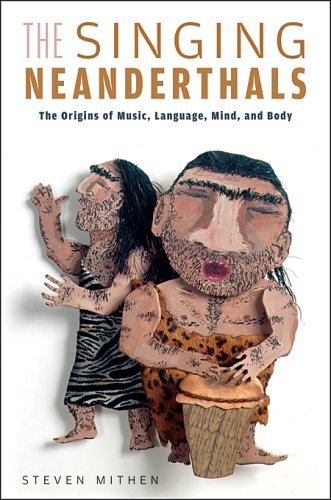
I’m finally getting around to reading Steven Mithen’s The Singing Neanderthals: The Origins of Music, Language, Mind, and Body. A few years back I gave an academic paper suggesting that musical development could be an analog to religious development on a neurological level in the Bronze Age. Since I’m not a neuroscientist I have to rely on others to do the experimental side of the equation. Mithen serves this function nicely. When I read about music and the brain, which I do frequently, I am surprised that more scholars of religion haven’t picked up on this connection. Since music is frequently “background noise” today, many people casually assume that it is insubstantial, a whim. I look at it (listen to it) from a different angle. I seldom listen to background music – if music is playing, I pay attention to it, and something in my unprofessional brain says Mithen is often right on target.

Of course, religion and music is not the main thrust of The Singing Neanderthals, but rather the idea that music was formative for human cognition. Perhaps music even developed before speech. For me this is an important piece of a much larger puzzle: whence did religion arise? Like all inquiries that delve too deeply into the past, the answer is lost among ambiguous artifacts and ancient dust. And yet, those who know more about this than I do seem to be pointing in the direction that both religion and music have their origins in the pre-Homo sapiens stage of our evolution. I’m not surprised. I only wish I could play along.


Out of Reach

Last weekend I had hoped to see the movie Creation: The True Story of Charles Darwin. This is a movie that has had trouble in the United States since distribution companies felt it would be too controversial for American audiences. Believing that evolution is still a taboo topic in the most “advanced” nation on the planet is a peculiar conundrum. Why are we so sensitive concerning our natural pedigree?

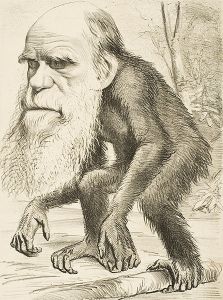
Primatologists are constantly discovering new and unexpected connections between the great apes and homo sapiens. We share biological, and as we are increasingly aware, cerebral traits. Empathy and xenophobia, two features once believed unique to humans, are in evidence among our great ape cousins. We are on a continuum rather than a segmented train.

Bearing these provocative thoughts in mind, I was ready to head out to the theater, even if I had to go alone, to see the story of Darwin. I’ve read enough biographies to know there are some heart-rending moments in the story, situations that I would not be able to face – but it is a story of truth. It is ironic that we sometimes fear the truth, since religion is our effort to find exactly that. So, resolve firmly in hand, I searched for New Jersey theaters showing the film. None. The nearest show was in Midtown Manhattan. Add a twenty-dollar train ticket to the cost of admission, and to an underemployed academic the price was out of reach. Perhaps some day the movie will become available for general public consumption. Until it does, however, I’ll just have to lament my frustration to a local empathetic ape.

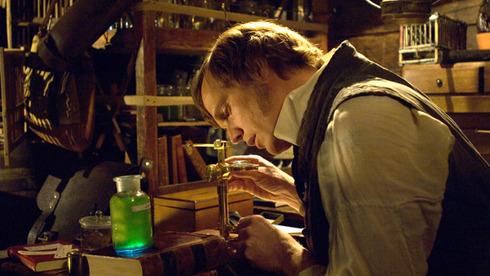
A scene from the movie, so I'm told


The Truth is in Here?

Constantly trawling for the shattered detritus of truth that rests scattered around our lonely little planet, I have often supposed they were here. I have never seen them, but in the Drake Equation there is a high probability that they exist. And now the newspaper says they may have been here all along. And closer than we thought.

Aliens. These latter-day angels and explorers of the cosmos are often pictured like E-T or the little gray aliens from Close Encounters of the Third Kind. The latest findings suggest they could even be quite a bit smaller than that. Paul Davies, a physicist from Arizona State, believes that life may have developed multiple times on earth, and perhaps some of the googol of microbes on our planet may have their origins in space. These potentially extraterrestrial microbes, he stated could be “right under our noses – or even in our noses.” Yikes! Time to put up the intergalactic “No Trespassing” sign!

Stop the alien menace!

In all seriousness, however, this concept of multiple origins of life, I fear, will be latched onto and misread by our Creationist fellow-life forms. I can see the fingers stiff from grasping at straws claiming that now there is scientific proof that different species do have different origins, thank you Mr. Darwin. The price to pay, if they apply logic, however, is not one evolutionary track, but many.

The movie Creation, focusing on Darwin, opened this past weekend in the United States. Delayed because of concerns that Americans can’t handle the truth, this film about Darwin’s sad voyage to the inevitable truth of natural selection will surely raise evangelical ire. Nevertheless, we did not design this world we evolved into, we simply inherited it. And the closer we peer at it, the more complex it becomes. These multiple evolutionary tracks may also explain the origin of Creationists – could they come from different stock than scientifically minded folk? In any case, the news today provides yet another reason to keep our noses clean and our eyes on the skies.


Eager for Eden

In a recent email from the Clergy Letter Project, Michael Zimmerman reports that the movie Creation is shortly scheduled to be released in the United States. To quote from the Project newsletter:

“You may have heard that the film, Creation, about Charles Darwin and his struggle with his faith after his daughter, Annie, died had trouble finding a US distributor because it was seen as being too controversial for the American public, particularly after being attacked on Movieguide.org, an influential site which reviews films from a supposedly ‘Christian perspective’.”

It is disturbing that a non-fiction film has been blocked from American viewers because distributors found the content too controversial. The controversy has nothing to do with sex or violence, but an assault on the fantasy of a literal interpretation of Genesis. Disturbing fact challenges comfortable fantasy.

In a related story, an article on CNN.com explores the sense of depression that several viewers of Avatar felt after the movie ended. While the reasons are deep and complex, the overall theme seems to be that these viewers can’t shake the image of a pristine world that seemed so real for two-and-a-half hours. They long for a paradise that doesn’t exist. A paradise that has never existed. I am not unsympathetic. Although I could not view the film, I left from the theater with a similar, if less intense, feeling. It is a similar emotion to that when a truly special event takes place and the mind plays it over and over like a new and significant song. Impressions and hazy images and euphoria wash over you, and a longing for a moment that can never be recaptured consumes your consciousness. These are some of the most bittersweet moments of life. They are the very heartbeat of fantasy.

There never was an Eden. Human existence has been brutal and harsh since we first stood upright and wondered why we could think. America is a nation in deep denial about this harsh reality. We would rather believe the biblical Eden is a literal paradise and that our aching imaginations are somehow giving us glimpses of a fabled utopia where life was perfect. Well, almost perfect. The movie Avatar presents a paradigm that many Americans can relate to: an electronic world of endless possibilities shielding us from the stark realities of illness, pollution, tragedy, and death. We are insulated in our surreal environment that we have created for ourselves.

The human capacity for wonder is perhaps the greatest asset that consciousness has deigned to bequeath us. We can imagine a world where all creatures live in harmony with their environment and love and peace flourish. But that is not our world. A good corrective to these tempting fantasies is to read some good old classic Greek tragedies. These imaginative explorations of the human condition are as true to life as dreams of utopian worlds are removed from it. It is all a matter of perspective. And the Greeks were writing B.C.E. — Before the Computer Era — when reality had not been hidden behind a haze of ephemeral electrons.


Make Room on the Ark — Another New Dinosaur!

Enter Aardonyx celestae! A new dinosaur announced yesterday in South Africa is being hailed as a missing link in the sauropod chain of development, much to the chagrin of Creationists. I have to admit that I never outgrew my childhood fascination with dinosaurs, and when we purchased the life-like models for my daughter as she was growing up I secretly coveted them for myself. The rate of discovery among new genera of dinosaurs is between 10 and 20 per year, meaning that the maybe 20 different dinosaur types I knew as a kid has ballooned into well over 500 different species and 1,800 genera. Late at night I still hear the call of paleontology and I slip Jurassic Park into the DVD player and weep.

With each new dinosaur discovered Noah’s ark must evolve into a larger boat for some among the Creationist camp. After all Genesis says “two of every kind” lumbered aboard. The newbie this time is a proto-sauropod, a missing link between bi-pedal herbivores and their earth-shaking descendants who required four tree-like legs to support their immense weight. It seems that Noah must have been quite the engineer to handle all this displacement. And it is a good thing too — scientists predict that the new genera to be discovered represent only about 30 percent of the total, and the number will likely continue to climb for a century and a half yet.

Dinos

Wikipedia proto-sauropods race for the top deck

So it seems that the God-of-the-gaps grows smaller while the ark grows larger. Of course, the dinosaurs might have evolved into all these different genera over time, but then, Creationists can’t allow for that, since it would admit room for evolution. And that seems about as likely as the Church of Jesus Christ of Latter-day Saints backing anti-discrimination laws against homosexuals!


Let’s Do the Time-Warp Again!

Yesterday MSNBC reported that the Vatican has again called for a conference involving serious scientists to discuss the implications of astrobiology — life in space. Despite the mocking sneers of the media, growing numbers of serious thinkers are doing the calculations and scratching their heads. When I was a child, I was assured that earth-like planets elsewhere in the universe were virtually impossible, statically. Now we know of several rocky orbs circling distant suns. Our own sudden advances in technology have started some to think that if we raced from heavier-than-air flight to the moon in only 66 years, and from landline to audio implant in about a century, maybe other intelligent life could do the same? What would the implications be for the geocentric world of Genesis and the Gospels?

The Catholic Church and Science are hardly best buddies; frequently they are not even on speaking terms. No, the tide did not change to a warm embrace with the (centuries late) apology to Galileo or the sudden realization under John Paul II that evolution is “more than just a theory.” All one has to do is think of the issue of stem-cell research and the eagerly offered hand is suddenly withdrawn. But on the issue of aliens, perhaps the church can race ahead of the projected God-of-the-gaps, do an end-run, and be ready to embrace E.T. when he finally makes himself known.

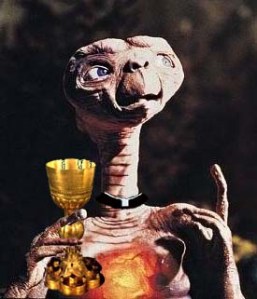
Don’t get me wrong, I am grateful that the Vatican has embraced evolution and thumbed its Roman nose to the creationists. (They deserve even more than that!) I am glad they are considering the possibilities of extra-terrestrial life. There is, however, a nagging doubt in my mind that they may be coming to the conclusion that the late Larry Norman once did that “if there’s life on other planets, then I’m sure that he must know, and he’s been there once already and has died to save their souls.” What good is advancement in science if mythology refuses to budge? What would an extra-terrestrial priest look like? What if they don’t have blood to fill their chalices? Do they have trumpet-horns on their saucers to announce the second coming? Yes, let’s explore our universe, but let’s not forget to update our credibility meters as well.

ETpriest

Our father which art in heaven?


Daniel in the Lyin’s Den

Yesterday I found myself. Online, that is. I was cited ambivalently as “some guy” in the Uncommon Descent blog comments, noting my Creationism’s White Box podcast. For those unfamiliar with Uncommon Descent, this is a blog hosting many posts by William Dembski, a leading creationist. Finding myself there, I instantly recalled that Daniel was never masticated in the lion’s den.

Not being one to judge without good cause, I read the critique with care. It read: “Some guy I read in the last few days here [link to my podcast] has suggested (to the approval of a few clerics) that creationism is an early 20th century phenomenon but all he’s really done is conflate creationism with the Creationist movement that grew out of, or was associated with, the publication of ‘The Fundamentals’.” Since academics like to split hairs (and even atoms), I thought I’d use today’s post to explain, in History 101 style, the problems with this assertion.

Creationism, like any other human enterprise, has a history. Christianity was born in a literalistic age, of sorts. Early Christians took the Hebrew Bible (pretty much The Bible in those days) literally. Belief in a flat earth and mythic beings still predominated the upper cortices of early brains too. My detractor could have been correct had the conflationism charges been laid at my door prior to the Enlightenment. The fact is that everyone born since the eighteenth century (academically speaking) has had access to science and the facts we’ve ascertained about our world. One of those sets of facts has had to do with evolution, and another with the history of the Bible. Interestingly, both of these sets of facts coincide perfectly: biological evolution took place and the Bible was a product of its environment. These truths have been available for centuries for any who would look at them.

The veracity of this statement is attested by the nearly universal acceptance of evolutionary theory by Christians in the western world in the late nineteenth century. Creationism, as such, did not exist at this time. It was in reaction to a number of social and theological factors that Creationism first hatched around the turn of the twentieth century. It was a new bird (I’ll avoid saying “hopeful monster”). Any claim that it was a default version of Christianity is strictly Retro — any such claim is tantamount to declaring that the Enlightenment never happened. I’m not a supporter of revisionist history, so I just can’t accept this flimsy construct. Fact is, Creationism is relatively new.

There is a great bibliography out there for anyone interested in getting the actual facts. Start with Ronald Number’s The Creationists: The Evolution of Scientific Creationism (University of California Press, 1992) and read on. Otherwise, feel free to believe in a flat earth — you can find good proof of this in central Illinois or Kansas.


Science Me This

I’ve just finished going over the creation and flood myths in Genesis 1–11 with my students. By my reckoning, this is about the twentieth time I’ve taken this journey. One comfort of walking a well-known trail is you know what to expect. The fact that always sticks in my mind is how good of a job the Creationists have done. In every setting where I have taught I have many students who unquestioningly accept that Genesis 1–11 was written as science by some kind of Mosaic mosaic of scientist, law-giver, and prophet, a regular Bronze Age Renaissance man. Since biblical scholars do not communicate well with the public (nor do they play nicely with each other), most students come into class wondering why the Creationist viewpoint is even under question.

I want to suggest something radical here: in our culture where science, technology, and finance are highly valued, we neglect to educate our kids in the basics of literary study. Schools push the technological envelope, and this is not a bad thing, but the kids come home and are shuffled off to church where the Bible is revered and a basic disconnect forms in their minds. A compartmentalized Bible, factually true, resides in one region of the cortex while in another scientific theory lurks. And when fact clashes with theory, fact always wins. They know they have to tell biology teachers that they understand evolution, they simply don’t believe it. They come to collegiate religion classes expecting Sunday School part 2.

Just this summer a grown man, Randall Price, director of Liberty Uni-, Univ-, University’s (sorry, I always choke on that one) Center for Judaic Studies once again made the weary trek to Mount Ararat to find Noah’s Ark. If he’d read Atrahasis or even Gilgamesh, he might have known he was looking in the wrong place. Nevertheless, he received coverage from a major news network (FOX, of course!), and those who never studied ancient mythology cheered him on. If we could teach children that the Bible is a literary document, teach them that it can be studied seriously, and that the Big Bang and “let there be light” are not the same thing, we might make some progress. Until then, we will have to contend with silly cartoons trumping hard-earned education.

Jack Chick has more publications than any Bible scholar

Jack Chick has more publications than any Bible scholar


Clergy Letter Project

A few years back I had the privilege of working at the same university as Dr. Michael Zimmerman, currently a biology professor at Butler University in Indianapolis. In my temporary stint as a Lecturer in the Religious Studies department at the University of Wisconsin Oshkosh, I discovered that Dr. Zimmerman, then the Dean of the College of Letters and Science, was the very man responsible for the Clergy Letter Project. I had read about the project before; in an attempt to demonstrate that Creationism is not mainstream Christianity (nor science, for that matter), the Clergy Letter Project was attempting to acquire a few thousand signatures from the ordained of various denominations who were willing to admit that evolution posed no threat to their religion.

As an occupational hazard of someone with my background, I know many, many clergy. I offered to solicit some help in reaching the goal on the list and spent the rest of the semester contacting various sacerdotal practitioners who rightfully saw the Creationist ploy for what it was and continues to be. Creationism is nothing short of an attempt to break through the church and state separation clause and attain federal support for a particular religious viewpoint. That particular viewpoint is not shared by the majority of informed Christians, but the population is easily swayed by Creationist rhetoric. Creationists do not deserve sympathy, for they are much more aggressive than they pretend to be. Subterfuge in the cause of truth is a contradiction in ethics.

Religion may be hardwired into human brains, but it need not seek to pick fights with factual truth as it is learned. At each stage along the progression of human achievement, various religious believers have felt that the new knowledge discovered confronted their faith with unsurpassable barriers. Faith, however, is a belief system, not a factual construct. If faith requires proof, as even the Bible itself says, it is not really faith at all. If you know any clergy who are willing to sign on for common sense and belief in the rational world in which we find ourselves, please send them this link and ask them to weigh in on the question. Nearly 12,000 clergy have signed to date. There are even separate lists for Rabbinical and Unitarian-Universalist clergy. Don’t worry about the Creationists. They will always be back for more.

An early Creationist attempt at intelligent design

An early Creationist attempt at intelligent design


Biblical Black Lagoon

During my summer-term courses I feel it is only fair to break the lecture time up a bit. Rutgers summer courses can run four hours at a stretch, and no matter how valiant the student, no one can pay attention to me for that long. I have long had an interest in the Bible in popular media, so for each class session I show a brief clip of a movie that features the Bible, often in a pivotal role. We then discuss how it is presented. As a personal pork barrel I give the students a multiple choice question on their exams as to which movies we have watched (it also gives them incentive to be in class, I hope). One summer, after sending the exam off to the print office, I realized I’d made a mistake. As usual, my interest in 1950s sci-fi flicks led to trouble. One film I hadn’t shown a clip from, and which I thought was Bible free (I hadn’t seen it in a long time) was The Creature from the Black Lagoon, a perennial favorite for both camp and kitsch.

Of course, The Creature from the Black Lagoon does have the Bible in it. The movie begins with a narrator reading Genesis 1.1. Well, I had to give all the students credit for that question, because there was no wrong answer. Nevertheless, the easy association between beginning the film with the Bible and its evolutionary plot-starter seemed worthy of comment. Back in the 1950s evolution was already a hot-button issue (so I’ve read). Forces lined up on the scientific and biblical fronts faced off like angry hockey players as they swung at that hard black puck of the truth. It does seem odd in a country so heavily reliant on science that the foundation of biology and its benefits (if scientists hadn’t recognized and reacted to the swift evolution among microbes I’d likely not be here typing this sentence) that one particular interpretation of a very small section of the Bible should have the power that it does. I’ve seen carnivorous, chrome-plated bumper Jesus fish eating the peacefully walking Darwin fish! Old metaphorical Moses would be scratching his head, I’m sure.

The Creature was, of course, also a metaphor (if I’m not shoveling out too much credit where it isn’t really due). The sequels to the original film grew progressively worse, but those who have the patience to sit through The Creature Walks Among Us discover that the gill-man is a man after all, under all that green rubber. The beast is us. Not too weighty of a revelation to be sure, but it isn’t too weighty a movie. Like any discriminating Bible reader I choose what to accept and what to explain away. When I watch The Creature from the Black Lagoon, it ruins the story for me to think ahead to the denouement of the gill-man being a real man. It is a passage I simply choose not to accept. (This is, of course, a metaphor.)

What might this be a metaphor for?

What might this be a metaphor for?


Religi-Religi-Religi-Religulous, That’s All Folks!

Tell me where is fancy bred,
Or in the heart or in the head? (Shakespeare, The Merchant of Venice)

Every great once in a while, a must-see movie comes out even for religion specialists. We have to lay aside our Biblia Hebraica Stuttgartensias for a while, stare at one of the talkies and scratch our heads. Last year my students asked me what I thought of Bill Maher’s Religulous, but I didn’t have a chance to see it (couldn’t afford it on the big screen, and who has time during the school year anyway?). So I finally got together with a friend to watch it on the small screen.

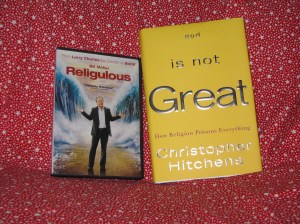
First off, the film is funny — hey, it was written by a comedian, so it’d better be funny! As Maher ticked off point after point after point where religion falls short of the mark, I felt as though I were watching Christopher Hitchens’ God is Not Great on the television.

Let's be friends

Let's be friends

Maher scores some big points for having done his homework on mythology and pointing out the mythical elements in mainstream Christian thinking, but I was left with some very basic questions: what about those who hold to religion for good reasons? What about those who don’t strap bombs on in the name of religion? What about those who promote humanitarianism for religious purposes? Can they be classed together with dangerous folk who use religion for nefarious rationales to get back at their enemies (generally anyone they don’t know)? The scenes of religion-inspired violence were extremely disturbing, but I was curious about the benign varieties of religion. Do they do any more harm than taking a toke, as Maher does a time or two in the film?

It occurred to me that religions offer a way out from what can be a very humdrum world. Evolution is certainly fact, but the long, slow process of evolving into something better fit for its environment doesn’t spur on the emotions like the Battle Hymn of the Republic. But isn’t that it in a nutshell? Religions show their flashier colors when they are in conflict, like peacocks competing for the affections of a peahen. Even those interviewed by Maher tended towards the more flamboyant practitioners of their faiths. What should really be on the docket is hatred. Religions may aid and abet those looking for excuses to harm those different from themselves, but religion is often the catalyst, not the cause. As religion goes through the long, tedious, and often painful process of evolution, it is sure to breed virulent strains that are nasty and evil, but once in a while the panda’s thumb emerges and humanity is ready for its next painful step forward.