
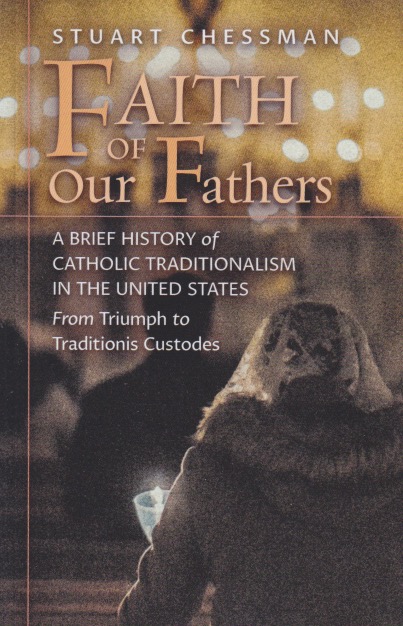
There’s a dilemma. Many thinking religious conservatives end up arguing against “secular” education and yet wish to make themselves out as rational, and reasonable. The truth is that underlying their position is the belief that the truth was revealed long ago and nothing has changed since then. They want educated individuals to agree with this so quite often they establish their own institutions to turn out “experts” who haven’t been challenged in their positions. This became clear to me yet again when reading Faith of Our Fathers by Stuart Chessman. Subtitled A Brief History of Catholic Traditionalism in the United States from Triumph to Traditionis Custodes, I was expecting a history. Instead it is more of a screed, or jeremiad, arguing that the Catholic Church is trying to destroy traditionalism. What I was looking for, I guess, was a “secular” history.
I’m interested in traditionalism. I taught, after all, for well over a decade at Nashotah House. What I learned there I also sensed in this book. There’s a certain naiveté associated with such theological thinking. (Political conservatism is much more insidious.) Small groups tend to think the larger organization has it in for them. In reality, the larger church (in both these cases) has much more pragmatic things on its collective mind. The narrow focus of traditionalists, however, interprets everything in the light of—in this case—rejecting the liturgical reforms of Vatican II. Having the mass in Latin is more important (as is clear here) than coming up with an effective way of dealing with Covid-19. Traditionalists are proud that they met more frequently during the height of the epidemic.
This kind of thinking is important to understand. For Roman Catholicism, as a hierarchical organization, the projection of unity is very important. Anyone involved in the upper levels of any administration knows that money—even for churches, especially for churches—is a major concern. Reputation influences cash flow, so reputation has to be guarded at all costs. No organization can appear to be caught up in medievalism in a capitalistic twenty-first century. I had hoped this little book would contain an actual history of the movement, looking at socio-economic, political, and religious causes and their ramifications. In other words, why people do things. Believe me, I understand the draw of traditionalism. Although it was in English my first Episcopal high mass threw me into a multi-year odyssey to a place (Nashotah House) where I learned what was really going on. It’s not all about smells and bells. Not by a long shot.
 Steve A. Wiggins