Other Worlds

There are any number of movies out there, and you find some that have evaded much comment by checking out the freebies on Amazon Prime.  That’s how I found Netherworld.  It’s not a great movie.  In fact, it’s about the opposite, but it is more southern gothic and since I’ve been watching Louisiana horror, well, why not?  It was free.  The story doesn’t make a whole lot of sense, which is a pity because the ideas seem to have some potential.  So, Cory Thornton has inherited his father’s Louisiana estate.  He didn’t know his father and the estate is run by an improbable staff of one.  (One suspects a low budget had something to do with that.  For the film, not diegetically.)  The estate abuts a brothel where one of the employees turns evildoers into birds with the help of magic.
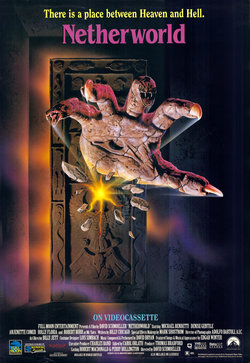
Meanwhile, the young master finds hints how to raise his estranged father from the dead, which, for some reason, he decides to do.  There are dream sequences and perhaps shades of Papageno.  Lots of birds in this film.  Cory—not very bright—only discovers late in the movie that his father was evil.  Hm, no hints of that in his admitted sexual dalliances and his desire to be resurrected.  No siree, none at all.  By the end I wasn’t surprised to learn that it was released directly to video.  But I was led down the rabbit hole by David Schmoeller, the director.  Schmoeller has received notice of such people as Stephen King, and has given the world some notable cult movies.  It’s fair to say he never made it big in Hollywood, but he worked on some films of repute, even drawing in Klaus Kinski at one point.

There are several tiers to the creative life.  There are those who attain fame, and layered down from them, those who produce movies, songs, novels—any kind of creative output—to those most of us have never heard of.  I find this profoundly hopeful.  Nobody is known to every single person on this planet.  Even the famous aren’t known by everyone.  I like to think I’m reasonably informed, but I keep on hearing about celebrities in art forms I don’t follow and have no idea who they are.  So before watching Netherworld I never paid attention to David Schmoeller, but then I learned he’d nevertheless made a career out of doing what he enjoyed, without becoming a famous director along the way.  There are some practical obstacles, of course.  Getting that first book published, or first movie distributed, but if you can get over that wall there may be a possibility of doing what you like.  It may not make you rich, but you’ll have accomplished something important.

Dangerous Dreams

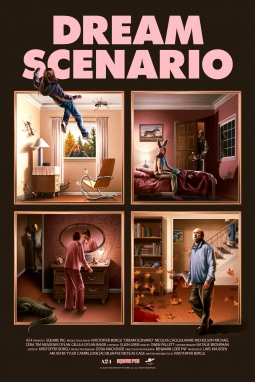
A friend wondered what I might make of Dream Scenario.  As much as I like movies I can’t keep up, what with a 9-2-5 job and writing my own books.  I’m really glad, however, that I learned about it.  It’s one of those movies with a difficult to define genre.  IMDb tags it as “comedy,” “drama,” and “fantasy.”  Rotten Tomatoes goes this route: “Comedy/ Drama/ Mystery & Thriller/ Horror.”  Is there anything this movie is not?  There are definitely some horror cues here, but it doesn’t feel especially like horror.  Except when it does.  Ari Aster, one of the producers, is associated with “art horror” films—think Hereditary.  Think Midsommar.  And it’s an A24 movie, but I’ve read that they’re moving a bit away from horror (the only kind of movie for which I know them).  So what is Dream Scenario?

In brief, it is the best I’ve seen from Nicholas Cage.  I’ve liked some of his films, but this one is incredible.  Certainly the story helps.  Paul Matthews (Cage) is an unremarkable biology professor who suddenly begins appearing in people’s dreams.  Nobody can figure out why, but when the story gets on social media he becomes famous.  Everyone loves him.  Then something happens.  The dreams become nightmares and everyone turns on him.  That summary doesn’t do justice to the film, but it’s essentially what goes on.  The telling of the tale, however, is masterful.  The nightmares, which are briefly shown, are what make this any kind of horror.  There’s no lingering over the fear.  It’s just part of Paul’s new life.

The closest I’ve come to encountering this idea is the novels by Hank Green: An Absolutely Remarkable Thing and A Beautifully Foolish Endeavor.  Of course, Green knows what fame is like—something few accomplish.  The movie explores how fickle it can be and how swiftly and viciously it can turn on those who find it.  In that regard Dream Scenario is also an exploration of life in the internet era.  It’s a time when the kids have to be asked to put down their phones for family time over a meal.  When the result of constant connection is “trauma.”  Unlike fame in the last millennium, “going viral” is just a matter of waiting until someone comes along with something that the net likes better.  And the commentary about how to merch shared dreams takes this in quite a different direction from Inception.  Dreams are strange, and remain poorly understood.  This is a movie that will make you ponder how much they are like the internet, and the results can sometimes be a nightmare.


Worthy of Note

I admit it.  I use Wikipedia quite a lot.  When I was teaching I wasn’t one of those professors who said “Don’t use Wikipedia,” but I did say that if students used it they should look up the references and make sure they were legitimate.  Wikipedia is quite an achievement—a place to go to find out about many things, but not everything.  This leads me to an observation that I hope isn’t uncharitable: there are a lot of underwhelming pages on the website.  Anyone can edit it, of course, but I see quite a few pages of academics that have no more than a short paragraph of an (often) unremarkable bio, followed by fewer books than I’ve written.  And they have an encyclopedia entry.  It makes me wonder what it takes to be noteworthy.

I know quite a few Wikipedia page subjects.  Most of them are nice people.  Their greatest accomplishment is having landed a university post—maybe that’s enough to make someone noteworthy these days.  I haven’t managed to do it.  But many have.  And most of them don’t have their own pages.  I’m a realist about things like this.  My books don’t sell enough copies for anyone beyond you, dear reader, to recognize me.  This blog hasn’t had a million hits yet (it’s halfway there, in any case) and I can’t seem to retain followers on Twitter, or X, of whatever it is this week.  But then again, I don’t expect to be on Wikipedia.  Some people that I think should be aren’t.  Popularity shouldn’t be the measure of importance.  (That works both ways.)

It used to be that I’d run across Wiki pages with a header saying that a subject didn’t seem noteworthy enough.  Sometimes such warnings were even for publishers—those of us who write need to find outside information about publishers, no matter how small.  I don’t see those warnings much any more.  I suspect Wikipedia is so large (over six-and-a-half million pages) that constant policing would be necessary.  And how would it feel to have someone put a page together for you only to discover later that you’d been removed for just being too ordinary?  That’s gotta hurt!  Everyone, it seems to me, is notable.  All people should be paid attention to.  I suppose the rank and file of all of us would clutter Wikipedia endlessly, but I still do wonder how it is that surviving in academia is enough to make a person essential to know about, beyond their faculty webpage.