Reading Unwritten

There’s a style of writing—I’m not sure what it’s called—where an author keeps revealing new, and necessary information on nearly every page.  The effect on me, as a reader, is almost as if the book is backwards; too much wasn’t revealed up front and that kept me from understanding the story as it unfolded.  I confess that the fault is mine.  I’ve always appreciated a narrative that begins with much of what you need to know and then reveals unexpected things along the way.  This unwieldy preamble is to say that I had trouble getting into the otherwise delightful fantasy The Library of the UnwrittenA. J. Hackwith is a solid writer, but since this is fantasy there’s some introduction to the unfamiliar world that readers like yours truly needs.  At least a bit more than is on offer here at first.

This is a fun book with a fun premise.  Books in Hell’s library are unwritten and restless.  If not watched, their characters come to life and the book goes missing.  The idea of the unfinished also applies to paintings and other creative endeavors.  At first I thought this was going to be like Jasper Fforde’s Tuesday Next novels (several of which are discussed on this blog; you’ll have to use the search function) but the character from a book quickly gets swallowed up in a larger story involving demons with backstories slowly revealed, as well as a librarian and a muse, also with baggage that we only see once the train has left the station.  About halfway through, the story really starts to move and becomes quite enjoyable.  I guess I need more orientation than some readers.

The novel unfolds into a potential battle between Heaven and Hell, but those aren’t the only realms in play.  There’s Earth, of course, as well as Valhalla, and some nameless realms where the gods have died out.  And it focuses on a library.  It’s this final aspect, I suspect, that leads many people to categorize this novel as an example of Dark Academia.  Indeed, that’s where I discovered the book, on a display table with that label.  Although written with a light hand, and often somewhat funny, there is a deeper meaning here, a narrative about the importance of books that faces the reality that some would rather destroy them than read them.  I’m sure there are some religious folk that would see this book as promoting satanism and darkness, but instead it emphasizes loyalty and goodness.  I’ll be pondering it a while.


Questioning Paradise

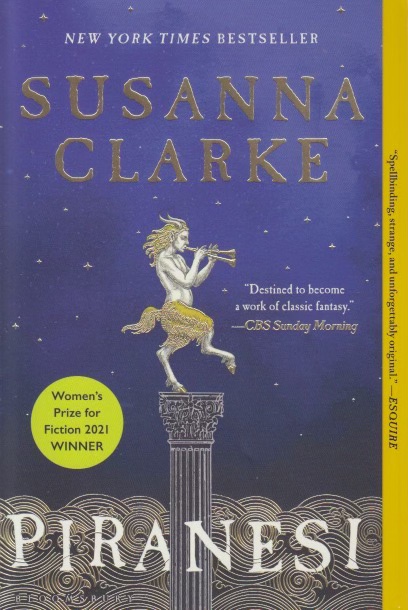
The term “dark academia” is somewhat difficult to define.  It is a rather new aesthetic, but it has been the topic of books and movies for some decades.  Among the books often considered dark academia is Susanna Clarke’s Piranesi.  Since it’s one of the shorter exemplars of the genre, I recently picked it up.  A bit disorienting at first, it is the story of a fantasy world where oceans flood the lower floors of an elaborate labyrinth in which two people live.  The narrator (or more properly epistolist) is one of the two.  We come to learn that he is actually the only full-time resident of this world.  And that this world was conjured from the world in which the rest of us live.  It takes Piranesi, the narrator, about 70 pages to realize that something isn’t quite what he’s been led to believe.

The writing is beautiful and the world-building is fine.  It would be possible to set an entire novel in this world, but, like most paradises, it wouldn’t satisfy.  Indeed, there’s almost a biblical recognition of sin and human character.  The voyage of discovery that Piranesi undergoes is both encouraging and dispiriting.  Having a world in which one’s needs are met, and where most danger can be avoided by careful observation, seems desirable.  There’s a sense of inevitability in Eden as well.  The human psyche requires challenges and exercise.  To remain in paradise would have been stultifying, if without danger.  I’m not sure if Clarke intended that in her novel, but I definitely encountered it there.

But what does this have to do with dark academia?  I asked myself that question along the way.  The creator of this world was, at one point, an academician.  Such are the kinds of people who attempt to build perfect worlds.  The darkness comes from the fact that this world is not what it seems to be.  It comes with a very high price.  Even so, it is compelling to those who find it.  Its creator is a cold and scheming individual.  Unlike some such stories, we don’t hear much of the university life that gives the genre its name, but the classical setting is much like what universities once taught.  And when they go wrong, this genre suggests itself.  I don’t want to reveal how the story ends.  It gets pretty exciting about halfway through and I had misguessed a few things along the way.  In many ways it feels like fantasy, but it also dips into the academic world gone wrong.


Nightly Entertainment

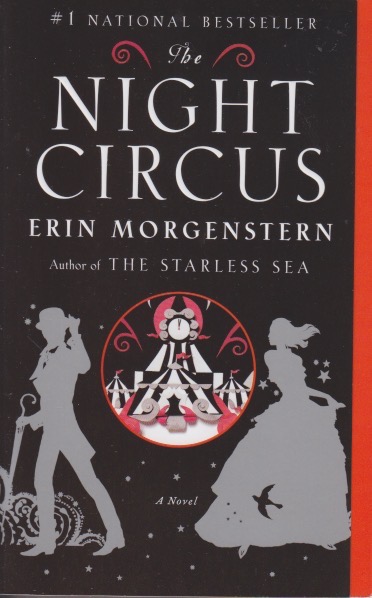
A list of most gothic recent books, I believe it was, that suggested The Night Circus by Erin Morgenstern.  It’s a big book—over 500 pages—so I decided I’d wait until autumn to get underway.  It ended up taking most of September and half of October to finish it.  Since I prefer to start fresh, I had no idea what it was about.  A night circus, of course, as the title indicates.  It is set in the late Victorian period, although I’m not sure all the turns of phrase in the book were current at that time.  There may be a few spoilers in the description, should you want to go out and read this yourself first.  I mention that because something that only becomes clear near the end is a pretty good starting place for giving an idea of what the story’s about.

A very old man (who doesn’t look or act old) is a very accomplished magician (not the stage variety).  One of his students becomes very proficient and the two begin a rivalry that involves each setting a protege against that of the other.  It is a contest, we eventually learn, to the death.  The younger magician selects a daughter he didn’t even know he had, while the original teacher selects a young man without prospects.  The battleground on which these two duel is the eponymous night circus.  Each tries to outdo the other in creativity and wonder.  The circus is open only at night (hence the name) and is fueled by actual magic.  A cast of characters gets introduced, and they’re very well drawn.  In my experience of reading the book, they drew me back in because you pretty much liked most of them and with magic involved, well, you never know.

The novel was gothic in the Victorian setting and in the sense that there is an ancient contest underway here that interrupts into the then present.  There aren’t spooky castles, however, or really even damsels in distress.  The women characters are all strong and resilient.  The writing is lively and the resolution is satisfying.  The real draw for this book is the writing and the complex story that doesn’t overwhelm or leave you feeling too lost.  It’s a magical realism with boundaries and offers a good message that magic is all around, if we only open our eyes to it.  It’s a good book to get lost in for a few weeks.  I appreciated the fact that the villains weren’t the focus and the violence was mostly implied.  It kept me turning pages, gothic or not.


Them Apples

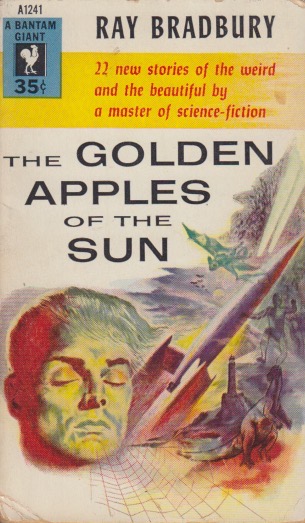
Although I’ve had this book as long as I can remember, I’d never read it.  Not the whole way through, until now.  As I kid I read Ray Bradbury when I could.  I’m sure I read a story or two in Golden Apples of the Sun, but I didn’t approach the entire collection.  I was drawn in at this late age by “The Fog Horn.”  This is the story that lay behind The Beast from 20,000 Fathoms, that classic of Harryhausen, the other Ray.  It’s been years since I’ve seen the movie, but the story was on my mind and I kept going.  Some of Bradbury ages well, while other stories, not so much.  The designation of his tales also changes over time.  As Stephen King says in Danse Macabre, Bradbury didn’t so much write science fiction (as the cover of this edition declares), even if the people occasionally get into rockets.

I realized as I read just how much my early writing style was influenced by Bradbury.  My stories were vignettes like these, not as accomplished, of course, but without lots of violence.  And with horror elements.  But it kept coming back to me how Bradbury’s characters, even the time-traveling ones, are stuck in the button-down forties and fifties.  I naturally overlooked this as a child but all these decades later and the strict binaries of, for example, men’s and women’s worlds, comes through on every page.  When women are the main characters, they’re usually not very flatteringly drawn.  The same goes for caricatures of races, although Bradbury is sympathetic he also uses stereotypes.  And many of the stories in this collection are just about everyday events, not a speculative element in sight.  Maybe I did try to read it through as a kid, but lost interest.

Writers struggle against irrelevance.  Those who look to the future sometimes get it right but often don’t.  And some reflect a present that we’d rather not acknowledge.  Of course, when I’m writing fiction I tend not to think in these terms.  The story simply takes you over and you can’t help being a refugee from the year in which you were born.  This is especially evident when Bradbury casts a rosy lens back toward childhood years.  As a child myself I had no idea that Bradbury was a time traveler from the twenties and thirties.  His childhood was nearly over by the time my mother was born.  It was a different world.  Some of his stories managed to transcend time and its for those that I keep reading him.


Empowerment

Recommended as a worthwhile contemporary gothic novel, Alix E. Harrow’s The Once and Future Witches is a feminist tour de force.  Set in a world similar, or perhaps parallel, to ours, it follows three witch sisters in 1893.  The sisters are estranged, having been raised by an abusive father, and each has found her own way to New Salem.  The old Salem had been destroyed after the witch trials.  The three find their lives drawn together, not even knowing the others are there.  But there are also still witch hunters.  None worse than Gideon Hill, the leading candidate for mayor.  I’ve long known that books written after Trump are often fairly obvious for the hatred that oozes from political leaders.  This is one such case.  The story is one of female empowerment in the face of constant male opposition.  It goes fairly quickly for a book its size.

It’s an enjoyable read but it grows, well, harrowing towards the end.  You come to like these three very different sisters and appreciate the gifts they offer to their world.  Men, however, make the rules and often they feel that women have no place in making decisions for the public good.  I’m amazed at the number of people who still believe this.  It makes novels such as this so important.  Women with power are crucial examples to present.  The three sisters may cause mayhem, but it is generally good for the city.  When men are in charge, things tend to get repressive.  Sound familiar?

Conveying the gist of a 500-page novel isn’t a simple task so I’ll simply say that this isn’t a conventional witch story.  There’s never a question that witches are good, but capable of doing bad things.  In other words, they are pretty much like all of us.  That’s not to deny that some people become evil and that such people will gain ardent, blind followers.  The characters are memorable and likable in their very humanness.  As far as genre goes, this is a magical realism novel.  As you get drawn into Harrow’s world it becomes believable.  It’s a book that should be widely read and its plea for tolerance must be heard.  I can think of other comparisons—others have also conveyed that an unquestioning religion may become evil unintentionally.  Such conversions aren’t the kind publicly discussed, but they do fit with human experience.  I’ve intentionally left out spoilers since I want to encourage readers.  It certainly has left me thoughtful.


Gods and Fans

The blog Theofantastique started a couple of years before this one.  I remember that sense of childhood wonder that flooded me when I first saw its posts about books and movies with monsters—the kinds of things l always liked to read and watch.  But it was more than that.  This particular blog presents the very tangible connection between religion and horror.  Not only horror, though.  As the title indicates, this is a place for genre fiction of three closely related kinds: science fiction, fantasy, and horror.  The three are separated by mere degrees of semantics, and all three play very near to the third rail we call religion.  In my way of thinking, horror is probably the closest of the three, but I shift among this secular trinity and often wonder in which genre I am at the moment.

For someone who grew up being taught that religion was all about history—including a history of the future, mapped, plotted, and planned just as carefully as a summer vacation—seeing the connection with genres that are all acknowledged to be fiction was, at first, a little shocking.  I’d been taught in literature classes that genre fiction wasn’t really literature at all.  “Pulps” were printed on cheap paper because, as you might again guess from the name, they weren’t worth much.  Many of those books are now collectors’ items and cost a pulp mill to purchase.  My list of books from my childhood that I’d like to recover has me looking with some worry toward my bank book.  The thing is, these are often insightful statements about religion.

Monsters were always a guilty pleasure for me.  Being small, shy, and insecure, it was easy to understand things from the monster’s point of view.  And very often religion was implicated.  Sitting in my apartment in New Jersey, at times unemployed, I began to explore the connection between religion and horror.  I thought I was the only one.  Eventually I discovered kindred souls, and soon came to understand that monsters are perhaps the purest representations of what religion can do.  Even after writing two books about this subject, Theofantastique is a place unlike any other I know.  It has far more readers than I ever will, but this isn’t Godzilla v. Mothra.  No, we’re all in this together.  And we’re gathered together for one purpose.  In any other circumstances you’d say it was religious.


Reptile Fantasy

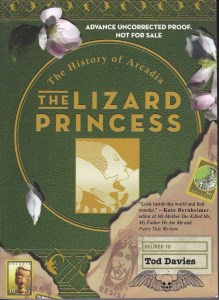
LizardPrincessThe generous folks at Exterminating Angel Press graciously sent me a copy of Tod Davies’ The Lizard Princess to review. A fantasy novel that includes a conflict between a world that admits of the supernatural and skeptics who deny anything beyond the material, it is a tale for our time. Indeed, the antagonism is real enough. We live in a world where fantasy can bring in untold wealth while we are taught that not an atom of it is true. Clearly material explanations fit the physical world we inhabit. It’s the world inside our heads that often rejects such materialism being taken to its “logical” conclusion. Davies clearly feels the angst of this discord. The Lizard Princess is a fantasy in the face of harsh reality. And we still need fantasy—perhaps we need it more than ever.

Throughout The Lizard Princess, whether intentional or not, biblical imagery pervades. The Bible offers classical stories that, no matter how we might receive them, continue to influence our ideas and ideals. Here, in a world created especially for the reader, the battle between good and evil is an everyday reality. The turns taken along this path are unconventional, and at times even uncomfortable. The awareness that there is a larger story in the background, however, offers some consolation. Angels, the Devil, and even a subtly veiled God are all players in this fantasy world of Arcadia. Mythical creatures abound, and transformations lead to new perspectives along the way.

In my conversations with other scholars I’m reminded that academics don’t often turn to novels for escape. Some do, of course, but the academy recommends a steady diet of technical non-fiction for those who wish to make an impact upon the world of knowledge. I have always been grateful for literature, however. During my years in graduate school and early in my teaching career I neglected the kinds of books that were my constant companions growing up. In a rural setting far removed from any institutions of higher learning, novels were often the only reading readily available. I never considered the time between their covers wasted. I found in The Lizard Princess a vivid world strangely like our own, but different enough to be more a parable than a simple piece of fiction.


The Illustrative Man

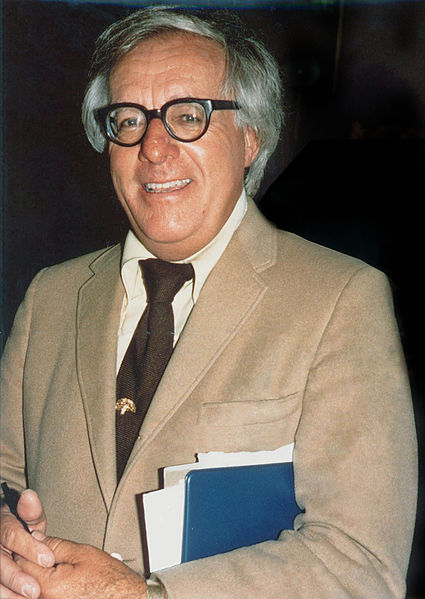
To a young boy growing up in an economically depressed small town without money to buy fancy things, escapist reading is a natural hobby. As with many boys, science fiction held my undying attention. My favorite writer was Ray Bradbury. His stories were short enough to consume in a single sitting, and they were full of wonder, and imagination, and possibility. I had nearly all of his books. So today, when I learned that Ray Bradbury had died, it felt as if another author’s works had been burned and the great man himself simply disappeared. Along with Edgar Allan Poe—whom I discovered early—and H. P. Lovecraft—whom I discovered late—Ray Bradbury represented what I believed a short story should be. I began writing short stories when I was in grade school. I still have a few of them, and the influence of Bradbury is most profound. At times it feels like the world is running out of dreamers.

Instead of churning out young people eager to explore the possibilities—and even the impossibilities—of the world, our educational system has become much more prosaic. We teach our young how to find jobs. Walking across Manhattan in a weary mood one morning it occurred to me: we go to college and we receive specialized training to make us fit for more cerebral jobs. We work those jobs in order to make corporate executives wealthier. Work benefits the one-percenters most. All the way to the office I dream of a life where I might have pursued creativity and exploration. I still awake before 4 a.m. every day to scrape together a few fragments of a moment to write before heading off to work in the big city. The characters I invent live in my head and die a subtle death as email and book proposals force their bossy way into my consciousness.

The worlds Ray Bradbury imagined were places where the familiar and the strange easily mixed. Many of his tales would be categorized as fantasy rather than science fiction today, but they manage to instill an almost religious reverence among those who believe paradise might be just over on that next unexplored planet. Or perhaps it will never stop raining there and the universe will drive us mad. When I “grew up” and needed to liquidate my juvenile assets, I sold most of my Ray Bradbury books to a used book dealer. Rarely a day passes when I don’t regret that impetuous move. And some days, such as today, I feel it especially deeply. One commodity that our fumbling world simply can’t afford to lose is its dreamers. On an unexplored planet somewhere out there, I know Ray Bradbury agrees with me.

From Wiki Commons


Towing Jehovah

Back before my blogging days began, one of my relatives was reading a book entitled Towing Jehovah by James Morrow. Given my field of study, I was intrigued by the title, made a note of it, and got on with my life. I was reminded of the story when reading a book on religion in popular culture, so it seemed the time was right to pick it up and see what it was about. First of all, it is a work of fiction, so nobody should get too upset. The premise is that God has died and his corporeal body has to be given a proper burial. Since the corpse is huge and since it has fallen into the ocean, a washed-up oil tanker captain is selected by the angels, who are dying out of empathy, to tow the body to its final resting place. Herein lies the tale.

The book won a World Fantasy Award, and is generally an engaging story. Any lifelong student of religion will naturally find bits to quibble with, but the fantasy author’s heart wants what the fantasy author’s heart wants. The question the book raised in my mind was whether it really said much about religion at all. Sure, there are several great one-liners and quirky observations about how the established religions might react to the death of God, but the book itself intimates that humanity does fine without a God, but it required a God to get it started. It is the story of humankind growing up. When I finished the book, however, I was left with the impression that religion is developed here in spite of God.

God, being dead, is a strangely silent character in the book. Western religions have taught us to suppose God is active, and very vocal. Just tune in any televangelist. In Towing Jehovah, God has become an idol, a prime mover that became the main event. It is a provocative yet somehow respectful treatment of God as an idea. James Morrow is often categorized as a secular humanist, yet his book tows God into the consciousness of a world that already largely ignores the divine. In this sense it remains a paradox. No matter what people say, God just doesn’t go away. The reader, cast adrift, like the corpus dei in the novel, keeps bumping back into God. The concept, once born, will live as long as human consciousness survives.


Eager for Eden

In a recent email from the Clergy Letter Project, Michael Zimmerman reports that the movie Creation is shortly scheduled to be released in the United States. To quote from the Project newsletter:

“You may have heard that the film, Creation, about Charles Darwin and his struggle with his faith after his daughter, Annie, died had trouble finding a US distributor because it was seen as being too controversial for the American public, particularly after being attacked on Movieguide.org, an influential site which reviews films from a supposedly ‘Christian perspective’.”

It is disturbing that a non-fiction film has been blocked from American viewers because distributors found the content too controversial. The controversy has nothing to do with sex or violence, but an assault on the fantasy of a literal interpretation of Genesis. Disturbing fact challenges comfortable fantasy.

In a related story, an article on CNN.com explores the sense of depression that several viewers of Avatar felt after the movie ended. While the reasons are deep and complex, the overall theme seems to be that these viewers can’t shake the image of a pristine world that seemed so real for two-and-a-half hours. They long for a paradise that doesn’t exist. A paradise that has never existed. I am not unsympathetic. Although I could not view the film, I left from the theater with a similar, if less intense, feeling. It is a similar emotion to that when a truly special event takes place and the mind plays it over and over like a new and significant song. Impressions and hazy images and euphoria wash over you, and a longing for a moment that can never be recaptured consumes your consciousness. These are some of the most bittersweet moments of life. They are the very heartbeat of fantasy.

There never was an Eden. Human existence has been brutal and harsh since we first stood upright and wondered why we could think. America is a nation in deep denial about this harsh reality. We would rather believe the biblical Eden is a literal paradise and that our aching imaginations are somehow giving us glimpses of a fabled utopia where life was perfect. Well, almost perfect. The movie Avatar presents a paradigm that many Americans can relate to: an electronic world of endless possibilities shielding us from the stark realities of illness, pollution, tragedy, and death. We are insulated in our surreal environment that we have created for ourselves.

The human capacity for wonder is perhaps the greatest asset that consciousness has deigned to bequeath us. We can imagine a world where all creatures live in harmony with their environment and love and peace flourish. But that is not our world. A good corrective to these tempting fantasies is to read some good old classic Greek tragedies. These imaginative explorations of the human condition are as true to life as dreams of utopian worlds are removed from it. It is all a matter of perspective. And the Greeks were writing B.C.E. — Before the Computer Era — when reality had not been hidden behind a haze of ephemeral electrons.