Prayer before Meals

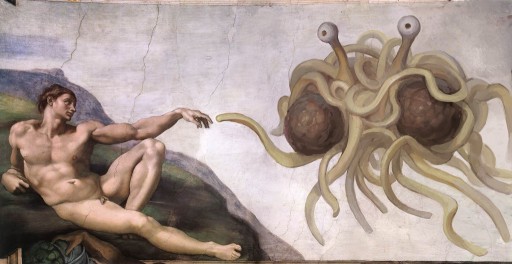
It was in Wisconsin. Oshkosh. I was teaching for a year in a replacement position, and my roster of classes at the university covered several aspects of religious studies. During the course of prepping a course, I first saw it. The Flying Spaghetti Monster. It was only a virtual Flying Spaghetti Monster sighting, but since Creationism was much in the news in those days, I boiled with curiosity. By now it would probably be a strain to explain the whole thing, since everyone knows about his noodly appendages and predilection for pirates. The short story is that the Flying Spaghetti Monster was an invented deity to demonstrate the ridiculousness of trying to get Creationism taught as science in public schools. For those who believed in other gods, such as the FSM, there should be equal time in the classroom, the argument went. Since that time Pastafarianism has taken on the semblance of a real religion with “believers” earning the right to have driver’s license photos taken with colanders on their heads, and even a book of scriptures being written.

An Associated Press story from Sunday’s paper tells of the world’s first known Pastafarian wedding. Bylined Akaroa, New Zealand, the blurb indicates that the Oceanic nation down under has decided that Pastafarians can officiate at weddings, and a couple was married with al dente accoutrements. The Church of the Flying Spaghetti Monster, it seems, is going the way of the somewhat more serious Jediism and Avatar religions in that people are deliberately electing fiction as their faith. Interestingly, this may not be a new phenomenon. We are told, for example, that Zarathustra deliberately outlined a new religion—one that may end up having had the greatest impact on humanity of all time, if roots are considered. In those days the strict division between fiction and fact may not have been a mental filter yet discovered. The “it really happened” test of religious veracity was still some distance in the future. Metaphor meant something then.

IMG_2753

The internet, it seems likely, has facilitated and accelerated the appearance of new religions. As with most things, the real issue comes down to money and power; if a government recognizes a New Religious Movement as legitimate, it may be granted tax exempt status. And how can it be proven that someone really does or does not believe what s/he says s/he does? If you’ve got a box of Barilla on your pantry shelf, who’s to say? It’s a short distance from that colander in the cupboard to the top of one’s head. And who doesn’t like pirates? And who’s to say that under that rotelle moon in a stelline-studded sky someone hasn’t indeed kissed their hand and swore the ultimate starchy allegiance? Keep watching the skies!


UCB

The Flying Spaghetti Monster came onto my radar while teaching at the University of Wisconsin, Oshkosh. I was teaching a course entitled The Bible and Current Events and the controversy over teaching Intelligent Design had been gaining steam. As I addressed the evolution section of the course, I became aware of the Flying Spaghetti Monster and his noodly appendages. The Jesus fish had recently evolved to a Darwin fish, and the Darwin fish was being eaten by a Jesus shark, then I finally saw the Flying Spaghetti Monster on somebody’s bumper. I looked it up online and discovered a whole mythology had been developed to go with this parody of a religion. It was lighthearted and funny and had an obvious purpose—to challenge the equally bogus claims that creationism is science. Now, I don’t try to change anyone’s religion. If someone finds creationism comforting, well, the United States is based on freedom of religion and who am I to dictate what someone else believes? The problem is creationists often don’t share that courtesy and try to get their religion taught in public schools as science, which it isn’t. The Flying Spaghetti Monster was their nemesis.

Over the weekend, when I actually have time to do a little surfing, I came across the United Church of Bacon. Noticing the similar food-based theme as the Flying Spaghetti Monster, I decided to check it out. It seems to have become a cottage (cheese?) industry to start your own anti-religion. A look at the United Church of Bacon’s website reveals it to be the brainchild of Penn Jillette of Penn and Teller, and friends. As usual, the voice of Teller is not heard. This is a legal church which performs many of the services of traditional religions, but without the belief. Bacon, it seems, is the ultimate reality here—to quote the church on a billboard: “Because bacon is real.” They have nine bacon commandments and an impressive list of charitable works.

Looking over all of this material, I wonder what the mainstream churches might take away from all of it. For one thing, the obsession that Christian denominations have had for centuries with correct belief has become a kind of albatross. Petty differences in theology tend to lead to hatred in the name of the prince of peace. Another is the repeated emphasis on giving has taken its toll. The United Church of Bacon openly advertises that they give money, they don’t take it. While few clergy become fantastically wealthy, it is no surprise that most bishops or those of equal rank never seem to go hungry or drive cheap cars. If entertainers are rich, it is because they offer something worth paying for. And for those of us who are vegetarians, the UCB offers the alternative of praising vegetarian bacon. You are, after all, what you believe.

Heretic?

Heretic?


Religion Al Dente

I first learned of the Flying Spaghetti Monster while teaching a course on the Bible and Current Events a number of years ago at the University of Wisconsin Oshkosh. Being freed from the confines of my humorless seminary teaching post, I was free to explore innovative ways to approach my subject matter. When discussing evolution, it was helpful to bring in Pastafarianism as an example of how some highly intelligent—and very creative—people deal with the ridiculousness of Creationism. Lest I be accused of unfairness here, Pastafarianism is also ridiculous. That is precisely the point. The Church of the Flying Spaghetti Monster (FSM) was formed to demonstrate that any inane idea might pass as a religion and should be given equal time with those who use ultra-conservative views on the Bible to effect public policy.

A friend sent me a link to a BBC story of an Austrian man who has finally been successful in his attempt to wear a pasta-strainer on his head in his driver’s license photo. Claiming the headgear to be demanded by the Flying Spaghetti Monster, Niko Alm wished to have his official ID photo taken with the symbol of his faith. I sense an evolution taking place here. The Church of FSM has gone mainstream in many respects; there is a Bible available, you can buy a bumper-magnet to rival a Jesus fish, adherents have designed a slick website, and it boasts many, many followers. While the website of the Church of FSM defiantly refuses to be taken seriously, it makes legitimate claims—religions do not require literal belief, and therefore Pastafarianism is a true religion with believers not being held to any particular doctrine.

The outcry against the FSM movement (which began roughly early in the new millennium) demonstrates its effectiveness. Are there really people who believe this religion? A tour of the website should be proof enough. The claims made by the group have analogues in traditional religion; many major religions teach events and doctrines that are equally unbelievable in the confines of the physical world in which we find ourselves. It is difficult to believe that Niko Alm actually takes this seriously, but who are we to judge? The FSM has moved from making fun of Intelligent Design to casting the very definition of religious belief into sharp relief. Who’s to say we haven’t all been touched by his noodly appendage?

Touched by his Noodly Appendage


Stranger Tides

Yo, ho, ho and a plate of spaghetti

The closest I’ve come to appreciating pirates is the command of the Flying Spaghetti Monster that its devotees must wear pirate costumes. Nevertheless, being only human, I was curious about the fourth installment of Disney’s Pirates of the Caribbean series although the old storyline had mercifully died out. This weekend my family joined a handful of others still showing interest and went to watch Captain Jack Sparrow’s antics on the silver screen. Perhaps it was because this movie actually followed, loosely, an actual book instead of a theme-park phantasmagoric pastiche, but I found the movie surpassed my expectations. I’m discussing it here because of the heavy dose of religious concepts brought into the story by the inclusion of a missionary.

In typical Pirates fashion, the character introductions are unconventional, and so it is with Philip, the missionary. Tied to a mast on Blackbeard’s ship as a kind of human talisman, the poor man is cut down by Sparrow and a crewman during a mutiny. The crewman declares to Philip, “You are either for us or against us!” to which the missionary replies, “I am neither with you, nor am I against you!” The crewman asks Sparrow if that is possible, to which Captain Jack replies, “He’s religious, I believe it’s required.” This was possibly the funniest line in the movie, but it was so because of the underlying truth. The sarcasm here is directed at a representative of a church that will ultimately lead to the destruction of eternal life. Granted, the agents of that destruction are Catholic, presumably.

Once the fountain of youth is discovered and Blackbeard and Barbossa engage in their swordplay, Spanish troops arrive and promptly destroy the pagan fountain declaring that the church (presumably Catholic) is the only means to eternal life. The Protestant missionary, meanwhile, in an act of self-sacrifice returns to free a misunderstood mermaid. (This is Disney, after all.) The dialogue is difficult to remember from a single viewing, but the addition of religious elements beyond the supernatural lent a gravitas to this final Pirate film that the others lacked. Even placed among the fantastic, the religious elements grounded it in a reality where faith, sacrifice, and fortitude became intrinsic to the story. I doubt I’ll head off to the Spanish Main any time soon, but I appreciate movies that offer a bit of substance along with their entertainment on that transatlantic crossing.