Not Plan 9

Dementia 13 is a strange little movie.  It’s Francis Ford Coppola’s directorial debut, and it was produced by Roger Corman and released by American International Pictures.  Like many Corman/AIP movies, it was low budget and quick.  It seems that Corman had some money left over in the budget from a previous movie and he offered Coppola the opportunity to direct a film shot quickly and funded by the leftover funds.  With a script written in three days (and it shows), he set out to film what was intended to be a Psycho knock-off.  The title might give that away, although I’m not sure what the 13 has to do with it, other than being “unlucky.”  Shot in Ireland with mostly American actors, the film is suitably gothic, but the original start to the movie is a red herring.  So what’s it about?

A rich heiress has never recovered from the death of her young daughter, who drowned in the rather sizable pond on the estate.  One of her three sons dies early in the film, setting up a subplot that goes nowhere.  The two remaining sons, unaware of their brother’s death, keep the ritual of the annual acting out the sister’s funeral.  While the widow of the deceased son tries to work her way into the will, she is axe-murdered, bringing this into the horror genre.  The family doctor suspects something’s wrong (although viewers are led to suspect him), and finally solves the crime after another bit character is beheaded.  Part of the problem is the film is too brief to develop the ideas properly.  Released at only 80 minutes, with a 5-minute gimmicky prologue, you really don’t have time to absorb the psychology of the characters.

The influence of Psycho is pretty obvious, the wet woman slowly chopped to death while in the water, is the scariest scene in the movie.  It’s shot in such a way that it’s not obvious that she’s actually being struck until the end of the act (a budget thing, I suspect).  The wealthy widow drops out of the story as the family doctor becomes the self-appointed detective.  Of course, the previous deaths have been undetected, so no actual police come.  In sum, creepy (but not too creepy) Irish castle, siblings working at cross-purposes, a scheming daughter-in-law, and the irruption of the past into the present, along with the black-and-white filming, ofter a quick gothic thrill.  Otherwise, it seems more like homework than an example of foundational horror, but still, it has had inspired a remake, and that’s saying something for a three-day script.
Christian Underworld

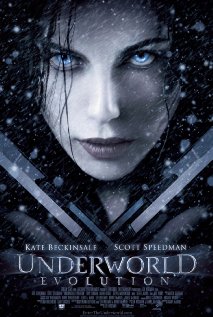
For constructing a mythology teeming with monsters, I must doff my metaphorical hat to the Underworld series of movies. Unrelentingly Gothic and stylish, I’ve watched the first two installments a number of times, but I have yet to see the last two (the latter of which is still currently in theaters). I have to admit that seeing Kate Beckinsale in her werewolf hunting gear two stories tall on midtown electronic billboards is some enticement to catch up with the story. Over the weekend I rewatched Underworld Evolution, number two in the set, to refresh my mind of the story. Quite apart from the implicit religiosity of vampires, the Underworld movies, while eschewing crucifixes and religious origins for vampires (which Bram Stoker’s Dracula by Francis Ford Coppola narrates to an explicit extent), nevertheless partake of the power of religion amid all the shootouts and weird transformations.

In Underworld Evolution, Marcus, the son of the original vampire, in a scene straight from Christian mythology, has the devil rebelling against his creator. As he is killing his powerful yet ineffectual father, Marcus predicts the beginning of a “new race created in the image of their maker—their new god. Me.” As he says this he has his own creator impaled on a demonic bat wing. Running him through with a sword he states, “And the true god has no father.” I admit I’ve been trying to read some post modern treatments of monsters, and this kind of reversal fits well with the conflicted outlook of the twenty-first century. Who is god? The good or the evil? The old certainties have grown gray and blurry. No wonder some people are uncomfortable.

Perhaps the most religious element in the film, however, is blood-memory. Blood is a cheap commodity in horror films, but it represents, in the Abrahamic traditions, life. In the Christian sense drinking communion wine is to consume the blood of Jesus, or at least to remember his death (the fancy word is anamnesis). Vampires, in Underworld Evolution, remember the lives of those whose blood they drink. The taking of life has a sacramental quality to it here. To a world less immersed in a Christian worldview, this concept might seem more macabre than it already is. Monsters often take their cues from the gods. So on a February weekend some of this feels terribly familiar. It may be a small underworld after all.


Mournful Metaphor

Sometimes the concept is great but the results disappoint. Those who have followed this blog know that a unifying concept over the past half-year has been the often hidden relationship between religion and monsters. Certainly this fascination has its roots in my refusal to admit that I’ve grown up, but with the popular media pushing the undead into our collective consciousness on a daily basis I feel a happy vindication. I posted last week about Seth Grahame-Smith’s new book, Abraham Lincoln: Vampire Hunter. Well, now that I’ve finished the book I would say that the jarring concept of our most honored president leading a secret life was fun to wrestle with, but the book failed to win me.

Lincoln’s great contribution to our nation is still echoing through a society slow to admit the equality of all. Perhaps that fact alone would render any book trying to throw some comic relief on a deadly serious issue mute before it even begins to spin its yarn. That, and I didn’t like the portrayal of the vampires. I’m no undead purist, and I’m aware that vampires have changed form and character over the centuries, but having masses of them in one place felt like being the proverbial cat-shepherd. Giving them political ambitions, with a nod to Francis Ford Coppola’s Bram Stoker’s Dracula, was too much. The issue of slavery, clearly the metaphor being utilized by Grahame-Smith, is hard to smile about. Lincoln’s personal suffering is difficult to lighten with his career as a vampire hunter. The story just didn’t work.

I’ve had enough bumps in my own life to eschew easy categorization. Even my current career must be listed in the TBD category. Nevertheless, I wasn’t sure if what I was reading was a serious attempt at a novel or a humorous exploration of a funny idea. I found the book catalogued in humor, but its narrative seems to have the earnestness of a determined novelist. When the story ended I felt as if I’d read a dime-store novel I’d purchased at Comedy Central. And with the headlines the way they are these days, I’d been hoping for a good laugh. Instead it seems that I have been bitten by a vampire wearing shades.

Two heroes, no smiles