Cain’s Dilemma

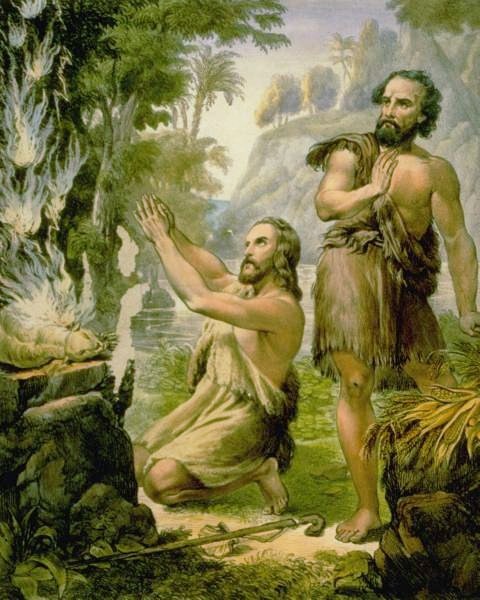
As I tweet the Bible into cyberspace, Cain strikes me as a most misunderstood character. Mercilessly portrayed as an ungrateful boor, the first vegetable farmer in folklore is demonized as the father of all sinners. Genesis, however, is impossibly vague on Cain’s crime. A close reading of Genesis 4 indicates that Cain was the first human being to offer a sacrifice to a higher power. Being a tiller of the soil, that sacrifice was of the fibrous kind, bereft of any fat or blood. The divine nose (metaphorically) is turned up at this attempt at pacification. In steps Abel with his bloody slaughter of animals and God is well pleased. Traditionally, Christian readers have attributed Cain’s evil intent toward Abel as jealousy. Genesis doesn’t seem to bear this out. “But unto Cain and to his offering he [the Lord] had not respect.” Cain was not jealous, but “wroth.”

Much later in time Paul of Tarsus will tell fledgling Christians that God is “no respecter of persons.” Still, in that first moment of divine favoritism, prior to any explicit instruction being given, we catch a glimpse of the future of this nascent religious movement. Even today, the literalists tell us, God expects something from us. What, exactly, differs from interpreter to interpreter. Cain’s crime was simply being human. Even more poignant in this case is the fact that the divine allowance for consuming meat has not yet been made. Abel raises animals for God’s appetite while Cain raises vegetables for human consumption. No sentient being is harmed in Cain’s offering. Abel, one might say, is the first killer in human history.

We all know the story. Cain will rise up against his brother and slay him. He will then receive a prototype of the mark of the beast and scamper off to rustle up a wife somehow. All this before the third natural born human being, Seth, is even conceived. Beowulf will reflect Cain’s dilemma centuries later, as Grendel is the spawn of the first murderer. The descendents of Cain are routinely demonized while the children of Seth repeat the cycle of divine favoritism over again. Here is Cain’s problem: God will like whom God will like. The rest cannot earn divine favor. The bloody consequences of this reading of history continue to play themselves out even today. Those who need divine approbation will go to any lengths to feel special, while all of us, the true heirs of Cain, have to work it out as best we can under silent skies.
Paradise by Half

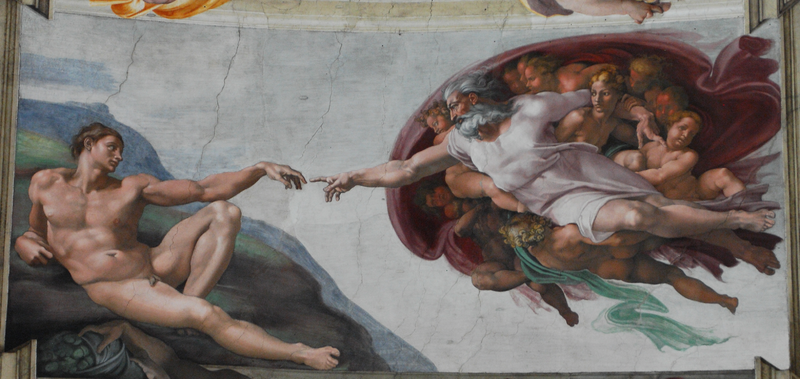
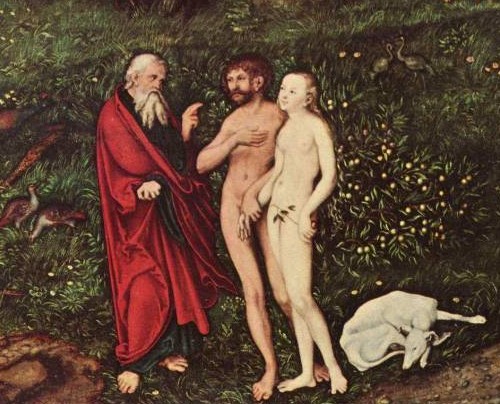
Some times the Bible is best taken in small doses. I’m no technical guru, but I do know that Twitter doesn’t always display the Bible bits I type in daily. Perhaps in some far distant future civilization that has learned how to recover “data” from fried pieces of digital storage devices, the Bible will be woefully incomplete. Maybe not woefully, depending on whose point of view sees it. Reading over passages worn smooth by timeless repetition, it is sometimes difficult to notice the harsh undertones. My twittering is up to Genesis 3 now, the infamous Garden of Eden episode. Over the last few days I’ve tweeted, “And the Lord God called unto Adam and said unto him, Where art thou? And he said, I heard thy voice in the garden, and I was afraid, because I was naked; and I hid myself. And he said, Who told thee that thou wast naked? Hast thou eaten of the tree, whereof I commanded thee that thou shouldest not eat? And the man said, The woman whom thou gavest to be with me, she gave me of the tree, and I did eat. And the Lord God said unto the woman, What is this that thou hast done?”

The weary “blame it on the woman” trope aside, several things stand out. God seems to be interested only in Adam. Perhaps the divine Dad wants to take his boy aside for a man-to-man chat, but it seems more likely in the context that Eve is simply irrelevant. Even Adam’s response is completely void of Eve, “I heard,” “I was afraid,” “I hid.” For a man about to shove the blame off onto his significant other (sorry, Tea Partiers, nowhere does Genesis say Adam and Eve were ever married), he is strangely circumspect about his recondite female. Even God sounds surprised, “Who told thee that thou wast naked?” Hmmm, who else is there in the Garden? Adam suddenly abandons the first person singular and begins his response with, “The woman whom thou gavest…” Blame anyone but Adam. The tragic disappearance of Eve until blame is to be attributed should warn us that the remainder of the Bible will not be a happy book.

The first chapters of Genesis have a lot of uncovering going on. God, like a detective in a CSI drama, tries to uncover the mystery of the naked man. When man is found naked he blames the woman, not even bothering with her name. Much is revealed here. Coming as it does as the first biblical story of human interaction, this tale sets the stage for all subsequent developments. From this point onward, with rare exceptions, the story will be a male narrative. Women will be assigned to, literally, support roles. Is it any wonder that women gather to protest against women’s rights, when under the thumb of such teaching? I suggest that what is required is even more uncovering. If we examine the bare facts of the Bible, we might be able finally to get to the root of this problem. That root lies deep in the literal interpretation of mythology.

Who's missing?


The Afterthought

This week I finished Genesis 2 on my venture to tweet the Bible, and even before reaching the famous snake scene in Genesis 3, I blushed. Not in a good way. Reading each word of the text in King James English (ironically, technically Elizabethan English), it becomes clear just how androcentric the text is. As a reader with sensitivity to historical eras, it is important not to judge the past by present standards. Nevertheless, it is difficult not to be offended at the assumed male primacy that had begun to be dismantled, only to be propped up again by sacred writ. As soon as people began to realize that sexual dimorphism did not equate to sexual dominance, the Bible came into the hands of the laity and there, beginning in Genesis 2, became the prooftext that women were made for men. Note: “for Adam there was not found an help meet for him. And the Lord God caused a deep sleep to fall upon Adam, and he slept: and he took one of his ribs, and closed up the flesh instead thereof; And the rib, which the Lord God had taken from man, made he a woman, and brought her unto the man. And Adam said, This is now bone of my bones, and flesh of my flesh: she shall be called Woman, because she was taken out of Man.”

One of these things is not like the others...

This passage is, of course, very familiar. Too familiar. Accompanying the ready availability of the Bible was the concept of divine writing. To a society of chamber pots and horse manure in the streets, the idea that God could write a book was sensible enough. The problem is, as our sophistication grew, our biblical sense couldn’t keep pace. Centuries later with probes soaring beyond our solar system, rovers on the moon, and space stations circling the planet, we still believe God wrote a book. And since God is male, the man’s point of view is normative. Of course, no one knows the reason for the story of Adam’s rib, but there is no doubt that ancient society, at least in this instance, was hopelessly patriarchal. It is society that determined which words would be considered sacred. The tale they chose matched their worldview.

The problem is that worldview gave an excuse to a patriarchal tour de force that has lasted for dozens of generations leaving women in their biblically predetermined place. There may be no sin as insidious as literalism. Those who cling to the King James do so only with special pleading, for anyone who has studied Hebrew (or any foreign language) knows that translation is an inexact science. Even Genesis 1 with man and woman created the same day, both in the image of God, still lists man first. Ironically the literalists miss the humor of a God who thinks man will be satisfied with the animals. Presumably all the animals were guys at this point, although the Bible literally doesn’t say. No religion that claims victims has the right to declare itself universally true.


Walking Monsters

It was a moment of weakness, or at least tawdry cheapness, that made me watch The Monster Walks. Just the day before the Cable Vision guy had stopped by, detailing how much money we could save by switching. We haven’t had television service since 2004, and even then it was only with a cheap aerial. Back in the days of Borders, I sometimes caved in and purchased the “Classic Features” movie boxes with 50 B, C, or D movies for what seemed a steal at less then 25 dollars. Maybe five or six of the movies from each set were actually worth the time spent watching them, but many of them proved an education. So it was with The Monster Walks.

Now, I readily confess to having a weakness for B movies. Made by people who were really trying, but who seemed to lack talent, I often identify with their efforts. So when I popped The Monster Walks into my DVD player, I had no idea what I might learn. The first revelation occurred in the opening credits where a character named “Exodus” was introduced. Since this was 1932, the character had to be African American. And comic relief. To spare you the pain of watching the movie, the plot is rather simple: rich man dies, helpless daughter inherits all to the chagrin of surviving brother and domestics, who plot to kill her by pretending to be a murderous ape. There also happens to be a murderous ape locked in the cellar. You get the picture. Aptly named Exodus is purely there as a foil for the educated, privileged white family. He was played by the talented but underappreciated Willie Best. As might (nay, should) be predicted, the scheme of killing the girl backfires and the ape kills the killer. Okay, so I can confess an hour wasted and get on with my reading. But the final scene arrested me.

Exodus wonders to the lawyer (who is there to read the will) why the rich man even had an ape. The lawyer, metaphorically transformed into a judgmental William Jennings Bryan, states that it was because he believed in Darwin’s theory of evolution. Exodus responds by noting some family resemblance to the ape. The blatant racism was hard to take, but in Black History Month the painfully obvious collective sins of our society should be laid bare. In 1932 Fundamentalism, often implicitly allied with racist causes, castigated Darwin’s theory for bringing all of humanity down to the same level. As long as a white god is creating the universe, the Anglo-Saxon can claim superiority. Never mind that Genesis was written by a Jewish writer living in Asia. Self-righteousness comes in many forms, but it always involves bringing others down to a rung below where the blessed stand. Has not the great Rick Santorum told us that even the Crusades were merely misunderstood?


Hic Sunt Dracones

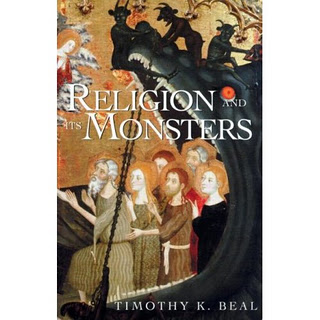
Even a visionary like Thomas Edison can’t know the directions in which an invention might be taken. The idea of the moving picture has immersed human beings in an alternate reality that is sometimes difficult to separate from the physical world we daily inhabit. As soon as movies were invented, producers and directors began to explore the depths of fear with the monster movie. What they were really exploring was the mystery of religion. I frequently write of the nexus of religion and the monstrous, and Timothy K. Beal wrote a book on that subject a decade ago in which I found another affirmation of my suspicion. Forthrightly titled Religion and its Monsters (Routledge, 2002), Beal’s playful yet serious exploration of the scary traces the origins of monsters to Genesis, and even earlier. Taking on Leviathan, the biblical sea serpent, Beal demonstrates the pre-biblical pedigree of this fierce monster and shows that, like most truly frightening entities, it began as a god. Indeed, what we call religion today grew up around fear of those forces beyond our control, a nature so harsh it could be none other than divine. The writers of the Bible clearly knew this story as Beal traces it from Genesis to Job, from Psalms to Jonah, from Leviathan to Devil.

In a shot/reverse shot formation, Beal takes us to modern-day monsters and shows their religious origins. Those things that frighten us on the big screen crawl there from their origins in the temples, shrines, and chapels of religions that don’t manage to subdue evil completely. The claims are made that the gods are stronger than the chaos that surrounds us, but they are still fighting nevertheless. From Dracula to Godzilla, the monsters have the gods on the run. And when the human protagonists finally get their monster pinned down, they discover that it is often God wearing a mask. Our monsters are gods gone bad. How else could they revive from the dead at the end of the reel? They never truly disappear. And if they do, there’s always more where they came from. The reason, Beal concludes, is that we are, in fact, the monsters.

According to the analysis of W. Scott Poole, Timothy Beal, like myself, falls into the “monster kid” generation. As I grew up, I quickly learned that to confess my interest in monsters was to risk the labels of juvenile, naïve, and immature. Grown ups are interested in money and sex and power. Only kids have any interest in dinosaurs, mythology, and monsters. An epiphany of sorts, however, seems to be unfolding. Scholars of religion in my generation are peeling back the rubber masks of our movie monsters and are discovering the face of the divine. Perhaps we are all adolescents at heart, fixated on the weird and bizarre because the paths to money, power, and temptations of the flesh are blocked to us. Or perhaps we are the Magellans charting a course for regions off the map. It is those regions, as Beal reminds us, that are illustrated with sea serpents and inscribed hic sunt dracones, “here be dragons.” Doubt it? Read your Bible and find out for yourself.


Legislating Reality

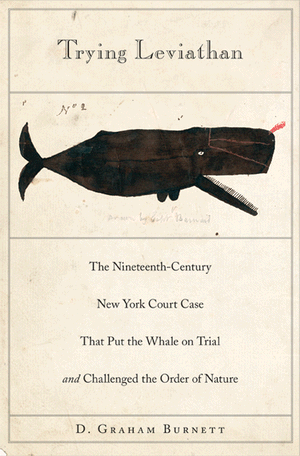
The follies that plague humankind come in an almost cyclical form. As old Ecclesiastes wrote, “there is nothing new under the sun.” I just finished D. Graham Burnett’s Trying Leviathan: The Nineteen-Century New York Court Case That Put the Whale on Trial and Challenged the Order of Nature. Other than the fact that the subtitle accounts for a good portion of the book, this account shows just how little we’ve progressed. At the heart of the book is Maurice v. Judd, a New York case of 1818 in which a whale merchant contested an assessor’s fee on “fish oil” by claiming a whale was not a fish. In “trial of the century” style, star witnesses were called in, bringing science to the docket. It was known, even in these pre-Origin of Species days, that a whale was a mammal, but what soon became clear as Burnett laid out the facts of the case was that the Bible held sway. Genesis divides the classes of nature into beasts, birds, and fish. This simplistic taxonomy was held by many in the nineteenth century to be a sacred statement of fact. If whales lived in the water, they were fish. The fact that they nurse their young, who are born live, and that they share the skeletal template of land creatures and have warm blood, and breathe through lungs, simply did not matter. If Genesis says fish, fish it is.

My mind immediately jumped ahead just over a century to the Scopes Trial. Once again, science was bent over the knee of Genesis and poised for a paddlin’. And the challenges still have not stopped. Call it Intelligent Design, or Answers in Genesis—anything but mythology—and it will keep coming back for more. Already, in 1818, lawyers were arguing that science could be decided in the courtroom. Facts only muddy the issue. If Genesis weren’t enough, Jonah’s “great fish” was called a “whale” in the Gospels, so, QED. There is no debating Bible science. Just to prove the case, we’ll bring it to trial so that twelve people with no science training can decide the issue based on rhetoric. Disciples of dogma. No surprise that the jury found the whale to be a fish. There’s no stopping a true believer.

My wife gave me this book because of my enormous fondness for Moby Dick. In both books the discussion of killing and butchering whales bothers me immensely, but I know that Melville is running after a beast of a metaphor and that whale-boat skimming across the surface of the ocean has lanced a far greater prey than a white whale. The creationists, however, fail to see the beauty of mythic images. Anyone who’s even watched a court drama on television knows that the truth is not what courts seek. Courts seek to convince a jury, whether a person is guilty or not. No matter if it’s a while whale or a white bronco involved. Truth is much more subtle and fragile. Truth can be discerned by facts. But the Bible is a heavy book, and when dropped from a great enough height, can fracture even the laws of nature. Like Ahab, the creationists are never truly gone forever.


Paradise Re-Lost

It is through the astute eye of my colleague Deane Galbraith that I came to know of my most recent reading project, Paradise Lust: Searching for the Garden of Eden by Brook Wilensky-Lanford. BWL (since the author’s name is a mouthful and since it took me four hours to get home tonight (at a distance of less than 30 miles) I’ll abbreviate her title. Being a fellow New Jerseyan, I’m sure BWL will understand) surveys various attempts that have been made over the past century-and-change to try to locate the Garden of Eden. Spurred on by the discovery that her own educated, rational great-uncle had also wondered about the mythical location of our mythical ancestors, she sketches various attempts to find Eden. Tracing a course that often crosses paths with my own academic background, BWL notes the pervasive—one might say undying—belief that once upon a time in a land far away there was a garden paradise.

Quite apart from the obviously folkloristic, and Mesopotamian, origin of the creation story, BWL demonstrates that the unifying factor behind the search for Eden is the four rivers mentioned in Genesis. The Tigris and Euphrates should be no-brainers, and no-brainer is a word that frequently comes to mind when otherwise intelligent people sincerely suggest Eden lies beneath the North Pole, or in Ohio, or Florida. Clearly this story left only psychological traces on the impressionable. Far more mysterious are the Pishon and the Gihon. The fact that these rivers have never been found (never existed) has fueled the economy of adventurers and bibliophiles for well over a century. The fact that people buy BWL’s book underscores the point. The end result is that any confluence of four rivers could potentially be Eden. What is lost is the biblical worldview.

The four rivers of Genesis 2 flow to the four points of the compass to water the entire earth since all ancient people seemed to have believed they lived in the middle of everything. The Genesis writer takes for granted that we’ve heard of them, and who, among the sophisticated, wants to admit otherwise? Since the story never happened, no physical evidence should be expected. And that’s what all of BWL’s explorers find. Nothing. Of course, if you want to run for President you’d better claim to believe in Eden, for plenty of Americans, despite our educational system, do. Many an ape is wiser. So if you want to find Eden, locate the center of the world. Given the traffic tonight, it surely must be New York City. If you’re going to look for it, you’ll want to take a book to read while the rivers of cars stop flowing. I’d suggest Brook Wilensky-Lanford’s Paradise Lust.


Floods and Fairytales

Never mind that the Bible gives only a cursory description of “Noah’s ark.” Never mind that the story in Genesis is clearly derivative from Mesopotamian originals such as the epics of Ziusudra, Atrahasis, and Gilgamesh (the Utnapishtim version). Never mind that all species of animals cannot survive within a single, extremely limited biosphere without evolving afterward into the diversity that the world currently hosts, even counting extinctions. Never mind that not enough water exists (with apologies to Kevin Costner) to cover all landforms without every mountain being pounded flat and stacked neatly on top of the ocean floor. In short, never mind reality—people will continue to build replicas of Noah’s ark. As a literary trope the ark has proved invaluable; many of my posts demonstrate how it appears and reappears in books and movies as a symbol of human irresponsibility. And yet, in order to demonstrate the veracity of an ancient myth, we continue to build fundamentalist arks.

Yesterday my wife pointed me to a msnbc story of an ark being built—and sailed—in the Netherlands. Certainly those in the “low countries” have global warming to deal with more immediately that those on higher (geologically, not morally, speaking) ground, and the engineer of this particular ark does not strike the viewer as a rabid literalist (he is a little too unkempt for that, and his shirt is not white and he wears no tie). John Huibers, however, worries about a more localized flood in the Netherlands. The ark may be overkill since polar bears, koala bears and panda bears are rare in Amsterdam, at least when one is not medicated. Arks, however, make great tourist attractions.

In Hong Kong the Kwok brothers built an ark replica in 2009. Greenpeace has one in Istanbul. A Christian theme-park featuring a full-size ark is under development in Kentucky, and just two years ago I drove past a roadside ark being built in Maryland. Most of these arks, interestingly, follow the design in the Sun Pictures’ production In Search of Noah’s Ark rather than the more traditional, mythic design in my children’s Bible. It is a natural human tendency to mistake form for substance. The story of Noah is a cautionary tale that has taken on daunting real-life implications in our treatment of our planet. Water is the signature of life, but for us land-dwellers too much is not a good thing. Thankfully, should a flood come, there will soon be enough arks around the world that would-be Noahs may find themselves in a buyers’ market.

Still my favorite ark


Literary Floods

Oryx and Crake ends with a cliffhanger. I read the book at the suggestion of a friend and found a dystopia that simply continues along present trends. Naturally I had to read the second part, Margaret Atwood’s The Year of the Flood. I had picked up this book first, not realizing that there was a previous novel, because I supposed the eponymous flood to be that of Noah. I was not disappointed on that score. In keeping with her strong biblical awareness, Atwood has given readers the creation in Oryx and Crake, and the deluge in The Year of the Flood. Set in the same forlorn future, those who survive the pandemic described in the first book seek to survive in a world where most of the people are gone. Many of the survivors, as we learn in the second installment, are former members of an alternative religion, God’s Gardeners. This quasi-cult, led by Adams and Eves, prepares for the waterless flood (pandemic) by caching Ararats—supply stores—around the broken-down city they inhabit. As in Genesis these Noahs and Mrs. Noahs are replications of Adam and Eve.

Not only is Atwood an engaging author, she supports the green causes advocated by her books. This is a more honest form of religion than most sharply chiseled theologies that do nothing to improve the lot of a suffering world. Academic religionists like to tell us exactly what God is like while shrugging shoulders over the destruction of everything he putatively made. In Atwood’s world, those who believe in God express it through care of their planet. As always, however, they are the modest voices easily drowned out by the unconscionable greed of the powerful. In the words of John Dickinson from the musical 1776, “Don’t forget that most men with nothing would rather protect the possibility of becoming rich than face the reality of being poor.” Rare is the person willing to take the higher road and set aside his or her own wants for the benefit of others.

Ethics, at one time, meant seriously considering the implications of what we do. With the morals of our “leaders” it is pretty difficult to hold to that illusion any longer. Yesterday I sat through another round of ethics training and learned nothing that I hadn’t learned in Sunday School as a child. Be nice to others, don’t use them for your own advantage, help those who need assistance. It really isn’t that hard. Newt Gingrich with his highly unethical treatment of his ex-wife, Anthony Weiner’s peccadilloes, Sarah Palin’s revisionist reality—these scarcely inspire confidence. The flood is upon us. I think I might rather live in a world the Margaret Atwood would envision, as long as she was there too, to show us how to survive.


Bread Alone

The sad story of the death of an eight-year old girl from Irvington, New Jersey bears uncanny echoes to a case a year and a half ago of a mother who starved her children believing God would provide. The current case of Christiana Glenn’s death is heart-wrenching and the outlook is not improved when it appears that the girl’s mother had religious motivation to abuse her child. Christiana died from untreated physical wounds and malnutrition, prompting columnist Kathleen O’Brien to write about how food and religion often come together in unusual ways. As O’Brien points out, religions generally safeguard children from food privations, but less scrupulous leaders of what are frequently termed “cults” do not have the same strictures. The only real difference between a religion and a cult is society’s attitude toward it—religions tend to be larger and with finer pedigrees, but beliefs are beliefs. When religions seek control over believers’ lives, they often delve into the practice of deprivations, generally mild. More extreme groups take the idea to fatal limits.

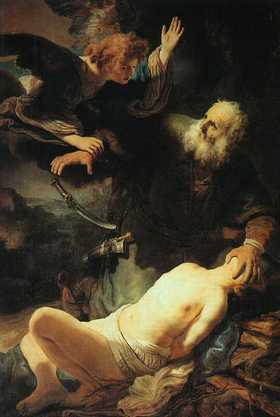
Even the Bible records from near the very beginning that deprivations are part of the religious expectation. One of the most complex and frightening stories from Genesis is that of Abraham’s near sacrifice of Isaac. No matter how theologians wash it, this story retains its stain of an adult—whether directed by God or not is a mute point—attempting to harm a child in the name of faith. The story, many centuries later, still sent Søren Kierkegaard into a tailspin that came out as Fear and Trembling. What kind of deity asks for a child to be harmed, even in jest? For Christiana Glenn, there’s no taking it back. The Bible tells us nothing of how the interior life of Isaac responded to this episode.

Food and religion are among the most common elements abused in American society. For our bifurcated (if not bipolar) outlook, one sustains body and the other sustains soul. While science still lacks evidence for the soul, the body remains the only basis upon which we have to base our ethics. Even biology dictates that care of one’s own young is an evolutionary imperative. It is tragic indeed when a religion overrides what all cultures respect as the ultimate “should” —take care of your children. In a world overpopulated by religious experts the street value of the soul will never face a recession. Believers, characterized my many religions as sheep, will go wherever their leaders tell them to go. As a culture suspicious of funding the study of religion, it may not be food that is reaped at the end of this harvest.

Thou shalt not...


Dukes and Serfs

Once upon a time in a land far away, a man and woman worked a fertile garden, blessed by God. That garden was in the incredibly rich, black soil of Savoy, Illinois. The zucchinis harvested were of biblical proportions. Some of them miraculously grew to the size of my calves seemingly overnight. The broccoli and carrots my wife and I grew had so much flavor that we couldn’t believe just how much leeched out while vegetables sat in the back of a truck or on a grocery-store refrigerated shelf. Even with their periodic mistings. It was as if Bunnicula had visited them at night. So long ago, the garden. It seemed obvious in those days why the writers of Genesis compared paradise to a garden. Ours was no Eden – it was hard work – but my wife and I had a lot of fun with it.

James Buchanan Duke, namesake of Duke University, owned a considerable estate outside Hillsborough, New Jersey. Having established both a tobacco monopoly and an electric company, Duke was enormously wealthy. He left his Hillsborough farm (not the tobacco farms which were in his native North Carolina) to his daughter Doris, making her one of the wealthiest women in the world. Her estate now consists of a socially conscious Duke Farms Foundation that has offered gardening plots to the plebeians of the region. So yesterday I found myself once again back in the garden. Sharing a plot with a friend, we arrived for opening day and were greeted by one of the organizers of the garden. Her name, of course, is Eve.

New Jersey planting requires more manure than the black earth of the Midwest. Yesterday I found myself shoveling horse manure, not for the first time in my professional life, while Eve supervised the garden. It seemed strangely biblical. Dodging between my summer classes this year, I will be emulating the first profession of our mythic father Adam. In the afternoon, after cleaning up, we headed to Rutgers Day, the university public-relations festival that shows off the tremendous wealth that cannot afford to hire full-time faculty any more. As I kept a weather eye on the clouds, worried about the seeds I’d just planted, the future continued to look stormy to me, even on the campus that has at times been my only source of barely sustainable income. Perhaps I should have changed my shoes, because it seemed to me that the smell of horse manure still hung heavily in the air.

I wonder if this is how Adam got started


Genesis Rising

Educating against the grain of an unthinking religiosity is a sobering enterprise. Every semester students provide presentations for my intro class on various issues that the Hebrew Bible informs in wider society. Inevitably one group will choose evolution as the relevant topic. While the actual theory of evolution is outside the scope of a Bible course, I spend more time on Genesis than on any other book. I carefully explain how “science” is a concept absent from the biblical world and how the creation myths in Genesis have no basis in the physical reality we know. The world Yahweh is busy creating consists of a dome turned upside-down over a plate-like earth. That see-through dome keeps out the waters that rush back in a few chapters later to flood the world. It is a fantasy world that even the most intractable creationist can’t accept. (Well, maybe not the most intractable.)

Nevertheless, the Creationist movement that began about 1920 has done its homework. That homework, unfortunately, has been in disciplines that both biologists and biblical scholars ignore – public relations. Any observer of modern American society can easily see the distrust with which education is regarded. As a culture, we dislike those who “think they’re so smart” while we daily use the gadgets and devices they design and improve. Biblical scholars are especially suspect because they engage in the most hubristic of all human activities: storming Mount Olympus (oops, sorry, Heaven) itself.

In a typical Rutgers University intro class of 50 or so students, with a wide variety of majors including the sciences, student presentations on evolution ultimately end up suggesting “let the students decide for themselves.” Although they consistently rate my instruction highly, they just can’t let go of the gnawing belief that Genesis 1 describes the world as it actually is. Disappointed, I am not surprised. When headlines constantly demonstrate the antipathy – if not downright hostility – that governors and some presidents have for education, we will reap what we sow. That, by the way, is from the Bible.

(It's just made of green cheese)


Sister Christian

“They heard the sound of Yahweh God walking in the garden at the time of the evening breeze, and the man and his woman hid themselves from the presence of Yahweh God among the trees of the garden.” That’s what the verse says. Perhaps it is just one of the dangers of a literalist upbringing, but when I saw the above ad in today’s newspaper I automatically took it as a scriptural reference. There were, however, no books of Accent, Elantra, or Santa Fe (the last nevertheless being named after a saint). Genesis has become a secular word. In fact, all words are secular, but many have been co-opted by their biblical context.

Every year I ask my students what Genesis is about. Every year the first answer is “creation.” This is, naturally, incorrect. Genesis is the story of Israel’s ancestors. 39 of the 50 chapters in the book are concerned with Abraham, Isaac, Jacob, and Joseph. The creation takes up only three chapters at the beginning. It is the Bible’s “once upon a time,” not the whole story. In an over-stimulated society, however, glib responses are mandatory. Genesis means creation and let’s just tell our kids about intelligent design and evolution and let them make up their own minds – I’ve got an important text to respond to! How far the Bible has fallen!

“Genesis” is a Greek translation of the very roughly “in the beginning” (translation issues abound here, but I’m just trying to make a point) in Hebrew that opens the book of Genesis. It was the convention in olden days to entitle books after their incipits; all fairy tales would have been titled “A Long Time Ago” under this rubric. And yet we are perfectly content, in the context of a “Christian nation” to go about misunderstanding the Bible from the very beginning. The Bible need not be understood as long as it can be thumped. And if you’re looking for a good deal on a Hyundai, why not make it biblical? Naked man and woman hiding behind the tree, however, will cost you extra.


Origins of Evil

The Bible might have benefited from a good editor. The final product is a world classic, of course, but contemporary people with their busy lives prefer straight and simple answers. These, often, the Bible refuses to yield. During a discussion of prophecy in class the other night the question of the origin of evil arose. I incidentally made reference to Isaiah 45.7 where God casually drops the line, “Forming light and creating darkness, making peace and creating evil, I am Yahweh making all this.” Many English translations attempt to mask the bald use of ra‘ “evil,” in this passage with nicer words such as “woe” or “calamity.” As I explained to my students, however, in a truly monotheistic system all fingers must point the same way for the ultimate responsibility. In this passage of Isaiah, Yahweh is presented as causing evil.

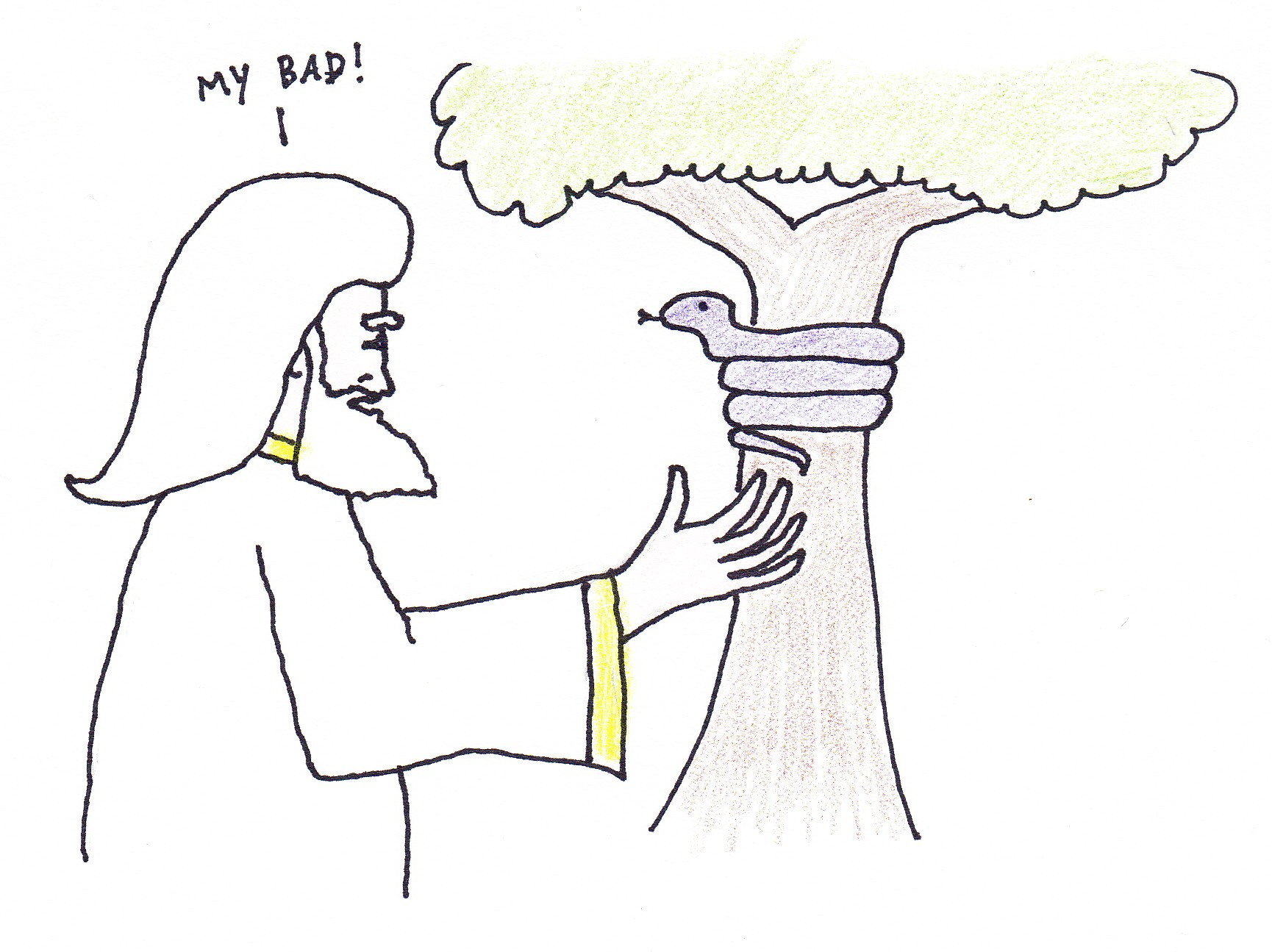
Now the editing of the Bible was never undertaken with the intention of creating uniformity, despite the railing of Fundamentalists. There are plentiful internal inconsistencies and disagreements. We should expect no less of a book written over a period of about a thousand years by several different writers grappling with life’s big questions. Inevitably students ask about the Garden of Eden. Genesis 2.17 has Yahweh state that newly created people must not eat of the “tree of knowledge of good and evil (ra‘).” Here the evil grows on a tree. Who planted that tree? It’s like blatantly laying the keys before your teenager and saying, “now don’t take the car.” Who is the source of that tree? (And, less frequently noted, the eating of the fruit in Genesis 3 is never called “sin.”)

The quintessential problem with a compilation is lack of uniformity. This did not bother ancient people as much as it does modern Fundamentalists. One reason is that many people equate the Bible’s value with it being a book that has all the answers from a single viewpoint. This the Bible lacks. According to the Bible there are various sources of evil. According to a strict monotheism (late in the Hebrew Bible) there can only be one. Enter the devil. To save the goodness of God a Zoroastrian anti-God had to be introduced. But the devil must stand in line to make his patent claim on evil.


Cyclotrons and Stardust

While recently watching an episode of Morgan Freeman’s Through the Wormhole, a connection emerged between religion and science. In an episode entitled “What Are We Really Made of?” the viewer is taken deep into CERN, and shown the tunnel where the Large Hadron Collider slithers like a 17-mile metallic snake coiling back on itself. In a quest for what ultimately constitutes sub-atomic particles, the script informs us, when the Collider is up to full speed it will recreate conditions as they were nanoseconds after the Big Bang. Scientists will be witnesses to creation itself. Their book of Genesis, however, will not be as easy to read as the one we currently have.

From CERN's website; the apocalyptic LHC

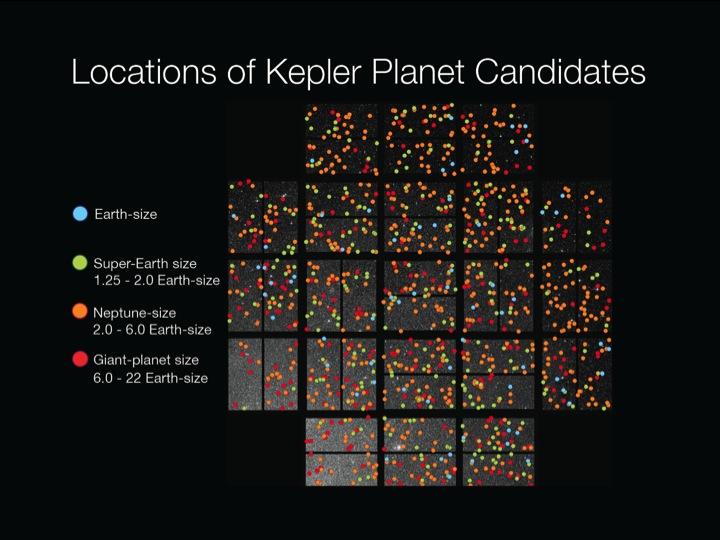
CERN represents perhaps the most sophisticated scientific instrument ever built. And the Kepler Space Telescope, one of the far-sighted members of our arsenal of understanding, has discovered rocky planets like our own 2,000 light years away. When the light of their sun left, Christianity was just beginning. Since then, millions of earthlings have died because of religious fanaticism. The deeper we peer, the less unique we become. Life is surely out there, and maybe building cyclotrons larger than CERN. The more we populate the universe, the lonelier we feel.

Kepler's guide to planets, from NASA

Scientists are also closing in on the creation of life itself. Working with self-replicating collectively autocatalytic peptide sets, they are nearing the point where we might say life has emerged independently in a laboratory. Where might religion be then? Human initiative in discovering the secrets of nature has balanced a divine creator on a precarious precipice. If life may emerge from a large soup of non-living peptides, and if we push the moments from the Big Bang back to merest fractions of a second while waving to our neighbors light-years away, have we consigned God to the unemployment line? I feel in better company now, although the light may have taken eons to arrive this far.