Hollow Bible

Sleepy_Hollow_-_Title_Card

The proofs for my article on the Bible in Sleepy Hollow are now here. It will be appearing shortly in the Journal of Religion and Popular Culture. For those who know my previous academic work—hi, both of you!—this represents a departure from the familiar for me. Some years back, floundering for a teaching position like a fish that’d flipped out of the acadarium, I talked to a colleague who confirmed what I’d long suspected: study of the biblical text is dying. Face it, nobody cares about J, E, D, and P, or even Q, anymore. We’ve made our point. The Bible is a composite document with many sources that people can still tuck under their arms on the way to the polls. It’s so easy to forget that this text is the basis for so many lives and eternal plans. While we scholars have been arguing with one another, culture has moved on. That’s why I looked at the Bible in “Sleepy Hollow.”

If the Bible isn’t relevant, why bother studying it? If the main character—dare we call him protagonist?—of the New Testament says to turn the other cheek and his “followers” advocate for gun ownership it’s time to ask what went wrong. Scholars know the Bible, but do we know the Bible? Long ago meaning slipped away from academics. Consider science. We can question global warming because the science has become a topic of conversation among specialists that the rest of us can’t hope to understand. Instead of trusting that they know what they’re talking about, we politicize it. Scientific research, even in major universities, is funded by interested third parties. You know, some scholars don’t think there really was even an E after all.

The Bible no longer means what the specialists say it does. I may have spent years of my life and thousands of dollars to speak as an expert, but I soon learned nobody was listening. Meanwhile, culture marches on, somehow supposing if two Corinthians walk into a bar the rich man in his tower makes the best sense, according to the Good Book. Indeed, if you want to find out what the Bible says, all you need to do is head up the Hudson Valley for a season. Or listen to those who hand out tracts and purchase firearms. What could possibly go wrong there? My article will be out in a few weeks. If you’re one of the two who read it keep in mind that there’s more to it than meets the eye.


Frozen Over

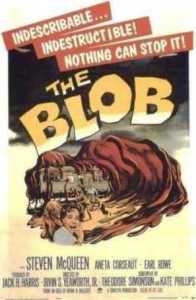
The_Blob_poster

For reasons that may eventually become clear, I was watching The Blob. It seems that each generation’s fears are unique to its time—let the reader understand. For whatever reasons, star-appeal I expect, Steve McQueen was cast as the teenage Steve Andrews. A little unbelievable as a twenty-eight-year-old teen (Sissy Spacek was a more convincing teenage Carrie at twenty-six) Steve drives around his small town trying to find and stop the Blob. What is the Blob? Nobody really knows. Emerging from a meteorite, it seems to be an EBE (Extraterrestrial Biological Entity) that encompasses, dissolves, and assimilates animal life forms, getting bigger all the time. In a day when the Russians were actual enemies, this is hardly an intentional vision of capitalism but an apt description nevertheless. If it touches you, you’re dead. Since it can ooze through air vents, there aren’t too many places at hide. It forces itself upon you.

Steve’s love interest, Jane Martin, has a lisping little brother named Danny. While big sister is out on a date battling the jello-monster, Danny—a future NRA member—charges outside in his pajamas shooting at the thing with his cap gun. Can this be? One capitalist shooting at another? Don’t be fooled. This is the nature of the free market. Either the Blob ends up on a dinner plate, or Danny does. We know that prior to 1960s monsters seldom kill little children (but don’t get me started on Frankenstein), so it is the Blob that will succumb. As the town’s teens combat the goo with fire extinguishers, freezing it, Jane, Danny, and Steve escape to go hunting another day.

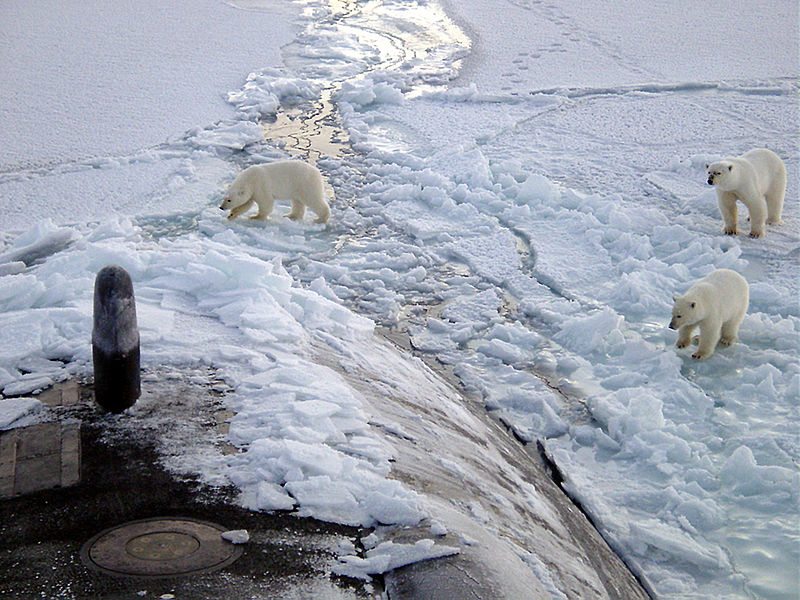
Those of you who’ve read my blog for any time know that subtext is often the point. I’m counting on you following along with me here—think of what day it is. The small town police chief, Dave, calls in the Feds. No wall will keep this alien out. It has to be deported. To some place that will never thaw. Like all good monsters, the Blob never really finally dies. It must be kept frozen to keep humanity safe. The final words Steve utters are indeed chilling, “As long as the Arctic stays cold.” Getting on sixty years later our “industriousness” has begun to melt the ice caps and the friends of the Blob deny global warming. I’ve seen The Thing from Outer Space too, and I know the last thing you want to do is thaw the Arctic. Remember what day it is, and do the right thing.


God’s Meteorologist

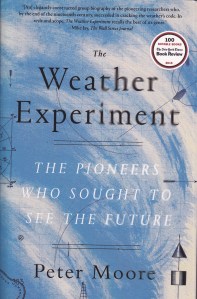
weatherexperiment“To understand the weather is somehow to glimpse the divine.“ I honestly don’t remember writing those words. A friend of my drew them out in a quote last year (perhaps the only time my book has every had such an honor) and they resonate with what a much better known writer has said. The Weather Experiment: The Pioneers Who Sought to See the Future was a book I bought upon first sight. Peter Moore’s story, like the science of the atmosphere, is only a small part of the whole. I glanced through the index for Increase Lapham while still in the bookstore, but despite his absence bought the tome anyway. I’m glad I did. Throughout this account of how meteorology developed in the nineteenth century religion and science are continually at play. As Moore points out, when faced with a violent storm, before any means of grasping the sheer enormity of the atmosphere existed, the only reasonable explanation was God. And it wasn’t just the clergy who believed this. Those we now recognize as scientists thought so too.

There are several key players in the drama of how we’ve come to our current understanding of the weather, but one that surprised me most was Robert FitzRoy. Everyone knows that FitzRoy was captain of the Beagle on Charles Darwin’s voyage that revolutionized science for ever. Some are even aware that FitzRoy, especially after his marriage, because a staunch evangelical Christian, parting ways with Darwin so far as to wave a Bible over his head at a public debate on evolution. I, for one, had no idea that FitzRoy almost singlehandedly invented the weather forecast. And that he did so as a government employee and doing so brought the ridicule of the scientific establishment because predicting was considered the purview of unscientific minds. It was as if the world I recognize had been whirled 180 degrees around by some unseen storm.

Any book on the weather, as I’ve learned, has to include a discussion of global warming. Climate change is real, and it is something we’ve done to our own planet. In a day when statistics can be produced showing that many scientific results are funded by companies with vested interests in the outcome of the experiments—even those at top universities—and we can see just how complex this web of financially motivated truth has become. Science is not pure rationality. It never has been, and it never can be as long as humans are the ones undertaking it. And we are beginning—just beginning—to see that there are some places where the wind blows freely through although those in white coats have assured us the room is sealed. This is a fascinating read and any book that makes me think I had the start of something profound to say is one I’ll buy on impulse any day.


Plain Floods

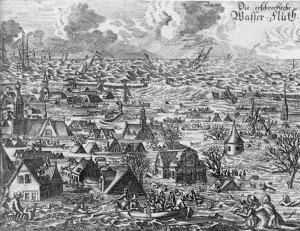
Erschrecklichewasserfluth

Floods are the stuff of legends. In fact, one of the most pervasive myths of all times is the world-wide flood. While some would see this as “evidence” that such an impossible flood actually occurred (some believing so fervently as to build replicas of imaginary arks), others recognize the flood as a basic human dilemma. We require water, and therefore we build our cities near a source of it. Rivers worldwide are prone to floods. While recently stuck in a holding pattern waiting for space for our flight to land at Newark, floodplains were more than evident from high above. My hometown regularly experienced floods when ice jammed the Allegheny River during the spring thaws. The floods of the Tigris and Euphrates rivers were, literally, epic-making. A piece in the Washington Post rather surprisingly reports “Legends say China began in a great flood. Scientists just found evidence that the flood was real.” The story by Sarah Kaplan demonstrates the universality of unruly water.

I know little of Chinese history and mythology. There’s no reason, however, to doubt that stories of ancient floods were as common there as elsewhere. The flood is, pardon the Christianization, the baptism of civilization. Things have to be washed clean before “civilization” can begin. In this case, according to the story, Yu, the founder of China’s first dynasty, tamed the flood. Now scientists are finding flood deposits from the Yellow River that match the 1900 BCE time-frame of this mythical founding. We can be certain that some will latch onto this date noting how Abraham was said to have emerged shortly after the flood (Genesis chronology says Noah was still alive when Abraham was born) and therefore this is proof of the Biblical flood. Even Sir Leonard Woolley advertised that he’d found the biblical flood in the river deposits of Mesopotamia. When it comes to literalism, any old flood will do.

No doubt many ancient flood stories go back to some historical event. The world was never completely covered with water in human times (before that nobody was here to see), but it’s easy to understand how people might have believed it could have happened. Our view tends to be local, often at the expense of universal costs. Consider global warming, for example. It’s difficult for us to see something that impacts us as such a distance. Taking care of the planet is so hard when we realize just how big it is. Our neglect, however, will definitely cause floods to come. Our denial makes myths for future generations. Headlines millennia down the road, if anyone’s left to read them, will, I’m sure announce with surprise that the devastating floods we’re creating now were indeed real.


Moving Mountains

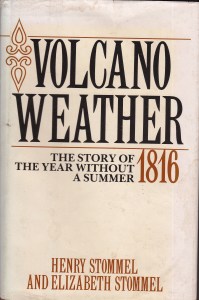
VolcanoWeatherJust 200 years ago, there was a “year without a summer.”  Well, that’s an exaggeration, but the name has stuck and is familiar to those of us with an undue interest in weather.  Although the coldness of that summer was far from universal, frosts came in New England in June, July, and August, killing off the staple corn crop for much of the region.  Snow fell even later than it usually does in the northeast, including a measurable fall in July.  My interest in this particular cooling episode was spurned by reading about the eruption of Krakatoa in 1883.  The connection?  Mount Tambora, a relative neighbor of Krakatoa, erupted in 1815 with an ejected debris volume of about ten times that of its later colleague.  The dust cloud from Tambora has long been a culprit for the dismal summer the following year.  Henry and Elizabeth Stommel researched and wrote a little book on this event entitled, Volcano Weather: The Story of 1816, the Year Without a Summer.  Although the book shows its age (it was written in the early 1980s), it remains a fascinating exploration of the many things that weather can do.  And has done.  Two of my favorites from this book were Napoleon’s adventures and the writing of Frankenstein by Mary Shelley during a rainy summer in Switzerland.
 
I should note, however, that the Stommels do not declare that Tambora was the reason for the year without a summer.  They tend to think the volcano had something to do with it, but the weather, that most protean of phenomena, can be impacted by the very small as well as the very large.  In fact, their description of the eruption includes the recognition that locals felt volcanic eruptions to be normal acts of the gods.  Many island cultures recognize the divine power of the molten earth.  The weather getting out of whack, we can be sure, leads to much prayer even today, thousands of miles from any eruption.  Something that hasn’t changed since the 1980s is that natural phenomena—especially powerful ones—evoke the divine.  Huge, impressive volcanoes, or even the very immensity and complexity of the atmosphere, suggest something we can’t comprehend.  Global warming will soon, however, bring this point home.
 

One of my takeaways from this book is the fact that the weather’s lack of uniformity emphasizes just how little we know.  The year without a summer mainly affected the northern hemisphere, and that only piecemeal.  Parts of northern Europe and North America felt it more intensely than other places.  It was not “the coldest year ever” and anyhow, is it even possible to know whether the coldest year would feel unnecessarily chilly where you are?  I’m pretty sure it’s snowing in some part of the world right now.  Human arrogance when it comes to global warming can be put into perspective by such acts of nature as Tambora.  From a human perspective, we live on a time bomb.  Volcanoes care not a whit for our bidding and wishes and dreams.  They can impact climate more instantly than our trite human efforts and thinking we alone are gods. To prepare for the future sometimes we need to look two centuries back.


The Philosophical Neanderthal

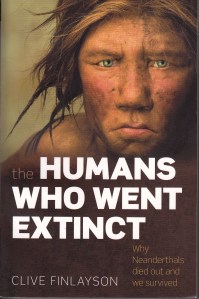
HumansExtinctExtinction. It’s a depression concept, but one that nevertheless constitutes a reality in evolution’s world. When applied to members of our own species we term it genocide and declare it an evil. Our perspective—not to dispute the value judgment—is hopelessly foreshortened. Our brains have evolved to promote individual survival, not to see the longue durée. How often do we worry about the extinction of Homo erectus? Or the australopithecines? Without them we wouldn’t be here, and yet, they’re gone. The case of the Neanderthals is perhaps closer to home. We now know that Homo sapiens overlapped with Neanderthals. Some of the questions raised by Neanderthal extinction are given serious consideration by Clive Finlayson in his study, The Humans Who Went Extinct: Why Neanderthals Died out and We Survived. To get a sense of how this works out, and how it applies with our current contribution to global warming, we must be prepared to view the extreme longue durée. Duration beyond comprehension.

One thing that becomes clear from the very beginning here is that climate has driven evolution perhaps more than we often think. Species, which tend not to live through the relatively long reach of climate change timescales, adapt to the circumstances of their environment. They either do, or they go extinct. Climate, however, is a balancing act teetering toward equilibrium. Hot and cold, evening each other out. Over an even longer duration, our sun will run out of metaphorical steam and things will get quite a bit chillier out there. For the meantime, however, shifts between ice ages and periods of warming will continue to seesaw across time and our race, among many, will need to adjust to survive. Perhaps acknowledging our own role in the current global warming might be a way to start. Our species tends to be short-sighted.

There is an irony here. History and prehistory have shown that, as Finlayson points out, that those best equipped to survive radical changes are the poor. Extinctions—some of them quite dramatic—have occurred before. They will surely come again. When times get tough, it seems, the comfortable get going. Going extinct, that is. Those who climb the corporate ladder the highest have the longest distance to fall when things go bad. The poor, who have to struggle every day to survive, are the ones who know how to get along in circumstances that turn sour. I have called this an irony for what might seem obvious reasons. There is another as well; here we have science pointing again in the direction of the Bible. There it was noted long ago that the meek would inherit the earth. And that’s a bit, it seems, that should be taken literally.


Chilling Thoughts

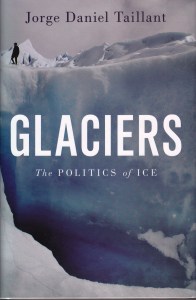
GlaciersI don’t think much about glaciers. At least I didn’t. Now they keep me awake at night. Literally. I just finished Jorge Daniel Taillant’s Glaciers: The Politics of Ice. Never have these ice sheets ever seemed to have so much personality before. I don’t live near glaciers, but I have seen a couple. A number of years ago I visited Glacier National Park in Montana. It was summer and the one glacier that was right by the road (Highway to the Sun) was melting. It was the first glacier that I knowingly saw, and I went my usual way, not thinking any more about them. Taillant’s book, however, indicates why everyone should be concerned about ice sheets. Not only is global warming a reality, our ice caps are melting on what appears to be a runaway timetable and we are not likely able to reverse the process until the damage is done. Not only our ice caps endangered, but our glaciers as well.

Why should anyone care about glaciers? For purely selfish reasons, I might point out that they are crucial to supplying drinking water for much of the world. Looking at the globe, it seems there is plenty of water to go around. Only about 3 percent of all water on the planet is fresh water, however. And of that 3 percent about three quarters of it is locked up in glaciers. Glaciers are the only source of fresh water in dry climates during years of drought or excessive heat. Whatever water isn’t used as these ice giants melt flows into the ocean, becoming part of the salt water majority. When the glaciers are gone, they’re gone. They are part of the fine balance that makes life on earth possible. The politics enter the picture when Taillant reveals that large mining interests, particularly in South America, have been destroying glaciers to get at the gold underneath. They block legislation and provide disinformation, all in the name of wealth. When they destroy glaciers, they destroy future prospects for life in the regions they mine. It’s an issue of social justice.

On our little planet that seems so big, we don’t often stop to consider that we didn’t really show up here by accident. We evolved with the features that our planet gave us—notably water—and we have continued to thrive only in the presence of water. It has often been said that future wars will not be fought over petroleum, but water. We can live without oil. We can’t survive without water. And our industrial action is blithely wasting away the largest reserves of drinkable water on the planet. I don’t live near any glaciers. I’ve only seen one or two in my lifetime, but I now worry for their health. Their future is, in many respects, our future. And that makes me want to pour a glass of water and reflect.


Think Bigger

PlanetRagesI’ve spent a lot of time with academics. Having been one myself, I know something of their habits. Getting through a doctoral program involves, at least in some fields, becoming the specialist on a very tiny piece of information. Since people have been thinking about things for millennia, finding something new to say can be a challenge. Often, by the time they’re done, newly minted doctors know an incredible amount about a very specialized topic. This is, in many ways, simply an intensification of the human experience. We think small. Part of the problem is that our brains haven’t evolved to think big. Having learned an awful lot about the weather in the book on Psalms, I have instinctively taken an interest in natural disasters. Charles Officer and Jake Page share this interest, as is evident in When the Planet Rages: Natural Disasters, Global Warming, and the Future of the Earth. This, however, is a big idea book. Globally big.

Throughout the first two sections of the book, which deal with humans in the face of nature, God often comes up. As scientist and science writer (respectively) Officer and Page simply reflect common beliefs. Nowhere do they advocate invoking God, but they note that throughout history, in the face of just about any species of natural disaster, people have. Many people still do. Disasters and God. What a team! We worship what we fear. Once Officer and Page reach the third section of human impacts on nature, however, God drops out of the picture and the fingers are pointing solely at us.

When I read about what we’ve already done to this planet, I, as a colleague once said, start seeking another species to join. We have destablized the atmosphere so throughly that it will take at least ten-thousand years to return to it’s pre-Industrial Revolution state. Ten-thousand years. At the same time, the largest industrial pollutor (the United States) has jury-rigged politics so that only the wealthy can attain high office. Votes can be bought and we simply won’t sign the Kyoto Protocol. Those who knowingly doom their children are the smallest thinkers of all. We have changed the course of the biosphere well beyond our share of time, and even those scientist who deny global warming know that it is true. You don’t bite the hand that signs the pay check. After all, specialists have a tendency to be very small thinkers.


Rutgers Presbyterian

It is indeed an honor to be invited to address a church group on topics that matter. While I didn’t directly address global warming in my book, it was in my mind as I wrote it. Early in my teaching career, I wasn’t sure how to cinch up the gap between the lexicography I was attempting and the real world issue that it should address. The seminar portion of yesterday’s program focused on topics associated with the weather, and I was gratified to hear that many of those present felt that a profound weather event had made an emotional impact upon them. Weather has a way of reminding us that we’re small and that forces beyond our control still exist. I’d forgotten how nice it is to while away a few hours with intelligent people who think about the world we all inhabit. I only wish I could have recorded all the wisdom I heard. We tend to think if someone’s not speaking to us from a major media outlet they’re not worth listening to. I am glad to be reminded that this is not so.

IMG_2515

During our discussion of global warming, the question arose as to what we could call “climate change” to make it appropriately terrifying. Various suggestions were made such as poisoning the sky, suffocating the earth, and old-fashioned, and to-the-point air pollution. We are a species that seems bent on its own destruction. The atmosphere is so incredibly large, but, as our host reminded us, so very thin. Life is supported only in what might be considered, in his words, a thousand-story tower. Beyond that, life runs out. We need to take the limited nature of this small envelope of gas surrounding us seriously.

I’ve come to realize that my fascination with the weather largely derives from looking at the sky. Such an activity is so basically human and so profound, that we simply overlook it most of the time. The sky is superior to us. It was, for most of human history, far out of reach. We have stretched our hands up to the realm of the gods and smeared it with our industrial filth. Many of those present, although not Catholic, applauded the Pope’s insistence that the world must be view holistically and that we must stop polluting our home. Pollution used to be an ugly word, but we have been taught to change our language to add ambiguity. “Climate change” is so neutral, with no one to blame. But it’s not at all accurate when it comes to the real costs. We’ve already impacted the weather for a millennium into the future at least. And I, for one, left our session optimistic that intelligent people cared enough to spend a beautiful Saturday afternoon discussing it.


Pontificating

I’ve been in a few New York crowds, but this one seemed on its best behavior. I was in the city later than usual since I’m giving a talk today at a friend’s church in the Upper West Side. My wife came to meet me and, knowing the Pope was going to be saying mass at Madison Square Garden shortly after her train arrived at Penn Station (for out-of-towners, Madison Square Garden sits atop Penn Station) we decided to meet at Herald Square and avoid the other kinds of masses. I walked to the square from work and realized my mistake—34th Street was barricaded and there were crowds already beginning to form. The Pope had a procession through Central Park, but I neglected to check on the remainder of his route. My wife arrived and, taken in by the rush of the moment, decided to stay and see what we could see. We were literally one person back from the road. The police kept saying that they couldn’t confirm he was going to come this way, but the helicopters hovering overhead seemed to tell a different story.

The crowd was so well behaved. No pushing or shoving, and even loud talking was mostly absent. It was, believe it or not, kind of reverent. Sure there were people with placards suggesting that one should get right with Jesus, and the occasional pedestrian saying, and I quote, “Why is there so much people here? The Pope? You’ve got to be kidding—can’t we cross the street?” By and large, however, there was good will. One of my coworkers had emailed during the day saying she’d gone by Saint Patrick’s the night before, but couldn’t see him. The crowd, she commented, was kind spirited. Perhaps that’s what having a kind-spirited Pope will do. After we’d stood for nearly an hour, I was beginning to wonder if the motorcade had taken another route—7th Avenue was closed as well. Then the cheering began.

Pope Francis rode by, the window down, waving at the crowd. My glimpse was only a fragment of a second, but it was clearly him. I’d met an Archbishop of Canterbury or two in my time, but here I was, no more than thirty feet from the Pontiff, if only for a second to two. And it was all pretty much by accident. Life surprises us that way sometimes. Reading his words about climate change to the leaders of the world, I can’t help but think we’ve needed a leader like this man for a long time. He’s as human as the rest of us, and he knows that we have only one world and in that one world are millions of people in need. And global warming will hit them first and hardest. And the God of the evangelicals who say the planet is ours to destroy is not the God he recognizes. He’s just one man, but he is able to bring the largest city in the country to a halt, even if just for a second or two. This could be saying something important for those who have ears.

IMG_2488


Almost Purgatory

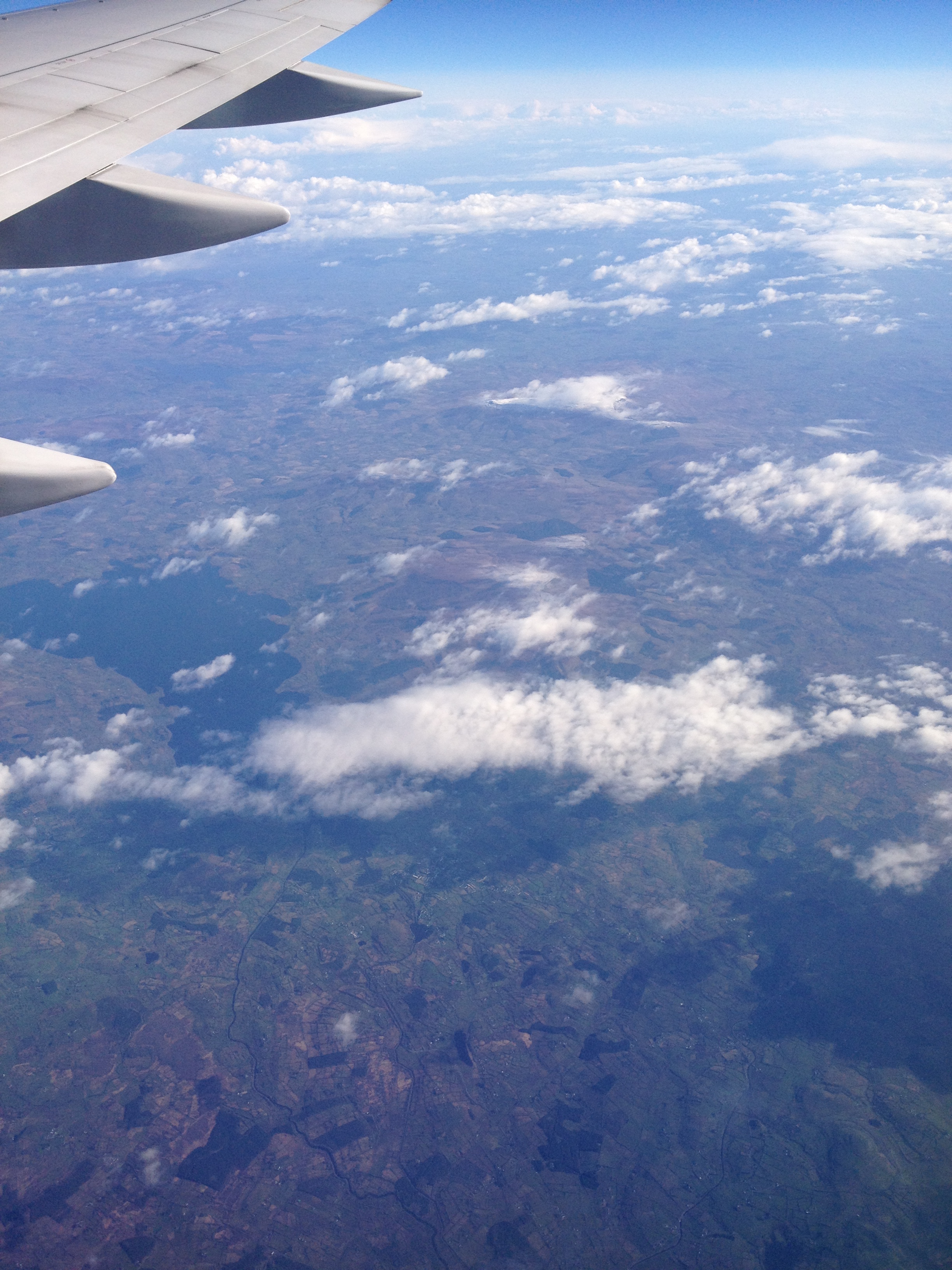
Although it is difficult to tell from 32,000 feet, I think I might have flown over Purgatory on my way home from the UK. The two days I was in Oxford were uncharacteristically sunny and warm. Although it was cloudy around London when we lifted off, the skies cleared by the time we hit the Irish Sea and once Ireland came into view I kept a close watch for what I hoped might be Lough Derg, the site of what was once deemed to be Purgatory. Our flight path took us over the right region, but the maps in the back of the in-flight magazine are never detailed enough for navigation, and the lake itself is not large enough to appear on any but the most detailed charts. Still, I think I might have seen it. If this was Purgatory and I was overhead, I guess I must’ve been in Heaven for a while.

IMG_2129

Symbolism began to kick in, despite the lack of sleep. Our view of the earth today corresponds in a rough way to that of the ancients. For sure, we are more sophisticated, as we suppose, but there remains a lake of fire beneath our feet and the heavens above our heads. The area in between, according to medieval thought, was Purgatory. It’s the place where we live. Believing in the intensely mythological development of a rich afterlife that borrowed elements from the Greeks, Zoroastrians, and Egyptians is hardly something anyone could undertake seriously in the modern world, but the trials we undergo here and now somehow make Purgatory believable as a symbol. When I think of the troubles over the past few weeks alone I can take some solace in a symbolism designed to help us avoid Hell.

As on my trip from New York, I watched hundreds of miles of ice floes, icebergs from the air. I’m not sure if this is unusual—I don’t fly overseas very often, and sometimes it is dark and I can’t see the water below. Of climate change, however, I am absolutely certain. We have undertaken to bring about Hell on earth because of industrial greed. I can’t help but compare how companies continued to promote smoking heavily even after they knew it was killing people. Lucre can make monsters out of ordinary humans. Was that Purgatory I saw back there, over the Emerald Isle? I may never know, but down here on the ground the warming trend continues. Perhaps the ancients knew more than we think they did.


Pope for the Planet

According to The Guardian, Pope Francis is about to weigh in on the faux question of global warming. Faux because there really is no question—we know it is happening. Some high ranking Catholic politicians, no doubt, will not be amused. Apart from the fact that Francis has proven himself a true saint from the moment he got out of the gate—distancing himself from European pontiffs far more interested in church politics than what really matters—he has brought a sensibility borne of knowing how people really live and what is really important. Global warming is real, and the science behind the assertions is unquestioned. Interested parties (such as big oil) have hired their spin doctors to confuse the voting public, casting doubt on one of the few certainties we have. Politicians, whose funding comes from business interests, of course choose what to believe. How anyone can be so shortsighted, or selfish, as to saw off the very branch on which they stand I can’t comprehend. Past popes were too busy trying to keep ladies out of the exclusive gentlemen’s club to worry about those who feel the brunt of global warming.

Photo credit: Chief Yeoman Alphonso Braggs, US-Nav, Wikipedia Commons

Photo credit: Chief Yeoman Alphonso Braggs, US-Navy, Wikipedia Commons

Of course, it will catch up with all of us eventually. I’m not much of a swimmer, and I’m worried. Hurricane Sandy (a superstorm only in the sense that it hit the affluent) showed us just how near sea level Manhattan is. One gets the sense that the fastest growing cities being in Texas is no coincidence. As long as it doesn’t impact me personally, what’s the worry? Some entire island nations stand at threat, but perhaps they should’ve considered that before they moved to an island. Here’s the news flash—all land is island. We need each other, and the lowlands are as important as the highlands.

Organized religions of all kinds have been under fire for years. As science began to explain more and more, religions had to explain their own existence. Many turned internal—not in the spiritual sense, but in the aspect of clarifying the precise points of what makes them right (i.e., different from everyone else). In the United States the small town without five or six different steeples was the exception rather than the rule. Meanwhile, the emissions continued. And continue. At least we know we’re right. At last there is a pontiff who is a realist. A priest who understands that church is all about caring for people—those in the lowlands as well as those in the highlands. Of course, politicians know how to turn off the religion when it gets inconvenient. As long as I get mine, all is right with the world.


See Serpent

GreatNewEnglandSeaSerpentSeeing, it is said, is believing. I have a feeling that this truism may have become effaced somewhat in this age of deft photo manipulation and apps that are marketed to insert ghosts and UFOs into any picture. Nevertheless, anyone who has seen anything genuinely puzzling knows that it creates a lasting impression. A world without mystery, although a capitalist’s dream, is a nightmare for everyone else. So it was, now that October is here, I settled down with J. P. O’Neill’s The Great New England Sea Serpent. I found O’Neill’s book in a used bookstore a few weekends ago (appropriately water-damaged), and since I have a fascination with the ocean and monsters, this seemed like it would appeal to both of my avocations. It did indeed. O’Neill isn’t a sensationalist writer, but rather she is a normal person with normal jobs who has an interest in strange animals. Beginning in 1751 and up to three-quarters through the twentieth century, people had been spotting a classical sea serpent along the New England coast, and occasionally on ocean voyages across the Atlantic. Of course, we’re told, sea serpents don’t exist.

The Great New England Sea Serpent is a compendium of sightings from many reliable witnesses over the centuries. Of course, to many it is impossible. To me this appears to be the same kind of arrogance we apply to the universe—if we haven’t catalogued it by now, it doesn’t exist—to suggest there are no monsters of the deep. As any oceanographer will tell you, we know more about the surface of the moon than we do about our own oceans. If you turn your globe (or app) just right, there are views of our planet where virtually no land is visible. We are a watery planet. Even with current technology, the deep ocean is difficult, and very expensive, to explore. Who knows what might be lurking there right off the bow? O’Neill’s account is full of old salts and snarky journalists, but at the core of it all is a humility in the face of the largeness of the sea. What do we really know?

Of course, there is a fear of literalism. The Bible (and other ancient texts) take sea monsters for granted. Leviathan is a dangerous beast and, no matter what the pundits say, is no crocodile. And yet, for the past several decades the reports of the New England beast have dried up. Where has our beloved sea serpent gone? I have to wonder with both our polluting our oceans and our increasingly efficient (and massive) ships, if we haven’t simply forgotten that ancient maps used to leave space for dragons. Our great ships, guided by GPS, and our oceans running a temperature, are sure signs that greed has surpassed wonder. Have we, in our self-centeredness, slain the last of our dragons? O’Neill, please understand, does not call them dragons. Hers is a sober and straightforward account. But when October comes I just can’t help but hope there are still some monsters out there, deep under the waves.


Sustain This

Sustainability“Grant me chastity and continence,” Augustine famously prayed, “but not yet.” That tragicomic scene kept coming to me as I read Jeremy L. Caradonna’s Sustainability: A History. Few ideas can bear the sheer weight of irony than that of a human population destroying their own and only planet. We know we’re doing it, and yet for a few more greenbacks to flash before our fabulously wealthy peers, we don’t mind warming the place up by a few degrees. There’ll be time to throw on the brakes right before the crash. I once took a ride, perhaps unwisely, with a friend who believed nothing could go wrong. Although the car didn’t actually roll, it came awfully close, and I am haunted by what might have happened. The difference between that incident and destruction of the environment is that the latter has already happened.

I’m cynical enough not to believe in simple solutions to complex problems, and reading Caradonna was a sobering finish to a day that had started out optimistically. Such books are not easy to read. Science does not come charging over the hill like the cavalry to save us at the end of the picture. You can’t take your marbles and go home when the marble is home. Sustainability does not set out to be a bleak book. There is a guarded optimism to it, and I was particularly pleased to see that sustainists readily recognize that without some kind of just distribution of goods, no system will ever be sustainable. I had no idea, until I read this book, that some economists advocate for a steady state economic existence instead of the ridiculously illogical constant growth. Constant growth in a world of limited resources is the worst kind of delusion.

We’ve gone pretty far down the road to destroying our planet. Already it will take many decades to repair the damage done. If we can muster the will to address corporate greed with a good old dose of primate ethics. Society, in all honesty, may have to collapse before that happens. If it does, of course, the strong will survive. I have a prediction to make, and it’s one that rationalists won’t like. If we can’t avoid the wall that is right before us, and if society as we know it buckles under its own greed, the survivors will, as sure as gray matter, devise a religion to explain it. As a species we are all about myths. Like fabled saints we believe we can have our fossil fuels and consume them too. Before rising sea levels wash us all away, do yourself a favor and read Sustainability. And when you’re awake for nights afterward, tell everyone else you know to read it too.


Beyond Redemption?

NonbelieverNation The Roman emperor Gaius, it is said, was insane. He perpetrated such antics as declaring war on the North Sea, making his horse a senator, and appearing in public dressed as various gods. Better known as Caligula, Gaius is often presented as evidence of the decadence that would eventually lead to the fall of the Roman Empire. Civilization, we’re told, has progressed enormously since then. We put people on the moon, and we carry in our pockets technology that appears, to mere mortals, as if it’s magic. We have elected an African-American to the White House and men have magnanimously granted females the right to vote. Oh how far we’ve come! And yet, in the midst of our self-congratulation, we have not one, but a plethora of high-ranking politicians in all three branches of the government who believe the world is only 6000 years old. They firmly believe Jesus will return on a white horse (presumably to be made a senator) any day now. And there will be a massive battle of good (us, or at least some of us) versus evil (those not evangelical in orientation) that will lead to the end of the world. And they are easily elected. Is that a knowing smile I see on Gaius’ face?

David Niose, president of the Secular Coalition for America, has written an important book entitled Nonbeliever Nation: The Rise of Secular Americans. Before you run for your shotguns, be assured that Niose is—like most secularists—not trying to do away with religion. Secularity is all about the founding principles of this country: freedom of conscience, the right to believe what we will. Or won’t. Up until the 1950’s the secular aspect of this country was taken more or less for granted. Tellingly, Niose opens his book by looking at the presidential elections of 1912 in which not one of the four candidates had a problem with evolution and even the most religious of them was very much a moderate. A century later and we have rampant Fundamentalists well funded and ready to push other nations toward initiating Armageddon. “Well, they started it!” And still, secular Americans are consistently portrayed as insidious snakes in the garden, trying to destroy everything.

It is difficult to read Nonbeliever Nation and not feel embarrassed as we see the promise of an advanced nation winding back its clock to the point that the educated are presented as ignorant at best—or more likely, evil. Where churches and corporations are increasingly difficult to tell apart, and where basic civil liberties for women and gays are still considered somewhat suspect, as if they hadn’t cleared the desk of the Big Man upstairs. Yes, he does have a beard and a son. And yet, despite the message of that putative son—known as a pacifist with radical ideas about social equality—the faithful bar the way for the oppressed while building the most massive arsenal in the world’s history. Rome, they say, was not built in a day. It didn’t even fall until 476, but already in the first century, large cracks had begun to appear. The difference is that America is far more religious. Does that give us any better chances, or worse? Read David Niose and decide. And, since global warming is real, the North Sea will eventually win in the end.