The Cthulhu You Knew

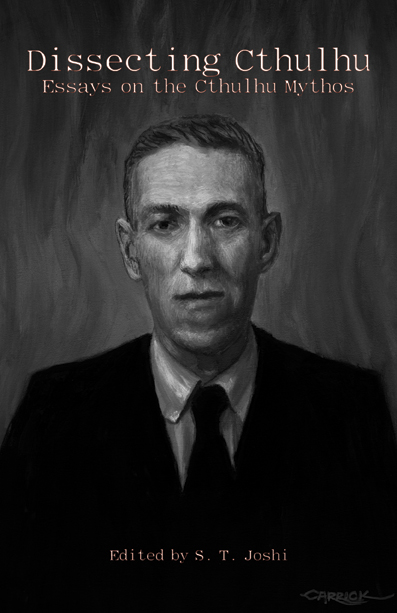
DissectingCthulhuThe word “fan,” an apocopated form of “fanatic,” is a word borrowed from the realm of religion. Most often associated with sports, it can refer to any overly enthusiastic devotee. While I enjoy reading H. P. Lovecraft’s fiction, I think I would stop short of calling myself a fan, but were I to take that step I would have some serious competition. The circle of those truly enamored of Lovecraft have yet to break into the hallowed, or perhaps haunted, halls of the western canon. Fans there are, but not the sort who find regular play in literature classes. Still, as I read S. T. Joshi’s edited collection, Dissecting Cthulhu: Essays on the Cthulhu Mythos, I came to realize just how committed Lovecraft’s fans are.

My fascination with Lovecraft arises from his felicity with gods. Some argue that his gods are aliens, but even Erich von Däniken hasn’t stopped the true believers. Dissecting Cthulhu is a collection of articles from a variety of Lovecraft analysts debating the fine, and sometimes gross, points of the postulated “Cthulhu Mythos.” Cthulhu hardly requires any introduction these days. He has basked in his underwater fame since the internet has made a star of him. The eponymous deity of the alleged cycle, the divinity, or alien, was never really put front and center by his creator. Deities are all the more powerful for being unseen. Here is where Lovecraft the atheist becomes Lovecraft the theologian. By creating gods we tacitly admit their subtle power over our psyches. We may call them aliens or monsters, but compared to us, they’re gods.

After reading Dissecting Cthulhu, however, I’m not sure that I could say much more about him than before. This is often a problem shared by theologians—what more can you say about an entity that won’t sit still long enough to be interviewed? Gods will be gods. The rest of us are humble hermeneuts. There’s no doubt that Lovecraft touched on a deep and abiding current in human experience when he held alienation high as the standard of life on earth. Somehow we resent Cthulhu for not being there, even though his is no octopus’s garden under the sea. Other galaxies were discovered and partially understood for the first time during Lovecraft’s lifetime. Suddenly it felt pretty lonely down here with all that empty space up there. It is better to populate such a large expanse with gods. Not seeing is believing after all.
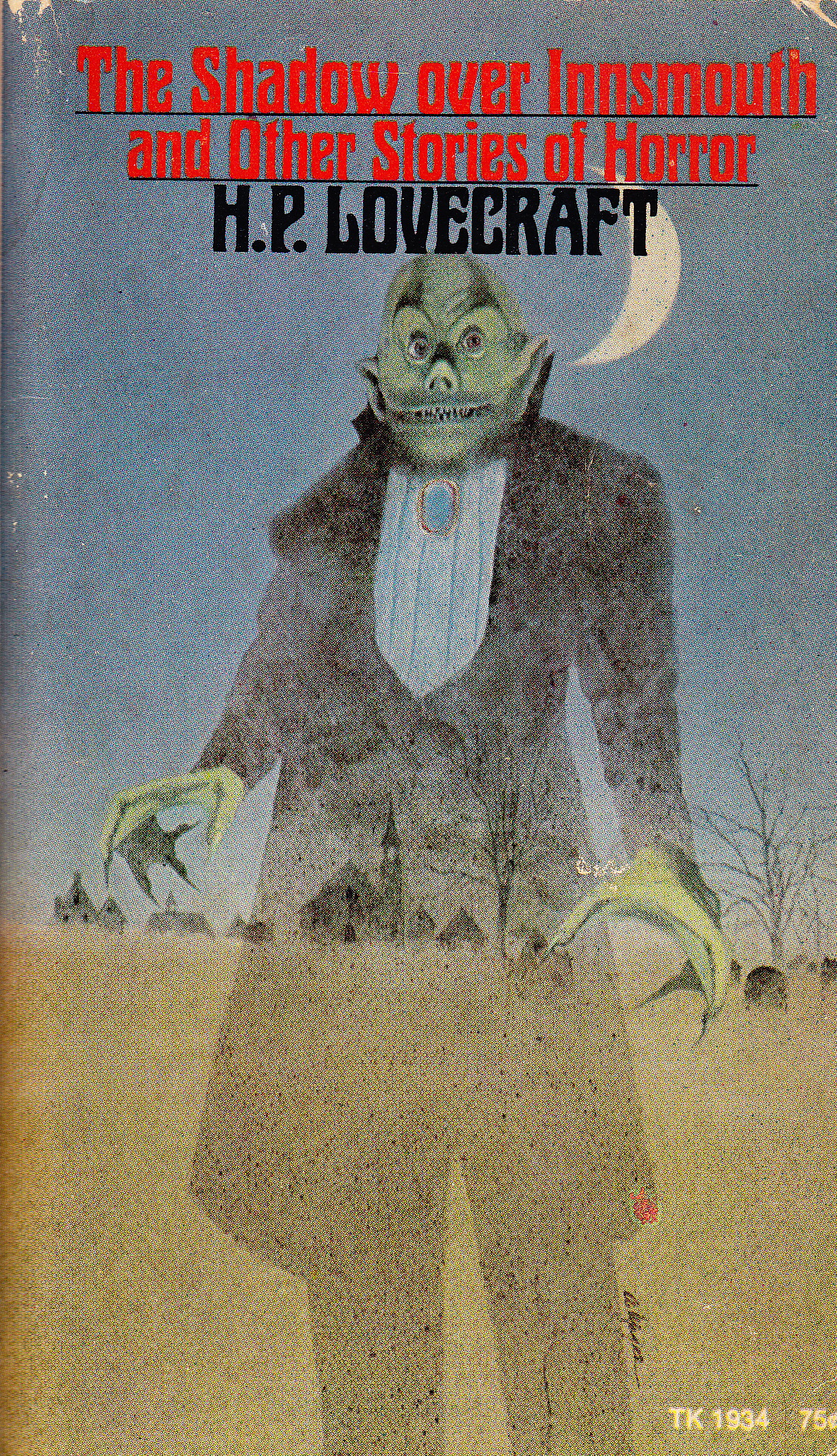

A Girl Named Cthulhu

It was only a 25-word blurb in last week’s Time magazine. A Canadian couple decided to let the internet community name their daughter. As of the time of writing the third most popular suggestion was Cthulhu. WWLD? The internet has brought Lovecraft’s sleeping deity to life. Ironically this evil, belligerent, and fearsome god tends to have more fans than some of the more loving, cuddling varieties of deity around which western culture arose. Children are a parent’s ultimate investment (or should be) and the name we bestow will influence their view of life. I still recall the scandal of when I first showed my Mom a baseball card where the player was named Jesus (Spanish pronunciation, please!). I innocently asked if that was allowed since we’d been taught that although other biblical figures were fair game, the name of God was a retired number. There was only one Jesus, and this baseball card a monument to sinful arrogance.

Cthulhu

Of course, we lacked the biblical training to know that Jesus is only the Greek form of Joshua, a name of fair game to any young lad. Naming after a deity was otherwise verboten. Of course, that has all changed now. Names are up for grabs, and it is getting harder to find unique ones. H. P. Lovecraft, who died in relative obscurity, could find publication only in pulp fiction magazines—the lowbrow literature of his day. The divine fruit of his fertile imagination has now taken on the dimensions of true divinity. How many potential names are out there on the internet? Lovecraft alone gave us many gods. All the Dianas, Thors, Carmans and Dylans out there are in good company. Why not name a child after a god?

Names do effect a child’s view of life. Growing up in a biblically literate family, I often thought of the Stephen of the New Testament. The first Christian martyr, he died with a vision of heaven in his eyes, earning the meaning of his name, “crowned.” I aspired to live a selfless life, in as far as such a thing was possible in the twentieth century. It was my name—it was my destiny. There are no other “Steves” in my family, and when I was old enough to comprehend that many children bear family names, I asked my Mom whence mine had come. It turns out that I was named not after a family member or even a saint, but after a cartoon character. Touché, Cthulhu! Long may those of us with unorthodox namesakes stick together. The world is our myth.


Dagon Cthulhu

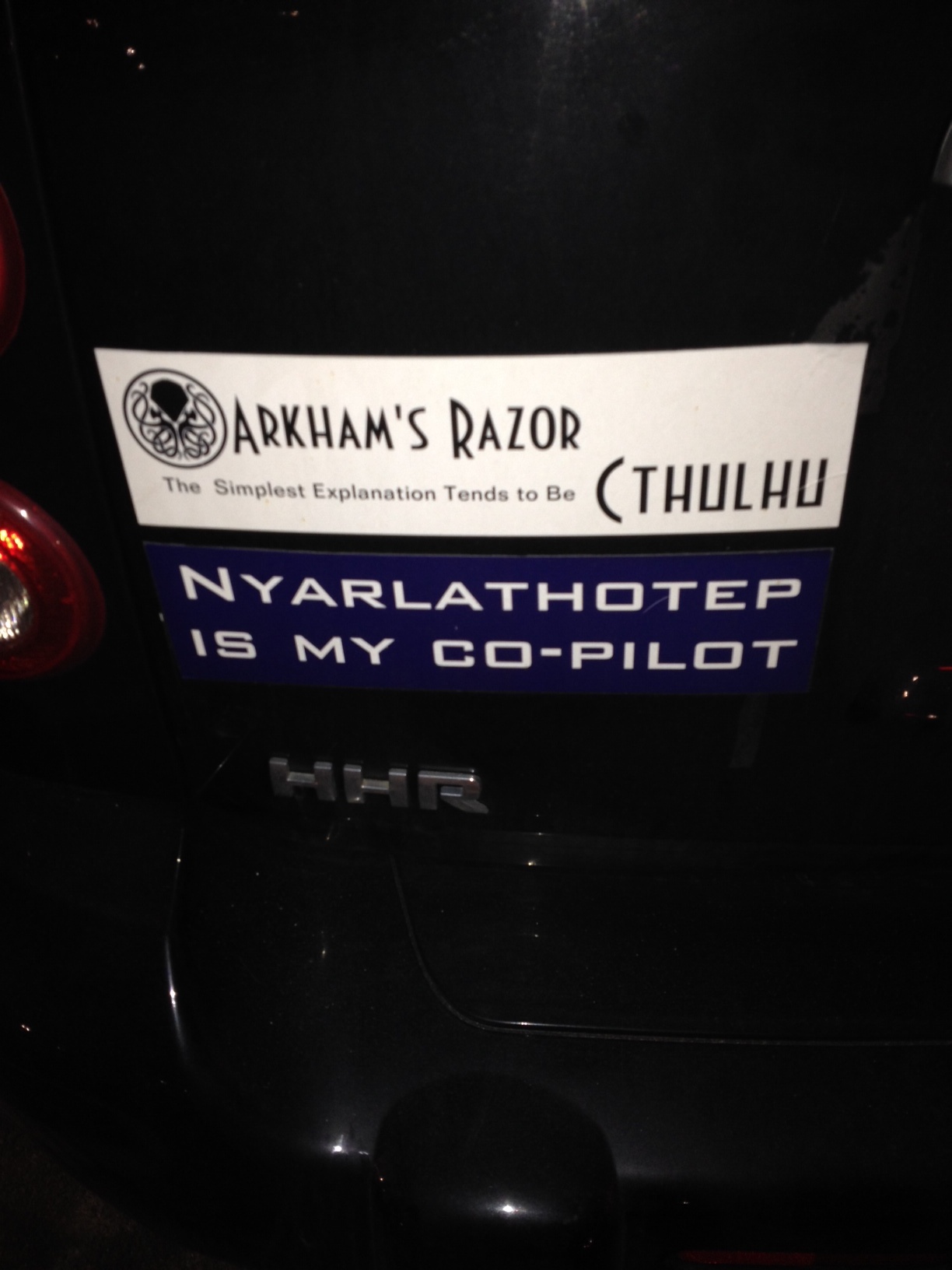
Cthulhu has taken over the world, thanks to the internet. I wonder what H. P. Lovecraft thinks as he lies dead, but dreaming under the loam of Providence. A lifetime of struggle to gain recognition as a writer left him without much of a following, relegated to pulp magazines for low brow and Innsmouth-dwelling mentalities. Now everywhere from Davy Jones’ face in Pirates of the Caribbean to car bumpers in any parking lot, Cthulhu has awakened. My wife sent me a photo of a couple of such bumper-stickers recently: “Arkham’s Razor,” reads one, “The Simplest Explanation Tends to Be Cthulhu.” “Nyarlathotep is my co-pilot” reads another. I first discovered H. P. Lovecraft through bumper-stickers.

Lovecraft

Back in my post-graduate days in Edinburgh, I had decided to write my dissertation on Dagon. This seemed a reasonable topic as no serious, book-length treatments of this elusive, Mesopotamian deity existed. My advisors talked me out of it, however, noting that material on Dagon was so scarce that it would be extremely difficult to scrape enough together to call it a dissertation. A few years later, it turns out, an academic book on Dagon finally appeared, but the fact remains that he was, and is, a major deity who somehow mostly disappeared from the ancient records—the victim of chance finds and perhaps more aggressive gods. For my birthday one year my wife bought me a bumper-sticker with a “Jesus fish” that had the word “Dagon” inside. I posted it on my office door in Oshkosh and the department chair asked me what the tentacles were meant to represent. An web search indicated that the Dagon was not the biblical “fish god” but the Lovecraft reincarnation. I had experienced an epiphany.

Lovecraft, although an atheist, knew his Bible. I once wrote a scholarly article on the Dagon story in 1 Samuel 5 where the Philistine statue of Dagon falls down, decapitated, before the captured ark of Yahweh. This is the sole narrative involving Dagon in the Bible, and it concludes by saying only Dagon’s “fishy part” was left intact. Lovecraft took this obscure Bible story and built an entire mythos from one of its characters. Cthulhu, Dagon, Nyarlathotep, Shub-Niggurath, and their companions have risen from the deep, and encircled the world in an electronic web. The fact that kids who’ve never read Lovecraft can identify Cthulhu at a glance, attests to his power. Even Batman fans who cite Arkham without knowing that it was originally Lovecraft’s creation keep the master alive beyond the grave. Isn’t that what resurrection is really all about? Even if a writer has to be discovered through bumper-stickers.


An Odyssey

Jorge_Luis_Borges_1951,_by_Grete_Stern

I learned of Jorge Luis Borges through the recommendation of a friend some years back. Of course, knowing about a writer is never quite the same thing as reading what s/he has written. So it was that I recently picked up an edition of Borges’ short stories entitled, biblically enough, “The Aleph.” I find that these stories require slow reading, chewing over rather than swift gobbling down, like so much of what ends up on the mass market shelf. In lives squeezed for time between the incessant demands of cell phones, social media, and plan old television (satellite or cable), spending unrushed minutes with a thoughtful story can seem a waste of time. I suppose that’s the sole benefit to a long commute on public transit—reading is always an option (although, sadly, not one frequently utilized, to guess from all the electronic farts emitted by computerized devices all the way home).

The first tale in my volume is “The Immortal.” Perhaps it is the hand of the translator, but the sensibilities of Borges are not unlike H. P. Lovecraft. Borge was influenced by Poe as well, and as the narrator of this tale encounters Homer in the land of the immortals, it is only fitting that the question of mortality should arise. Joseph Cartaphilus, the narrator, notes that the three western religions all claim to offer immortality, but in reality focus on the only part we intimately know, the part we call being alive. Often this idea has come to me as well when encountering one so sure of an afterlife but so fearful of death. If immortality does not banish terror of the grave, what use is it?

Indeed, as Cartaphilus realizes that he has drunk from the river of immorality, even the company of a devolved Homer can not entice him to live forever. Off he rides in search of death, a solace that comes only once he has sold his story in the form of a used book dealer, within the back cover of the Iliad. Once the story takes on the life of the teller, he is free to die. There is so much going on in this brief tale that two readings have only begun to scratch the surface. Borges lays religion’s follies at its feet, but shows that there is still much more to fear. I can see the draw, and as a new year dawns, I can see myself becoming more acquainted with Borges and gaining the insight that only thoughtful fiction can bring.


Rites and Wrongs

One thing about Amazon Prime is that you can watch a movie multiple times with no real fiscal consequences. Alone on a Saturday, I started my ritual of looking for a movie to match my mood. I’ve posted before on Cabin in the Woods, a kind of Lovecraftian parody of the five-people-in-an-isolated-cabin motif, but the movie is so deeply based on religious motifs that I noticed many things I’d missed the first time around. When the college kids descend to the basement to choose, unwittingly, their fate, they happen upon a diary written by Patience Buckner—one of the zombie family that will eventually emerge to murder three of the five. So far so good. The backstory to the Buckner family is sketchy (Drew Goddard and Joss Whedon are said to have written the script in three days, not much time to develop backstory), but they are religious zealots who believe in pain as a spiritual purgative. In other words, they hurt each other in an attempt to be religious. This idea is not without historical foundation, and although it plays only a small role in the movie, it is part of the larger plot as well.

The entire control center that is intended to keep the old gods satisfied, is a highly technical ritual center where the horror movie tropes take place to appease the ancient ones. As Sitterson and Hadley explain, the suffering of the kids as they face the ritual sacrifice is an essential element in pleasing the gods. It is, nevertheless, a ritual. As each victim is killed, a lever is pulled channelling blood down across icons of the roles played by the scapegoats. Marty, the stoner who ultimately figures out what is going on, makes the point that for a ritual all you need are robes and sticks. Of course, ritual is one of the main constituents of religion, and ritual has to meet the specs provided by the gods.

Cthulhu takes Manhattan

Cthulhu takes Manhattan

Modern day fascination with H. P. Lovecraft has led to a resurgence of interest in “the old gods.” Lovecraft, while personally an atheist, knew the powerful draw of the idea. Gods are controlled by ritual. Many religions trace the architecture of rituals to the deity placated by them, but this tacit domestication is a kind of archaic rule of law. Humans do this, gods will do that. The hastily written story of Cabin in the Woods abides by this pattern. As long as somewhere in the world a human sacrifice is made according to specifications, things will continue as they are. In other words, our random world is a throw of the dice by the gods. Unlike his contemporary, Albert Einstein, Lovecraft’s gods did apparently play dice. Cabin in the Woods is a modern farce of that ritual and is, in an unexpected way, a deeply religious movie.


Weird Tales

WeirdTaleSince I first discovered H. P. Lovecraft, I believe that I have read all his published fiction. Most recently a multi-year marathon took me through the S. T. Joshi editions published by Penguin Classics. Reading those editions led to a natural curiosity about S. T. Joshi; H. P. Lovecraft is still an author struggling for respectability, although the internet has brought him great fame. The literary elite consider many genre writers as gauche, and those who read them decidedly low-brow. When I saw that Joshi had written a book entitled The Weird Tale (the genre designation preferred by Lovecraft), I decided to learn more. Joshi, I had known from his webpage, is an ardent atheist, but also a true admirer of Lovecraft’s craft. Since I’ve tried my faltering hand at fiction a time or two, generally having even less success than Providence, I wanted to see what Joshi had to say.

Few things are as inspirational as reading about writing. Those of us compelled to do it find it an endless source of fascination. What drives us to it? We don’t know. Where do the ideas come from? We can only guess. Why do we do it? We must. And so, it is clear, also felt the authors surveyed in Joshi’s fine little book. Although the names of Arthur Machen, Lord Dunsany, Algernon Blackwood, M. R. James, and Ambrose Bierce mostly just tickled some remote tendrils of synapses in my skull, this study was the first real knowledge I had of any of them. While some patterns emerge, there is a notable diversity of background to the writers of the weird. One element that Joshi doesn’t fail to notice is their religious conviction, or lack thereof. In many ways this is odd, but in others it feels perfectly natural. Many materialists count creativity as the predetermined motion of particles and energy that evolution makes inevitable. The writers, however, refuse strictly to conform.

Lovecraft was an atheist and mostly a materialist. Joshi is puzzled, however, when Lovecraft seems to call this certainty into question. I’m not. Lovecraft did not believe in God, but he invented gods. How difficult it must be for a creative mind to dabble in the divine and simply walk away at the end of the day. Lovecraft was no stranger to peculiar residues that clung to the unwary and the bizarre transformations that could occur under the aegis of misplaced belief. But like the narrator of many of his tales, at the end he too knew he’d been affected. I don’t mean anything as crass as deathbed conversion. Rather, like all those who are truly intelligent, we must admit that there are some things we just don’t know. Cthulhu may not be slumbering beneath the sea but many will not sleep easily at night with their closet doors open. To expect anything less of Lovecraft, to me, seems just too weird.


Caledonia Dreamin’

“Edinburgh is a mad god’s dream.” So penned poet Hugh MacDiarmid with sentiments that could’ve been composed by H. P. Lovecraft. My association with Edinburgh seems accidental, but there is little in my life that compares to this mad god’s dream. The Gnostics used to believe that there was nothing in divinity that precluded a kind of divine madness. Philosophers, back when they still considered god a postulate, argued about whether the deity was good or evil. If they’d come to Edinburgh, I suspect, the debate would’ve taken on a whole new cast. In his poem “Edinburgh,” MacDiarmid captures the untamed nature of a city that has never been given the accolades of Paris, London, or New York, but is just as edgy and twice as beautiful.

Dreaming gods, of course, are nothing new. Vishnu, according to some strains of Hinduism, is the god whose dream is the universe. In the Ugaritic Baal Cycle, it is a dream that reveals to the ancient god El that Baal has returned from the land of death. And, of course, Cthulhu lies dead but dreaming in the city of R’lyeh. To me, Edinburgh is a wonderful alchemy of divine dreams. I was a young man, still so very naive when I moved here. Looking back at those old photos, I see a much younger face from the past, telling the camera that yes, he’d found paradise, the very place of God’s dreaming. Our human politics, however, trump divine dreams every time. Although I never wanted to leave, I was not permitted to remain. Yes, the camera does, at times, capture the soul.

DSCN3490

I am on the train that will take me from Edinburgh, having seen it anew through my daughter’s eyes. I came here penniless some twenty-four years ago, but with a head full of dreams. Life has taught me the cost of dreams since that time, and I have had to pay with wrecked careers and uncertain futures, trusting that the god who is dreaming all this is mad indeed. Nevertheless, like the gods, I refuse to stop dreaming. As much as Hugh MacDiarmid captures the spirit of Edinburgh, as I sit here, with a wee bit of mist in my eyes, my mind is on the words of another poet, Baroness Nairne. To her I will have to leave the last words, from this south-bound train. “Fareweel, Edinburgh, where happy we hae been.”


First World Religion

H. P. Lovecraft’s contemporary, and sometimes inspiration, Algernon Blackwood has recently come to my attention. Like Lovecraft, Blackwood was an early twentieth-century writer of supernatural tales. Raised with a father of “appallingly narrow religious ideas” Blackwood came to write stories involving strange religious characters and occult themes. I recently read his famous story, “The Willows,” for the first time. The entire premise is built around a sacrifice required by strange gods on an isolated island in the Danube River. Much of Lovecraft’s literature, as is readily apparent, builds on the Old Gods. Lovecraft was an unflinching atheist, but he knew that the divine had the ability to frighten in a way that the purely material often does not.

The early twentieth century exerted an enormous influence on the religious landscape of the modern world. Although my historical specialization is much earlier, it is clear that the events of the First World War forever changed the way that religion was viewed. Historically, those not involved in the fighting of wars had often been insulated from them. With the advent of technology that allowed military devastations to be photographed and swiftly disseminated, people around the world realized what an atrocity war actually is. Not glorious. Not triumphant. And despite the abundance of piety in foxholes, no deities evident anywhere. It is well known that horror of war at least partly led William Jennings Bryan to advocate a more fundamental brand of Christianity to counterbalance the “evils” of evolution that led to such nasty ideas as eugenics and social Darwinism. It is no accident that the Fundamentalist movement began to take hold with the revelations of the First World War.

GermanInfantry1914

Ironically, today many use creationism as the excuse to challenge all religion as a misguided set of antiquated principles that have no place in an enlightened world. The sad truth is that those who immediately dismiss religion out of hand don’t realize that the creationist concern arose precisely for the same reason: the horrors that science was unleashing upon regular, simple religious believers. The two viewpoints, however, can live together. Although many of the writers of the early twentieth century had no room for faith in their accounting of reality, they did believe in its effectiveness in creating fiction that had to be taken seriously. Atheists, perhaps, but not angry ones. Perhaps the angry ought to spend some time amid the willows to evaluate more fairly the ambiguous role that religion play has played and continues to play in an uncertain world.


Lovecraft in the Woods

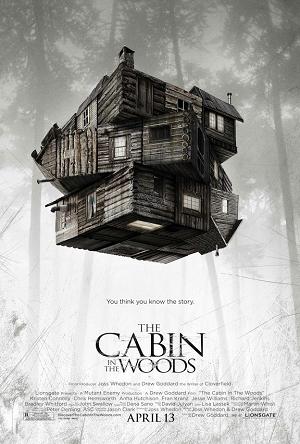
CabinintheWoodsYou know the basic plot: five college students—always an uneven mix of genders—travel to a remote cabin in the woods during a break. Extreme bloodshed ensues. The Evil Dead? Cabin Fever? Blair Witch Project 2? This time it was The Cabin in the Woods. With the exception of Cabin Fever, all of these films have a religious origin for the horror unleashed on our protagonists, with varying degrees of seriousness. The premise of getting away into the woods is overtly sexual in nature, often with the added vice of drinking or drug use far from the eyes of watchful society. Something inevitably goes terribly wrong. Were they a tad less graphic, most of these movies could pass for morality plays in their adherence to the convention, made obvious in The Cabin in the Woods, that the virgin is the sole survivor. Of course, this is done with tongue deeply embedded in cheek. Joss Whedon, who brought us Thor and The Avengers, knows all about gods, and they are the driving motivation behind the evil lurking in this contrived cabin in an artificial wood.

In this parody of the splatter film, the blood of the archetypal teens is collected to appease a Lovecraftian pantheon of unseen “ancient ones.” These are the gods of old, hidden deep beneath the earth in a slumber, placated by the ritual sacrifice of the whore, the athlete, the scholar, the fool, and the virgin. The sacrifice is orchestrated by techie priests who wear white shirts and lab coats, in a hermetically sealed laboratory under the cabin where they are set to unleash any variety of monsters on the kids, leading to their gruesome demise. First the protagonists must “sin”—not a difficult prospect, given the arrangements—and be punished. If the ritual fails, the world ends when the “evil, giant gods” are released; echoes of Cthulhu are rife.

Horror movies offer more than scares. If done well, they provide catharsis as well—a kind of celluloid redemption. Writers and directors, however, have moved toward self-parody to distort the horror film into a kind of comedy. Even as early as The Evil Dead, the humor is evident. Joss Whedon, however, effectively wields the evil gods, just as in The Avengers. Deities are revered less for their goodness than for their sheer power. H. P. Lovecraft, an atheist, gave us the old gods. Hollywood has run with them. Instead of catharsis, viewers are left with an undefined unease—something is not quite right with this universe that has been created. Gods, whether holy or horribly profane, demand much of humanity. The response may be abject devotion or laughter. The sins remain the same as human vices of old. It is the gods that have been transformed.


The Triumph of Lovecraft

The deeper you peer into the mouth of nature, the more Lovecraftian the world becomes. Just days after I had posted a little meditation on Cthulhu, the great old god of H. P. Lovecraft’s unholy pantheon broke into the mainstream news. No less a source than NBC ran the headline “Tiny Cthulhu ‘monsters’ discovered in termite guts” only a few days ago. The microbe with the scientific name Cthulhu macrofasciculumque lives in the digestive system of termites, helping them in their destructive work. True, Lovecraft described Cthulhu as a bit bigger than that, but the first appearance of the microbes, according to Megan Gannon, reminded the discoverers of the eponymous terror of the Cthulhu mythos.

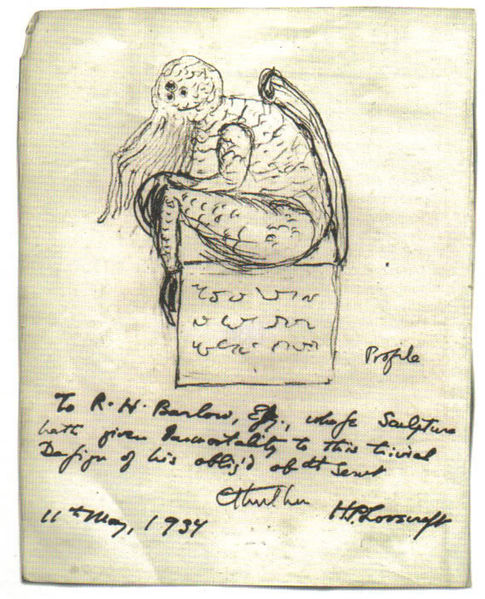
From microbes to the major football leagues such as the Baltimore Ravens, writers of the macabre have left their mark on our culture. The darkness they describe so richly is something we all feel at some level, but that we sublimate most of the time so that we can get on with our lives. Cthulhu macrofasciculumque may be very, very small, but the super-viruses and bacteria that we are encountering have the ability to destroy us just as surely as the chimerical colossus of Lovecraft’s nightmares. When we look for a way to describe these terrors, we have brave literary heroes from whom we might draw. We would be lost without them. They make it safe for us to venture into that darkened room, for they have been there before us. Lovecraft gave the world its first scientific description of Cthulhu, and although that description defies adequate reconstruction, we recognize it when we see it.

As Lovecraft saw him.

As Lovecraft saw him.

Science has brought us so very far. We can now see to almost the brink of an infinite universe and delve into the guts of termites. We have the ability to prolong life and increase physical comfort for those who can afford it, and we can annihilate entire nations at the press of a button. Drones can fly overhead and do the dirty work, and we don’t even have to step outdoors. Yet when we meet something that shivers our scientific spines, we turn back to the old gods to name it. Yes, religion may be the bête noire of science, but the dark night of the soul is not illuminated by LED’s or lasers. To see in this dark you need to have the night vision of literary perception. And those lenses, according to Lovecraft, reveal that the old gods are dead but still dreaming.


A Weird Resurrection

Driving through an unfamiliar city doesn’t allow for much time to appreciate what you’re seeing. Back in February when I was visiting Austin, Texas for the first time, it was 65 degrees outside. Given the irascible temperatures in New Jersey this year, that felt like summer. Of course, the locals were bundled up since it was, for Texans, unseasonably cool. The weather has been off this year. Of course, we know who to blame. Cthulhu. As I was trying to find the University of Texas with an impatient GPS as my co-pilot, I spied someone walking down the street wearing a Cthulhu ski mask. I can’t express how badly I wanted to pull aside and snap a photo, but pulling aside in a strange city can lead to unwanted adventures. Especially when your co-pilot is an opinionated GPS. I’ve been to north Philly and the south side of Chicago. I didn’t want to take any chances that Austin might hide such districts.

Cthulhu mask

H. P. Lovecraft, like most original thinkers before the computer age, was ignored in his lifetime. I wonder what he would have felt if he had divined that the internet would one day bring him world-wide fame. His writings, of course, had been appreciated before the computer was invented, but the web has nearly as much Cthulhu as it does LOL Cats. Even those who’ve never spent a dark night curled up with the Necronomicon recognize Cthulhu’s octopoid visage when they see it. Davy Jones of the Pirates of the Caribbean fame borrowed his unforgettable face from the Old Gods discovered by Lovecraft. Cthulhu has become a cultural icon of the chaotic, the cosmic, and the somewhat comic.

In a strange way Cthulhu stands for resurrection. In Lovecraft’s mythological world Cthulhu lies under the sea, dead but dreaming. A dying and rising god of utter terror. Lovecraft, an atheist, built his fiction nevertheless around a series of gods. Today his stories are noted for their moody portrayal of improbable worlds, and his storytelling has had an incredible influence on many of those who attempt to generate worlds that are fantastic but somehow still believable. Cthulhu’s resurrection, however, is not to be desired. Even if these he represents life anew, it is a life humans could not bear. In a deeper sense yet it is Lovecraft himself who has experienced a kind of resurrection. A writer forgotten in his lifetime, but rediscovered when it was too late for him to realize just what he’d created, the true master of Cthulhu, I like to believe, lies dead but dreaming, and he has already revealed that he will rise and the masses will tremble.


Gods in Spandex

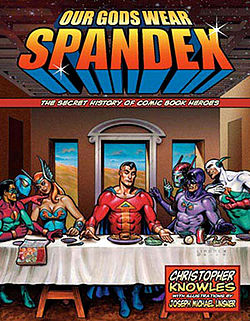
OurGodsWearSpandexOne thing leads to another. Reading Jeffrey Kripal’s Mutants and Mystics stirred an interest in comic books that I hadn’t felt since before my college days. Often excoriated as puerile, escapist doggerel for pre-pubescent boys, comics have grown to be respected members of adult society. I often wonder what the draw might be. Hollywood has certainly cashed in on it with any number of blockbuster flicks each year coming from the brains of the comic book writers and artists. So I picked up the quirky book by Christopher Knowles and Joseph Michael Linsner entitled Our Gods Wear Spandex: The Secret History of Comic Book Heroes. Reading it was kind of like looking in a mirror that has been buried in dust for a few decades. I hadn’t realized that my tastes in childhood comics was a reflection of a longing for the divine world with healthy doses of science fiction, and even H. P. Lovecraft, thrown in along the way. Knowles ties in a remarkable breadth of material to demonstrate that our superheroes are, in the final analysis, gods. That point may be taken in any number of ways.

The academic world suffers from a fear of respectability. That may seem a strange assertion, but I’ve spent a great deal of my life among academics and I know that many of them are insecure and tentative. Does all this reading, writing, and analysis ever get read by anybody? Does anybody take me seriously? Academics are haunted types. So when a subject as vulgar as comic books arises, scholars are reluctant to touch it. It might look like we actually enjoy reading the funnies. Still, popular culture has demonstrated an unexpected depth to much that we read in the strip world. As Knowles points out, a deep undercurrent of the occult and esotericism runs through many hero story lines. Several heroes began their lives as classical gods, only to assume the spandex and become incarnate humans with special powers we long to have ourselves. We would fly, if we were given the chance.

Our Gods Wear Spandex may never be viewed as an academic book by most. It has too much visual interest and not enough recondite footnotes. All the same, it is a profound look at what people really desire. We worship gods because of their special powers. If God were one of us with our humiliating weaknesses and limitations, would we ever worship him or her? Of course not. We only seek to appease those who are stronger than we are. Entire governments and ecclesiastical bodies are built on that very principle. Heroes are like us. Mortal, and yet, with something more. They die. But like the gods, they can come back. Reading Knowles it becomes clear just how much religious thought pulses through the veins of the comic book world. We may be grown up and sophisticated. We may have left behind childish things. But when our backs are to the wall, who doesn’t secretly wish they were Wonder Woman or Superman? And maybe that wish is a prayer.


Wrongful Resurrection

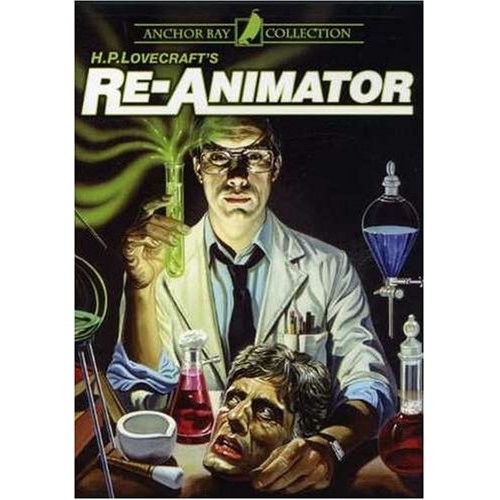
Re-Animator

H. P. Lovecraft was a tortured man. An atheist, he saw the inevitable dilemma of human life. We want to live forever, but even the short time we have is full of suffering. Almost Buddhist in his sensibilities, Lovecraft also knew the hubris of trying to reach too far. I was reminded of that when I recently watched Stuart Gordon’s Re-Animator. Like most of Lovecraft’s stories, the translation to film is difficult. The angst and haunting lie far too deeply embedded in the original stories to show, even with the finest acting, with any degree of verisimilitude. And the tales have to be padded out to get to that magic 85-minute mark. Nevertheless, there is something of their master still in them.

Re-Animator is based on Lovecraft’s short story, “Herbert West—Reanimator.” West discovers the secret to bringing the dead back to life. In the movie version, the result is unremitting chaos. The dead are somewhat zombie-like until Dr. Carl Hill, very freshly dead, retains his consciousness and begins his insidious plan to create a cohort of more proper zombies to do his will. Like Gordon’s other interpretation of Lovecraft, the eerily moody Dagon, there is a little too much blood-lust for my liking, but a point is being made, so I watch on. The point is very much at the heart of Lovecraft’s personal dilemma. We want to live forever, despite the pain and disappointments of the life we know. Life is optimistically resilient that way.

Lovecraft died a painful, natural death at the age of 46. His writings never demanded much attention during his life—thus seems to be the fate of many of the truly original. In the 76 years since his death he’s gained an enviable following. He might almost be said to have achieved a kind of immortality. A safe immortality. As he knew in life, resurrection is a double-edged sword. We may be reluctant to give up the only life that we (most of us, anyway) have consciously known, but have we really considered the implications of going beyond the line that nature has drawn for every living thing ever animated? Our technology keeps us alive in bodies that only continue their inexorable march toward the grave.

Am I sounding a bit bleak? Blame it on the rain. Immortality, in any belief system, only comes at a great cost. H. P. Lovecraft knew that and took the risk in spite of it.


Read Ban

Someone in the Greenville County Library doesn’t get out much. The LA Times reported this week that a surprised parent got a look at Alan Moore’s Neonomicon, a graphic novel that her child was reading, and went to the library to get it banned. There is a perverse kind of logic to this. The 14-year-old minor checked the book out from the adult section. The story doesn’t say why, but anyone familiar with H. P. Lovecraft would immediately see the familiarity of the title to his fictional Necronomicon. And anyone wanting to read that is surely above the age of innocence. As a result of this imbroglio another book has been banned. As the parent of a teenager I understand concerns about reading material, but then I know that graphic novels can be, well, quite graphic. I know because I read.

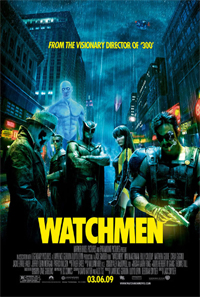
I’m currently reading a fascinating book about religious aspects of comic books. Many of us grew up with comics, and anyone who’s read some psychology knows that people are very much image-oriented. Even our Bibles for children are heavily illustrated—often with drawings nearly as far from reality as those of an Alan Moore story. Adults raised on comic books have been enticed back with such novels as The Watchmen— something that looks like maybe kids are the intended readership, but they’re not. The only way for adults to know is to read. (That, and to consider that the movie version of The Watchmen scored a solid R rating. That little itch should be telling you something.) But reading literature has fallen out of fashion.

While waiting for my bus home one day I decided to take the more local route because the bus was still at the gate when I arrived at the Port Authority. This is a longer ride, but with any luck it might get me home ten minutes earlier. When I asked a woman if I might sit next to her, and I began pulling out my book, she said, “you’re that guy that reads.” Guilty as charged. As I wait for the express bus, I spend the time with a book. Until she said that I never considered that almost nobody else does. Forget the days of earnest looking men, faces hidden behind newspapers, passing the commute by reading. Now it’s all ages and genders, holding electronic devices. Not that I’m surprised. People are visually oriented, after all. But I immediately recognized Moore’s nod to H. P. Lovecraft in naming his novel Neonomicon. I think I might have an idea of what to expect if I were ever to read it. It is, however, far easier to ban books than to take the time to read.

Watchmen


Mermaid Missionary

Last summer I was invited to address a church in Princeton about Christian themes in the movies. Back in my seminary days I often presented biblical material at adult forums, but my interest in religious themes in movies has grown over the years. I don’t claim to be an expert, but I have watched secular movies with an eye toward religiosity since I was in high school. The day of the presentation followed a recent viewing of Pirates of the Caribbean: On Stranger Tides. Although I’ve posted on it before, that particular movie is among the most heavily freighted with Christian themes of any I’ve seen. Now that I’ve had a chance to watch it again on the small screen without the distractions of getting home through traffic afterward, I would redouble my assertions. The very premise of the movie—the hope for eternal life—is a decidedly Christian refrain and the pirates, who wear their sins on their sleeves, are eager to attain it. The missionary, mentioned in my previous post on the film, serves as a kind of foil for that theme, insisting that all souls can be redeemed. Except, he decides, Blackbeard’s.

The reason that Blackbeard falls out of the missionary’s personal book of life is his mistreatment of a mermaid. Now the swarming, man-eating mermaids are among the most memorable images from the story. One has to be captured to unlock the magic of the Fountain of Youth, and the victim happens to be the missionary’s mermaid. In a Florence Nightingale moment, the two different species fall in love—celibate preacher and heathen, mythological creature. An odd couple indeed. Carried in a glass coffin filled with water, the mermaid also needs air to survive and the heartless pirates don’t really much care. To save the little mermaid from asphyxiation, Philip shoves his Bible into the gap he breeched between coffin and lid, saving the fishwife’s life. Talk about conversion!

When the glass coffin breaks, spilling all the water, the mermaid is reborn as a human. Echoes of Splash come to mind here, as well as Disney’s earlier effort, The Little Mermaid. The transformation in this case, seems spiritual as well as physical. Syrena, whose very name invokes the classical sirens, is the one who delivers the magical chalices (communion, anyone?) to Jack Sparrow to save the life of Angelica, or, more likely, to bring Blackbeard to an end. Our busy mermaid, now transformed again to her fishly form, saves the injured missionary by converting him to her way of life under the waves. There are shades of Lovecraft here as well as a reversal of Ariel’s fate in Little Mermaid. Although critics were harsh on this movie where a comic character now takes on a serious role, I still find it compelling. Nearly all the main characters undergo transformations as the story unfolds and whether heathenish or not, almost everyone ends up a better Christian of one sort or another.