Kermit’s Secret

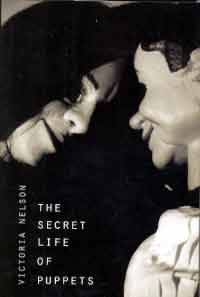
When I was a post-graduate student in that Gothic city of Edinburgh, I decided to spend some time reading Umberto Eco’s Foucault’s Pendulum. It was intended as harmless entertainment, but as anyone who has read it knows, the story soon unravels into an unbelievable world of dark religions that haunt a naive protagonist. While I was reading it, a packet, hand-addressed to me, with no return address, came to my student mailbox. The contents consisted of several tracts, in German, warming of the dangers of Satanism. No letter, no explanation. Foucault’ s Pendulum had me paranoid already, and this strange package completely unnerved me. Well, I’m still here to tell the tale. While reading Victoria Nelson’s brilliant The Secret Life of Puppets, I learned that she had a strange episode while reading the same novel. It was an apt synchronicity.

Nelson is a scholar who should be more widely known. I found her because her recent Gothicka was prominently displayed in the Brown University bookstore in May. I saw it after taking a personal walking tour of H. P. Lovecraft sites. Synchronicity. I had read, in a completely unrelated selection just a couple of months ago, Jeffrey Kripal’s Authors of the Impossible. Synchronicity. For many years I have honed my Aristotelean sensibilities, following devotedly in the footsteps of science. Problem is, I have an open mind. It seems to me that to discount that which defies conventional explanation is dirty pool in the lounge of reality seekers. I have always been haunted by reality.

I’m not ready to give up on science. Not by a long shot. Like Nelson, however, I believe that there may be more than material in this vast universe we inhabit. Indeed, if the universe is infinite it is the ultimate unquantifiable. The Secret Life of Puppets is alive with possibility and anyone who has ever wondered how we’ve come to be such monolithic thinkers should indulge a little. For me it was a journey of discovery as aspects of my academic and personal interest, strictly compartmentalized, were brought together by an adept, literary mind. Religion and its development play key roles in the uncanny world of puppets. Those who wish to traverse the realms they inhabit would do well to take along a guide like Nelson who has spent some time getting into the puppets’ heads.

Gothic Religion

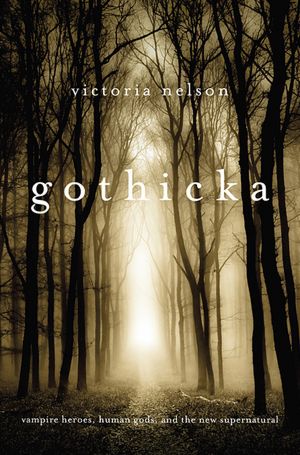
Every great once in a while, you run across a book that seems to have been written just for you. I’m cheap enough to wait for most books to be issued in paperback (and storage is getting to be an issue in our cozy apartment), but sometimes the urgency is too great and I can’t resist. In Providence a few weeks ago, I visited the university bookstore—one of my favorite places in town. On the new arrival table was Victoria Nelson’s Gothicka. For what seemed inexplicable reasons, I always found Gothic tales among my favorite growing up. Poe was a standard, but he was accompanied by other stories that elicited the same cocktail of sensations, accompanying a dark and mysterious atmosphere with a suggestion of menace. Transfixed by even the mere presence of this book, I knew I was in the power of a force to which I would eventually succumb. And, unexpectedly, the book helped to explain part of my childhood.

Not every book I read has to do with religion. Far from it. I expected Nelson to discuss literature and movies and culture—all of which she does—but not necessarily religion. The first three chapters proved a revelation in that regard. Nelson deftly explains how Gothic largely overlaps with the characteristics of religion, bringing the supernatural into human lives and insisting that we tremble before it. Perhaps best explained by pastor Rudolf Otto in The Idea of the Holy; the transcendent is something that terrifies as well as compels. In a culture where organized religion appears to be losing ground, Gothic offer the opportunity to tremble before the supernatural, and many people find it almost a religious experience. As becomes clear, the “almost” may appropriately be dropped.

Tracing the trajectory of my own reading interests, Nelson next provides an insightful chapter on H. P. Lovecraft. In many ways the initiator of worship of the dark divine, Lovecraft’s Cthulhu and kith and kin represent an undisguised secularization of deity. At the same time, the trembling is still very much present—indeed, it is a native part of the experience. Lovecraft, who was an atheist, understood the literary utility of gods. They frightened and haunted him with their very non-existence. That is power. Gothic acknowledges and embraces that power while never relinquishing its darkness. Nelson’s Gothicka holds the potential of a journey of self-discovery. As she ranges deeper and deeper into that world, the reader discovers just how much it is part of being human in a world tormented by fallen gods.


Ebenezer

Providence has been on my mind lately. Most obviously, traveling to Providence for my niece’s graduation from Brown brought the city back to mind.  A book I’ve been reading has been referencing H. P. Lovecraft, a person readily associated with Providence as well.  And who can forget the Baptists?  While in Providence we visited First Baptist Church, widely considered to be the actual first Baptist church in America.  Portions of the commencement ceremony are held here, but between times it was open for the curious.  I guess I qualify.

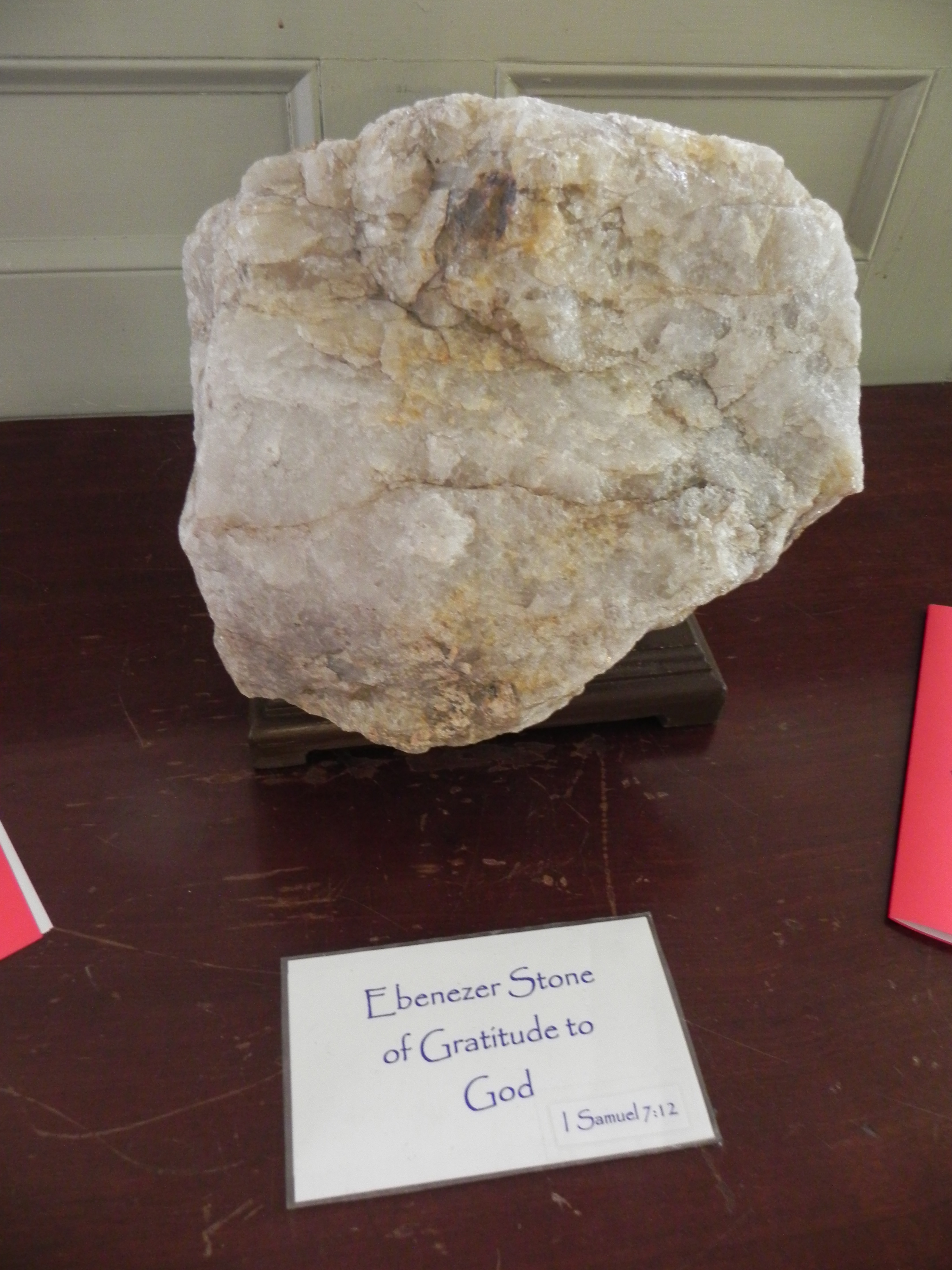
Baptists are a widely diverse group.  In the United States they are often guilty by association with the shenanigans of the Southern Baptist Convention, and given the numeric force of the Baptist Church that can appear a little intimidating.  Nevertheless, Baptists were (and generally are) great defenders of religious tolerance.  Their own non-hierarchical tradition allows considerable freedom within the denomination itself.  Houses of worship (originally meeting houses, not churches) were plain and devoid of symbolism.  That is still a hallmark of most Baptists today.  Inside First Baptist, I was surprised to see a symbol.  A chunk of rock, an Ebenezer, rested on the table at the back of the meeting house.  The origin of a “stone of help” (an adequate translation of “ebenezer’) is certainly biblical-the reference goes back to the story of Israelite victory over the Philistines in 1 Samuel 7.  Samuel is reputed to have set up the stone as a memorial of the unanticipated victory.  After that story, the stone never reappears in the Bible.

The Baptists have always been concerned with idolatry. They do make a point that some Christian traditions rely very heavily on trappings to get the message across.  They are also correct in that early Christianity was a much simpler faith than the densely layered, extremely complex, imperfectly blended varieties of religion that today claim the title “Christian.”  It isn’t a copyright-protected brand and there is little that all Christians could be said to have in common.  As I touched the stone of help, I realized not even all Baptists share the stringent standards of no symbolism in their churches.  That is probably a good thing, because that, in itself, is symbolic.


The Illustrative Man

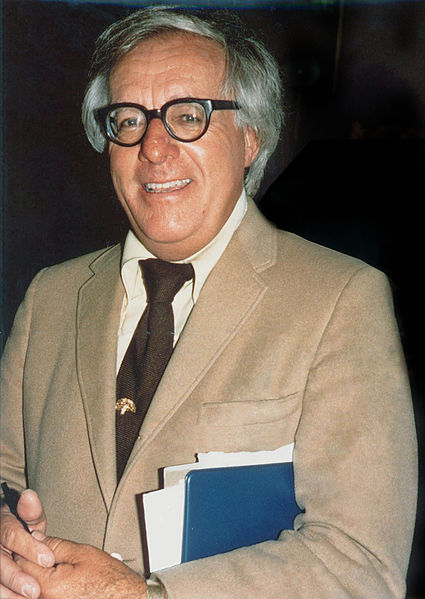
To a young boy growing up in an economically depressed small town without money to buy fancy things, escapist reading is a natural hobby. As with many boys, science fiction held my undying attention. My favorite writer was Ray Bradbury. His stories were short enough to consume in a single sitting, and they were full of wonder, and imagination, and possibility. I had nearly all of his books. So today, when I learned that Ray Bradbury had died, it felt as if another author’s works had been burned and the great man himself simply disappeared. Along with Edgar Allan Poe—whom I discovered early—and H. P. Lovecraft—whom I discovered late—Ray Bradbury represented what I believed a short story should be. I began writing short stories when I was in grade school. I still have a few of them, and the influence of Bradbury is most profound. At times it feels like the world is running out of dreamers.

Instead of churning out young people eager to explore the possibilities—and even the impossibilities—of the world, our educational system has become much more prosaic. We teach our young how to find jobs. Walking across Manhattan in a weary mood one morning it occurred to me: we go to college and we receive specialized training to make us fit for more cerebral jobs. We work those jobs in order to make corporate executives wealthier. Work benefits the one-percenters most. All the way to the office I dream of a life where I might have pursued creativity and exploration. I still awake before 4 a.m. every day to scrape together a few fragments of a moment to write before heading off to work in the big city. The characters I invent live in my head and die a subtle death as email and book proposals force their bossy way into my consciousness.

The worlds Ray Bradbury imagined were places where the familiar and the strange easily mixed. Many of his tales would be categorized as fantasy rather than science fiction today, but they manage to instill an almost religious reverence among those who believe paradise might be just over on that next unexplored planet. Or perhaps it will never stop raining there and the universe will drive us mad. When I “grew up” and needed to liquidate my juvenile assets, I sold most of my Ray Bradbury books to a used book dealer. Rarely a day passes when I don’t regret that impetuous move. And some days, such as today, I feel it especially deeply. One commodity that our fumbling world simply can’t afford to lose is its dreamers. On an unexplored planet somewhere out there, I know Ray Bradbury agrees with me.

From Wiki Commons


Haunted Pilgrim

No visit to Providence is complete without a tip of the hat to H. P. Lovecraft. As someone who dabbles in the noble art of writing, I have great appreciation for those who somehow made an impact (often only after they’ve died) on the literary world. I discovered Lovecraft only after I left Nashotah House, which was probably a good thing. Nevertheless, I have come to appreciate his breadth of vision, populating the earth with ancient gods who emphasize the powerful and heartless side of divinity. His vivid images of Cthulhu pervade popular culture to a level that few of the uninitiated would ever expect. And yet, deep in the depths he lurks. So when I was in Providence over the weekend for my niece’s graduation, I spent an afternoon seeking out some time with H. P.

Place inherently partakes of that we term holiness. Where something happened matters. There is no science to explain it, but it is something people know. It is for this reason that I try to visit the homes and resting places of classic writers. Over the years we’ve visited the haunts of Mark Twain, Laura Ingalls Wilder, Edna St Vincent Millay, Washington Irving, Edgar Allan Poe, and others, as well as H. P. Lovecraft. Simply standing in or near the places they once frequented provides a form of inspiration unavailable in any other way. So it was that I found myself at 598 Angell Street in Providence. It is a house still occupied, with no indication of who once called this building home. Lovecraft lived here from 1904 to 1924. If it weren’t for the Lovecraft walking tour I found on the Internet, I would have never known.

In many ways a provincial man, Lovecraft was born and also died in Providence. Apart from a stint in New York City, he spent his time in his hometown. I walked to 454 Angell Street, the address at which he was born. I knew the building had been razed in the 1960s, but I wanted to see what society deems more important than preserving those places that sequester the holy for haunted pilgrims. Although I couldn’t tell for sure, since house numbers change, I believe his birthplace is now the Starbucks that sits pleasantly in a small commercial district. I wonder how many of the thirsty realize where they’re sitting. Have they read any of Lovecraft’s stories? If so, are they uncomfortable sipping coffee in such a spot? Or perhaps it has become a kind of secular sacrament—a toast to all artists whose pasts have been obliterated.


Cthulhu’s Revenge

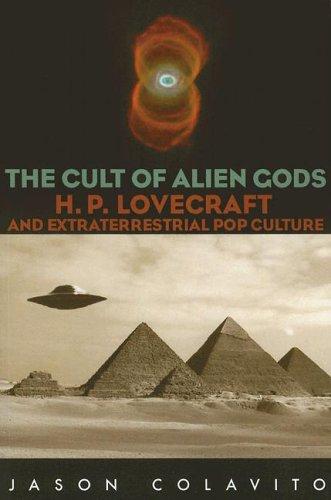
H. P. Lovecraft. Monsters. Aliens. UFOs. Ancient Egyptians. Sumerians. Is there nothing this book doesn’t have? Having read many of H. P. Lovecraft’s stories over the years, I have always been taken by how, as a writer, Lovecraft disappeared from public attention only to spring back in the 1990s. I discovered Lovecraft while doing research on Dagon, the putative “fish god” of the “Philistines.” Every time I typed the name of the deity into Google, I came up with pages and pages of Lovecraft. In my lonely room on a gray Wisconsin campus, I began to read his stories and shiver with fear as I walked across a dark parking lot to my car. Jason Colavito obviously has a great appreciation for Lovecraft as well, and his book The Cult of Alien Gods: H. P. Lovecraft and Extraterrestrial Pop Culture is a fun read for a November night. Colavito suggests that the “ancient astronaut” craze that has informed many a young mind stems back to Lovecraft’s fiction. Cthulhu and his ilk.

I’m not sure that Colavito convinced me that the ideas of ancient aliens began with Lovecraft, but he does an excellent job of exposing the foibles of many theorists who build houses of cards on shifting sand. One of the most interesting connections Colavito makes is that Creationism and Ancient Astronaut-ism are not dissimilar. “Both are, in essence, a concession that science is the ultimate arbiter of truth, and both seek to (mis)use science to give absolute authority to their beliefs” (331-2). This is an aspect of Creationism I hadn’t considered before. In the uncompromising desire for scientific respectability, the only option open is to bend science to the will of religion. This distortion must be carefully executed, convincing the followers that true science has validated a religious ideal. Rhetoric and occluding argumentation must be utilized carefully here. It seems Cthulhu has world domination in his squishy mind again.

Lovecraft famously gave us fantasy worlds where ancient space creatures left their impressions as gods upon a vulnerable humanity. Mysteries of the past—and Colavito doesn’t deny there are mysteries—are so easily explained by dei ex machina, and working with fantasy is so much easier than working with physics. To approach the mysteries with an answer already in hand, however, is to deny science its glory. As a civilization we owe much to a scientific understanding of the universe we inhabit.


Mystic Messiahs

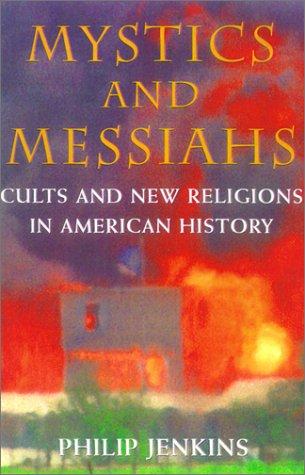
It is difficult to know where to begin when discussing Philip Jenkins’ Mystics and Messiahs: Cults and New Religions in American History. As a student of religion I early found myself drawn to the question of where religions begin. In the case of many religions we have an identifiable founder. Frequently that founder ends up being a god him (or more rarely) herself. In order for any putatively revealed religion to attain any credibility, the ultimate source must come from on high; God himself. So it is that we look askance at any religion that has appeared in the last couple of centuries, when, as we knew at the time, the earth was no longer the center of the universe and science had taught us to know better than to accept the old-timey stories of a god in the clouds. We can accept the ancient, time-honored stories, venerated as they are by centuries. If someone today tells us that God has spoken to him or her, we refer them to psychiatrists first, and then to the mind-altering drugs.

Jenkins, writing in the shadow of the tragedy of the Branch Davidians at Waco and the ritual suicide among the members of Heaven’s Gate (one of the members’ sons was one time a student of mine in seminary), tries to demonstrate that such groups are part of the fabric of religion. What is new in such movements is not the fact that they suddenly come into existence, or that society reacts violently to them, but that we now have a concept of “cult” to label them. Jenkins convincingly illustrates that fear of new religions stretches back for centuries. Even in the seventeenth century people experimented with new religions. When they survive, they become “churches.” Consider the Mormons, the Seventh-Day Adventists, and the Pentecostals. They all began as “cults” and are today considered just another variety of Christianity. Most adherents to religions do not inquire too closely as to the origins of their brand. Historically we know that the three denominations mentioned above are well under two hundred years old.

In a fascinating twist, Jenkins describes how the Zeitgeist of the early twentieth century was ripe for such developments. One of the sources, ironically, was the fiction of H. P. Lovecraft. His weird stories often invoked cult-like groups devoted to unusual practices that sometimes turned deadly. Also during that same time period, Christian Fundamentalism began as an effort to sort out what was “fundamental” to Christianity that set it apart from the cults (including Pentecostalism, now one of the most dominant Fundamentalist sects). As Jenkins points out, when these new sects become mainstream, they vehemently seek to destroy all new comers. Christianity began as a cult in the eyes of both Jews and Romans.

Religions are inherently conservative. As we will see in the approaching election, the religious background of a candidate plays a major role in public acceptability. We enjoy freedom of religion in the United States, but only to a point. Jenkins should be required reading for every religious believer. Tolerance would be the only proper and reasonable response.


Dream Quest

H. P. Lovecraft was a writer who remained unappreciated during his life but who has become a very influential literary figure after his death. So it is with artists. Known mostly for his short stories, one of the novellas he wrote, “The Dream-Quest of Unknown Kadath,” carries immense religious implications. Those familiar with Lovecraft’s fictional world know of the god Cthulhu and the “Other Gods” that he places in outer space. In “Dream-Quest” Lovecraft states that these Other Gods, “are good gods to shun.” While mere fiction, the concept of divinity has become pliable in the hands of its human author. Mortals are those who describe gods, those who decide what their deities will be like. The dream of the titular quest involves the earth gods having been removed from their shining city to leave the dark and dangerous other gods in charge.

While some would dismiss Lovecraft as overly inventive, his view of the earth being clouded by the crawling chaos Nyarlathotep strangely matches what we see playing out in the headlines. Those who are supposed to protect the masses, their leaders – elected or otherwise – have shown themselves to be interested in personal gain above all sense of duty. Throughout the world, and increasingly clearly in the United States, the working poor are seen as simple commodities easily manipulated and programmed to support those who would exploit them. Crawling chaos has landed.

Lovecraft’s “Dream-Quest” has a host of unlikely heroes, among them the cats of Ulthar. These cats maintain a true divinity appropriate for the descendents of Bastet. Feline divinity represents hope to Randolph Carter, Lovecraft’s protagonist. They also represent the tendency of the earth gods only to appear when most sorely needed, otherwise simply to set their own agenda. Where are the cats of Ulthar now? The problem with gods is they don’t always show up when you need them. Many dismiss Lovecraft as just another overly imaginative writer of cheap fiction, but to those will to listen carefully he was an author that could hear a very faint pulse. Even if that pulse was coming from under the floorboards to haunt a reality where the earth gods had gone away.

A little writer shall lead them


Son of Stone Flies

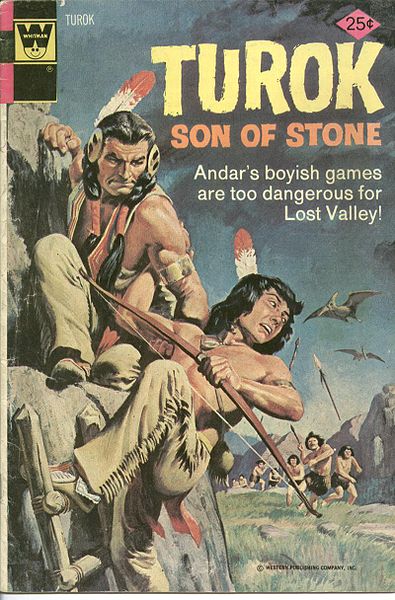
One of my favorite comic books growing up was Turok, Son of Stone. We couldn’t afford as many comics as our friends, but among brothers we’d share our resources and get a fair variety of reading material. Turok belonged to my older brother. It felt so ancient and sophisticated, tinged with primal urgency as Turok and Andar attempted to make their way from the Lost Valley where dinosaurs daily threatened their existence. The comics had a gravitas that even The Valley of Gwangi lacked. In one installment, a scroll-keeper joined Turok and Andar and claimed his sacred scrolls would show them the way free of this accursed valley. Turok doubted this and was rebuffed with “Fools scoff at what they don’t understand!” as their erstwhile companion decisively re-rolled his scrolls for storage in a handy leather pouch.

One pilgrim's progress

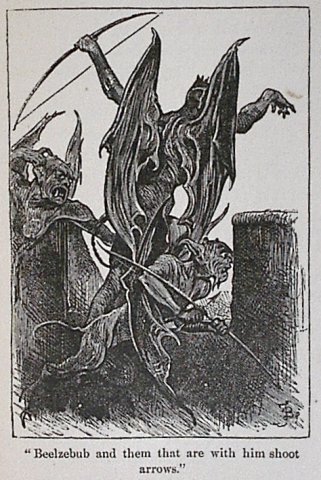
That image comes back to me when I think of how ancient writers sometimes used ridicule to castigate competing religions. It even happens in the Bible. A friend recently inquired into the figure of Baalzebub, the famous “Lord of the flies.” The Bible attributes worship of such a deity to the Philistines, the popular pagan foil of the children of Israel. The Philistines, as we know today, were a sophisticated group of Indo-European settlers on the coast of the eastern Mediterranean who showed up about the same time as the early Israelites were emerging from their “Canaanite” milieu. Since they didn’t practice circumcision and didn’t worship Yahweh, the Philistines were shackled with the worship of ineffectual fish-and-insect deities. (Dagon would never regain his proper significance until he was rediscovered by H. P. Lovecraft many centuries later.)

A different pilgrim's progress

With the discovery of the Ugaritic tablets, the common usage of the term zbl (let’s say zebul, so it can be pronounced) was clarified. Zebul commonly designed “prince.” One of the recipients of this honored title was the deity formerly known as Baal. Baal-Zebul, “Prince-Lord,” the great thunderer Hadad. From the sketchy evidence of Philistine religious practice, it seems the new-comers did adopt some of the gods of their new land, and perhaps among them the lordly Baal. In order to disparage the cafeteria choice of their neighbors’ gods, a biblical writer renamed Baal-Zebul, Baal-Zebub, Lord of the Flies. There have been other explanations for the title, but the lessons learned from our youngest days often furnish our adult interpretative lenses. This explanation makes sense to me, and it reminds me of a bit of wisdom from Turok, Son of Stone.


Evil Echinoderms

Ever since I can remember, I have longed for the ocean. Not a good swimmer, and not one to eat the myriad creatures that fill its immense waters, I find myself nonetheless drawn to its endless pounding surf and salt spray. Even before I’d read Rachel Carson’s The Sea Around Us, discovered the eternal fascination of Herman Melville’s Moby Dick, or had even heard of H. P. Lovecraft, I knew that I belonged to the ocean. It need not compete for my affection. It had already won. With family visiting this weekend and with an unseasonably warm March weather-system, we went down to the Jersey Shore yesterday to visit my old friend. Sandy Hook is a peninsula that juts up from New Jersey toward New York City, a sandbar of undeveloped free ocean access administered by the National Park Service. During the summer it can be intensely lined with fishermen and sun-worshipers, but in March it was a reasonable place to be. Sea creatures are abundant when left alone, and we saw our first harbor seal of the season, along with a galaxy of sea stars. These echinoderms had eluded me thus far; we’ve been to the shore several times during our Jersey days and had never discovered any. One large sea star had been stranded in an evaporated tide pool. Compassion overcame me and I carried it down to the surf to offer it a chance for continued survival.

Miserable sinner?

Recently I reread Jonathan Edwards’ horrific yet classic sermonic masterpiece, “Sinners in the Hands of an Angry God.” Vividly depicting a furious deity barely capable of restraining his repressed wrath directed toward wicked human beings, but for an uncommon dose of misplaced compassion, Edwards suggests we all deserve ghastly destruction. Edwards underscores one of my recurrent observations about religion – it is a means of control. The great Puritan divinity only accepts penitent Puritans, all others go directly to Hell, not passing Go, not collecting their two-hundred dollars.

As I held that helpless sea star, destined for the cruel, drying rays of an unclouded sun, I did not think of its multiple transgressions. Murderous predators, sea stars consume other sea creatures, including their own kind, in the constant struggle for survival. This one had obviously had a successful run and had grown to an impressive size. I felt no rage, no desire to destroy this killer. Instead, I saw a radiant example of a being evolved to live in an environment that I can not even comprehend, just doing what it needs to get along in its undersea world. And I recognized the wrath of God for what it really is – one man’s unfulfilled plan to decide the destiny of his fellow creatures.


Horror and Head-colds

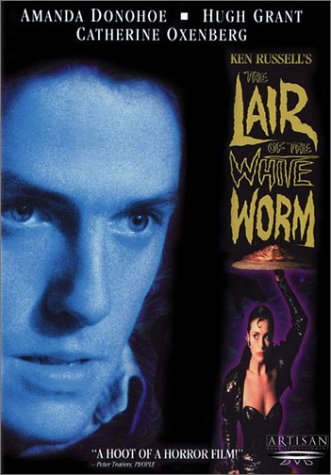
Religion is such a pervasive vehicle for movies, whether disguised or blatant, that pointing out such connections might seem too easy. Finding these connections in horror movies is child’s play since religion constantly probes our deepest fears. Trying to get over a lingering head-cold and suffering from lack of sleep, I pulled out Ken Russell’s 1988 film, Lair of the White Worm. The film itself is not unlike a Nyquil dream, disjointed with sudden shifts of setting and context. The immediate connections with The Cult of the Cobra and Stuart Gordon’s Dagon – based on H. P. Lovecraft – were unexpected bonuses.

Through all of the B- special effects pulses a strong religion subtext. The crucifixion vision juxtaposed with Roman soldiers raping nuns was a dead giveaway. The supporting female characters bearing the names of Eve and Mary could not be more obvious. And the snake wrapped around a tree – is this Sunday School 101? Lacking the sophistication of Robin Hardy’s Wicker Man, Lair of the White Worm nevertheless does strike some similar religious chords. When archaeologist Angus Flint discovers a Roman temple dedicated to Dionin under a convent in England’s north-country, a mosaic of the great white dragon wrapped around a cross tells the viewers all they need to know.

Like Marduk, Baal, Yahweh, Zeus, and St. George, Lord James D’Ampton becomes the dragon-slayer. Chaoskampf (god slays dragon motif) is perhaps the most ancient form of religion, alongside the world-wide flood and dying gods returning to life. These archetypical images populate many films to the point of saturation and Lair of the White Worm is a treasure trove of them. The plot successfully invents an ancient deity, Dionin, whose name and cult have clear connections with that of Dionysus, himself a dying and rising god. This religion is in conflict with Christianity, and the film is opaque enough not to reveal the winner. I need to ponder this some more. In the meantime, I think I need another dose of Nyquil.

Take it with a dose of Nyquil


A Sigh for Cybele

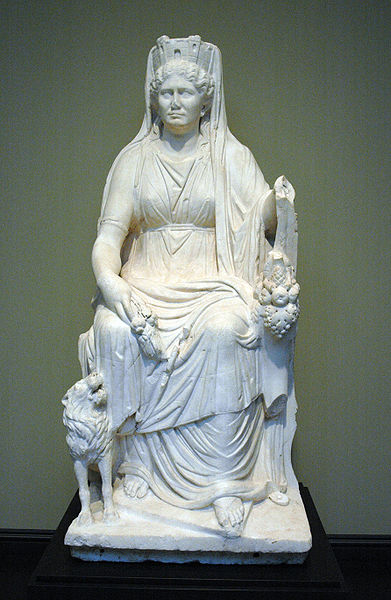
As we fall out of the holiday season into that distinctly chilly and sometimes cheerless February, Cybele comes to mind. Over the past several weeks I have added posts focused on the holidays associated with December and January. In the course of my research for a children’s book on American holidays (not published), I was astonished at how frequently Cybele appeared among the origins of current holiday practices. Having researched ancient Near Eastern mythology long enough to complete a doctorate in the field, and to write a book on an ancient goddess (Asherah), the lack of reference to Cybele in my sources was unexpected. I pushed this question mark to the back of my mind, but as I was reading H. P. Lovecraft’s story “The Rats in the Walls,” I found Cybele once again.

Cybele eventually became a major Roman goddess, although she was never among the Greek Olympians. Her importance shows in her connections with several Roman festivals and practices of antiquity, some of which have survived even to the present. Greco-Roman adherents to Cybele worship considered her to have been of Phrygian origin. Many scholars, however, see in her name and character echoes of a Semitic goddess named after Gebal, or the native name for Byblos in Phoenicia. If so, she is one further piece of the puzzle connecting the classical world with that of the fertile crescent.

Wikipedia Commons Cybele

A standard title for Cybele was Magna Mater, or “great mother.” As such, she was frequently associated with the earth itself, widely considered to have been a primordial female deity in the ancient Near East. In many respects she resembles Asherah, although the two are never explicitly identified. In myths where she is associated with Atys (later Attis), she becomes the spouse of a “dying and rising god.” She is prominent in festivals around mid-March, at the time of the renewal of fertility in the Mediterranean basin. Matronly, stolid, and powerful, Cybele lurks in the background of religious sensibilities. Her association with spring offers something to look forward to as the overly long, yet short, month of February starts to become visible.


Birds of a Fang Suck Together

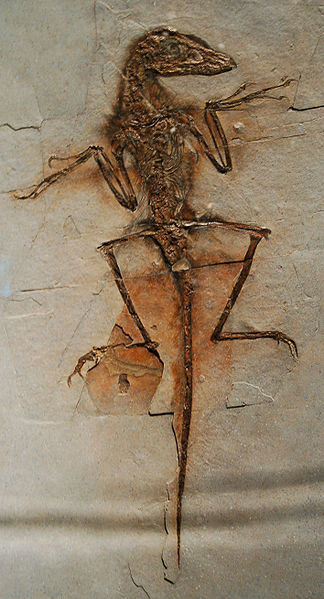
It reads like a cross between a Hitchcock movie and a Lovecraft story — paleontologists have unearthed a fanged bird fossil from the Cretaceous Era. Despite the cartoonish images this news flashes into my head, the startling find also suggests that this turkey-sized predator was also venomous. The first known ancestor to the avian family that used poison to immobilize its victims. A venomous bird.

Don’t let the cherubic Sinornithosaurus fool you! (From Wiki Commons)

Martin Luther is rumored to have said that you can’t prevent birds from flying over your head, (but you can prevent them from nesting in your hair). This new discovery suggests that there might be poisonous birds hovering around out there. And of course, Creationists must make room on the ark for this extraordinary creature. Since all critters, according to Genesis, were on the ark, our Sinornithosaurus must have lurked in some dark corner. I wonder how old Noah classified them — were they nestled among the birds or were they roaming about in the dinosaur wing? These toothy pterosaur wannabes were closely related to the velociraptors and microraptors that once served as the tetrapod mosquitoes of the Cretaceous Park world, stealth biters who’d glide down upon you undetected. The Creationists railing against transitional forms are scratching their theologically inclined heads.

I welcome the discovery like an early holiday gift. Although no one will ever see a living poisonous reptilian turkey soaring down from a Cretaceous canopy, we can all wonder and imagine. Fangs bared, venom dripping, it drops into our comfortable world and makes us reconsider. Apparently poisonous birds did not make the evolutionary cut, but I, for one, will be keeping a closer eye on the sky when I’m out in the woods or jogging around town early in the morning.


The Call of Balu

After writing a post on Natib Qadish, a modern revival of Canaanite religion in the United States, I received some comments from Lilinah of Qadash Kinahnu, another modern Canaanite religion revival. These movements are a fascinating development in an overly technological era — both movements have online resources that include serious scholarly treatment of ancient religions of the Levant. Both appear to be sincere attempts to get in touch with what modern religions seem to have lost. Both have heard the call of Balu.

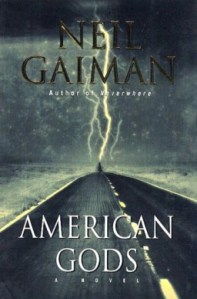
In a society where universities seldom offer programs to study the Ancient Near East, people are starved to know about it. I realize that the field of study will never bring in the money that the sciences or finance do, but obviously there is something deeply satisfying about it. And students are hungry for it. Not only appreciated by those who start revivals of ancient religions, many of those who read more recent popular treatments are intrigued. Neil Gaiman’s American Gods was a New York Times bestseller. Although much belatedly, H. P. Lovecraft’s Cthulhu Mythos has become a paradigm for many undergraduates I’ve met. I was reminded of this as I watched Stuart Gordon’s 2001 movie entitled Dagon. A relentlessly tense and macabre film, the Lovecraftian base assures a constant draw for those who hear the call of the ancient deities.

We love technology. I’m posting this entry on an internet where ideas are simply electrons forced into recognizable patterns. We can’t imagine what life was like before being able to communicate with people just about anywhere in the world instantaneously, and where we can live our entire lives without ever actually touching physical money. Over all the noise of technological progress, however, can be heard the distinct call of Balu — a call to a simpler era, pre-Christian, pre-Judaism, pre-Iron Age. It was an era when human destiny fell into the hands of ancient gods.


Death of the Gods

Americangods

Ancient gods surround me these days. Surely part of it is due to having recently finished Neil Gaiman’s American Gods (I know I’m a few years late on this, but novel-reading time is at a premium even when teaching only part-time). Gaiman’s not the first to have taken on the theme of “what if ancient deities still survived?”. As a child I read Lester del Rey’s Day of the Giants with its science-fictionalized version of Ragnarok, and even earlier H. P. Lovecraft had resurrected Dagon and Cthulhu. Gaiman’s treatment, however, is contemporary and is a barometer of how the old gods are faring these days.

Dark and witty, Gaiman’s treatment is a fun-house ride through the fanciful concept that old-time gods and folk-heroes emigrated to American with their believers. The resulting adventure brings a multi-cultural mix of supernatural powers that end up mostly focusing on the Norse mythological cast. Same was true of del Rey — the Norse mythology reflects a stark world of raw power, betrayal, death and resurrection, that resonates with northern European experience. Anansi and Chernobog also take starring roles in American Gods, although the only ancient Near Eastern deities with any prominence in the story are the Egyptian Thoth and Anubis in supporting roles.

Casting an eye over the American landscape, this assessment is perhaps true to life. Ancient Near Eastern deities seem so distant and unfamiliar. Gods long dead. Despite recent movements to revive the worship of Mesopotamian or Canaanite deities, their powers seem to have dissipated at the middle of the first millennium B.C.E. as Yahweh gained a prominence he has never relinquished, and the Greeks and Romans paved over the graves of Ninhursag and Yarikh with European versions of the more prominent West Asian gods. Universities reflect this lack of knowledge with slowly dying departments of Ancient Near Eastern studies. Like Gaiman suggests, America seems to have gone after the more modern gods suited to our present-day lifestyle.