Cat Curse

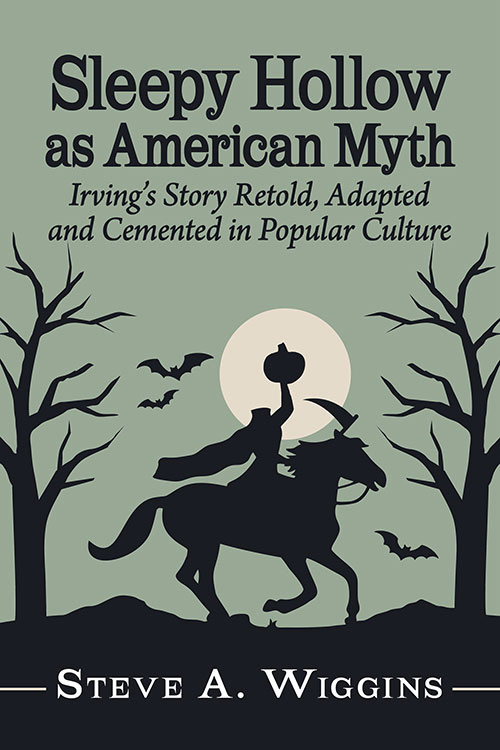
In researching Sleepy Hollow as American Myth, I watched every feature-length movie of “The Legend of Sleepy Hollow” that still exists.  I also watched many other productions, based, however loosely, on the Legend.  I was unaware that The Curse of the Cat People should’ve been included.  There is no database of all cultural references to Sleepy Hollow, and although Curse of the Cat People has many fans, nobody advertises it as related to the Legend.  But it is.  I happened to watch this 1944 film because I’d been thinking about Cat People.  My jaw dropped when the film opened with a teacher taking her children on a walk and explaining that this was Sleepy Hollow.  My book had been published just last month and I was discovering new material!  The movie is a bit disjointed, apparently because studio executives wanted new material added and some of the edited pieces explaining the story were lost.  Still, it is well worth seeing.
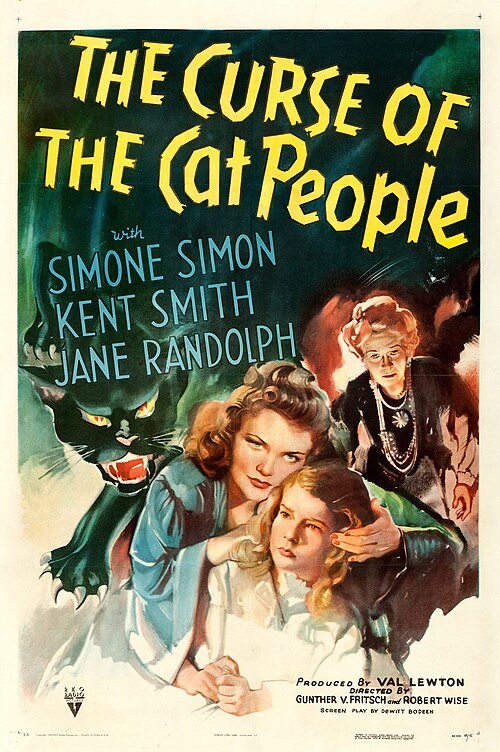
Six-year-old Amy Reed has no friends.  A daydreamer who has a rich fantasy life, she frightens her father, Oliver, who had been married to Irena—one of the cat people.  Oliver never believed Irena was really a cat person and is afraid his daughter is suffering under similar delusions.  This is because Amy is given a ring that grants wishes by an old widow who tells her a version of the Legend of Sleepy Hollow.  The wish Amy makes is for a friend and Irena, the ghost of her father’s first wife, shows up.  There are no cat transformations here, but there is a great deal of psychological subtlety.  Is Amy really seeing Irena or is her loneliness filling in the voids in her life—her father is distant and refuses to accept what his daughter tells him. Instead he punishes her for it.

When Amy gets lost on Christmas Eve, Irena saves her from the murderous daughter of the widow who gave her the ring.  It’s clear that some of the connective tissue is missing, but the story is sincere and smart, even if only very loosely a sequel.  The story of the headless horseman, pre-Disney for those of you who’ve read my book, presents the horseman as collecting unwary wanders on the bridge and compelling them to ride with him.  He’s not after anybody’s head.  Indeed, this is the way he’s described in Irving’s story.  Just as I’ve begun collecting films for Holy Sequel, it looks like I should begin keeping a list for Sleepy Hollow as American SequelCurse of the Cat People will be first on the list.


Painting Sleepy Hollow

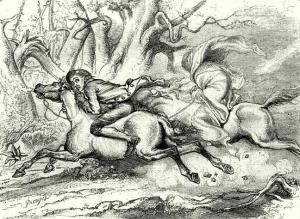
Not being an art critic, I’m in no place to analyze John Quidor’s The Headless Horseman Pursuing Ichabod Crane.  Having written a book about Sleepy Hollow, however, there are a few things I might point out.  I should begin by noting that this post was spurred by a jigsaw puzzle.  Normally I only work on said puzzles around Christmas time.  Several years ago friends told us about Liberty Puzzles.  They’re made of wood and are heirloom quality.  My wife took the hint and she generally orders one, on behalf of Santa Claus, each year.  We have a few now but since we only do them once a year (and usually only one of them at the time), I had forgotten that we had a Liberty Puzzle of Quidor’s painting.  The original is located in the Smithsonian and I really didn’t discuss it in my book.  The painting is dated 1858, almost forty years after the publication of Irving’s tale, but while Irving was still alive (he died the next year).

John Quidor, The Headless Horseman Pursuing Ichabod Crane, public domain via Wikimedia Commons

The painting is correct in displaying a pumpkin that isn’t a jack-o-lantern and it presents one of the obvious difficulties of painting a nighttime scene.  The painting is fairly dark.  One of the benefits of working on a puzzle like this is you look closely at the scene.  My first thought was that it seems odd that the lightest part of the painting is Gunpowder’s rump. Next is the path.  The path draws the viewer’s eye back to Gunpowder and an understated Ichabod Crane.  I realized that the lighting is meant to reflect the moon’s rays, as the orb is just peeking through the clouds at the upper left.  And, of course, Quidor was not painting from real life.  On the right lie some small buildings, including the Old Dutch Church.  The Headless Horseman blends into the dark, which is exactly how Irving describes him in the story.  There’s no bridge, however, at least not yet.  All of this matches the wording of the legend.

Quidor painted mostly scenes from Washington Irving’s works.  Having been born in Tappan, during Irving’s lifetime, that makes sense.  He was also painting before the Disney cartoon came out.  One of the cases I make in Sleepy Hollow as American Myth is that the image most Americans have of the story comes from Disney.  The painting has no sword, and indeed, neither does Irving.  The one dramatic effect Quidor allows is the raising of the pumpkin before the bridge.  That takes place later in the chase.  In a sense this painting is perhaps the most authentic visual interpretation of Irving’s story before it made the transition to celluloid.  It’s puzzling.


Naming Sleepy Hollow

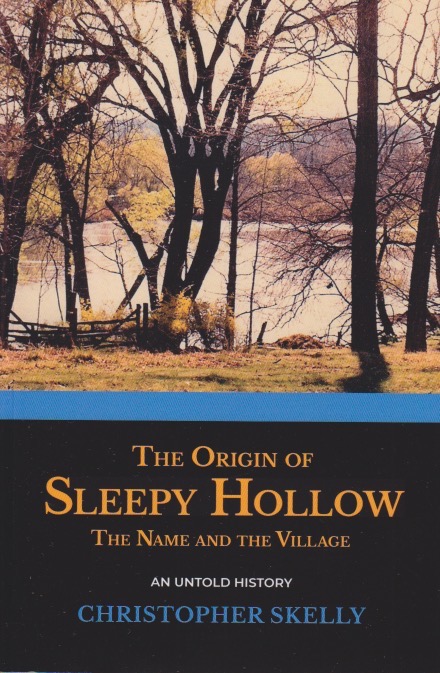
Local history has always been an interest of mine.  Although I’ve never lived in Sleepy Hollow, my book on “The Legend of Sleepy Hollow” is due out this week.  I try to keep an eye out for further information on the region.  Christopher Skelly’s The Origin of Sleepy Hollow: The Name and the Village, an Untold History appeared after I’d submitted my manuscript to McFarland, but I wanted to read it regardless.  A new father living in Wisconsin at the time, I was not aware of the name change in 1996.  I do remember looking at a map after we’d moved to New Jersey and seeing, for the first time, the name Sleepy Hollow along a route we planned to take to a point further up the Hudson.  I remember thinking, “I didn’t know there was an actual place called Sleepy Hollow.”  Well, that may have been because prior to 1996, there wasn’t.

This self-published account of how the name came about is valuable local history.  Not exactly belles-lettres, it nevertheless begins at the earliest Dutch naming of the area as the Dutch version of Sleepy Hollow.  By the time Washington Irving wrote his story around 1819, the area had already gone by several names but the village of Tarrytown was well established.  And, over time what was vaguely called Sleepy Hollow by the Dutch became North Tarrytown.  I learned here that the haven, or harbor on the Tappan Zee that was first called some version of “Sleepy” had been the victim of landfill so that a railroad could be put in.  The author is clear that the “Hollow” is still visible if you know where to stand and look.  He also explains the motivations behind changing the village name that began in 1988. 

One things I learned in my own study of ancient history is that place names tend to be remarkably resilient.  European settlers ignored much of the indigenous nomenclature, but did adapt many examples of it.  Our species needs to reference where things, or other people, are over very large distances.  We know where Edinburgh is, even if we live in Australia.  Names are important.  Personally, I’m glad that some citizens of North Tarrytown decided to change the name of their village to Sleepy Hollow.  And not just because I have a book coming out on the topic.  I’m sure the change has boosted tourism immensely, even if that wasn’t the initial motivation.  It’s nice to know that the change was actually back to the first Dutch ideas about the place.  And that a visit to Sleepy Hollow is possible because of one influential little story.


Dead, Not Sleeping

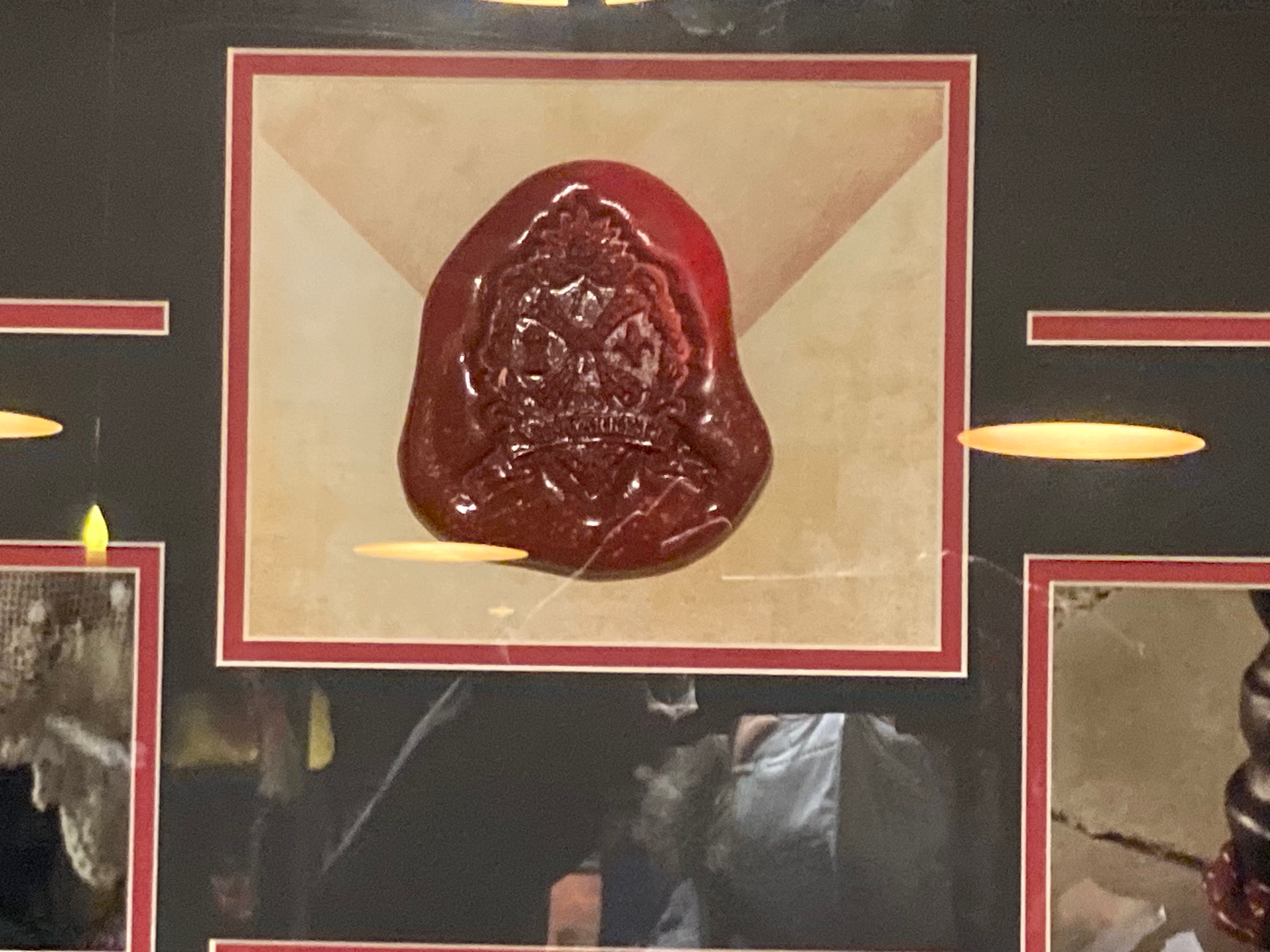
A Nightmare in New Hope is a fairly intimate space.  The owner told us that the collection will change and grow, given that he’s still collecting.  Having a particular interest in Tim Burton’s Legend of Sleepy Hollow—having a book (ahem) on the subject coming out soon (cough)—I was particularly anxious to see what props they had.  To make sense of this it helps to have seen the movie, but you’ll catch on, even if you only know the Disney version of the story.  There were three main items from the movie that they have on display.  One is the wax seal used for the Van Garrett will, used as the movie opens.  The seal is quite large.  Of course, movies substitute props from time to time, blended by celluloid magic.  CGI doesn’t leave as many tracks.

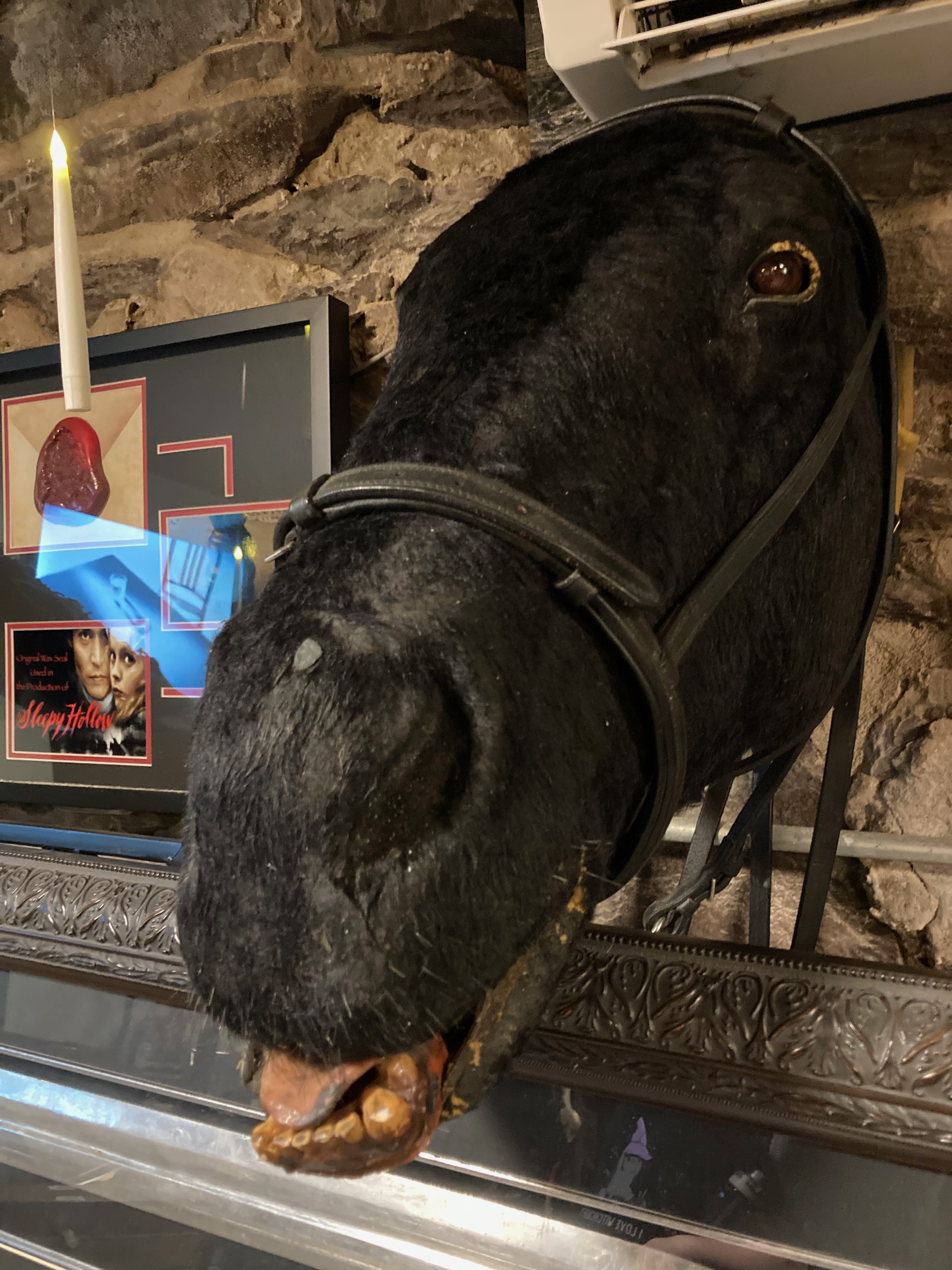
The second artifact is one that wouldn’t have occurred to me to have even existed.  This was the animatronic horse’s head for Daredevil, the Headless Horseman’s mount.  There are a couple scenes in the film involving horse acting, and I’d just assumed that trained animals were used.  Being up close and personal with this artificial head, a couple thoughts came to mind.  One is that right next to it, it’s quite obvious that it’s artificial.  The second thought was just how much thought and effort goes into a big-budget movie.  For a few seconds of a close-up horse head, this model had to be constructed and used and then set aside.  I asked the owner about how such things were acquired, and he noted that production companies don’t keep everything.  He also noted that movie artifact prices have skyrocketed.  Both because horror is now popular and because CGI, as noted, doesn’t leave tracks.

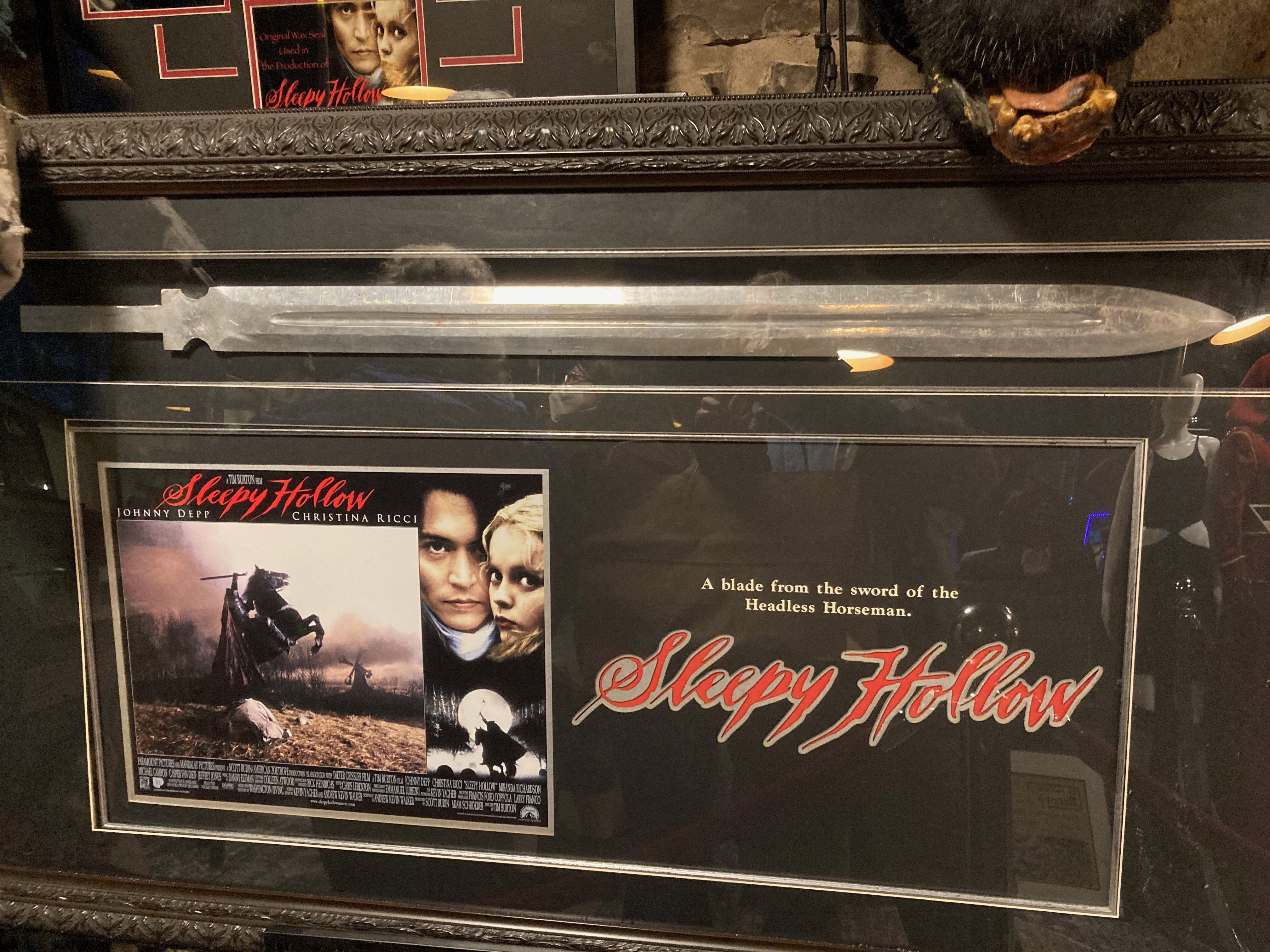
The third, and most proudly displayed Sleepy Hollow piece is the Headless Horseman’s sword.  This appears in the movie far more often than either Daredevil’s head or the wax seal.  One of the aspects of Washington Irving’s story I discuss in Sleepy Hollow as American Myth is that the Horseman’s weaponry changes over time.  I won’t say more since, like museum owners, those who write books hope that they well sell a few copies.  I’ll be revisiting A Nightmare in New Hope from time to time.  For the items on display, I’d seen probably 90 percent of the movies, and a few of them I’d discussed in some detail in either Holy Horror or Nightmares with the Bible.  Of course, the Sleepy Hollow book is forthcoming (ahem).


Still Sleepy

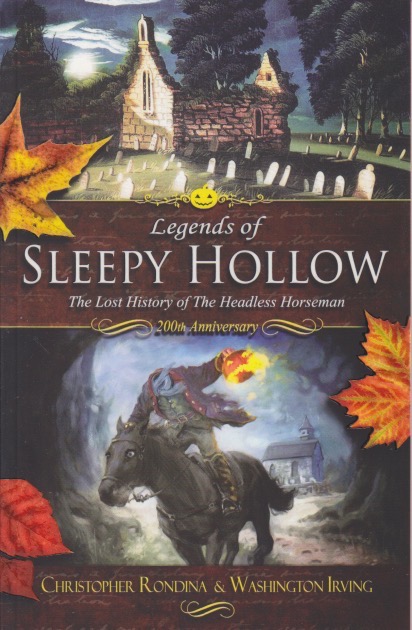
One thing I quickly learned when beginning work on Sleepy Hollow as American Myth was that the story hadn’t really been studied too much by those with academic training.  There are some exceptions, of course.  Another thing I swiftly picked up is that many people who wanted to write on the legend chose the method of publishing the public domain story with a variety of annotations, essays, and other additions, to make a salable book.  Often these are self-published and not always immediately obvious to the researcher as to whether they contain anything important or not.  I had not run across Christopher Rondina’s Legends of Sleepy Hollow: The Lost History of the Headless Horseman until well after my manuscript was submitted.  I found it in the bibliography of a ghost-hunter version of Sleepy Hollow that wasn’t even published by the time I was going into production.  (It doesn’t even have an ISBN.)

I do have to say that Rondina’s variety of this composite genre isn’t bad.  He includes Washington Irving’s story and expands it with an introduction, and brief chapters considering any historical background that there may be.  He also adds a chapter on modern media of the story that includes one television adaption that I failed to find for my book.  Interestingly, after I’d written the manuscript I discovered Joe Nazare’s similarly annotated version, also with a number of the media I’d analyzed in it.  I’d actually corresponded with Nazare earlier, having discovered his website.  Not wanting to discuss what my book was about until after I sent it in (others have more time to write, perhaps, than I do) I didn’t mention our common interest and didn’t discover his annotated version until it was too late to include as a conversation partner.

Self-publication has perhaps become inevitable since standard publishing is difficult to break into.  And the internet gives anyone the ability to self-publish without too much effort.  It does, however, make doing research a bit more difficult.  I determined early on that I could not review every annotated version of Irving’s story.  I selected a few of the most promising and moved on.  Both Rondina and Nazare had interesting things to say about the tale, and it’s a pity that they weren’t discoverable until after the fact, at least to me.  I like to give credit where credit is due, but any ideas that seem similar to these two sources in my book will have to stand as examples of convergent thinking on the part of fans of the “Legend of Sleepy Hollow.”  I know there are many other fans out there and I hope they find the resources they need to understand the story just a bit better.


Seasonal Poe

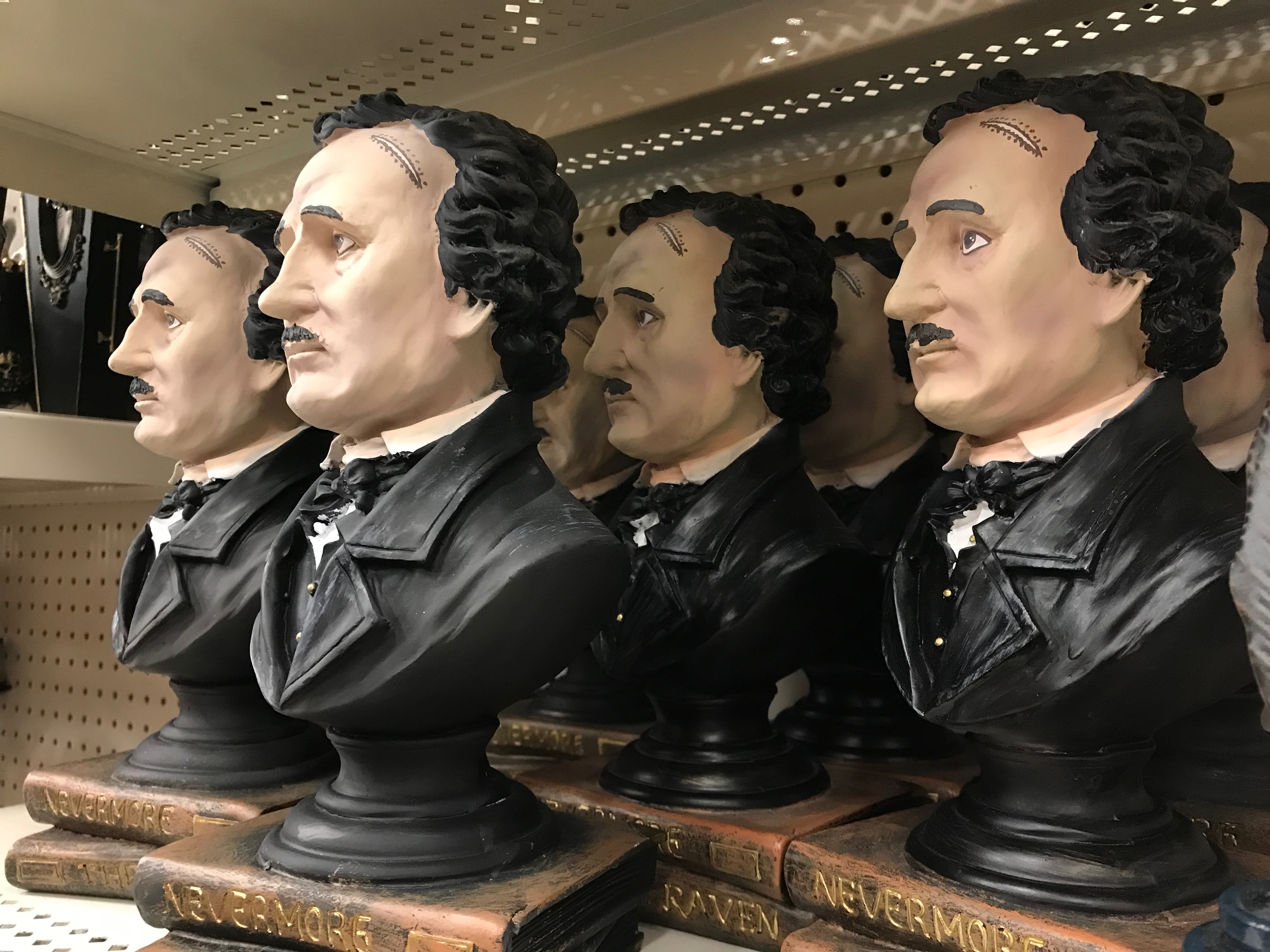
The more I read of and about Edgar Allan Poe, the more convinced I become that he wasn’t as associated with horror in his own mind as he has become.  As one of the earliest American writers, he has become the icon of those who wrote on the dark side.  His contemporaries—Washington Irving, Nathaniel Hawthorne, and Herman Melville—did as well, but it was Poe who became iconic.  On a recent trip to Michaels to take in the seasonal ambiance, Poe’s presence was difficult to ignore.  I wasn’t prepared to shoot a photo-essay (I’m not sure how they feel about such things in a store, in any case) so I didn’t photograph all the pieces.  “The Raven” is frequently referenced, with typewriters with the poem emerging and large, ominous black birds about, but Poe himself also appears.  There are, of course, painted busts of Poe.

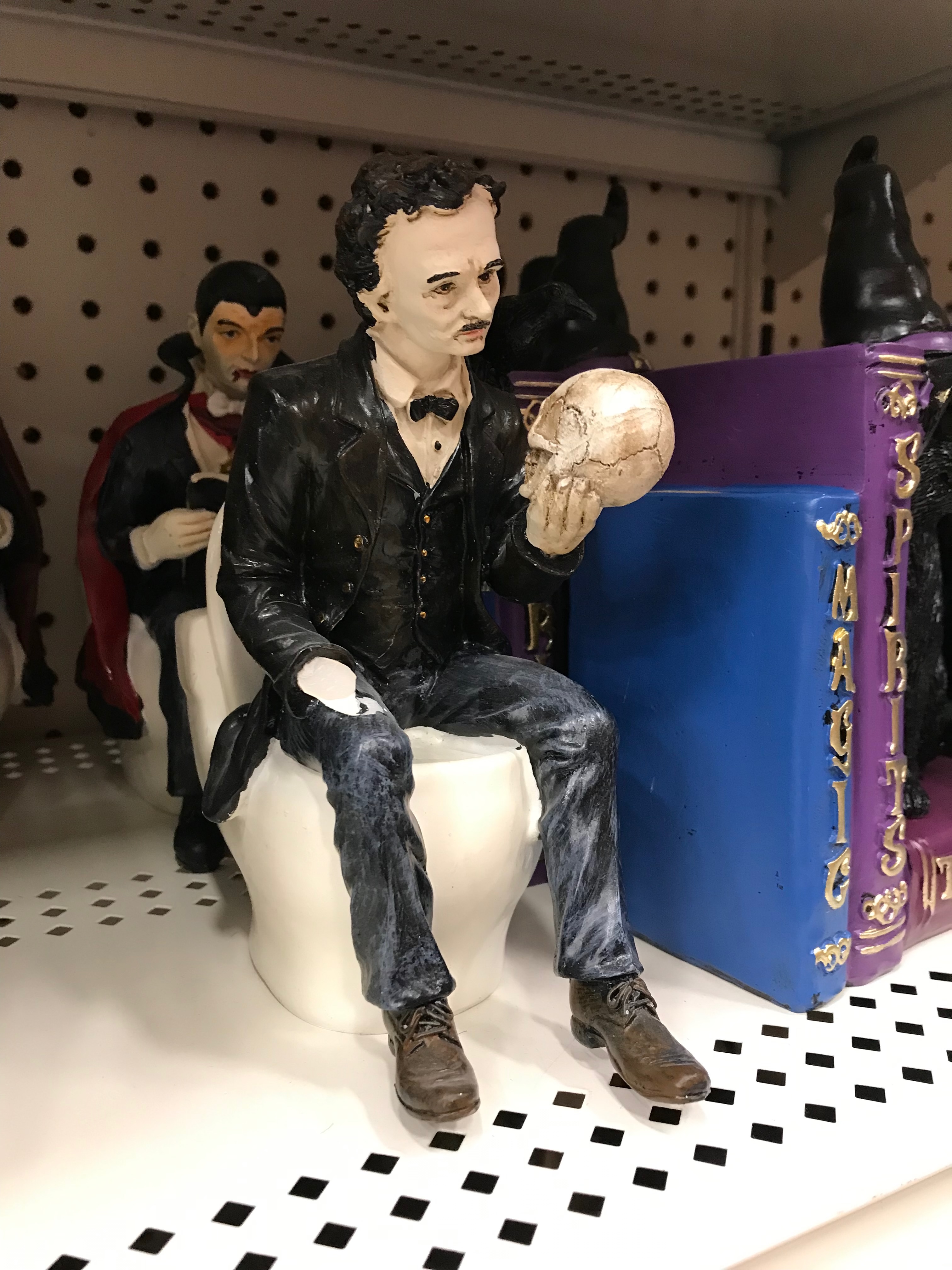
But Halloween has grown more whimsical over the years.  Arguably for my entire life it has been primarily a children’s holiday, but many have noticed that those of us who grew up with Halloween have retained adult interest in it.  Part of this is no doubt commercial since the captains of industry have learned people will spend more on Halloween than any other holiday except Christmas (I do discuss this in my forthcoming book).  And indeed, the Headless Horseman appears quite a lot as well.  Irving, however, isn’t there on the ground.  Poe is.  The whimsical part comes through in showing the humor of the season.  For example, although Poe is shown in the noble bust format, he’s also portrayed (fully clothed) on the toilet.

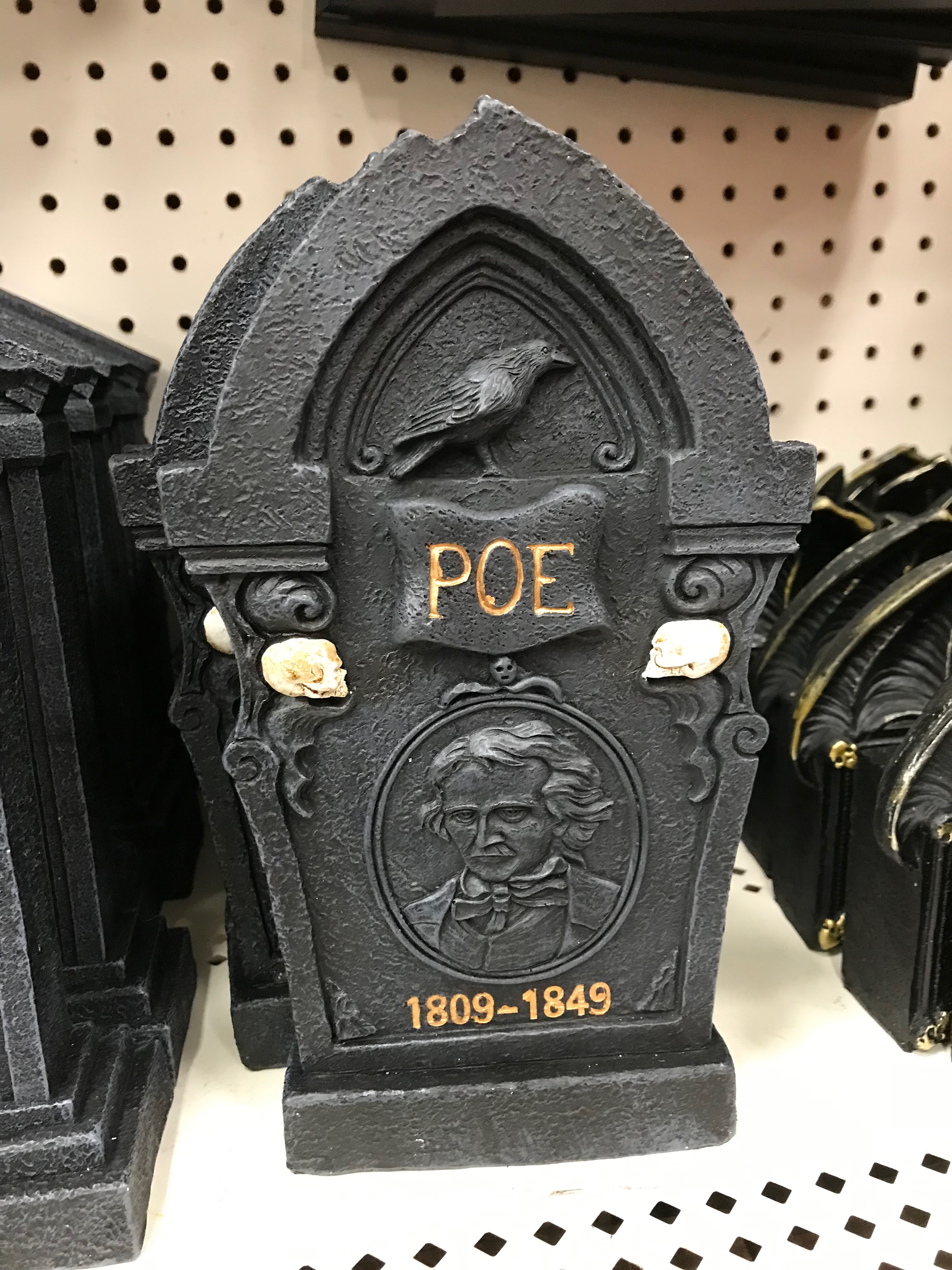
Finally, there were figurines of a fanciful tombstone of Poe.  They even got the dates correct.  Now, there’s more to be said regarding the comparison with Irving.  You can find the Headless Horseman on the toilet as well (along with Dracula).  You can find the Horseman in bust format as well.  When it comes to tombstones, however, the fictional Ichabod Crane shows up alongside the nonfictional Poe.  That casts a certain light on Irving’s most famous story.  I’ll save that for another post, however, since authors are expected to repeatedly plug their books.  I left Michaels strangely reflective.  Poe-themed merchandise is fairly typical any given year, but since we’re having our first Halloween party in some years, and since I’ve been exploring Poe’s range as a writer, this clear abundance of Poe as an icon gave me pause.  As if I were coming within view of the melancholy house of Usher. 


Prosthetic Horse?

Old habits die hard.  As a young researcher, I was dogged about reading everything possible on a subject before writing on it.  Both the profusion of information and the endlessly ticking clock of mortality now suggest that if you want to say something, say it.  You need to do a reasonable amount of research, but you’ll never read everything.  This is the kind of thinking I should’ve heeded before spending a couple of bucks on Headless Horseman.  I should specify, the 2022 film by that name.  The name has been used before and it has an unspecified coding.  Often it has to do with Washington Irving, but not always.  A 1972 Russian film by Vladimir Vajnshtok is titled The Headless Horseman, but it has to do with a completely separate story.  In any case, Jose Prendes’ 2022 film isn’t what you expect.

Sophia, a girl with a former boyfriend who’s a drug dealer, gets engaged to Brandon.  He’s not too bright, but he’s clean.  When her ex, named Angel, tries to kidnap her back, Brandon dies defending her.  The Devil shows up and a deal is made.  Brandon has 24 hours to kill the gangsters.  He’s given a bladed glove (where have we seen that before?) and a burning jack-o-lantern head (ditto?).  Did I mention this all happens on Halloween?  Well, Brandon just isn’t up to killing people and he fails in his mission, defeated by bad guys with holy water.  So Sophia sells her soul to get Brandon back.  She manages to kill the thugs, but gets shot in the process.  Brandon make a third counter-offer with the prince of darkness, to harvest souls.

The pacing for the film is all off.  The writing is about the worst I’ve ever heard.  Someone being sucked to Hell stops to discuss semantics with his girlfriend?  Really?  And not only that, the special effects are sparingly used.  You’ve got a flaming pumpkin head—use it!  I guess part of me felt cheated by the premise that never materialized.  The “headless horseman” isn’t trademarked, nor can it be copyrighted.  It does, however, convey an expected story that viewers know.  The point of this effort seems to be, if you sell drugs you’ll ultimately get yours.  Those who are innocent will also get theirs, although perhaps will remain on Satan’s good side.  For all its faults it does demonstrate how religion and horror play well together.  Even when they haven’t much good material to work with.

John Quidor‘s The Headless Horseman Pursuing Ichabod Crane

Hollow

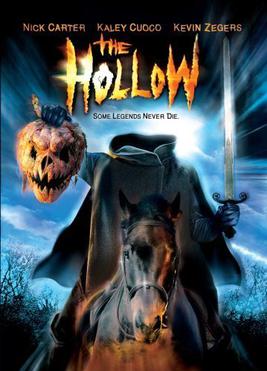
Now that we’re officially in September, it’s kosher to talk of Halloween horror (I’ve seen Christmas decorations in the stores already).  Well, around here we don’t really need an excuse, but since it’s handy I’ll use it.  Regular readers know I’ve been on a Sleepy Hollow kick lately, and I’d been wanting to see The Hollow.  Released as an ABC television movie, it had a fairly modest budget of only about $900,000 but managed to pull in stars with name recognition.  A pre-Penny Kaley Couco also appears as the new version of Katrina Van Tassel.  Let me back up a bit.  This is set in the present day.  Halloween eve.  Karen (not Katrina) is watching a Sleepy Hollow retelling being done by Ian Cranston, but her bored escort, Brody (Brom, anyone?), goes to the graveyard instead with some of his friends.  Two of them are killed.  Oh yes, there will be spoilers.

It turns out that Ian, who’s just moved to the area, is the last remaining descendant of Ichabod Crane.  You see, after Ichabod fled, and settled in New York City, he changed his name for fear that the Horseman would find him.  Now that a Crane is back in town, the Horseman rides again.  The teen-rivalry between Ian and Brody plays out at Karen takes a shine to the newcomer.  A descendant of Hans Van Ripper, who unaccountably talks like a pirate—lots of “ye”s thrown in—realizes that the Horseman’s after the young Cranston.  Since he’s the town drunk, though, nobody really believes anything he says.  On Halloween the town has a haunted hay ride in which each side of the love triangle is involved.  Brody plays the Horseman, but suddenly there are two of them—uh oh!

Cranston, who’s on the fencing team (to the everlasting shame of his football-coach father), is able to engage the fiend in swordplay and eventually destroys him.  He gets the girl and impresses his father all in one predictable way.  There are some laughs along the way, but for the most part this is played as teen drama.  Some racy scenes (and head-chopping) led to an R rating, but there’s little that’s surprising here.  For anyone who’s interested in the various ways Washington Irving’s “Legend of Sleepy Hollow” has been repackaged over the years, it’s a reasonable enough diversion.  When Halloween draws closer, however, it may well be time to try something a bit more appropriate for the harvest season.


Updating Irving

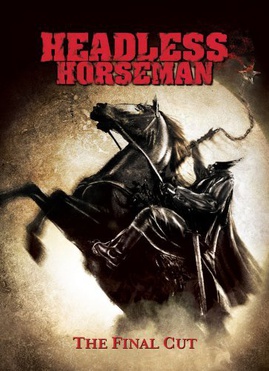
Movie quality is measured by many standards.  It’s pretty clear that budgets can make a difference—Hollywood movies generally outshine television movies.  Streaming services, like Netflix and Hulu, have been gaining ground here, but they still lack some of the qualia that come from long-term players in the industry.  Often this was measured, pre-pandemic, by box office success.  I’m not sure how it’s all quantified now, but I’m sure it still comes down to money.  To me, the deciding factor about the quality of a movie is often the writing.  Even with a modest budget excellent writing can make up a lot of ground.  Headless Horseman originally aired on the SciFi channel (now Syfy) in 2007, and I wrote a tiny bit about it in a former post.  I recently rewatched it with an eye toward how religion is integrated in it.

Headless Horseman is not a great movie.  Its writing doesn’t inspire and it leaves too many gaps in the narrative to carry the viewer along easily.  Still, religion plays an important role in the story.  This one resets Washington Irving’s tale in the south—from the license plates, Missouri.  The horseman is a serial killer who offered his victim’s heads to the hydra, the serpent that guards the entrance to Hell.  When the killer is stopped and his body sent through the gateway, he comes back every seven years to chop heads.  The town where all this takes place has the biblical name of Wormwood, and everyone in it is literally family.  So every seven years they have to trap seven outsiders to make their offering.  The person who originally stopped the killer was the local priest.

Even this brief synopsis reveals how deeply religion is engrained in this retelling.  Irving’s classic story is set in an overtly religious period (particularly Protestant, of the Reformed variety), and wears this lightly.  Everyone can be assumed to go to church and the Headless Horseman is a Hessian mercenary decapitated by a cannonball during the Revolutionary War.  Over time, with many retellings, the horror becomes more and more involved with religion.  To the point that the religion itself is the real engine of fear.  A town protecting a Hell-guarding hellion doesn’t exactly make them Satanists, but it does mean they’re not far from it.  The in-breeding is, however, a bit insensitive.  My recent rewatching wasn’t with an eye toward the Bible, as my last viewing was.  When retelling the story, however, it seems religion will surface where once it was only in the background.


Back to Tarrytown

The very name “Hollow” takes me there.  It’s a resonant geonym.  Near Franklin, Pennsylvania, my early hometown, runs a route called Deep Hollow Road.  For me, with its lush, thick trees and shadowed valley, it always exemplified what the term “Hollow” intended.  And of course, there was Sleepy Hollow.  Now that my article on various movies based on the Irving story has appeared in Horror Homeroom (it’s free), I’m again thinking about my dance with that particular story.  In fact, after I submitted the article I watched yet another version of the tale, Pierre Gang’s 1999 The Legend of Sleepy Hollow.  This film on Sci Fi (before it became SyFy) purports to follow the original closely.  It nevertheless has to pad out the story and does so with religion.

Religion—specifically the Bible—and the tale as represented in Fox’s four-season series Sleepy Hollow is what started me on the current leg of my journey.  I sent an article to the Journal of Religion and Popular Culture on the topic and when it was accepted I expanded the idea into the book Holy Horror.  So it is that I’ve tried to watch as many versions of the story as I can.  There have been many made-for-television renditions.  Some are available for free on the various services that draw from my pocket monthly.  Others cause me to debate whether I want to pay for seeing a sub-par effort for the sake of completeness.  The scholar’s heart still beats within me, I guess.  The Gang version expands the story with a church scene, not in the original tale.  To inculcate the Bible, however, Tim Burton’s film of the same year was necessary.

For me no story better encapsulates October.  Perhaps it’s the crucial role of the pumpkin.  Perhaps it’s the ambiguity of the headless horseman himself—is he a hoax or something more?  These kinds of questions are answered by various filmmakers but since the viewer ultimately decides the question is left up to us.  If I were still an academic my next book project would be clear.  Instead I’m trying to bask in the wonder that is October—the season of transition from bright blue skies and colorful leaves to long, chill nights and bare trees.  Our time outdoors becomes more focused so that we might get back to the warmth inside.  And if we’re looking for a tale to read that’s not really that scary, but which captures the ghosts of the American imagination, “The Legend of Sleepy Hollow” beckons.


Not Sleepy Yet

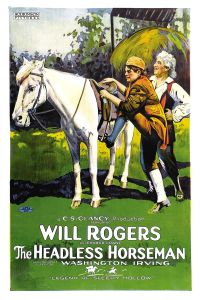
Over a recent weekend I watched four versions of “The Legend of Sleepy Hollow.”  (I have two excuses.  One is that it’s October, and the second is that I have an article on Sleepy Hollow coming out on Horror Homeroom.  For the second, read on.)  The story is one that made an impact on me as a child, probably because of Disney’s Adventures of Ichabod and Mr. Toad.  The cartoon version, which was one of the four I watched, is silly and scary both.  It leaves it to the imagination whether the headless horseman is real or not.  Before that I watched the silent 1922 Headless Horseman staring Will Rogers.  Clearly in that film the headless horseman is what we’d now call a liberal hoax.  It was Brom Bones scaring Ichabod Crane away from Katrina Van Tassel.

The canon of characters grows with Tim Burton’s 1999 film Sleepy Hollow.  Although Burton is hit or miss for me, this strikes me as one of the best October movies I’ve seen.  The headless horseman is quite real and the spiritual world intersects with the rational, crime and punishment world in the haunted western wood.  I didn’t have time for the 1980 television movie this time around, but I decided to watch the 2007 television movie Headless Horseman.  A rather puerile splatter film set in Missouri, it posits that this is the real headless horseman behind Washington Irving’s story.  It has a lot of religious imagery, which is often what I’m looking for in horror.  The writing is poor and the characters shallow, but it isn’t a total waste of time.

What all of these films demonstrate is that Washington Irving’s story, as simple as it is, really resonated with Americans.  How can you reason or plead mercy from a headless man?  Look closely, for there is a parable here.  The headless are merciless and they have the ability to frighten.  The story is generally set in the harvest season.  The 2007 movie makes the horseman’s appearance as a crucified scarecrow.  Although the original story had no such religious elements, they’ve become a standard part of its accrued cultural heritage.  The headless horseman has gone from secular to religious, for it is an American story.  Originally set in the period after the Revolutionary War, it was part of an unsettled nation’s frustrated attempt at normalcy.  This, I believe, remains.  When we can’t make sense of our surroundings, we look back to those stories that seem to have some insight into who we are.  Headless horsemen are quite useful in that regard.


Not so Hollow

It is difficult to say how an idea might grab you.  I really have no idea why Washington Irving’s “The Legend of Sleepy Hollow” took my childhood imagination prisoner and has kept it stoutly locked up over all these years.  Perhaps it was the Disney version seen as a child that left me with shivers of wonder akin to a species of joy.  The autumnal setting, the implied ghost, the ambiguity of the final scene.  I used to be as avid a philatelist as one can be in a small town, and the Sleepy Hollow stamp of 1974 held me transfixed long before I ever encountered Tim Burton’s vision of the legend.  After having watched the silent Headless Horseman a couple of times, I went back to The Sketch Book of Geoffrey Crayon, Gent., and read the original again.  This time I followed it up with the appendix in my edition, written a decade or two after the story by an older Irving.

The 1922 movie runs fairly close to the literary original (for the most part), especially when you add the appendix.  The appendix (in the edition I have—The Modern Library, 2001) is an essay titled “Sleepy Hollow.”  It reflects on Irving’s recollections of what Sleepy Hollow was like in his youth (he returned to the area to settle later in life).  The village church, which features in “The Legend,” provides a source of much of his reverie and this is incorporated into the early cinematic version as well, in the Sunday morning scene.  I also noticed how frequently psalmody enters the original story.  The tale does not mention the Bible, but psalmody was an early form of church music, and “The Legend” has Ichabod use it when he’s afraid as well as for teaching students to sing, for a few shiny shillings.

Washington Irving is sometimes credited with the invention of the short story as a literary form.    His younger contemporary Edgar Allan Poe worked in that format, and the two of them contended with making a living (the former more successfully) purely as literary writers.  Irving’s spooky tales, however, often have something of the comic about them.  His story-telling style uses folksy, folkloric exaggeration and humor to prevent it from becoming too dark.  Poe would snuff the candle and let the fear be unhindered.  I knew of Sleepy Hollow before I discovered Poe, and this recent resurgence is perhaps a way of exploring my own literary roots.  It’s nearly half-way through September already, and Tarrytown beckons. 


Horseman Horror

Yesterday was distinctly autumnal around here.  Cloudy and cool, the overcast was definitely moody although the equinox is still a couple weeks away.  Still, the mood was right for the Legend of Sleepy Hollow.  The earliest full cinematic adaptation of Washington Irving’s story is the 1922 silent feature The Headless Horseman, starring none other than Will Rogers.  Now, Irving’s story is fairly brief, and to get nearly a full seventy-five minutes out of it, the tale lends itself to some padding.  The film makes a great deal of Ichabod Crane knowing Cotton Mather’s A History of Witch-Craft, and even being accused of being in league with the Devil that leads to a  disturbing scene where he’s nearly tarred and feathered.  In reality Mather’s book was Wonders of the Invisible World, but the point of the film is better made with the fictional title.

Having watched Tim Burton’s 1999 version—Sleepy Hollow—many times, I was taken by the introduction of the Bible into the story.  The groundwork, however, was laid by Edward D. Venturini’s version.  True to the story, Ichabod teaches Psalmody in his role as schoolmaster.  Venturini’s film has a contrived scene in the church on Sunday that includes a lengthy sermon with everyone—even the usher—falling asleep.  The episode, which is lacking in Irving’s original rendition, introduces the Bible into the narrative.  The connection is thin, but nevertheless present.  Burton picked up on the religious element and built it firmly into the plot as Ichabod Crane’s backstory as a skeptic, raised by “a Bible-black tyrant.”

As someone interested in the integration of religion and horror, early examples, despite the comic aspect of Venturini’s version, are often instructive.  The comedic spirit is actually in the original; Irving’s tale gives a caricature description of Crane that gives the lie to the handsome protagonists beginning with Jeff Goldblum on through Johnny Depp and Tim Mison.  Will Rogers plays the homely image to its hilt, and although lighthearted, the movie has some classic horror elements.  To arouse his dozing parishioners, the minister yells “Fire!” When they awake asking where, he states “In Hell,” which sleeping churchgoers can expect.  Although the eponymous headless horseman is shown to be Brom Bones, a remarkably effective early scene presents a skeletal, ghostly rider that haunts at least the imagination.  The sun is out this morning, and the brooding skies of yesterday have passed.  They will be back, however, as the season for ghost tales is only just beginning.


Underground Easter

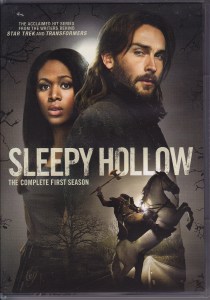
SleepyHollow

Recently I had the opportunity to write a post for the OUP Blog on the topic of Sleepy Hollow. I’m not exactly obsessed with the program, but it fascinates me that a television show that is so religiously based was such a hit for a couple of seasons. Religiously based, that is, in a thoroughly secular way. That may sound like a contradiction, but that is precisely part of the charm. We are constantly being informed that religion is on its way out, but we keep coming back to it in other guises. Sometimes disguises. Since today is recognized as Easter among many western Christian groups, I thought it’d be appropriate to consider resurrection. We know that resurrection is an idea that pre-dates Christianity and that it is one of the most basic religious hopes people share, in some form or other. It is also one of the central themes of Sleepy Hollow.

The premise of the series is that Ichabod Crane has been resurrected two centuries after his death. Alive in Sleepy Hollow, he and Abbie Mills fight off a variety of weekly frightening monsters, the primary one being the Headless Horseman. But the Headless Horseman is also a resurrected character. Ironically, he is Death, and even Death comes back from beyond. As particularly the first season goes on, we find other characters dead and risen. George Washington comes back from the dead to give instructions for coming out of Purgatory. The second horseman of the apocalypse, War, is a character brought back from the dead. In the second season, Thomas Jefferson, in a kind of futuristic sense, is brought back from the dead as a kind of living hologram. Where, o Death, is thy sting?

Sleepy Hollow is a secular program. There is no overt religious message. To tell a compelling story, however, the writers keep coming back to the Bible and other sacred texts, and supernatural themes. In researching the program I learned that other networks (who has time to keep track of them all?) also have supernatural features and that competition is fierce. Meanwhile we’re being told that religion is all but stomped out under the weight of rationalism. My observation is that it may be dressed up as something different. It may even be in disguise. Religion, however, is experiencing its own resurrection in popular culture and the idea of Easter has yet to be considered obsolete.


Local Lore

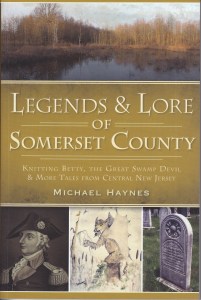
SomersetOne of the true joys of having more than a day off work at a time is the privilege to spend days reading. Although I read on the bus as a matter of course, it is a defined time, and editing isn’t as much reading as most people think it is. While doing research for my Sleepy Hollow paper, the question naturally arose: where did Washington Irving get the idea for the headless horseman? According to Irving’s biographers, the story was not an uncommon one. Headless ghosts are not unique, and he wrote the story while living in Europe as part of the serialized Sketch Book of Geoffrey Crayon, Gent. There is no practical way to know where he first heard the story. During my research I heard of a local source: Legends and Lore of Somerset County (New Jersey), by Michael Haynes. In this little compendium of stories of my current county, there is a claim that Irving learned about the story right here in New Jersey, where a traditional headless ghost rides. Again, it is impossible to say where he got the idea, but people like to feel that their local traditions are important enough to engage a major writer’s imagination.

Haynes presents several other regional tales that may rival the Jersey Devil and give ghosts a location just down the road. I suspect most places have tales of ghosts and mysterious beasts. It is always interesting to find out about those lurking in your own neighborhood. Scholars are now beginning to turn their attention to the sanctity of space. Location is very important to mobile beings like ourselves. The place where we find ourselves becomes “our place” and with the patina of time, often a personally sacred space. Tales of what happened here often take on the cast of the supernatural.

Local history has always held a deep fascination for me. Any region that I know, in a sense, intimately, is a region that has become part of my personal history. My region of Pennsylvania, for example, defines me although neither of my parents, or their parents were born in that state. And Massachusetts, Michigan, Scotland, Illinois, Wisconsin, or New Jersey, places I’ve lived, have become somehow alive with history. Legends and Lore of Somerset County contains tales that are not always believable in the workaday world we inhabit, but that’s the beauty of sacred space. Going beyond the mundane is entirely the point. Although Washington Irving may or may not have first heard of the headless horseman here, we have that legend, and there’s only so much that history can do to remove such a claim.