Whose Bible?

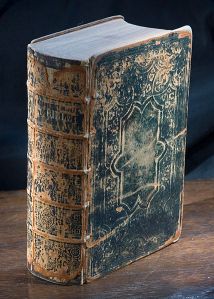
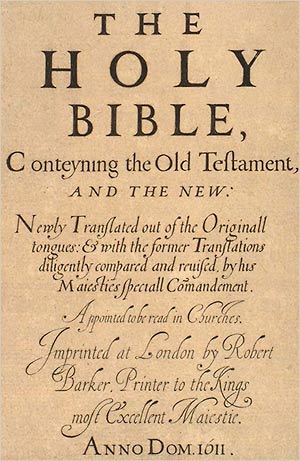
“What the Bible really says.”  That’s a phrase you find in many places.  In academic books and on the lips of “true believers.”  Nevertheless, it’s a problematic formulation, no matter who uses it.  Biblical scholars often like to “correct” public assumptions about the Bible, but since the association of most people with the Bible is emotional, chances of changing any opinions remain slim.  There seem to be two troublesome words in the phrase: “Bible” and “really.”  Let’s take them in turn.  The Bible doesn’t exist.  Well, it does, but it’s an intellectual formulation, not a book.  This can be asserted with a great deal of certainty.  Why?  Because the boundaries of the Bible are porous and nobody, but nobody, has the authority to close them.  Just a quick example: the books of the Apocrypha—Bible or not?  Most Protestants fall on the “not” side of that question, although the King James Bible included some of the Apocrypha.
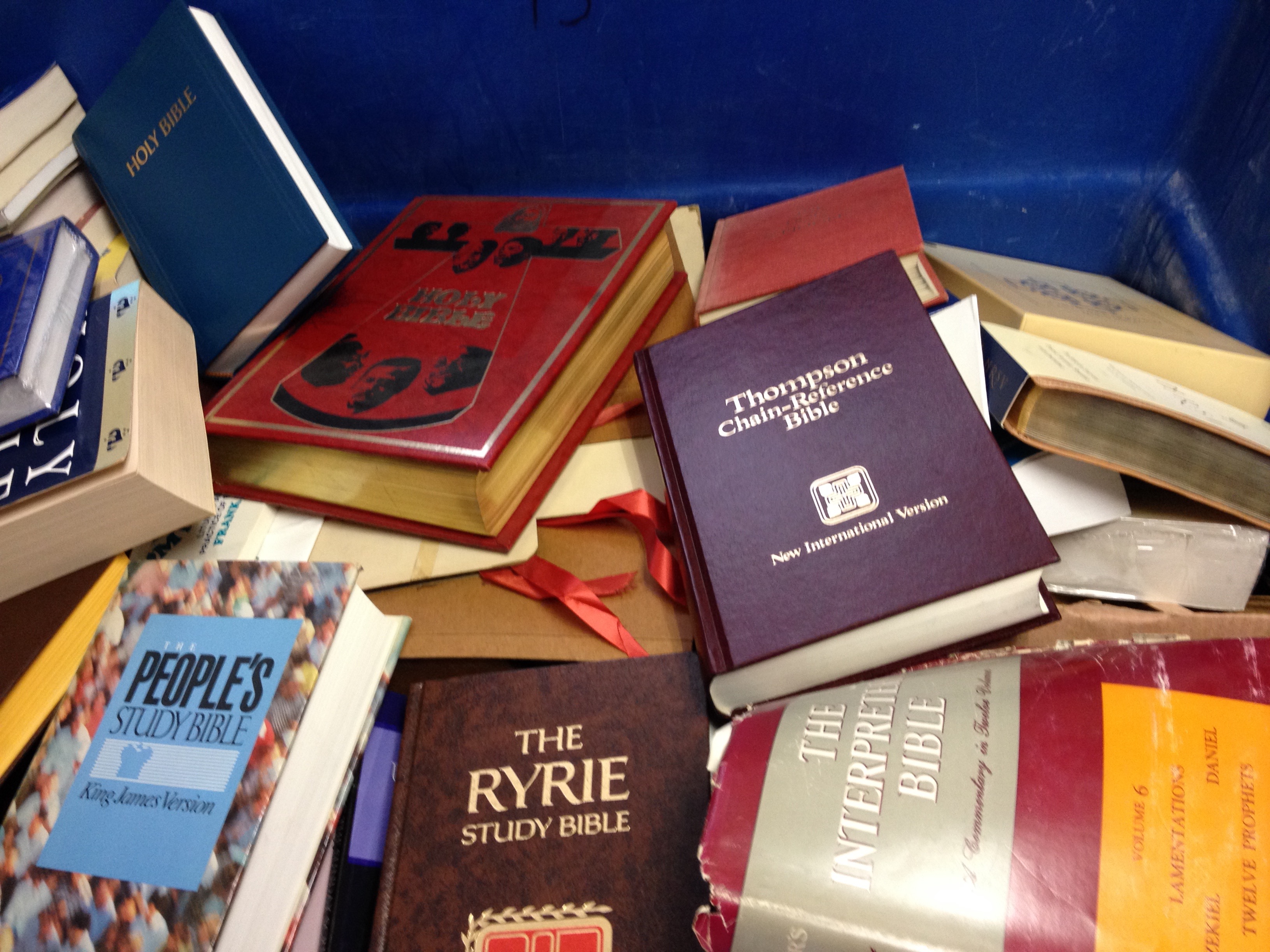
The question gets more vexed when we start asking about books like Jubilees and 1 Enoch.  There are ancient Christian churches that include them.  Since they are African, however, Europeans/North Americans have privileged the western canon, and have excluded them.  They are, however, part of “the Bible” for millions of people.  The book of Jude quotes Enoch as Scripture, just saying.  Things get even dicier when you include scholarly opinion.  Many biblical scholars believe The Gospel of Thomas has just as much credibility as (if not more than) the canonical four.  Since biblical scholars can’t add or remove books, however, it’s a moot point, although they are the best informed. 

“Really” is really problematic.  Who has the authority to determine what the Bible “really” says?  Doesn’t this actually mean, “the correct interpretation”?  Who is qualified to make such a statement?  A preacher?  Did God tell them personally?  Did they think to record it?  Or should it be the experts—biblical scholars who spend their lives and careers learning everything possible about the Good Book?  Again, no person, or body of people, has the right and authority to make that decision.  What does the Bible really mean?  I wouldn’t leave that up to any of the many, many clergy I know.  It requires a bit more training than they have.  And I’m still really bothered by the “really” part.  It’s always going to be a matter of interpretation.  Yes, I know hermeneutics always spoil a good time.  Until, however, we can all agree on what “the Bible” is, nobody can say what it “really” says.

Bible Horror

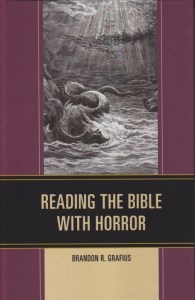
The combination may seem odd, but it is definitely a valid one.  The Bible and horror, I mean.  My colleague in this venture, Brandon R. Grafius, has published the first book in the Horror and Scripture series, Reading the Bible with Horror.  This is a fascinating little volume that explores the productive use of horror films when it comes to interpreting the Bible.  The Bible isn’t all horror, of course, but a good deal of it is.  That’s one of the keys of biblical interpretation—no one method covers it all.  At least when I was teaching I used eclectic methods both because some methods work better than others in some places and because no one method is the correct one.  Using horror to interpret the Good Book is one of the newest methods out there.

The methodology involves looking at horror films (mostly) and finding biblical parallels.  Both the Bible and the movies interpret one another.  This can be a kind of reception history—the idea that to understand Scripture we must look at how it has been “received.”  The way that people read Holy Writ after it was written is as important as the way biblical specialists read it.  We all know what literalism is, and biblical scholars are well aware of its shortcomings as a method.  There are tons of other methods that seek to show the relevance of the Good Book, and one of them is to see how horror makes it so.  To get to this point the reader must get beyond our social bias about horror as a degraded, evil genre.  Some of it is quite bad, of course, but much of it has redeeming value.  Redeeming value so obvious that it can be used to interpret the Bible.

Grafius studies only limited examples here, for instance, the book of Job with its human suffering and superhuman Leviathan.  He also looks at hauntings and biblical ghosts, as well as haunted locations.  His chapter on haunted houses made me stop and think quite a bit.  He concludes with what will be the most challenging concept for many—the idea that God can be monstrous in the Bible.  He clearly can.  Apart from theodicy, one of the major reasons critics attack Christianity is the character of God as portrayed in the Bible.  Grafius isn’t attacking Christianity but rather he’s trying to show how a most unlikely source can shed genuine light onto it.  Reading the Bible with Horror is an insightful step in that direction, even if it’s a step into a rather haunted house.


Bible Use

In the current presidential race, it seems, the Bible hasn’t been as large an issue as it has been in the past. Bluff, bravado, and bullying seem more the order of the day. Goliath rather than David. This makes me think of the varied uses that the Bible has had in American life. It has been used as a spiritual guide, a textbook, a set of moral principals, a grimoire, and a science primer, as well as a political playbook. It is versatile, the Good Book. It has been prominent in American society from the very beginning, but clearly its prominence is starting to fade. Not likely to disappear any time soon, the interesting question is how people use the Bible, often without reading it. This is what scholars call the “iconic book” aspect of the Bible. It is performative—it acts in a way that has an outcome, no matter what the intent of the user. As I’ve argued in academic venues, it has become a magical book.

An iconic book (photo by David Ball)

An iconic book (photo by David Ball)

Wondering whether this is a new situation or not (I deeply suspect it’s not) I’ve been reading about the Bible in early America. Almost all the reference material points to the “official” uses of the Bible—that by statesmen and clergymen (both classes of “men” in the early days) with almost nothing of how it was used in private. This question involves some exercise of the imagination since there are few data. Would not a family, struggling to survive, see in the Bible a powerful book? And would not a powerful book be capable of subverting the laws of nature? Reading about the witch trials in Salem, we see that thunderstorms and other “prodigies” were considered magical. Surely one could use the Bible for unorthodox purposes? There’s little to be said in the absence of evidence. The use of magic in the colonial period, apart from the trails of witches, was not unusual.

How do we measure the ways the Bible was used when nobody beyond interested parties, such as clergy, wrote about it? Mr. Trump even tries to quote it from time to time, but since his citation that sounds like a joke opener, “Two Corinthians [go into a bar],” he seems to have let that hot potatoe drop. The Bible, seldom read, remains a powerful book. The source of its power, I suspect, is in its use by the common people. Many people are familiar with it, and believe in it. Some have even read it. It remains, however, one of the great mysteries among the early European settlers. We know they had their Bibles with them. How exactly they read them, when not under the eye of the preacher, we apparently have no way of knowing.


Tweeting the Bible

I have an underused Twitter account. My life isn’t so interesting that I need to give my few followers (fewer even than those who read this blog) updates throughout the day. In fact, I mainly use it to let my Tweethearts know what I’m blogging about on any given day. While reading a book on the influence of technology on religion (more anon) it struck me that one of the more interesting aspects of biblical studies is the fact that the well never goes dry. For those who read sacred texts, there is no end of interpretation. I’ve addressed this before on this blog—religion is as individual as each believer. The more I read biblical interpretations, however, the more I see the subtle textures and layers that readers find in the text, despite what most religious leaders desire. And I don’t restrict this to the Bible—any sacred text can be read in multiple ways. The Bible, however, has been foundational for this person that I’ve become, and so I’ve decided to do some close reading.

I’m going to tweet the Bible. (If you are one of my rare followers, don’t worry—read on.) I’m going to tweet the maximum 140 characters per message once a day. For this task I will be using the King James Version, arguably the most influential book ever written in the western world. Doubt me? Watch a presidential candidate debate. Or google Girl Scout cookies. Why am I doing this? Well, I wonder what the Bible says when it is broken down into byte-sized nuggets. At character 140 I will stop, and the next day I will begin where I left off the day before. This exercise will be a way of looking at the Bible from a fresh angle. Besides, it’s been a few years since I’ve read the entire KJV. I don’t pretend that nobody else has thought of this—I’m sure there are many Bible tweets out there. I’m curious, however, at 140 characters a day how long it will take, and what will emerge. Yes, I know that there are mathematical whizzes out there who could calculate the answer in a matter of seconds, but I just have to see for myself. The doubting tweeter.

A new look at an old book.

There may be occasions when I fail—isn’t the Bible about forgiveness anyway? In my job I travel quite a bit, and sometimes Internet access is dicey. Most hotels, however, still sport a Gideon Bible, so resources should be no problem. It will be an adventure, and the Bible could stand some adventure these days. Besides, interesting pericopes will give me something to blog about occasionally. For those who haven’t been subjected to years of higher education on the Bible (or other texts), a pericope is a passage cut out from its surroundings. It is the favorite of televangelists and other proof-texters who prefer to not to face the larger implications of reading the whole Bible in its context. I like to think of this exercise as Internet hermeneutics. So let the adventure begin. If you are really bored and want to follow a glacially paced Bible reading, my Twitter name is stawiggins. When interesting observations emerge, however, I will let my blog readers know as well. In the technical age, life is tweet.