Qohelet’s Advice

Academic hypersensitivity.  I fear it’s on the rise.  I know I’ve experienced it myself—that flushing rage and disbelief that someone has written a book on the very topic on which you also published a book, and didn’t cite you.  How could they have overlooked your contribution?  I’ve seen scholars angered to the point of wanting to ruin someone’s career for not citing them.  Now academics can be a sensitive lot.  Remember, some of them specialize to a point of general social incompetence.  Anyone publishing in their specialization is like making a claim to have slept with their spouse.  This subject is theirs!  They’ve spent years reading and researching it.  How dare some new-comer not know this!

One thing many academics don’t realize is just how much material is published.  The flip side of this is just how obscure their work is.  Trade publishing and academic publishing aren’t the same thing, and the former are the books that really get noticed.  When I wrote my dissertation, back in the early 1990s, I had read everthing I possibly could on the goddess Asherah.  When I proposed the dissertation topic there had been a total of about three books written on Asherah that I knew of.  Enough to have a research base, but not enough to suggest it was a crowded field.  While I was whiling away my time in Edinburgh, another American ex-pat was writing on the same topic in Oxford.  The day of my doctoral defense, the outside examiner came in with a book just out on Asherah—in German, no less—and asked how my dissertation related to it.  Even today when I see a book on Israelite religion I flip to the back to see if my book’s listed.  Generally it’s not.  Today it’s impossible to read everything published on Asherah.

In my own case, however, I’m slowly coming to perceive the reality of the situation.  Books continue to be produced.  Articles are published at a blinding rate.  Even Google has to take a little time to find them all.  An overly inflated sense of self-importance can be a painful thing when it meets with the sharp pin of reality.  Your academic book may well go unnoticed.  Even if it’s good.  It may be priced at over a hundred dollars—I still pause and fret and kick the dirt a few times before buying any book that costs more than twenty.  Silently and slowly, I suspect, the frustration builds.  You see a book, then two, then three, that seem to be oblivious to your contribution.  A new book for review lands on your desk and Vesuvius erupts—why am I not cited?!  Has my work been forgotten?  Calm down.  Breathe deeply.  The book of that neophyte before you will also become obscure in due course.

Job’s Jobs

Many years ago, after Nashotah House decided it no longer required my unique outlook, I bought a book.  (That’s my default reaction.)  This book was on how to write killer cover letters.  I don’t remember the title or the author, but I followed the advice, well, religiously.  It got me nowhere.  Business tricks, at least historically, don’t work in academia.  Sitting at home, pondering my sins, I flipped to the chapter on advice to take if none of the rest of this was working for you.  Here’s where the human side began to show through.  Have you been eating onions or garlic before your interviews? it asked.   Do you need to lose weight?  Try dressing nicer.  It occurred to me that the business world lacks the imagination required for denying jobs.  And besides, who was getting any interviews before which I shouldn’t eat garlic?

Business advice is, in a word, shallow.  It assumes that if you’ve got the goods there’s no reason you won’t get hired.  Reality is a bit more complex than that.  I often ponder how people simply go for what they want.  They reach for the biggest piece without pondering the repercussions of their actions.  I see it in my small world of publishing all the time.  Those who are “hungry” (read “greedy”) succeed.  Those who wait behind to help others simply can’t compete.  So the cover letter book did get that part right.  Is it possible, however, to devise a society where everyone fits?  Not all are created equal, perhaps, but do we have to reward those who seem to care only for themselves?  Let them eat garlic.

The cover letter book, in the end, never really did me any good.  I found my way into publishing by being willing to aim low.  I’ve written many cover letters since leaving Nashotah House, and only two ever led to a job.  Those who work in business, what with their concerns about readers’ aromas and weights, seem never to have considered the intricacies of the intellectual job market.  What strikes me as particularly odd is that there are plenty of smart people out there, and yet they haven’t organized to offer alternatives to the greed-based structure on which our work lives are based.  They can’t, it seems, gaze beyond capitalism as a mechanism for helping individuals lead productive lives.  Business operates on the principle of replaceable parts, many of which happen to be human.  And even those who know how to write can’t hope to compete against those who prefer cogs that know to avoid onions.


Post Facto

“Yea, though I walk through the valley of the shadow of death,” Psalm 23 asserts, “I will fear no evil.”  Nor should one fear evil when flying over Death Valley, as I did coming out of San Diego, but I did.  There are perhaps not too many national monuments that can be appreciated from 30,000 feet, but the only way I’ve seen both the Grand Canyon and Death Valley is by plane.  My flight home from AAR/SBL had me sitting over a wing, so a photograph of the famed graben would simply show mostly wing and a bit of Death beyond.  This valley holds the record for the hottest ambient temperature recorded on the surface of the earth (134 degrees) and is famed as one of the filming locations for Star Wars.  Still, from the air the juxtaposition of mountains and salty, flat dearth was impressive.  I had no one with whom to share my excitement; the kid next to me was watching a movie on his phone and I had no idea who he was or if he’d be interested.

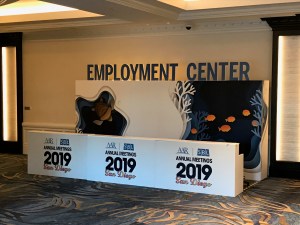
Disneyland, they say, is the “happiest place on earth.”  While I have my doubts about than endorphin-laced claim, I do know one of the opposite locales.  The hotel in which I stayed, the Grand Hyatt, San Diego, hosted the AAR/SBL Employment Center.  The hotel is not to be blamed for holding the most unhappy place on the planet, but as I looked at the booth I wondered if this was truth in advertising.  Should it not read “Unemployment Center”?  That two-letter prefix would make this at least honest, if not cheery.  I have spent some of the most miserable hours of my life in the employee hopefuls’ lounges at past conferences.  Hours and hours wasted, waiting to see if anyone, anyone at all was willing to grant you an interview.  I saw more than a few tears shed in that horrid place.  Some of them mine.

Now I’m high over Death Valley.  It feels far too sanitary to experience it in this way.  The professorate, which seeks to improve the world, is generally a powerless lot.  Signs scattered throughout the Convention Center and hotels asked such things as Does your school have over 50% contingency faculty?  And statements like Tenure track is not the norm.  The psalmist, it seems to me, got it right.  If you want to face the valley of the shadow of death and not fear, you have to walk through it.  The more people who do, the better the hope that we’ll land this plane with some kind of resolve to do be open to visions and to act upon them.


Geography Lesson

As someone who eschews easy labels, I’m always conflicted when someone asks what my doctorate is “in.”  Universities have departments, of course, and different academic fields have differing standards of what qualifies you as an expert.  My Ph.D. was mainly in the field of history of religions, but focused (all such project must be narrow) on what is best called ancient West Asian cultures.  Recently someone showed me a website with free geography quizzes on it.  (I post the link here with the caveat that this can be very addictive.)  This friend asked me how good my Asian geography was.  I knew that once I got east of Iran I was going to be in trouble.  Some countries, such as Russia, India, China, and Japan are hard to miss, but the others I was properly humbled over.

I tried the quiz again and again until I could point to any of the official Asian nations with a fair degree of accuracy.  Eurasia is a very large landmass, and when you consider that it is, apart from human-made canals, attached to Africa this is a lot of space to label.  Considering that many isolationist politicians can’t correctly find smaller countries on a map without an app, I started to realize just how lopsided the world is.  Many more people live in Asia than populate the “New World.”  They actually have more space than we do here, but much of it is too cold or too dry for comfortable living.  Still, I considered that if I’d had this quiz as a kid I might’ve known my geography much better than I do.

As I’m preparing to attend the American Academy of Religion and Society of Biblical Literature Annual Meeting in a few days, I recall priding myself at knowing all fifty states of my native country.  I’ve been to all but five of the lower 48—Alabama, Kansas, Oklahoma, New Mexico, and Nevada have eluded me (the conference never meets in them and I don’t have friends who’ll put me up for free in them).  But at least I know where I haven’t been.  

After trying my hand at Asia on the app, I attempted Africa.  Let’s just say I still have a lot left to learn.  And unlike when I was a kid, I look forward to taking quizzes.  Work interferes with web time, though, and learning modern countries isn’t the same as knowing where Hatti or Elam used to be.  Religion, after all, forms borders just as impermeable as mountains, oceans, or deserts.


Old Grains

Back when I was somebody—a professor is somebody, even if only a seminary professor—I was invited to meet with a group of Seattle writers and intellectuals.  I was in Seattle already because driving all the way out here was possible when you live in the Midwest and your summers are basically open and free.  (Professor’s privilege.)  One of the group members, the one who invited me, asked me about grain.  When the club met they ate.  With a bent toward history, one of them brought period-appropriate bread.  What kind would be fashionable for a night of ancient Near East talk?  (I was still researching and writing on Ugarit at the time, before Ugaritology passed away.)  Without stopping to think I replied “Einkorn.”  I didn’t know if einkorn was still around or not.  All I knew is that it was the earliest (at least as understood at that time) domesticated grain.  The loaf that arrived that night was a more accessible grain variety.

All of this came back to me as I stood in the local health-food store.  We don’t shop here for regular groceries—it’s expensive to eat healthily—but we’d been invited to someone’s house and said we’d bring appetizers.  The health-food store had vegan cheeses, so we needed crackers to go with.  Then I spied the word “einkorn.”  The Seattle discussion had to be well onto two decades old by now.  I was finally able to answer my question, einkorn was still alive.  The craze for ancient grains did not exist in my professorate days.  Some companies, according to occasional news stories, were trying to brew the beer of ancient Egypt or Sumer, but the health conscious hadn’t gone so far as to trying to replicate the diet of the earliest agriculturalists.

Ancient grains cost more because the yields are smaller.  Although the grain heads look disturbingly like those house centipedes that scamper in the basement when you flip on the light, they aren’t nearly the size of a current wheat head.  It stands to reason that it takes more of them to make up the same amount of flour, and appetites have grown over the millennia.  Like most vegans, I read boxes.  Another ancient grain cracker, apart from brown rice, included amaranth, flaxseed, millet, quinoa, sesame, and sorghum.  Never mixed this way in antiquity (for amaranth and quinoa were part of the “new world” and the others “old”), modern mixologists have devised new ways of using ancient grains.  Einkorn nearly went extinct with the development of wheat, rye, and barley.  But it hung on, and now, as a dozen millennia ago, it has a way of sustaining both dreams and fantasies.


Greatest Weakness

What a privilege it must be to work in a world of ideas!  (And to get paid handsomely to do so.)    My particular (and peculiar) career—if that’s what you call it—is intimately bound up with academics.  Those who know me personally treat me nicely, but the vast majority who haven’t a clue that I’m anything other than a guy who’s helping them get published sometimes forget their privilege is showing.  I’m not busting on my homies; I know what it’s like.  But I’ve noticed some interesting trends (“turns” in academese) that are fascinating from the point of view of an ordinary mortal with a mortgage and a great deal of anxiety about it.  For example, I find catch phrases time and again.  (See what I did there?)  Academic writers learn that if they buck the conventions they’ll be relegated to presses that don’t enhance your career.  All roads lead to Harvard, after all.

All of this is preamble to a curious trend that I’ve been seeing claiming that an idea’s greatest strength is also its greatest weakness.  I read this time and time again, so I began to wonder about the origin of this idea.  Now, not even Google understands “what is the origin of the phrase greatest strength is greatest weakness?” but it does bring up about a thousand-and-one websites about job interviews.  I’ve had many of these throughout this thing I’m calling a career, and just like everyone else I’ve read that when asked what your greatest weakness is reply that your greatest strength (whatever it may be) is it.  The classics such as “I’m a workaholic,” or “I just can’t stop acquiring more x” (and we all need more x), are tired cultural tropes.  How did academics pick up on this?

Does it stretch back to Achilles and his heel, or Goliath and his gigantism?  Or is it that to admit weakness is to disqualify yourself from a job?  A well-meaning friend told me I should go through this entire blog (as if anyone, including me, has time to do that) and expunge all mentions of having lost my job.  They should be replaced with insinuations that I’d chosen to leave.  “Nobody,” he implied, “likes a loser.”  Well, I guess my greatest weakness is that I’m an honest graphomaniac.  I write incessantly.  Novels and nonfiction books, short stories and essays, and even a learned article or two.  I used to be an academic you see.  And I was always honest.  It was my greatest weakness, if you see what I mean.


Time To Meet

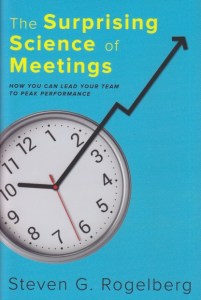
I feel compelled to state up front that this wasn’t the mind-blowing book I was writing about in yesterday’s post.  One of the perks of working in publishing is the occasional offer of a free book.  (It’s not as generous as you might think, so when one is offered I always say “thank you.”)  The Surprising Science of Meetings, by Steven G. Regelberg, isn’t exactly “mind-blowing.”  The realization that some people make a living studying meetings was certainly, well, surprising, but the corporate world is all about returns on investments and boring stuff like that.  We all hear of companies that value innovative and exciting ideas, but most of us know the feeling of being desk drones parked behind a soulless monitor all day.  At least I’m no longer confined to a cubicle.

The academic world I once knew was the stimulating environment of learning for its own sake.  The academy has followed the business world to its own form of perdition and as Rogelberg points out, there are millions of meetings any given day.  Many of them are poorly run.  This book is for those who want meetings to flow more effectively, to better the bottom line.  Still, I found the chapter on servant leadership particularly hopeful.  I couldn’t help but wonder if Rogelberg was aware that servant leadership was something that developed in the church, out of the effort to imitate the way Jesus was said to have led his flock of disciples.  The point was not to aggrandize himself (this is a chapter 45 and his ilk should read) but to help others to be their best.  This is the kind of leadership—rare, to be sure—that the church has always, at least vocally, promoted.

It didn’t take long for ecclesiastical organizations to start running like businesses, however.  The bishop became a boss rather than someone who reluctantly had the crozier forced into his (or her) hand.  I’ve always believed you should have to take a pay cut to become a bishop.  That would immediately weed out most of the climbers.  In fact, if servant leadership is really the ideal, and the good of the company is really the goal, pay cuts should be expected as you climb the corporate ladder.  Can you imagine a business world where workers were well compensated, and those who really had vision sought promotion because their motivation wasn’t their own bottom line?  It’s an intriguing idea, to be sure.  I’d like ponder it more, but I’ve got a meeting to get to.


Pay Per View

One of the things editors can teach academics is that the latter should pay more attention.  Especially to the world of publishing.  An erstwhile academic, I learned to go about research and publication in the traditional way: come up with an idea that nobody else has noticed or thought of, and write about it.  It is “publishing for the sake of knowledge.”  (Yes, that is Gorgias Press’s slogan, and yes, it is one of my hooks—marketing, anyone?)  The idea behind this is that knowledge is worth knowing for its own sake.  Researchers of all kinds notice details of immense variety and there’s always room for more books.  Or at least there used to be.  The world of publishing on which academics rely, however, is rapidly transforming.  Money changes everything.

The world has too many problems (many of them generated by our own species) to pay too much attention to academics.  Universities, now following “business models” crank out more doctorates than there are jobs for employing said wannabe profs, and those who get jobs pay scant attention to knock-on changes in the publishing world.  Just the other day I was reading about “pay per use” schemes for academic writing that, unsurprisingly, came up with the fact that most academic books and articles lose money.  If someone has to pay to read your research, will they do it?  Especially if that research is on a topic that has no obvious connection with the mess we’re busy making of this world?  Probably not.  Publishing for the sake of knowledge is fast becoming a dusty artifact in the museum of quaint ideas.

For those still in the academic sector that means that research projects now have to be selected with an economic element in mind.  “Would anyone pay for this?” has to be one of the questions asked early on.  The question has to be answered honestly, which requires getting out from beyond the blinders of being part of the privileged class of those who are paid to think original thoughts.  Academia has followed the money.  A capitalistic system makes this inevitable.  How can you do business with an institution that doesn’t play by your accounting rules?  And academic publishers, which have difficulty turning a profit due to low sales volume, are bound to play along.  This situation will change how we seek knowledge.  More’s the pity since some of the things most interesting about the world are those that nobody would think to pay to view.


Gods, Monsters, and Publication

One of life’s great ironies is that those of us not born to wealth have to spend the years we’re young enough to enjoy ourselves stabilizing our situation until suddenly we realize we’re too old to do that kind of thing any more.  I know I’m being overly dramatic, but it often does feel like life operates backwards.  My professional career began where I’d hoped it would end, as a professor.  I taught and published for almost twenty years and really nobody paid much attention.  At least I had my teaching.  I also had a family to support, so I had to accept the shift to publishing when that came along with an offer of a full-time job.  Thus it has been for about a decade now.  Within the last decade colleagues have begun to approach me, asking me to contribute to academic volumes, or to be involved in pursuits that are more associated with professors than editors.  I could do with more irony in my diet.

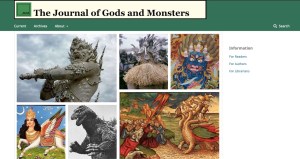
All of this is a long-winded invitation to check out the new Journal of Gods and Monsters.  I probably won’t be writing articles for it; lack of library and research time (both of which I had when invitation-free) assure that my scribbling will be non-technical and hopefully of the more general interest crowd.  Then why am I telling your about this journal, fresh from the box?  I’m on the Executive Advisory Committee and the first Call for Papers has been issued.  Now, this blog really has no way to include attachments that I know of, so if anyone wants in on the ground floor for this journal please contact me (the About page on this website says how).  I contributed to the first number of the first volume of the Journal of Ancient Near Eastern Religions and look where I am now!  You just never know.

In addition to the books on which I’ve been assiduously working, I’ve got a number of commitments to edited volumes and encyclopedias (these invitations waited until I was safely out of academe before rolling in).  The monster crowd is, I assure you, a welcoming one.  As we seem to have turned the corner into autumn a touch early this year, and I see leaves beginning to change before August is out, my mind turns toward the realm of the uncanny.  It may be less academic than ancient religions, but the world of monsters feels much more relevant these days.  If you’re a researcher in these realms I’ll be glad to send you a call for papers.


https://godsandmonsters-ojs-txstate.tdl.org/godsandmonsters/index.php/godsandmonsters


Linking

So I’m active on LinkedIn.  I try to keep social media down to the essentials, but you never know when opportunity might rap its knuckles next to your shingle.  When LinkedIn began they ran the warning that you should only connect with people you actually knew, since people can say bad things about you and hurt your job prospects.  Since that kept me down to about a dozen connections (many academics, being secure with tenure, don’t bother with LinkedIn), I eventually followed the advice of a wise friend and accepted invitations from people I didn’t know because, as he pointed out, they might be the ones with jobs to offer.  That made sense.  There is a flip-side to it, however, and that is people think I have work to offer.  I don’t.  At my job I have no hiring capacity whatsoever.  (I can feel the links being broken even as I write this.)

The vast majority of people who contact me on LinkedIn want something from me.  They obviously don’t read this blog.  (See paragraph above.)  Many people send me messages wanting me to publish their books.  Editors, my dear and gentle readers, work in specific disciplines.  No one contacting me on LinkedIn has written a book about the Bible, although my profile indicates that’s my gig.  And besides, many companies, including mine, have policies against doing business over social media.  I often think of this because the book business is easily researched.  There’s a ton of information both online and on shelf about how to get published.  Messaging someone on LinkedIn is not recommended.

Writing a book takes a lot of effort.  I know, because I’ve done it a number of times.  If you’re going to put years into doing something, it pays to spend at least a few minutes learning about how the publishing industry works.  I made rookie mistakes in my younger days, of course.  But that led me to learn about publishing even before I had a job in the industry.  Quite apart from my job, I freely admit to being a book nerd.  And publishing, despite its many problems, is an inherently fascinating industry.  Although I’ve had academic books accepted for publication, I still struggle getting my fiction to press (I have had short stories published, but my novels remain unread).  I won’t contact other publishers I know through LinkedIn, though.  I’d rather have it be a personal experience whether it’s acceptance or rejection.  And that’s something social media just can’t replicate.


Reading Railroad

Rereading books takes time.  When I was a professor my reading time was largely limited to the summer and winter breaks.  Those who haven’t experienced the academic lifestyle firsthand may not realize just how incredibly busy you are during term time.  Class prep, grading, delivering lectures, leading seminars, committee meetings, office hours—it really is much more than a nine-to-five job.  Time to sit down and read through books is limited, and since those books are heady, academic tomes, they take considerable time.  (I’m reading an academic book at the moment and I can only get through a finger-full of pages at a sitting.)  All of this means I’m generally reluctant to reread books.  Not that I’m a traditional academic anymore, but because I have a huge and growing stack of books I haven’t read yet.

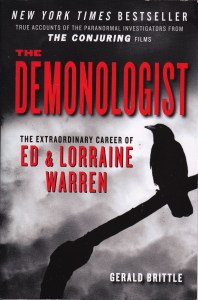
Nevertheless, a project on which I’m working required rereading Gerald Brittle’s The Demonologist.  I read this about two years ago, while commuting.  The thing about reading on a bus is that the quality of reading time is strained.  Recall isn’t the same as when you’re in a comfy, stationary chair, and no stranger’s head is lopping onto your shoulder as they doze.  (Yes, that happens, and frequently for those of us on the first bus of the day.)  In any case, my copy of this book doesn’t have an index and I couldn’t remember if some specific instances were discussed.  The only thing for it, then, was to read it again.  My second reading was done with more skepticism than I could conjure on a bus ride, but still my original sense remains: we willfully cut out much of human experience if we stop our ears completely.  At least in principle.

Ed and Lorraine Warren were self-taught ghost-hunters.  More often than not, their cases turned into what they believed were demonic cases.  Since academics tend not to publish much about such things, the self-taught are pretty much free to declare themselves experts—just switch on reality TV and check me on this.  Experts are those with experience who are willing to share it.  The other day I met someone who, like me, used to live the commuting life.  We both agreed that telecommuting was a more authentic way to exist—your otherwise mandated three or four daily hours traveling can be more sanely used at home.  Still, we had to agree, bus time could be used for activities like reading, and once you stop commuting you have to carve time out for it.  In such a situation rereading a book is at times necessary.  When I was a professor, I reread frequently.  But then, it was mostly articles or books that I wouldn’t take on in their entirety.  In the reading life there’s never enough time.


AKA

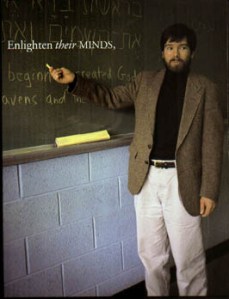
“Professor?”  While not technically correct, I was surprised and not unpleased to hear the title yesterday while on the streets of Easton.  One of the greatest compliments a former teacher can receive is word from a former student.  While dressed in Saturday clothes on the way to the country’s oldest continuously operating farmer’s market, I wasn’t sure the voice intended was for me.  I’ve been out of the classroom now since 2011.  Sure enough, one of my students from Rutgers recognized me and called out.  We had an ersatz but wonderful conversation after a completely chance meeting.  Already since graduating he’s had a few different jobs, but he remembered the classes I’d taught and I recalled that he’s the person who started me reading Neil Gaiman.  Teaching is, you see, a two-way street.

I’m doing a guest service at a local church next Sunday.  In preparation I’ve had lots of emails (for me).  One of them was from the music director.  He opened by calling me “Reverend.”  I’ve never been a reverend.  The idea isn’t unappealing but I’ve gone pretty far down the path of independent thinking and any church that would ordain such as me would need to be comfortable with that.  In fact, I heard a sermon recently by an Episcopal priest and was pleasantly surprised at how welcoming and, dare I say, liberal it was.  I was never really welcome in that club, I know.  When I was still fairly fresh out of seminary and working on my doctorate the idea of being “Rev. Dr.” was still appealing.  Now I go by my first name.

Labels.  I tend to eschew them.  Like my young colleague I’ve had to learn that work doesn’t necessarily define you.  (I’ve had many employers, however, who not only beg, but insist to differ on that point.  The ideas of owning individuals die hard, apparently.)  On the weekend, though, off the clock, people are calling me “professor” and “reverend.”  I’m generally sitting in a corner with my laptop on those early mornings calling myself a “writer.”  For none of these things do I receive any pay.  (Well, perhaps some for writing, but very little and very infrequently.)  The move to our new location was a chance, I think, to try to remake myself.  A chance to figure out what labels, if any, really fit.  Better throw “telecommuter” and “remote worker” into the mix.  Those are the ones, come Monday morning, that matter most.


Mere Humanities

Categories, while necessary, can be troubling things.  One place to see this clearly is in academia, which is itself a category.  In the long history of deciding what counts as a legitimate job (you can make a living now being a YouTuber!) somewhere in the Middle Ages, based on the idea of the monastery, the university arose.  This required some justification—people are to be paid for researching topics and teaching others to do the same?  Not quite back-breaking labor, but it can lead to lumbago nevertheless.  Topics had to be worthy to permit this excused absence.  Law and theology were the earliest majors available.  Hobbes’ two swords.  Church and state.  This makes sense since monasteries were all about obeying rules and obeying God.  Theology was the queen of the sciences.

Perhaps unbelievable in today’s world, it was thought that other topics than theology—called humanities so as to distinguish them from divine discussions—should be added to the curriculum.  These were topics that the educated were expected to have mastered, and they included things like history and, yes, mathematics.  In the early days the building blocks of science (such as math) were considered humanities.  Theology wasn’t.  The Reformation complicated things because now there were lots of theologies.  And this thing called the Enlightenment was suggesting that they were all just a bit naive.  Still, universities grew up around theological training grounds, including places like Harvard, Princeton, and Yale.  Slowly, however, theology began losing relevance and became more and more a humanities subject.  Call it a strange form of incarnation.

By the time I became aware of theological study, it was firmly, and deeply a humanities subject.  Often called “religious studies,” other academics often considered it a throw-away major, but if you dug deep enough you found yourself learning dead languages that even a scientist couldn’t comprehend.  When I began attending a Christian liberal arts college, it was clear the engineers and others of what would come to be called STEM topics were given preferences.  Science, Technology, Engineering, and yes, Math.  Some of the subjects that had started out as mere humanities, now received the praise (and cash) while theology—religious studies—had become a purely dispensable humanities topic.  These days humanities majors are dropping like theologians, and going to university means preparing for either business or science-based careers.  Subjects in which you make more mere money.  And one of the founding subjects of this entire enterprise will earn you a starting salary position at Walmart.  And that’s a category worth avoiding at any cost.

Photo credit: Ben Schumin, Wikimedia Commons


Revisiting Mesopotamia

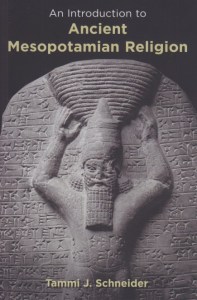
As a refresher on my own ancient history, I picked up Tammi J. Schneider’s An Introduction to Ancient Mesopotamian Religion.  This was one of those books that spawned several internal conversations simultaneously as I realized just how much modern lenses color our perceptions of past societies.  Before commenting on that, however, a few necessary points must be made.  Our knowledge of Mesopotamia is in its infancy.  There are only a handful of universities around the world that have the resources to prepare young Assyriologists adequately.  Once prepared, those young folk will be introduced to the job market of those with far lesser education because there are practically no jobs in the field.  Seems a poor way to treat the civilization that invented wheels, arches, and beer.  Or so I’ve read.  In any case, many tablets in ancient languages have never been translated because there simply aren’t enough people to do it.  Any conclusions, therefore, must remain tentative.

Ancient religion in western Asia was extremely political.  From our perspective, this seems odd—although it’s happening again in real time.  Ancient societies relied on the cooperation of religious and political leaders and each institution helped the other.  They didn’t have the added complication of monotheism to deal with.  In trying to keep all the gods happy, they simply reasoned that if things fell apart, another god had grown to a superior position.  Certainly they believed the gods were there—we do too.  We call them cash, the stock exchange, and commodities, but we still worship and adore.  And they keep the government going.  (I kind of liked it better when they were old-fashioned gods; at least they had sympathy for the human condition.)

After getting to know the gods, Mesopotamians recognized that humans were to do the work for them.  Gods, after all, owned the land and priests and kings were powerful individuals.  You didn’t want to cross them.  Rituals were developed to ensure the smooth continuation of seasons and agriculture.  As Schneider points out, we don’t have enough information to understand all of this.  Our information comes from across millennia and from locations sometimes hundreds of miles apart.  If this is a puzzle well over half the pieces are missing.  We glimpse people like us, trying to survive.  Gods are unpredictable, but you can try to read a liver or two to find out what’s on their minds.  And some of the kings thought they were gods.  The more things change, the more, it seems, they stay the same.


Drowning in Words

One of the features of this blog, which as inclined more lately toward books of all sorts rather than simply religion, is that I only write one post per book read.  There’s no law that says this should (or must) be the case, but I’ve held myself to that standard for about a decade now, and if I have trouble recalling a book this blog is generally a kickstarter for my memory before hauling myself off to the attic to find the physical copy—long live print!—to do a bit more detailed work.  This method sometimes leads to crises of my own making.  Long books take some time to get through.  And despite the action-packed picture you get of my life from this web log, many long weeks are spent doing work and I can’t really share the details here.  And so it goes.

Like many people I read multiple books at a time.  Although I have a kind of general plan, the actual books being read at any one time often depend on my ability to lay my hands on a copy.  And since I’m in the final stages of Nightmares with the Bible, I tend to prioritize books I really should read in whole for that tome.  I also read (and write) fiction.  Normally I reserve my fiction for bedtime reading; it’s more pleasant to prepare for sleep with an engaging story that I know isn’t factual enough to haunt me.  Sometimes the fiction is a long book too.  Two lengthy books going simultaneously feels like trying to pass a truck going uphill.  Or swimming underwater.  The insistence of the necessity of taking a breath (writing a blog post on a book) strains against me as I look up and see the surface still some distance away.  Drowning in words, however, isn’t that bad.

As I confessed to a friend the other day, I am a graphomaniac.  I write incessantly.  To do that it helps to read incessantly.  At any one time I’ve got several books going, and I’ll let you know when I reach the end of any of them.  This is, I suppose, the bookish life.  Ironically I read more now than when I was a professor.  Those days were filled with lesson prep, teaching, and reading student papers.  Grading tests.  Fulfilling administrative duties.  On the days when I feel like lamenting my lack of time (and those are most days) I need to remind myself that a great deal more of my effort is now spent with books than it used to be.  You’ll have to trust me on that since I don’t always get to write about reading until the long books are done.  And that’s okay by me.