Fine Young

Horror is getting harder and harder to define.  Maybe it’s because movies are venturing further and further into mixed genres.  The best genre I’ve seen suggested for Bones and All is “romance horror.”  It is a most unusual love story with a tinge of the supernatural to it.  Maren has an unusual problem.  She eats people.  This started when she was three and her father, when she turns 18, sets her out on her own.  Another “eater,” Sully, finds her by smell, teaching her that eaters can identify each other that way.  Sully begins to creep her out, so Maren heads west to try to discover her mother.  She sniffs out another eater, Lee.  Not sure he wants to get mixed up with another person with his issues, he nevertheless allows her to come along.  They travel from Kentucky, through Missouri and Iowa, to Minnesota.  Along the way other eaters find them, by smell.
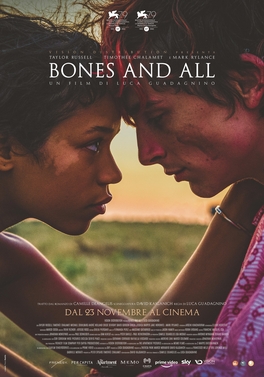
In Minnesota, Maren finds her mother in an institution and learns that her mother was also an eater.  Eventually Lee confesses that his father was an eater.  Sully, who’s mentally unstable (for an eater) has been following Maren and decides he has to kill her for what she knows.  Lee rescues her, but is critically injured in the process and insists that Maren eat him.  Now, from that description you might think this is either a comedy or a film with horror score and stingers, but it’s neither.  It’s a straightforward romance, following two lovers with a unique problem.  Only it’s not as unique as all that since there seem to be quite a few cannibals around.  The theme, and the feeding scenes, are definitely horror.  But is this a horror movie?

Although Maren and Lee are moral people, and likable, they are the monsters in this film.  While they try not to kill, they are driven to eat other people and they do resort to violence to do so.  The signature accoutrement for horror are absent as the focus remains steadily on the building romantic relationship.  You want Maren and Lee to succeed because they’re nice people.  But they are monsters according to definition.  Often in horror serial killers and other humans may serve the monster role in the absence of supernatural, or preternatural creatures.  There’s an almost vampire-film feeling to this story (the heightened senses, and all that blood) but eaters aren’t constrained by daylight or crucifixes.  It’s the kind of movie that keeps asking the question “What am I?” and leaves the viewer to try to digest a definition. 


Scary Things

I recently set myself the challenge to come up with the scariest movies I’ve seen, up to 1979.  The date is the publication date (I think) of Stephen King’s Danse Macabre, which gave me the idea.  Book publication dates can be difficult to decipher; I have the Berkley Trade paperback edition, which is copyrighted 1981 and published in ’82.  So, let’s just say 1980.  Now, I would never challenge Mr. King, who is older, and wiser (not to mention much better known) than me.  And I suspect, if I understand writers at all, his views may have changed since then.  Several of the films he discusses are thrillers.  And, of course, each person’s viewing history is unique as their thumbprint.  So let’s give it a try.  First, I need to say there are different kinds of scary.  We all have our triggers, and I’m going for things that frightened me.

Photo by Stefano Pollio on Unsplash

Since we’re using 1980 as the cutoff, The Shining has to be on the list (of course King wrote the novel).  Like most of these movies, I saw it at home and the theatrical experience would’ve made an even bigger impact.  The Exorcist also has to be on this list as well.  For older fare, Eyes Without a Face certainly qualifies.  The Haunting, based on Shirley Jackson’s The Haunting of Hill House is among those in this period but it isn’t terribly scary.  I watched a number of King’s movies—many of which I’d never seen—and found some frightening ones among them.  Night of the Hunter, which makes me add the original Cape Fear, should be included.  So is The Bad Seed.  Something all of these have in common, apart from perhaps The Exorcist, is that they derive their terror from psychology.  There may be some supernatural involved, but the mind is the truly scary part.

Growing up—and even in the present—I’m not really looking to be scared.  I have no trouble getting to that state all by myself, thank you.  The monster movies of childhood thrilled with the unusual, and the realm beyond the everyday.  The haunted house movie held its own frisson for a similar reason.  Of course, children are often not developed enough to understand the nuances of psychological horror.  The more I ponder it, the more it seems that “horror” is the wrong name for what I’m after.   We gain bragging rights by watching scary movies.  And I don’t count jump startles as truly frightening.  I’m more of an existential dread kind of guy.  But I do love monsters.  Even this little exercise made me realize how difficult ranking such movies can be.  Perhaps I should bow to the King.


Bottoming Out?

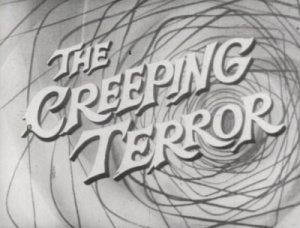
It was an honest mistake, I swear!  I had remembered reading in Stephen King’s Danse Macabre that The Creeping Unknown was worth seeing.  I’d known about this movie under the title The Quatermass Xperiment since I was a tween.  The problem when you grow up with no money in a small town is that you don’t have access to such things.  Then a friend gave me a DVD of The Creeping Terror.  I thought it was The Creeping Unknown.  The disc hadn’t spun too many revolutions before I realized I was watching what may be the worst movie ever made.  Many reserve that for Plan 9 from Outer Space, but believe me, this is much worse.  The story of a couple of aliens sent to eat people to transmit to their superiors what our weaknesses are, it seemed to me that the main weakness is nobody thought to run from this slow-moving monster, except one guy who just abandoned his girlfriend to it. (Apparently girls don’t run.)

Like that other baddie, The Beast of Yucca Flats, the audio was not preserved so nearly all of the film is a voice-over by an authoritative-sounding announcer.  There are a few dubs, but they aren’t well done.  And then extended scenes of young people at a dance (have you ever heard of just filling up time?) are intercut with perhaps the slowest monster attack in history.  There’s so much not to like here.  The poor acting.  The plot nearly as dimwitted as Trump.  The stock footage of a rocket launch run backwards to make it look as if it’s landing.  The sheriff making out with his wife in the patrol car while “on a break” from looking for the monster.  The instrument panels from beyond our galaxy with Arabic numerals and Latin letters.  You find yourself hoping for the Apocalypse so you won’t have to watch the rest, and it’s only 74 minutes long.

Somehow it comes as little surprise that the director (also producer, editor, and star), under the name Vic Savage, disappeared never to be heard of again.  The film’s main financier, had to try to put the movie together for release.  (He also had a role in the movie.)  There is, as I’ve mentioned often before, an aesthetic to watching bad movies.  I’ve ended up seeing many of “the worst of all time” in my spate of movie viewing over the past three or four years.  This is the first time it has happened by mistake.  I do have to say that it’s easier to appreciate a bad movie when you can see that it’s coming and prepare yourself accordingly.  The Creeping Unknown remains elusive.


Yes, Maybe

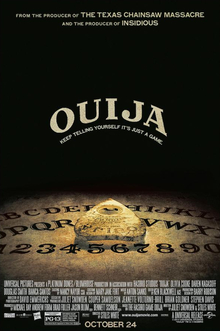
The truth is, only experts and professionals can really keep up with horror films.  As the most successful genre of, well, genre films, there are tons of them.  I completely missed Ouija when it came out about a decade ago, despite the fact that it did well at the box office.  The only reason I watched it now was that a friend sent me a list of horror films from a reputable website that recommended the prequel to Ouija, but I felt that I needed to see the original before finding out what happened behind the scenes.  The original didn’t fare well with the critics and it’s pretty clear why.  The story, although it has twists, isn’t really convincing and the acting is off at times.  (Five teens left alone to watch a haunted house while their parents just take off for weeks at a time?)  Still, it’s atmospheric, and it plays on a scary theme.

I must confess that ouija boards frighten me.  I consider myself both rational and skeptical (in the classic sense), but there’s just enough doubt with spirit boards.  I’ve never owned or played with one.  (Interestingly, the movie was funded in part by Hasbro, the current seller of the game.)  In fact, when I discovered the Grove City College yearbook was called Ouija, I was a bit put off.  (By the time I graduated they’d changed it to The Bridge.)  Although GCC wasn’t really traditionally gothic, like most colleges it had its share of ghost stories.  Even in conservative Christian country things go bump in the night.  And while most stories told about tragedy after using an ouija board are unverified in any way, still…

So, the movie posits a deceiving entity that kills teens who contact it.  I suspect I need to watch the prequel to find out why.  It does manage to have a few scares, but it’s mostly about atmosphere.  I agree with Poe on this point—atmosphere’s often the point of a story.  Although the critics are right (who discovers a body in the basement and goes to an asylum for advice instead of notifying the police?), some of us do watch horror films for this kind of haunted house experience.  And while I’ve got Poe in the room, the threat to young ladies is there.  One thing missing, though, is any talk of religion.  No Ed and Lorraine Warren warnings of demons.  This is a straight-up nasty dead person who likes to kill those who want to communicate with their dead friends.  It does create a mood.  And it cries out for a prequel.


Der Golem

The golem is a monster of fascination.  It has been the subject of movies from quite an early period.  The earliest, now mostly lost, seems to have been Paul Wegener’s Der Golem (1915).  This film became the first of a trilogy, with the second (also lost) being, The Golem and the Dancing Girl (also originally titled in German, 1917).  The third film mostly survives and is therefore often called The Golem, based on the fact that it is the one we can still see.  Der Golem: wie er in die Welt kam (The Golem: How He Came into the World, 1920) is considered a must-see early horror film, although that designation comes from the fact of there being a monster.  It’s not scary.  It is, after all, a silent film.

Having watched some recent examples of Jewish horror I realized that I’d missed this one and set out to rectify the situation.  This film is actually the prequel to the other two, with Wegener’s golem having already established a cinematic presence.  I wasn’t sure what to expect from the story, but I supposed that it would be the oppressed Jews creating a golem to protect them and that it would eventually go berserk, as soulless people generally do.  It may have helped to have seen the two missing films, I suspect.  This golem is made to protect the Jews, but the edict against them is cancelled by the fact that the golem exists.  The emperor is impressed with the Jewish magic and allows the Jews to remain in their ghetto.  The golem, however, develops feelings for Rabbi Loew’s daughter, which is an interesting twist.

The rabbi does lose control of his creation, and it refused to allow him to deactivate him by removing the secret word revealed by Astaroth, under a star on his chest.  A little girl outside the ghetto, picked up by the golem, playfully pulls off the star and saves the day.  This really isn’t Jewish horror, at least not in the sense of more recent films.  It’s not very close to the Jewish golem legend and saving the Jewish community is left up to a gentile girl.  The ending clearly inspired James Whale’s Frankenstein some eleven years later, but the messaging of the film is pretty much what you might expect for a non-Jew trying to tell a Jewish story.  The fact that a demon is involved in bringing the golem to life puts us into a more Christianized view of things.  Still, this historic film, which is just over an hour in length, started something that has grown more sophisticated as Jewish horror started to come into its own.


Prosthetic Horse?

Old habits die hard.  As a young researcher, I was dogged about reading everything possible on a subject before writing on it.  Both the profusion of information and the endlessly ticking clock of mortality now suggest that if you want to say something, say it.  You need to do a reasonable amount of research, but you’ll never read everything.  This is the kind of thinking I should’ve heeded before spending a couple of bucks on Headless Horseman.  I should specify, the 2022 film by that name.  The name has been used before and it has an unspecified coding.  Often it has to do with Washington Irving, but not always.  A 1972 Russian film by Vladimir Vajnshtok is titled The Headless Horseman, but it has to do with a completely separate story.  In any case, Jose Prendes’ 2022 film isn’t what you expect.

Sophia, a girl with a former boyfriend who’s a drug dealer, gets engaged to Brandon.  He’s not too bright, but he’s clean.  When her ex, named Angel, tries to kidnap her back, Brandon dies defending her.  The Devil shows up and a deal is made.  Brandon has 24 hours to kill the gangsters.  He’s given a bladed glove (where have we seen that before?) and a burning jack-o-lantern head (ditto?).  Did I mention this all happens on Halloween?  Well, Brandon just isn’t up to killing people and he fails in his mission, defeated by bad guys with holy water.  So Sophia sells her soul to get Brandon back.  She manages to kill the thugs, but gets shot in the process.  Brandon make a third counter-offer with the prince of darkness, to harvest souls.

The pacing for the film is all off.  The writing is about the worst I’ve ever heard.  Someone being sucked to Hell stops to discuss semantics with his girlfriend?  Really?  And not only that, the special effects are sparingly used.  You’ve got a flaming pumpkin head—use it!  I guess part of me felt cheated by the premise that never materialized.  The “headless horseman” isn’t trademarked, nor can it be copyrighted.  It does, however, convey an expected story that viewers know.  The point of this effort seems to be, if you sell drugs you’ll ultimately get yours.  Those who are innocent will also get theirs, although perhaps will remain on Satan’s good side.  For all its faults it does demonstrate how religion and horror play well together.  Even when they haven’t much good material to work with.

John Quidor‘s The Headless Horseman Pursuing Ichabod Crane

More Excuses

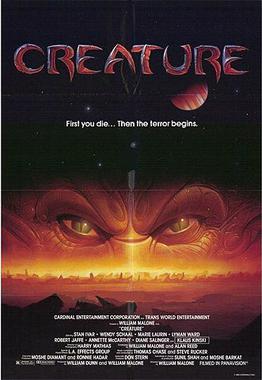
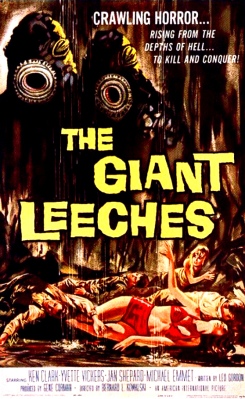
Perhaps it was my Shingrix-addled brain—but we all know that’s an excuse—I decided to watch Creature (1985) and Attack of the Giant Leeches (timeless) over the past couple of days.  The former was a decision made when not having the energy to read, I could still search Amazon Prime for “free to me.”  I was all set to start Attack of the Giant Leeches when I scrolled over Creature only to learn it would be free for only eight hours more.  I recalled, somewhere in the haze, that a movie called Creature was on my watch list, and since time was running out, I clicked play.  Clearly a knock-off of Alien, with even a Sigourney Weaver stand-in, it was one of the most badly written films I’d seen in a long time.  I was surprised to learn it’d had a theatrical release.

A crew stranded on Titan, one of Saturn’s moons, finds a creature—one that looks like a down market version of Ridley Scott’s nightmare—that feeds on unsuspecting astronauts.  Still, the surprises kept coming.  The impossibly pretty women and rugged men of the crew seemed unlikely.  And was that Klaus Kinski trying a move on the security officer that he wouldn’t have survived if he’d tried it on Sigourney?  And how was it even possible that this was nominated for the Best Horror Film of 1985 at the Saturn Awards?  Okay, granted 1985 wasn’t a banner year for horror, but Creature really doesn’t seem to hit the bill for “best of” category—but it was over 25 years after a classic.

Attack of the Giant Leeches is obviously the lesser of the two movies, but it falls into the category of “so bad it’s good.”  The leeches are clearly people in rubber suits, and the caricatures of the hooch-swillin’ swamp-dwellin’ lazy ole homeboys is just too good to pass up.  And the fact that it’s just over an hour long is a bonus when you’re having trouble keeping your eyes open.  Those black-and-white sci-fi horror films of the fifties sure take me back to more innocent times (not the fifties, and the film isn’t all that innocent).  Given that both movies were free on Prime, and given that my head was fuzzy from my vaccine, I counted this as a worthwhile effort at staying awake.  We seem to have come to a more sophisticated era, in many regards.  Such films can’t compete with their modern-day counterparts and even streaming companies are producing their own these days.  There’s something to those older films, however, and maybe it’s helped along by a shot in the arm.


Double Feature

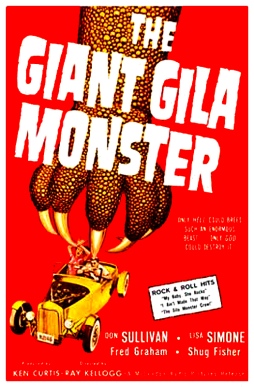
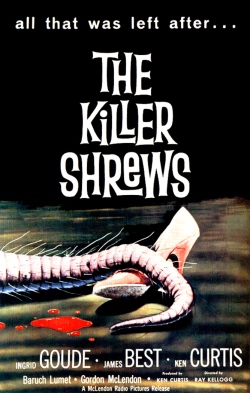
Creature features were a regular part of my youth, and, I suspect, where my appreciation of horror films began.  Nobody was really afraid of Godzilla or other monsters that were clearly people in rubber suits.  The use of forced perspective to make regular-sized animals into giants was obvious even to a child, but that didn’t make such movies any less fun to watch.  The Giant Gila Monster and The Killer Shrews both involve gigantic versions of rather small animals and both of them were produced outside of the studio system by Gordon McLendon, the owner of a chain of drive-in theaters.  Looking for B-movies for double features, he decided to make a couple of his own.  These two didn’t cost that much, but the special effects artist, Ray Kellogg, agreed to do them if he could be the director.  Together they make quite a double-feature of their own.

The Giant Gila Monster is never explained beyond the effectively shot beginning stating the who knows how big some things grow in the unexplored west.  Not even using a real gila monster, the lizard (unlike Komodo dragons, which one expects, were too expensive and untamable) isn’t aggressive and seems, from my perspective, to be just barely putting up with the fake trees and models it has to crawl over and around.  And everyone, apart from Mr. Wheeler, is nice.  The local Texas teens want to drag race but Chase Winstead, the gold-hearted mechanic, keeps them in line.  It’s a perfect world, in a Republican kind of vision, except for that darned giant lizard.  Winstead even figures out a way of getting rid of it so the authorities don’t have to.

The Killer Shrews, in reality puppets and dogs dressed up as shrews, is more adult-themed.  Four scientists on an island—contradicting the voiceover at the opening—have bred giant shrews.  The supply-boat captain and his Black mate are trapped on the island by a hurricane, where the mate predictably gets eaten by the escaped shrews.  McLendon himself appears as an over-the-top nerdy scientist while the producer, Ken Curtis, appears as another, more action-oriented man of science.  In a move a little unexpected for the fifties, Dr. Craigis’ bombshell blonde daughter is also a scientist.  But she’d be willing to be a sea-captain’s housewife if only she could get away from these awful shrews!  There’s a bit more tension in this one as one of the scientists is already engaged to Miss Craigis, but he’s a drunk and she wants out.  So might some audience members, but both films found international distribution and made money.  Now widely available for free, they are a slice of childhood served up in giant proportions.


Like Sheep

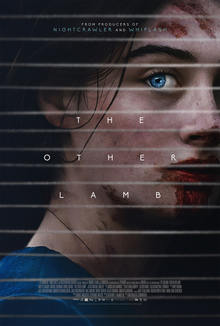
Since horror grew up in the late 1960s, religion has become a favorite theme in the genre.  Although religion had been in horror from the beginning, Rosemary’s Baby marked a definite sea change.  More and more religion has been moving from a subsidiary theme to the main vehicle of horror.  Małgorzata Szumowska’s The Other Lamb is a case in point.  “Shepherd” is the leader of a separatist religion that consists only of women.  The premise itself is creepy enough, but it becomes clear that Shepherd—the group literally has a flock of sheep—physically abuses the women.  They are divided into two groups: sisters and wives.  When unexplained things happen, Shepherd gives prophetic pronouncements.  His followers are expected to accept everything he says on blind faith.  Many religions do this by proclaiming faith against evidence a virtue.

One thing that I’ve emphasized in various presentations I’ve done is that Christianity, and perhaps all religions, work because believers are great followers.  While Shepherd uses biblical-sounding language, there are no Bibles in the film.  There are recognizably Christian themes, but the doctrine isn’t familiar.  Part of the reason, obviously, is that Christianity has a negative view of sex and Shepherd treats his flock as his harem.  The women follow because he “rescued” them from worse situations and their communal life is better.  Only it’s not.  When a woman director stands behind such a film, there’s clearly a message being sent about male privilege.  Any system set up with male superiority will lead to abuse.  When Shepherd’s enclave in the woods is discovered, they must move.  He instructs the women that they are going to find Eden.

Throughout, the movie is more creepy than scary in the traditional sense.  There are no jump-startles, but the situation makes you sense that something’s not right.  The women, acclimated to this lifestyle, many of them for years, know no other way of being or even where to go.  They have no vehicles.  Forced to move, they walk—Shepherd carries nothing while the women backpack out supplies.  Once Eden, on the shore of a lake, is reached, Shepherd baptizes the sisters and drowns the wives so the younger women can take their place.  You get the sense throughout that this movie is a parable.  Men like to take the privilege of determining women’s fates without understanding women’s needs.  This new kind of horror is insightful and symbolic.  There is no final girl when women band together.  The Other Lamb deserves wider exposure than it’s had.  It’s a good example of what religion can do to those who simply follow.


Walking Home Alone

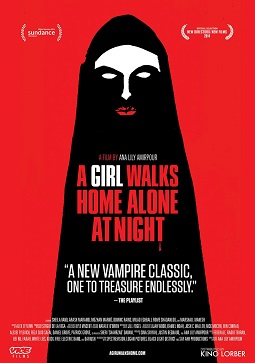
It is an American-Iranian, female-directed vampire movie.  Shot in black-and-white and entirely in subtitled Persian, A Girl Walks Home Alone at Night is a very unusual and artsy movie.  The film has been described as a “spaghetti western” as well, but that’s a bit more difficult for me to see.  If all these disparate elements seem odd, the director’s background may help explain it.  Ana Lily Amirpour was born in England, but of Iranian heritage.  She moved to the United States as a child and began making movies quite early.  A Girl Walks Home Alone at Night is her best-known film to date (I only found out about it by reading a book about horror films that recommended it.)

The title may set certain expectations that will be subverted by the film.  There will be spoilers here, so if you’re likely to see the film you might want to wait to read on.  Who knows?  Maybe spoilers will make you want to see it.  The girl who walks home alone is the vampire.  She’s perfectly safe at night.  The story involves her falling in love with a compassionate young man who’s trying to support his heroin-addicted father.  The movie is quite gritty.  The girl is a conflicted vampire, which happens to be my favorite kind.  She’s never explained.  She simply is.  Her first victim that we see is the drug-dealer and pimp who’s pressuring the young man’s family.  Although they live in poverty, he takes their car in payment.  He’s a nasty piece of work.

The young man, also conflicted, takes over the dead thug’s drug-selling business, but doesn’t take advantage of people.  The vampire is attracted to his virtue.  She also befriends one of the thug’s prostitutes because she’s sad.  Apart from the dead petty crime boss, everyone in Bad City lives in humble circumstances.  The young man finally throws his father out of the house.  The vampire attacks him, leaving him dead.  The young man, in love with the vampire but not knowing she’s a vampire, talks her into leaving with him although he can see she’s implicated in his father’s death.  This is a most unusual film, praised for its feminine outlook.  That’s unusual in both vampire movies and horror, but there’s no reason that it should be rare.  More of an art-house movie than a cineplex blockbuster, A Girl Walks Home Alone at Night is a movie that will leave you wondering.  And that, it seems to me, is a good thing.


Horror Deprivation

Is there such a thing as horror deprivation?  Life has been so busy that I haven’t been able to carve out the time to watch any horror movies for several weeks now.  That steady diet has given me blog topics and a strange kind of personal comfort in this all-too-scary world.  More than that, it is often a coping mechanism.  I sometimes think more people might read this blog if I “rebranded” it as horror-themed, but perhaps there’s a different way to go about it.  Some writers, with enough shares and likes, have their daily observations become part of the national wisdom.  The rest of us, it seems, are simply background noise.  I’ve also been told blogs are passè and that may be the case.  I have trouble keeping up.  I don’t even have time to watch horror!

As with most things in life, I keep a list of movies I need to see.  Like claws such a list continues to grow unless it’s trimmed once in a while.  A movie is a couple-hour commitment and when even weekends are programmed to the last minute it’s difficult to squeeze them in.  I always welcome the more pleasant weather of spring, but so does the yard.  I’ve always thought, like good haunted house owners, that I would let the yard go.  Here in town there are ordinances, though.  It doesn’t look tidy—right now dandelions exceed the tolerated grass length a mere day after mowing.  Like triffids they pop up and won’t go away.  I could be in, watching a movie.  My credibility’s on the line here!

The pandemic, from which horror movies will arise, led many people to having too much time.  Netflix soared.  For whatever reason, it had the opposite effect on me—is this a special effect?—I had even less time than before.  I had to cancel my Netflix account because I had no time to use it.  Horror is a coping technique.  Real horrors spill from the headlines daily.  Sometimes the antidote is in the poison itself.  The way to be less scared is to watch more horror.  We’re still in the pandemic and Putin decides to start a war.  Republicans confess that Trump tried to take over by force and then backtrack.  Global warming continues apace.  There comes a point when the only therapy is to watch something worse unfold, as long as it’s fiction.  It’s Saturday.  It’s raining.  What can one possibly do?


The Best Religious Horror Movies Streaming Now

Here’s an extra-special second guest post this week, enjoy!

Many horror movies have religious themes, plotlines or undertones. Here are a handful of the best religious horror movies to make you pray the bad away, in order of release.

Rosemary’s Baby (1968)

Rated R

Director: Roman Polanski

Starring: Mia Farrow, John Cassavetes, Ruth Gordon

A young couple moves into a NYC apartment with a haunted past. When the wife gets pregnant, she experiences an array of strange feelings, believing her baby may be the spawn of Satan.

Stream Rosemary’s Baby on Hulu, Sling TV, The Roku Channel and Amazon Prime Video.

The Exorcist (1973)

Rated R

Director: William Friedkin

Starring: Ellen Burstyn, Linda Blair, Max von Sydow

An increasingly strange-acting 12-year-old girl causes her mother to volley between scientific and supernatural explanations. Ultimately, she seeks the aid of a priest who himself is experiencing a crisis of faith.

Stream The Exorcist on Netflix.

The Exorcist spawned two sequels: Exorcist II: The Heretic (1977) available to stream on Apple TV, Vudu and DirecTV and The Exorcist III (1990) available to stream on Apple TV and FuboTV. There was also a 2016 television remake of The Exorcist that lasted two seasons and is now available to stream on Hulu and Amazon Prime Video.

Carrie (1976)

Rated R

Director: Brain De Palma

Starring: Sissy Spacek, Piper Laurie

Based on a novel by Stephen King, the master of horror himself, this is the story of a shy, introverted and sensitive teen bullied by her schoolmates and abused at home by her highly religious mother. Then, she becomes imbued with the devilish power to take revenge on them for the suffering and humiliation they’ve made her endure. This is such a timeless and beloved horror classic, it’s been remade twice: once made-for-TV in 2003 starring Angela Bettis and Patricia Clarkson in the leading roles and again in 2013 starring Chloë Grace Moretz and Julianne Moore in the leading roles.

Stream all three versions of Carrie on Apple TV, Vudu and AMC On Demand.

The Omen (1976)

Rated R

Director: Richard Donner

Starring: Gregory Peck, Lee Remmick, David Warner

When the wife of an American diplomat gives birth to a stillborn child, he adopts a child named Damien. After the child’s first nanny commits suicide, the family calls in a priest, who delivers a dire warning: the child may be the anitchrist himself.

The original The Omen spawned two sequels and one remake.

Stream the original The Omen on Hulu, Paramount+, Epix on Amazon Prime Video or Epix On Demand, Tubi and DirecTV.

Stream Damien: Omen II (1978) and Omen III: The Final Conflict (1981) on Apple TV and Vudu,

Stream the 2006 remake of The Omen on HBO Max.

Summary

Catch up on these, and you can say you’ve survived the most harrowing classic religious horror films of all time.


Moving Movies

I read something recently which began something like, “Do you remember when you first saw…?” (fill in the blank with a title of a movie).  This got me to thinking.  Movies used to be community events.  I’m not the first to notice this, but your community would wait (especially if it wasn’t especially urban) until a hyped up movie came to a local theater.  Everyone would see it and it was all that they’d talk about for days.  The internet makes all of that rather obsolete.  Even the part where you were the less popular sort who had to wait for the film to be shown on television to get in on the fun.  You can set up an account to see the movie at home while those who aren’t afraid of Covid go to the theater.  Or you may be like me—so busy that years pass before you get to it.  Hopelessly behind.

There is definitely a benefit to being able to catch a movie you missed at the theater when it’s convenient to do so.  You might be a bit late to the party, though.  And, depending on your tastes, you may be watching the movie alone.  I can’t recall having ever gone to a theater alone until recent years.  Once when my wife was away, pre-pandemic, I went to a local theater to catch the latest Annabelle movie.  Since I’m an early person the theater was pretty empty—at least one guy and his girlfriend, or a girl and her boyfriend, depending, were there with me.  Maybe a couple others I didn’t know.  Nobody to talk it over with.  Like bowling alone, I suppose.  The last movie I saw in a theater, The Conjuring 3, I was literally the only one there.

Photo by Denise Jans on Unsplash

I did recall the first time I’d seen the movie in the article.  I was watching with headphones on, sitting in my bedroom.  Sometimes it’s the living room.  I do recall my reaction, which is, after all, what the article is about.  Still, it was a movie that was watched without discussion, without seeing the reactions of others.  Watching it was, nevertheless, an enjoyable enough experience.  An intellectual one, even.  But as a former teacher I still have this haunting sense that if there’s no-one with whom to exchange information, remembering that first time becomes somewhat muted.  I suppose that’s why I keep this blog going.  I can interact with others on the internet and, collectively, recall seeing our movies together.  Attempt to be part of the discussion.


Horror Shortly

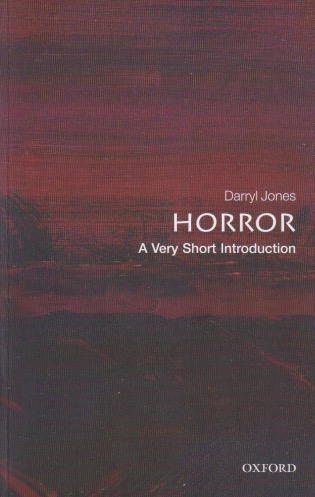
Some short books have an outsized punch.  Especially when dealing with a large topic such as “horror.”  This isn’t just horror movies, which could easily fill such a book, but also literature and other media as well.  Darryl Jones has proven himself on this topic before and this Very Short Introduction is a showcase of what is a fascinating genre.  I’ve read a number of books in this series and this stands out as one that works admirably within extreme limits—they are very short—in making good decisions about representative aspects in what is really a sprawling field of inquiry.  The introduction lays the task out well and I came away from each chapter feeling inspired.  Of course, not all of horror can be covered in less than 150 pages.  Some may find their favorite fear unaddressed, but they’ll learn something nevertheless.

In his first content chapter, Monsters, Jones focuses on vampires and zombies.  These are both forms of cannibals as they’re currently conceived, zombies being relative newcomers to most favored monster status.  His next chapter, on the occult and supernatural, takes on the Devil himself before addressing satanists, demons, and ghosts.  These are, of course, religious monsters.  Although Jones doesn’t dwell on that aspect, the close relationship is nevertheless evident.  For those of us who explore religion and horror this framing proves helpful.  It’s worth pausing here to consider how all of these entities overlap a bit.  As anyone familiar with ghost hunters knows, ghosts and demons may both be found haunted places, and the Devil is the head demon.  Of course, horror is a fiction genre but many people believe in these entities.  That brings religion and horror within the same room.

Body horror occupies the next chapter, and here werewolves come into the picture.  Other aspects of body horror are also discussed, but the painful transformation of the shapeshifter is prime territory.  Horror and the mind brings us to psychological thrillers and the gothic fear of madness.  The topic segues nicely into science, which the next chapter covers.  Not only science itself but the mad scientist.  Finally, the lengthy afterword looks at where horror has gone, and may be going, in the new millennium.  Something that struck me, and which brings this back into religion, is how frequently Darwin and evolution are mentioned.  This concept challenged the human place in the divine hierarchy and led to much of what we think of as horror.  This book is a great resource in a small package.


Keeping Categories

Writing books about movies with a limited budget presents some challenges.  Our subscription to Disney Plus doesn’t really help with the horror genre, but my wife insightfully added Hulu to the package.  Now Hulu isn’t known as a horror streaming hub, but they do have some movies on my viewing list.  The other day I noticed one of their offerings with a title I didn’t recognize.  I  tried searching it on IMDb and came up with nothing.  A bit more research revealed it was an episode of an original Hulu series, mixed in with the horror movies.  The eroding of categories bothers me a bit.  It’s not just Netflix and Hulu and Amazon with movies, but it’s across the board.  I grew up when movie and television were easily distinguished.  Now we live with hybrids.

The same is happening in publishing.  When I sit down to write a book I have a specific end-goal in mind.  Everyone knows what a book is, right?  Well, the future of publishing is all about breaking that down.  Already years ago you could purchase aggregates for classroom use.  These were custom-selected chapters from certain books (electronic, of course) that an instructor could bundle into a “textbook.”  You could mix in articles, blog posts, anything to which you had the rights.  Such a textbook is not a book.  Nobody set out to write it in that form.  It looks like things are moving more and more in that direction.  You’ll be able to purchase just a chapter, or even a paragraph, to use.  Even if the book only makes sense when taken as a whole.

The electronic era is all about breaking down what civilization took centuries to build up.  Not everything about civilization has been good, of course.  It has been patriarchal, treating women unfairly.  It has been supremacist, treating those less technically developed in horrendous ways.  It has been classist, favoring the rich and their interests over those of the vast majority.  Still, it has left us some good legacies—the book, the symphony, the movie.  Such things have made us better people.  It may be fine to break such things down—who knows?  Maybe it will create more fairness for more people.  It won’t help me, however, when I’m trying to write a book about movies.  You still have to know what counts for each category, even if you have to do so on a budget.