Horror Shortly

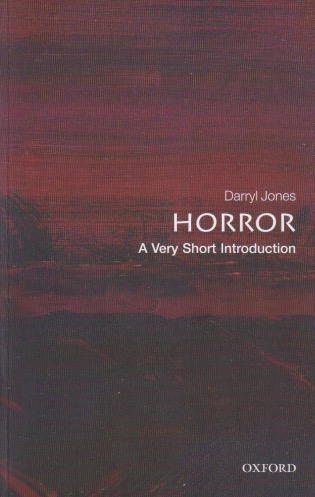
Some short books have an outsized punch.  Especially when dealing with a large topic such as “horror.”  This isn’t just horror movies, which could easily fill such a book, but also literature and other media as well.  Darryl Jones has proven himself on this topic before and this Very Short Introduction is a showcase of what is a fascinating genre.  I’ve read a number of books in this series and this stands out as one that works admirably within extreme limits—they are very short—in making good decisions about representative aspects in what is really a sprawling field of inquiry.  The introduction lays the task out well and I came away from each chapter feeling inspired.  Of course, not all of horror can be covered in less than 150 pages.  Some may find their favorite fear unaddressed, but they’ll learn something nevertheless.

In his first content chapter, Monsters, Jones focuses on vampires and zombies.  These are both forms of cannibals as they’re currently conceived, zombies being relative newcomers to most favored monster status.  His next chapter, on the occult and supernatural, takes on the Devil himself before addressing satanists, demons, and ghosts.  These are, of course, religious monsters.  Although Jones doesn’t dwell on that aspect, the close relationship is nevertheless evident.  For those of us who explore religion and horror this framing proves helpful.  It’s worth pausing here to consider how all of these entities overlap a bit.  As anyone familiar with ghost hunters knows, ghosts and demons may both be found haunted places, and the Devil is the head demon.  Of course, horror is a fiction genre but many people believe in these entities.  That brings religion and horror within the same room.

Body horror occupies the next chapter, and here werewolves come into the picture.  Other aspects of body horror are also discussed, but the painful transformation of the shapeshifter is prime territory.  Horror and the mind brings us to psychological thrillers and the gothic fear of madness.  The topic segues nicely into science, which the next chapter covers.  Not only science itself but the mad scientist.  Finally, the lengthy afterword looks at where horror has gone, and may be going, in the new millennium.  Something that struck me, and which brings this back into religion, is how frequently Darwin and evolution are mentioned.  This concept challenged the human place in the divine hierarchy and led to much of what we think of as horror.  This book is a great resource in a small package.


Keeping Categories

Writing books about movies with a limited budget presents some challenges.  Our subscription to Disney Plus doesn’t really help with the horror genre, but my wife insightfully added Hulu to the package.  Now Hulu isn’t known as a horror streaming hub, but they do have some movies on my viewing list.  The other day I noticed one of their offerings with a title I didn’t recognize.  I  tried searching it on IMDb and came up with nothing.  A bit more research revealed it was an episode of an original Hulu series, mixed in with the horror movies.  The eroding of categories bothers me a bit.  It’s not just Netflix and Hulu and Amazon with movies, but it’s across the board.  I grew up when movie and television were easily distinguished.  Now we live with hybrids.

The same is happening in publishing.  When I sit down to write a book I have a specific end-goal in mind.  Everyone knows what a book is, right?  Well, the future of publishing is all about breaking that down.  Already years ago you could purchase aggregates for classroom use.  These were custom-selected chapters from certain books (electronic, of course) that an instructor could bundle into a “textbook.”  You could mix in articles, blog posts, anything to which you had the rights.  Such a textbook is not a book.  Nobody set out to write it in that form.  It looks like things are moving more and more in that direction.  You’ll be able to purchase just a chapter, or even a paragraph, to use.  Even if the book only makes sense when taken as a whole.

The electronic era is all about breaking down what civilization took centuries to build up.  Not everything about civilization has been good, of course.  It has been patriarchal, treating women unfairly.  It has been supremacist, treating those less technically developed in horrendous ways.  It has been classist, favoring the rich and their interests over those of the vast majority.  Still, it has left us some good legacies—the book, the symphony, the movie.  Such things have made us better people.  It may be fine to break such things down—who knows?  Maybe it will create more fairness for more people.  It won’t help me, however, when I’m trying to write a book about movies.  You still have to know what counts for each category, even if you have to do so on a budget.


Can You Recall?

While recently in touch with a colleague I’ve never met, I agreed to send along a filmography of my two horror movie books, Holy Horror and Nightmares with the Bible.  I tend not to read my own books after sending them to the printer.  Defensively it might be that I can say, “I know what I wrote,” but in reality it’s probably more a lack of self-assurance.  Writers often experience self-doubt and although you’ve convinced an editor and an editorial board you may still have your harshest critic to please.  Even though you’ve read the book many times through—at least fifteen each for these two books—you fear you might’ve overlooked something.  So it was strange trying to recall which films I’d actually discussed.  Or how many.

The latter point became clear in a recent review on Reading Religion.  Knowing how I went about piecing together Holy Horror, I’d forgotten just how many movies I watched and rewatched for it.  While it was never intended to be a comprehensive treatment of the Bible in horror (I haven’t seen all horror films), it nevertheless ranges widely.  After having submitted it I continued to watch horror and I continue to find various Bibles in it.  The amazing thing is just how truly widespread the Good Book is as an iconic symbol.  Indeed, I’d been reading about the Bible as an iconic book and that idea took hold in the early days of putting words down for the book.  As an editor I help authors figure out these kinds of issues all the time.  Physician heal thyself.

Even though Nightmares with the Bible just came out over a year ago I couldn’t list all the films off the top of my head.  Sometimes you need reminders.  My books are never discussed at work.  The people I interact with on a daily basis have no interest in them.  In other words, unless I’m having an interview or reading a review, I don’t have much opportunity to think about them.  I’ve moved on to my next projects.  The draft of The Wicker Man has been submitted and I have three promised articles to work on.  Still, I’m trying to settle on the next book.  I seem to have found some acceptance among the horror crowd.  Biblical meteorologists and researchers on Ugaritic goddesses are much less seldom in touch.  Monsters are often mixed forms.  I should know that after watching all these movies.


Global Swarming

It’s a veritable horror trope.  The swarm, that is.  We fear being overwhelmed by vast numbers of apparently innocuous insects or arachnids, although they are much smaller than us.  It’s their logistical superiority, and perhaps their utter disregard of personal space.  Summer at Nashotah House was the time of the earwigs.  They came out in such numbers that no room in the house was safe from them.  There was a horror element to pulling your toothbrush out of the holder only to find one hanging onto the place you were about to put your fingers.  Or opening the refrigerator to find that one had crawled into the butter.  Any time you picked something up you might find an earwig under it.  They would crawl up the walls and across the ceiling.  Other places on campus would be overrun with ladybugs or black flies.  It was in the woods, after all.

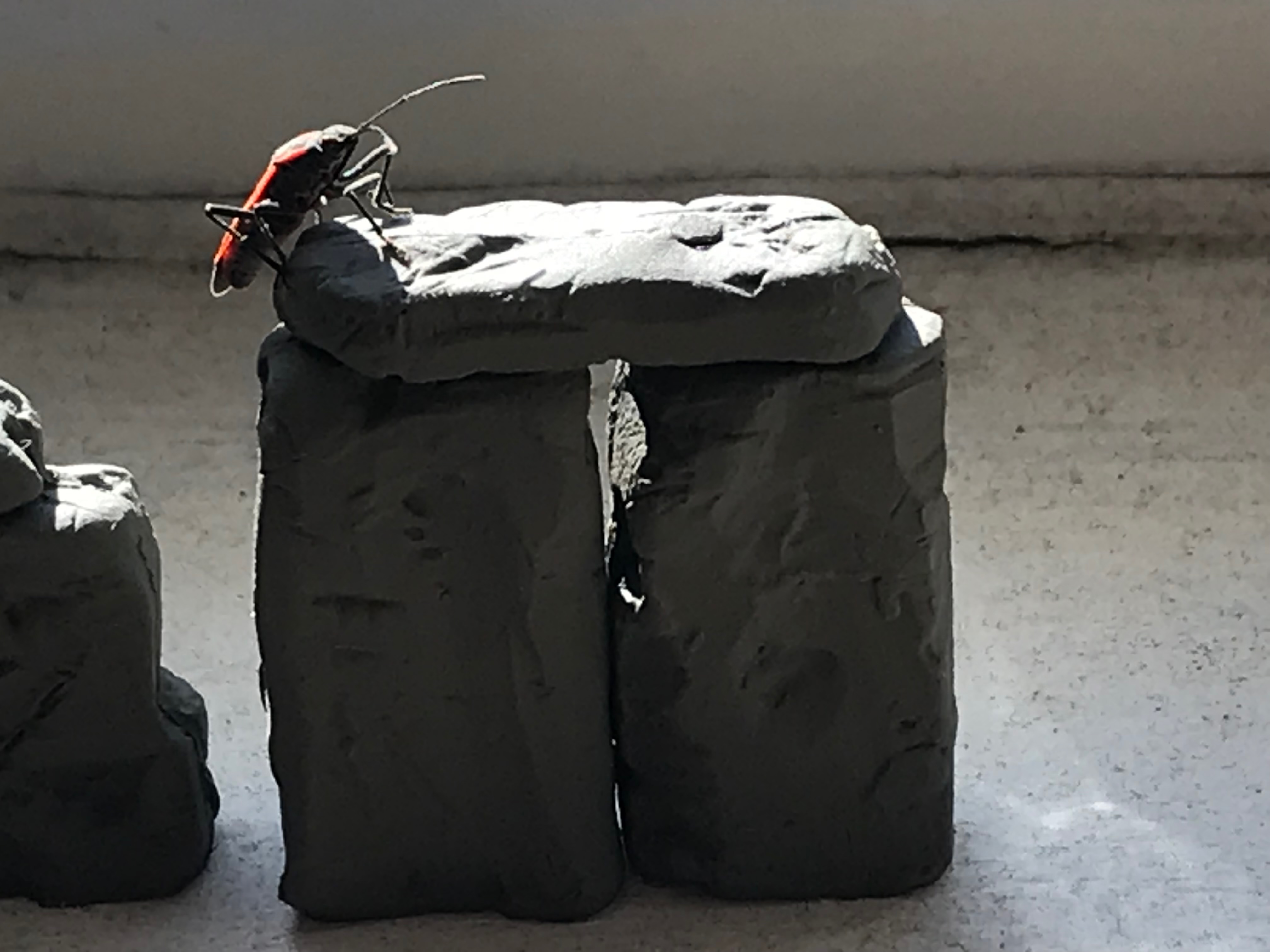
Most places we’ve lived since then have had their native bug that gets in, often in numbers.  Our current nemesis is the box elder bug.  Although harmless, it is a true bug in every sense of the word.  I’m Buddhist in my desire not to kill and there are too many to catch and take them back outside.  Fortunately they’re pretty localized—they like my study, probably because its southern exposure means it gets sunshine even into December.  We’ve had some cold days but November has been experiencing global warming and the box elder bugs, clueless, wander all over the place.  Most of them are near the end of their life and die after poking around for a few days.  Others are quite frisky.  Some remind me of horror movies from the fifties.

I have one of those desk set Stonehenge models.  I don’t have the space to set it up fully, and the die for the model was obviously done with poorly sculpted clay, so it takes some imagination to think the trilithons resemble those of the actual site.  When I noticed a box elder bug crawling over one, however, it took me back to Tarantula and other such films where the menace wasn’t just a little old bug, but a huge one.  Our monsters these days have shrunk, however, and fear comes in small packages.  Box elder bugs are harmless but annoying.  Of course, they’re still out this year because we’ve warmed the place up for them and even in November they, well, swarm.


Reading Wicker

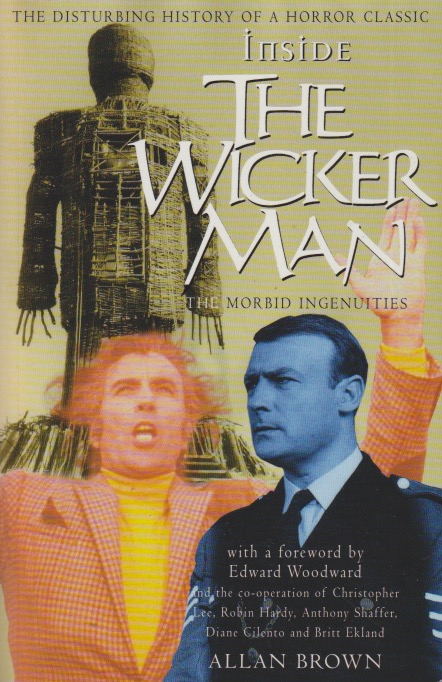
Have you ever read a book where factual errors make you question the larger picture?  I suppose being trained in research makes me more bothered by small inaccuracies.  Don’t get me wrong, I’ve made mistakes myself.  Even in publications.  But when they come near the beginning it’s rather unfortunate.  That’s not to say I didn’t enjoy Allan Brown’s Inside The Wicker Man.  I actually enjoyed it quite a lot.  There’s a real treasure trove here for fans of this cult classic.  I suspect it’s the definitive treatment of the misfortunes the film faced after it was shot, and even during the shooting process itself.  It’s somewhat surprising that so many of us have even heard of it.  When the film’s production company turns against the project it must present special difficulties. Errors are human. Most of the mistakes in the book were about religion.

For Wicker Man fans this book is a great resource.  Not only does it tell the story, but it serves as a useful reference. It includes information on locations, script excerpts, and behind-the-scenes stories.  You get to feel that you know the people involved beyond simply seeing them as characters in a play.  One of the points that Brown makes, while obvious in retrospect, is crucial:  The Wicker Man works as horror not in spite of religion, but because of religion.  I struggle to articulate what the two share in common, but it is useful to be reminded that a prime example comes in this unusual movie.  I wrote about it in Holy Horror, but there’s much even there that I left unsaid.

Brown had the distinct privilege of interviewing many of the people involved in the making of the film.  Most of the cast and crew have since died—the movie was, after all, nearly half-a-century ago.  Even so, when attempting to get at what a novel, movie, song, or piece of visual art means, the realization soon dawns that it’s often in the mind of the observer.  Some songs, for example, speak intensely to some people while being ignored by many others.  The Wicker Man never swam into the mainstream.  I discovered it during an intense period of watching as much quality horror as I could get my hands on.  Immediately I was struck by its intelligence and its strong message.  I’ve watched it several times since, making me, I suppose, a fan.  Enough of one to read this book and enjoy it, in any case.  And to recommend it to others who may be interested in the fascinating film it explores, along with its religion.


Time for Golem

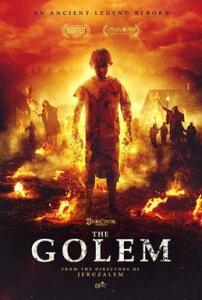
I don’t claim to understand how the film industry works.  My two books on horror and religion deal with interpreting the movies, not their native cinematic environment.  I say this because I limited my treatments in them to films with a theatrical release.  Mainly this was so that readers would have had easy access to them.  Some films, of course, never go to theaters and it seems that happened, in the United States, to the Israeli movie The Golem.  I saw a trailer for it last year and patiently waited for it to arrive.  I recently found it on an online streaming service and finally had a chance to watch it.  Golems, as original Jewish monsters, have shown up in a variety of popular media including The X-Files and Sleepy Hollow.  Film treatments have been rare, and this one makes for a fascinating monster movie.

What makes the golem so compelling is that it is an explicitly religious monster.  To create a golem (according to the film) the maker must use Kabbalah, Jewish mystical texts, to learn how to bring it to life.  Hanna (Hani Furstenberg), the female protagonist, is the only one in her seventeenth-century village willing to try.  The real hook, for me, is that the golem she creates is a little boy.  The role must’ve been fun to play.  Golems cannot speak, so there are no lines to learn.  Kirill Cernyakov nails the part with an ability to portray emotionless menace.  The problem with a golem, you see, is that it goes on rampages, killing even those it’s conjured to protect.  Since the movie is intended to be a retelling of the classic story (involving the golem of Prague), it doesn’t have too many surprises.  It is, however, a thoughtful movie.

Write-ups on it call it “the Jewish Frankenstein,” but scholars who research Frankenstein often go the other way, seeing Frankenstein’s monster as a form of golem.  The basic idea is taking something inert and bringing it to life.  Afterward the creator is unable to control it.  It’s too bad that The Golem didn’t get a wide theatrical release.  I’ve seen far worse horror films that did.  Perhaps the focus on religion was too blatant?  One of the points I make in Holy Horror and Nightmares with the Bible is that religion and horror belong together.  Some Jewish viewers will undoubtedly spot inaccuracies (even this goy did) but the movie isn’t a religious text.  It is an appropriate rebuff to Trumpian “politics” and even features a plague.  It is a movie for our time.


Bird Land

Since I like to blog about books, my usual reading practice is to stick with a book once I start it.  This can be problematic for short story collections because often there’s one in particular I want to read.  Somewhat embarrassed about it, I have to confess that sometimes it’s because I saw the movie first.  So it was with Daphne du Maurier’s “The Birds.”  Du Maurier, the daughter of a father who also wrote horror, caught Alfred Hitchcock’s attention.  Several of his movies were based on her works.  Not all of them can be called horror—a genre that’s difficult to pin down—but they deal with gothic and thriller themes that had an appeal for Hitch.  In fact some analysts date the modern horror film to the period initiated by this iconic director.

I have a collection of du Maurier’s short stories, written in the day when 50 pages counted as a short story rather than “product” that could be “exploited” in various formats.  (Today it’s not easy to find literary magazines that will publish anything over 3,000 words, or roughly 10–12 pages.)  In any case, “The Birds” is an immersive tale.  The movie is quite different, of course, set in America with a cast of characters that can only be described as, well, Hitchcockian.  Du Maurier’s vision is much closer to the claustrophobic pandemic mindset.  A single English family, poor, tenant farmers, far from the centers of commerce, must figure out how to survive the bird attacks on their own.  The suddenly angry birds attack their hovel in time with the tides (they live near the coast) so the family has to gather supplies between attacks and try to last another night of pecking and clawing.

The story is quite effective.  Reading it suggests the importance of self-reliance and willingness to accept a changed reality on its own terms.  No explanation is given for the birds’ change of attitude.  Human intervention in the environment is supposed but how would a simple family living of the fringes of the fabric woven by the wealthy know?  Forced to react, they try to keep the kids calm while knowing, at some level, this can never end well.  The movie maintains the ambiguous ending, which is probably what makes it so scary.  Corvid or covid, there are things out there that drive us into our homes where we must shelter in place.  Although I didn’t read the whole book, this choice of story seems strangely apt for the current circumstances.


Quiet Now

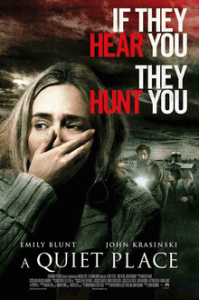
The funny thing about my movie watching is that it’s a reflection of my scattered lifestyle.  While I was teaching my career progression was linear with a goal of moving beyond Nashotah House to a college or university that shared my values better.  Publishing was a fallback, and I’ve learned a lot but I haven’t unlearned my academic leanings.  So, like the rest of my life, my movie watching is piecemeal.  I found a copy of A Quiet Place in a Halloween sale.  My wife bought it for me and on a weekend on my own I watched it.  I had no idea what it was about, but I’d read that it was an intelligent horror film, and that was good enough for me!  There may be spoilers here if you live in a cave, like I do (metaphorically), so be warned.

The backstory isn’t fully spelled out, but the monsters in this movie are blind and attracted to their victims by sound.  The focus is on a family in upstate New York that’s trying to survive without making any noise.  Since there are kids involved, you’ll see how tricky this could be.  John Krasinski’s film builds the suspense wonderfully.  Borrowing from M. Night Shyamalan at his best, and Alien and even Stranger Things, the movie has a odd effect.  When it’s over you don’t want to make any noise.  I watched it while my wife had to work over the weekend, and I put the DVD away as quietly as I could, and then went to bed.  Awaking alone the next morning, I continued the vigil.  Critics praised the movie for its silence, perhaps what we’re most afraid of in this noisy world.

I spend a lot of time saying nothing.  Editing is a quiet job.  Telecommuting is a quiet lifestyle.  At Nashotah House we had mandatory quiet days, which, if they weren’t mandatory I would’ve loved.  I’d seriously considered a monastic lifestyle when I was younger—there’s great value in being quiet.  A horror film that teaches that lesson, despite many obviously unanswered questions, is worth paying attention to.  Horror films have continued to grow more intelligent over the years.  This one is rated PG-13 and will have you on the edge of your seat (or under the bed) anyway.  And it’s got an important message.  For those of us who don’t say much (maybe that’s why I write all the time) a movie like this acts, if you will, as a loudspeaker.  Does anybody hear me?


Spiritual Fear

There’s an old adage that if a headline asks a question the implied answer is “No.”  I’ve found that to be true, largely.  I hoped differently when I saw the article titled “Are Horror Films Secretly Spiritual?” by S. Rufus in Psychology Today.  Rufus, admittedly not a fan of horror, ponders whether it might not meet a spiritual need for some.  She would not count herself among that number, should the assertion prove to be the case.  Indeed, her post has more sentences ending in question marks regarding this assertion than it has straightforward declarative ones.  Rufus notes that ancient religions involved a kind of fear-based response appropriate to the lifestyle of those open to constant threat by the natural world.  She seems to believe that civilization has saved us from that.

Now one of the questions with which I constantly struggle is why I watch horror.  I do not like being afraid, and when people find out about my fascination with horror they tend to treat me as if there’s something wrong with me.  I guess maybe I think that civilization has not so much eliminated the sources of threat so much as changed them.  Those who grow up poor know fear.  Fear of want is extremely prevalent in our capitalist society.  I see the “street people” when I go into New York City.  They are not few.  Once you start to get away from affluent suburbs just about anywhere you start to see the run-down houses of those who can’t cope with the demands of a consumerist society.  Even those of us with an education are liable to joblessness and the very real terror that attends it.

Civilization, in other words, comes with its own costs.  Religions originally began—some of them at least—largely from the fear response.  Yes, people were afraid.  The gods, properly propitiated, stay the hand of disaster.  For now.  Some religions, such as those in the monotheistic family tree, tend to suggest higher principles like love can be the motivation.  These religions, however, quickly begin to make threats against those who are heterodox, and reintroduce fear into the formulation.  I suspect, from my own experience of all of this, that the answer to the question may actually be “yes”—horror films do offer something spiritual.  There is a catharsis, if I may borrow a term from psychology, in them.  The spiritual element may, however, run much deeper than that.  Until human society truly takes love and justice as its operating principles, we will have horror films to help us learn to cope.


Book Signing

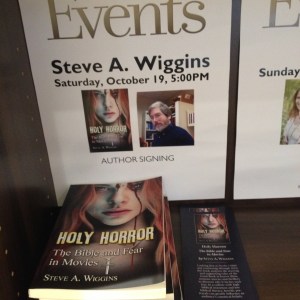
Okay, so I’ve got a book signing for Holy Horror coming up at the Moravian Book Shop in Bethlehem.  And they’ve advertised it in the local paper.  I’m humbled and honored by this, especially since I have no local following.  When I go to the website of the newspaper, The Morning Call, ads pop up on the top, bottom, and center of the page, obscuring the event.  I take this as kind of symbolic.  Life is crowded.  We seem to have turned the corner to autumn around here with nights being distinctly chilly.   After the languorous heat of summer when even thinking about winterizing seemed to add another layer of insulation over already too warm body, now we suddenly have to try to fit it in among an already crowded schedule.  At least I don’t have to commute too much any more.

I’m trying to get ready for the book signing, but I don’t really know what to do.  Perhaps I should try to get some business cards printed up.  Maybe I should think of some catch-phrase to use if anyone actually buys a high-priced book.  What should I wear?  Working at home can make you feel like a recluse sometimes.  I don’t have enough money to be considered eccentric, but I don’t get out among hoi polloi much either.  If most people have as much trouble as I do clicking off the ads to get to the event underneath, those who swing by the table are likely to be few.  Still, I’m looking forward to meeting local horror film fans.  They are, in general, a surprisingly cordial bunch.

After Nightmares with the Bible I’m going to focus on trying to find more mainstream publishers.  The reason is simple: academic publishers tend to be overpriced.  I’ve worked in publishing long enough to be able to decode pricing schemes.  There is a logic to them, even if at times it feels like you’re being overshadowed by pop-up windows.  To get a wide readership you need a pretty big platform, and getting a following on any form of social media takes the one thing I don’t have enough of.  Time.  You see, just the other day it was summer and we felt like we were baking.  Now the equinox has plunged us into the days of getting the furnace cleaned and operational and looking at the prices of insulation and shaking our heads.  Somewhere under all of these pop-ups are ideas waiting to be written down.


Power of Parables

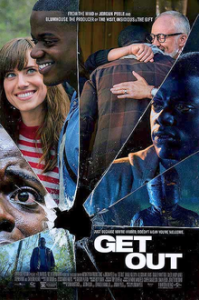
Parables come in all sizes and shapes, horror movie-shaped, some of them.  In my perpetual struggle to catch up, I finally got to see Get Out.  One of the raft of well-made, intelligent horror films that have been released recently, it’s been out long enough that I suspect my spoilers will be well known.  The Armitage family, resident in upstate New York, has been kidnapping and using African-Americans to make up for the perceived weaknesses of their family and friends.  One of their main means of obtaining victims is through their daughter Rose, who brings her boyfriends home for the weekend so they can be hypnotized by her psychiatrist mother and operated on by her neurosurgeon father.  The reveal comes slowly, but the discomfort begins early on.

Released early in the Trump White House tenure, the movie is a study in an intense xenophobia that nestles somewhere between Guess Who’s Coming to Dinner and The Stepford Wives.  It’s inherently uncomfortable watching Chris Washington, the protagonist, being treated as if his very presence requires constant comment in the world of white privilege.  He, of course, had misgivings before ever climbing into Rose’s car, but her convincing display of liberalism was enough to overcome his hesitation.  For me, watching the film made it clear that privilege is something assumed, even when it isn’t had in any explicit way.  The Armitage family and their friends are well-to-do but even if the setting were more mundane the message would still have worked—our culture imposes and reimposes its message of white superiority in subtle ways that the camera captures here.

Quite apart from its nature as a parable, Get Out is a demonstration of the social consciousness of horror.  Its reputation as a debased, low-brow appeal to all that’s unsavory to watch is misplaced at times.  While Get Out is uncomfortable it’s that way for a reason.  Were it not, it would lose its important message.  All privileged people need to be able to see through the eyes of those who are culturally disenfranchised, and although the “us versus them” mentality is problematic it has to be faced honestly and openly.  The very fact that a human construct like race could be used as the basis for a horror film in America raises questions that ought to make all of us squirm.  Setting the story in New York, where prejudice might be supposed not to remain only underscores how deeply its roots have grown.  Horror with a conscience is perhaps as much a vehicle for social change as it is a genre more honest than often supposed.  That’s how parables tend to be.


Horror Homeroom

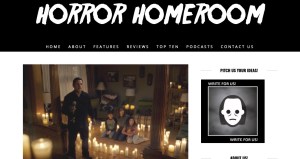
With a happy coincidence I discovered a website called Horror Homeroom.  Featuring articles and podcasts and reviews on horror films, I felt its siren call.  Then I learned it is run by a professor at nearby Lehigh University, making it even closer than I initially supposed.  I wanted to be part of the conversation.  You see, after years and years of being a Bible scholar and having to fight to find any kind of interest whatsoever in what I had to say, I’ve found the horror community extremely welcoming.  Perhaps because we all know at some level that horror is considered transgressive—it isn’t unusual to find critics who still claim it’s debased—we find each other.  There’s an aesthetic to horror, and it isn’t about gore and violence.  Horror, when done well, is an excellent marker of what it means to be human.

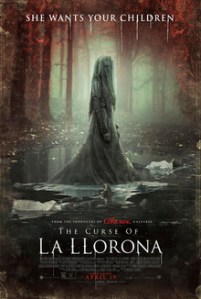
Life always ends in death.  Many people spend as much time as possible trying to avoid thinking about it.  There is, however, great creativity in facing squarely what you cannot change.  Well, that’s a good sounding excuse anyway.  All of this is by way of announcing my guest blog post on Horror Homeroom.  A few weeks back I was quite taken with The Curse of La Llorona.  Not that it was a great movie, but it had a way of coming back to haunt me.  Part of it has to do with the poorly understood way that local customs blend with imperialistic religions.  Faith is a local phenomenon.  Once you switch off the televangelist, you’ll begin sharing beliefs of your neighbors.  There’s no such thing as a pure religion.  Pure religion is one of the most dangerous myths there is.

Those of us who study religion professionally have been taught to call the blending of religions “syncretism.”  I’ve stopped using that word for it because it assumes that there are pure forms of religion.  Religion always takes on an individual element.  We make it our own when it gets translated into our personal gray matter.  The idea that there is a pure form of any religion requires an arbiter of greater rank than any here on earth.  You can always say “but I think it means…”  Horror, I suspect, latched onto this truth long ago.  Without some hint of doubt about your own individualized belief system, it’s difficult to be afraid.  Horror need not be about blood and gore.  Often it isn’t.  Often it’s a matter of asking yourself what you believe.  And once you answer it, opening yourself to asking questions.


Summertime Boos

There are so many of them that it’s difficult to keep up.  Movies, I mean.  And they can be an expensive habit.  As some readers may know, I’ve followed The Conjuring franchise pretty much from the beginning.  That particular film was long anticipated (at least in certain circles), but still I waited until it was available for home viewing to see it.  I always feel kind of selfish going to the movies on my own since they are a kind of event—a form of social outing.  For me, however, horror movies are research, but that hasn’t taken away the thrill of seeing one on the big screen once in a while.  The Conjuring branched off into the Annabelle movies, and I caught the latest offering in the latter series in a theater.  I hadn’t realized that The Curse of La Llorona had been released a couple months earlier, and that it was being considered part of the diegesis.  It was back to the small screen to catch up.

La Llorona is based on a Mexican folktale and is tied to the other films in its universe by a character who recurs from Annabelle, Fr. Perez.  He’s not the protagonist, but he does introduce one way in which horror responds to the present insanity we call the US government—the character who defeats the fiend is hispanic.  In fact, most of the characters in the film are from hispanic families in Los Angeles.  They take down the ghost without the assistance of border guards or any kind of wall.  They don’t need the simpering help of the GOP.  Like most of the movies in this franchise, however, they do make use of religion.

When Fr. Perez can’t offer immediate help to the family beset by La Llorona (“the weeping woman”), he points them to a local shaman.  In this otherwise Catholic world, the truly amazing outcome is that the faith healer does possess the knowledge and ability to stop the evil.  While the backstory of the ghost is well known, the nature of the entity is a bit unclear.  Most Conjuring films feature a demonic presence, so it’s kind of a relief to have a garden variety ghost for a change.  You see, when Ed and Lorraine Warren challenge entities in these movies they do so with religious accoutrements which tend not to fail.  Ghosts, however, traditionally don’t require a religious banishment.  We’re entering new territory here, of course.  And I hadn’t even known about this film until after I’d seen its predecessor.  How can you hope to keep up with spirits?  It’s a full-time job. 


Double the Magic

Since The Prestige came out over a decade ago I’m not going to worry too much about spoilers below.  This post also comes with another caveat: if you watch this film you’ll be left scratching your head and finding yourself strongly tempted to punch the replay button immediately.  Like most Christopher Nolan films, the movie is complex and intelligent.  It also plays on an age-old horror theme of the doppelgänger.  There be spoilers here!  

Following the rivalry of two stage magicians seeking the ultimate illusion, there’s a great deal of sleight of hand in the way this movie manipulates its viewers.  You are in the audience of a magic show and you’ve volunteered to go up on stage.  I watched this film on the recommendation of a friend without even checking the genre.  That can be a disorienting experience in itself.  One of the first questions we bring to movies as well as to texts is “what kind is it?”  I had the assurance that it was “the good kind” and that was about all.  That assessment was right.  While the credits rolled—it was already late at night, for me—I was strongly tempted to start it all over.  Sometimes people ask me why I watch horror films (and no, this is not horror) and I think the answer is related to what I find here.  Like most people I want the advice of others on what to do should things go wrong.  And in The Prestige they do go wrong.  Spoilers follow.

The crux of the film involves actual doppelgängers that result from Nikola Tesla’s experiments.  Tesla was a mysterious person in real life, and without knowing the genre you can watch this film and find it believable.  There’s a kind of faith involved in movie-going, after all.  One of the early exploiters of the doppelgänger was Edgar Allan Poe.  In “William Wilson” he narrates a tale of a double that might indeed be the real William Wilson.  The Prestige plays the same card.  Most of us live knowing that daily our senses can be fooled.  We actually enjoy it once in a while.  Stage magicians stake their livelihoods on it.  Nolan is a master of bringing complex twists to the silver screen.  In Holy Horror I briefly discuss his Memento.  I have a suspicion that I might’ve had more to say about it had I watched this film earlier, with a copy of Poe in hand.


Frankly

Even in the 1960s, if I recall, Dracula and Frankenstein really weren’t that scary.  I mean this in the sense of the 1931 Universal movies that began the entire trend of “horror” films.  They were, nevertheless, monarchs among those of us who claim the sobriquet “monster boomers.”  (I’ve never considered myself as part of any generation, but there’s so many people that you’ve got to sort us somehow.)  Recently I talked my wife into watching/re-watching these two films with me.   The pacing makes it seem like everything in the 1930s was stuck in slow motion.  The frights are difficult to feel, given what we’ve seen in movies since then.  And they are both, it occurs upon reflection, movies in which religion is the norm against which we measure monsters.  God is assumed.

Dracula, of course, fears the crucifix.  His chosen home in England is a ruined abbey.  Although the source of his monstrosity is never discussed, he is intended to be an embodiment of evil, draining the life of innocents.  Renfield craves flies and spiders in order to ingest their life.  Christianity can’t tolerate such evil and Dracula must be staked (off screen).  Frankenstein’s monster is much more obviously theological.  Opening with a warning to the audience that the film may shock due not only to its frights, but also because of Henry’s desire to create life, the film has philosophical discussions between Henry and his associates, and ends with the moral dilemma of what to do with an evil created by human hands, yet clearly alive like other people.

Metaphorically speaking, these first two horror films set the stage for later developments in the genre.  It isn’t so much fear and startles that define the genre as it is a deep dread of offending the powers that be.  Childhood was so long ago that I can no longer recall just which movies I saw on Saturday afternoons, but these two were among them.  Even as I was beginning the spiritual journey that would assure my job was never far from the Bible, I recalled with fondness the frissons of watching Dracula and Frankenstein—and then the host of other Universal monsters such as The Wolf-Man, The Invisible Man, and The Creature from the Black Lagoon (the last being scary in the classical sense).  The world in which they operated was deeply religious, for even the gill-man was an implicit condemnation of evolution.  These monsters were informing a religious outlook that would last a lifetime.  Going back to Dracula and Frankenstein is like turning back to the first page of Genesis and beginning again.