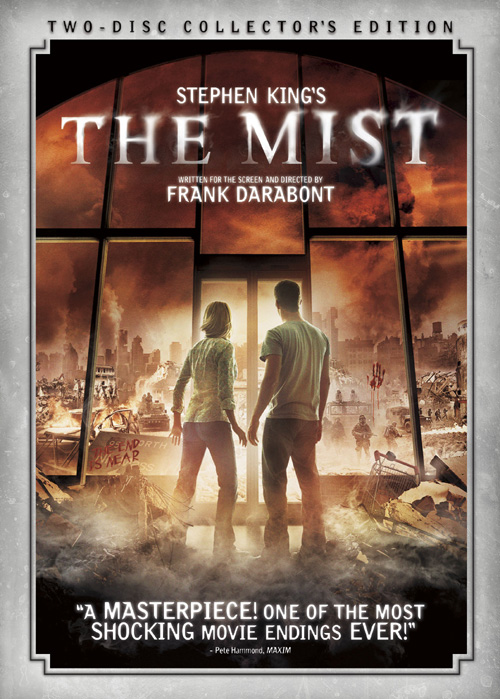
The Mist in the Pulpit

With the teaching schedule I have, vacations are not viable. One semester blends into another like some demonic tapestry with blurred edges between the somewhat discrete components. Breaks just aren’t part of the picture. While my family is on a well-deserved vacation, I’ve been home doing class prep and lecturing. On those nights when I have no classes, I sometimes watch a movie to hear the sound of human voices. This week one of my picks was The Mist.

My fascination with horror films stretches back to my college days, concurrent with my first degree in religious studies. Never a slasher fan, I’ve preferred the more thoughtful movie that has a (hopefully) profound message. I’d never read Stephen King’s novella on which this movie was based, so I didn’t know what to expect. All I knew was “there’s something in the mist.” The build-up was great until the creatures were shown – after that it became a standard monster flick. A human menace arises in the form of Mrs. Carmody, a religious zealot who is convinced the mist is the apocalypse. As the survivors try to form some plan of action, Carmody’s preaching becomes more and more strident and self-convinced as the “wicked” die and the “righteous” are spared. Not having read the book, I’m not sure if her over-the-top rhetoric originated with King or with Frank Darabont, the screenwriter/director.

I have often posted on the relationship of monsters and religion, but The Mist is almost too easy to cite. Perhaps released too late to make it into Douglas Cowan’s Sacred Terror, the connection between religion and fear is patent and bald. Mrs. Carmody’s religion, apart from being very generally Christian, is hard to identify. She insists on human sacrifice while constantly referencing the Bible. Although there are examples of human sacrifice in the Bible, that particular cultic activity is never advocated for monster invasions or the apocalypse. Carmody is a parody of religious over-reaction to the unfamiliar and dangerous. In her insistence that others take her point of view, the caricatured Carmody becomes a danger that threatens the community. It is left indeterminate whether her followers survive or not.

The religious agitator is a trite and tired character, but one that has instant recognition value. In The Mist, however, I came for the mystery and stayed for the monsters. Mrs. Carmody could have said much more by saying much less.
Blogging the Blob

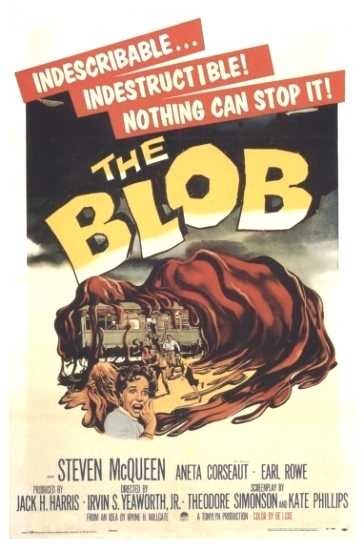
It has no shape. It has no brain. It oozes in where it is not wanted and wreaks havoc on the innocent people of the local community. It is in the hands of an apocalyptic clergyman. No, it isn’t the Republican Party, it is The Blob (1988). Having just watched the remake of the 1958 sci-fi film of the same name, a number of elements relevant to this blog (blob?) stood out in sharp relief. The most notable change from the original movie comes in the form of the role played by Reverend Meeker, the (apparently) Catholic priest turned tent-preaching revivalist. Of course, the whole government conspiracy plot is also new to the film, but that is best left to other blogs.

As noted in previous posts, religion and horror genres share much common ground. While it is hard to take a blob seriously – the role of Bob the blob in Monsters vs. Aliens is precisely comic relief – the idea of a crazed minister unleashing chaos is perhaps a little too believable. The real source of terror in the 1988 version of The Blob is not the monster but those who control it: the government and the church. When the government demonstrates that it cannot control the monster it has generated, it moves into the hands of Reverend Meeker. Here it rests until, after a sermon about the end of times, the reverend pulls out his jar of blob and indicates that as soon as he receives a sign from God, it will be released.

In a strange way this strange film proved prescient. The move of religion into politics was underway already in the Reagan years, but it was a threat few took seriously. It was not until W’s reign that the implications began to become clear. A religiously motivated electorate resembles a blob in significant ways. Once released it is difficult to contain, even by its creators. In aspect it is laughable, but in consequence it is deadly. It stops at nothing short of total domination. This film, which never made the impact that many horror films achieve, may turn out to be the scariest movie of its era after all.

Not your parents' blob


Wicker or Wicked?

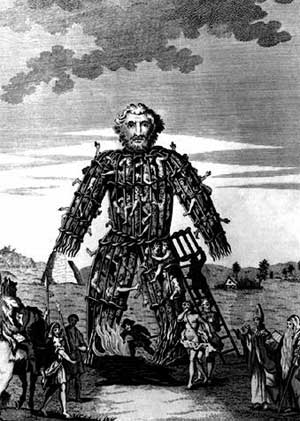
While I continued officially unemployed I keep to a strict regimen of not watching television except on the weekends. Since we don’t have cable or even a digital conversion box, my viewing is limited to grainy VHS tapes or DVDs. Many of them I’ve watched over and over. Last night I picked out one of perennial favorites, The Wicker Man (1973, of course!) for late-night viewing. Although classified as a horror film, the only terror comes at the very end in a scene that I always find difficult to watch. What keeps me coming back to this film is its unrelenting criticism of religious hypocrisy. (That and the longing evoked by the footage of a Scotland I left many years ago.)

Briefly told, a Highland police sergeant, Neil Howie, is lured to a fictional Summerisle in a mouse-and-cat game where he ends up the victim of a neo-pagan cult. The stunned Christian constable cannot believe the superstition evident on the island could still exist in modern Britannia, leading to one of the highlights of the film. Questioning Lord Summerisle, played by a striking Christopher Lee, Howie accuses him of paganism. “A heathen, conceivably,” Summerisle concedes in a tight shot, “but not, I hope, an unenlightened one.” Howie is shown growing increasingly rude and unsympathetic, forging a makeshift cross to lay over a Druidic burial. He threatens Lord Summerisle with being investigated by the authorities of the Christian nation under whose aegis he falls. The tensions between religions grow until the final scene.

The constant interplay between control and conviction raises again and again what the true nature of religion is. Summerisle reveals that the neo-paganism began as an expedient way to encourage the locals in growing new strains of crops. The images of palm trees in the Hebrides may seem unwarranted, but having strolled among them on the Isle of Arran nature itself belies the orthodoxies of convention. Does religion rule by force of law, depth of conviction, or pure expediency? The makers of the film were wise enough to leave that to the viewer to decide. No wonder that on many a bleary-eyed weekend night, ousted from my once stable career by the overtly religious, I choose to watch, yet again, The Wicker Man.


Horror and Head-colds

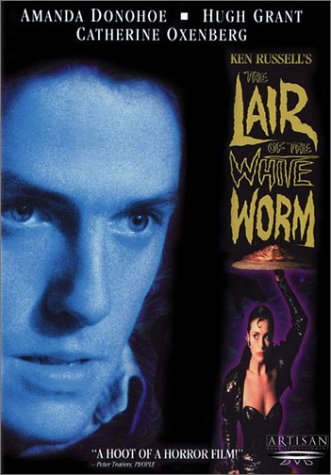
Religion is such a pervasive vehicle for movies, whether disguised or blatant, that pointing out such connections might seem too easy. Finding these connections in horror movies is child’s play since religion constantly probes our deepest fears. Trying to get over a lingering head-cold and suffering from lack of sleep, I pulled out Ken Russell’s 1988 film, Lair of the White Worm. The film itself is not unlike a Nyquil dream, disjointed with sudden shifts of setting and context. The immediate connections with The Cult of the Cobra and Stuart Gordon’s Dagon – based on H. P. Lovecraft – were unexpected bonuses.

Through all of the B- special effects pulses a strong religion subtext. The crucifixion vision juxtaposed with Roman soldiers raping nuns was a dead giveaway. The supporting female characters bearing the names of Eve and Mary could not be more obvious. And the snake wrapped around a tree – is this Sunday School 101? Lacking the sophistication of Robin Hardy’s Wicker Man, Lair of the White Worm nevertheless does strike some similar religious chords. When archaeologist Angus Flint discovers a Roman temple dedicated to Dionin under a convent in England’s north-country, a mosaic of the great white dragon wrapped around a cross tells the viewers all they need to know.

Like Marduk, Baal, Yahweh, Zeus, and St. George, Lord James D’Ampton becomes the dragon-slayer. Chaoskampf (god slays dragon motif) is perhaps the most ancient form of religion, alongside the world-wide flood and dying gods returning to life. These archetypical images populate many films to the point of saturation and Lair of the White Worm is a treasure trove of them. The plot successfully invents an ancient deity, Dionin, whose name and cult have clear connections with that of Dionysus, himself a dying and rising god. This religion is in conflict with Christianity, and the film is opaque enough not to reveal the winner. I need to ponder this some more. In the meantime, I think I need another dose of Nyquil.

Take it with a dose of Nyquil