Ride the Ghost

There’s a book in this, for some enterprising person.  You see, I watched Ghost Rider because I felt I had too.  I’m not familiar with the Marvel comic on which it’s based, but I’d seen many references to it and knew I had to catch up.  That having been said, I don’t think it’s as bad as the critics opine.  First about the movie, and then the book.  Johnny Blaze makes a deal with the Devil (Mephistopheles) to save his father from cancer.  The big M then has his father die in a failed stunt.  (Father and son are motorcycle stunt riders.)  Blaze is compelled to become “the Devil’s bounty hunter.”  He, like the biblical Satan, accuses evil-doers, only with his flaming skull head and super powers, he condemns said evil-doers without being evil himself.  He transforms at night and Mephistopheles wants him to take out his (M’s) son, Blackheart.  He ultimately does, but disses the Devil at the end.
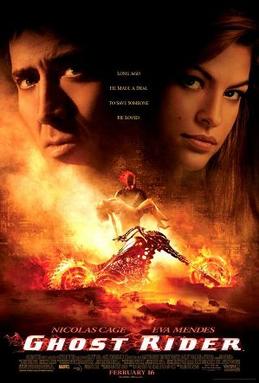
One of the questions I have about metaphysical horror (or action/adventure) is how moviemakers have to make the fight scenes physical.  Shooting a non-corporeal entity with a shotgun, or wrapping said entity with a chain, should do nothing to it.  There’s no physical body to affect.  That’s the difference between movies like this, or Legion, or Constantine, or any number of others, versus The Exorcist and its kin.  The Exorcist portrayed an evil that was real, but non-corporeal.  It took over the body of Regan, yes, but nobody was running around with guns, swords, or chains to try to take the demon down.  I think that basic underlying fact is one that makes such movies falter with critics, if not at the box office (where they tend to do well).  This leads to the book.

One of the main points of Holy Horror is that many people learn their religion from pop culture.  That being the case, someone needs to write a book on how Hell is viewed by the average citizen.  The kind of person who watches movies like Ghost Rider.  Movies that have a definite idea of what Hell might be like.  Most people probably have little idea what a soul in torment might be.  (The rise of mental illness, however, may be changing that balance.)  They imagine physical pain inflicted by nasty weapons that people use on one another.  Someone should look at this idea from the perspective of what religions, such as Christianity, actually teach.  I’ve got my plate pretty full with potential books, but here’s an idea free for the taking, courtesy of Ghost Rider.
Dangerous Dreams

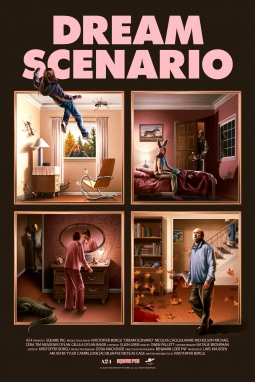
A friend wondered what I might make of Dream Scenario.  As much as I like movies I can’t keep up, what with a 9-2-5 job and writing my own books.  I’m really glad, however, that I learned about it.  It’s one of those movies with a difficult to define genre.  IMDb tags it as “comedy,” “drama,” and “fantasy.”  Rotten Tomatoes goes this route: “Comedy/ Drama/ Mystery & Thriller/ Horror.”  Is there anything this movie is not?  There are definitely some horror cues here, but it doesn’t feel especially like horror.  Except when it does.  Ari Aster, one of the producers, is associated with “art horror” films—think Hereditary.  Think Midsommar.  And it’s an A24 movie, but I’ve read that they’re moving a bit away from horror (the only kind of movie for which I know them).  So what is Dream Scenario?

In brief, it is the best I’ve seen from Nicholas Cage.  I’ve liked some of his films, but this one is incredible.  Certainly the story helps.  Paul Matthews (Cage) is an unremarkable biology professor who suddenly begins appearing in people’s dreams.  Nobody can figure out why, but when the story gets on social media he becomes famous.  Everyone loves him.  Then something happens.  The dreams become nightmares and everyone turns on him.  That summary doesn’t do justice to the film, but it’s essentially what goes on.  The telling of the tale, however, is masterful.  The nightmares, which are briefly shown, are what make this any kind of horror.  There’s no lingering over the fear.  It’s just part of Paul’s new life.

The closest I’ve come to encountering this idea is the novels by Hank Green: An Absolutely Remarkable Thing and A Beautifully Foolish Endeavor.  Of course, Green knows what fame is like—something few accomplish.  The movie explores how fickle it can be and how swiftly and viciously it can turn on those who find it.  In that regard Dream Scenario is also an exploration of life in the internet era.  It’s a time when the kids have to be asked to put down their phones for family time over a meal.  When the result of constant connection is “trauma.”  Unlike fame in the last millennium, “going viral” is just a matter of waiting until someone comes along with something that the net likes better.  And the commentary about how to merch shared dreams takes this in quite a different direction from Inception.  Dreams are strange, and remain poorly understood.  This is a movie that will make you ponder how much they are like the internet, and the results can sometimes be a nightmare.


One out of Three

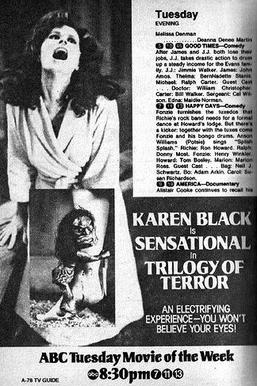
While reading about Dan Curtis, I became curious about Trilogy of Terror.  As a child subject to nightmares, my “horror” watching was limited to Saturday afternoon movies on television and Dark Shadows (also a Dan Curtis production).  In other words, I didn’t see Trilogy.  While we were allowed to watch The Twilight Zone from time to time, I understand my mother’s reluctance to let us watch scary content.  She was trying to raise three kids on her own, one of whom (yours truly) was plagued with bad dreams.  Why would you let them watch scary stuff, particularly before bed?  In any case, Trilogy was a made for television movie; Curtis did some theatrical films, but mostly stayed with television.  It consists of three segments starring Karen Black, based on stories by Richard Matheson.  Only the third one was scary.

Poster, from TV Guide, courtesy of Wikimedia Commons, copyright: TV Guide

The first two segments feature Black as either the apparent victim of blackmail or being controlled by a drug-addicted sister.  The stories, being Matheson, have twist endings, but they don’t really scare.  The final segment, for which the movie is remembered, involves the trope of the animated creepy doll.  That made people sit up and pay attention.  This wasn’t the first creepy doll exploited by horror, but it did predate Child’s Play and, of course, all those Annabelle movies.  The doll here was a Zuni fetish.  Its purpose is to enhance hunting skills and, of course, it comes with a warning.  Don’t take off its golden belt or the spirit trapped inside will be released.  The belt comes off, of course.  The doll naturally attacks Black and, not being really alive, can’t be killed.  The movie made an impression back in the day and is difficult to locate now without shelling out a lot for a Blu-ray disc.  (Diligent searching will lead to streaming options, however; trust me.)

Having inherited more realistic scary dolls in the franchises mentioned above, it takes a bit of imagination to realize how frightening this would’ve been in the mid-seventies.  Although a Zuni fetish isn’t a toy, killer toys had appeared before and would appear again.  They all seem to rely on the uncanny valley where things resemble people but we know they’re actually not.  We survive by being able to read other people and getting an idea of their intentions.  The fetish here has pretty clear violent intensions, being a hunter with pointy teeth.  We all know that there are some people like that.  Such television movies aren’t always easily found, and if they’ve become cult classics like Trilogy of Terror, discs are priced pretty outrageously.  If you’re unrelenting in your searching, you might just find your possessed doll.  And an early example of what’s still a pretty scary idea.


Mad Homework

Watching movies can be studying.  It’s all a matter of what the exams are.  I studied enough when I was young to know that Vincent Price was a horror star.  Probably I had no conscious idea what “horror” was yet, contenting myself with terms such as “scary movies” or “monster shows.”  The Mad Magician was one of his earlier efforts and not really a great film.  The Prestige, of course, makes any magician film pale in comparison.  Still, many special effects were new in 1954 and gimmicks could be used to lure audiences in.  Many of these movies, such as Mad Magician, are ironically difficult to locate these days, having had their distribution rights bought up by various companies who know that some of us still have homework to do.

Although classified as a horror movie, there are really only a few tense moments in the whole.  It seems pretty clear who’s going to be magiced to death before it happens.  One does wonder how you avoid massive blood splatter when cutting someone’s head off with a buzz-saw.  (It might’ve made quite a 3-D effect, had they decided to put it on camera.)  Audience tolerance (and the Hays Code) wasn’t up to that level in the fifties.  It seems there was a lot of learning going on in the day.  How to make a movie frightening without violating strict rules regarding what might be shown?  Of course, the combination of writers, directors, producers, and actors have to combine just right to make a winning film and stories that rely too much on 3-D tend to show.

The villain in this case, as is often true in early Price movies, has justification.  The murders begin because his sponsor insists that any trick he invents, on or off company time, belongs to him.   Many modern employers try to institute similar terms—their salary buys you, in essence—while claiming to offer a good work/life balance.  That’s a new and foreign concept to our farming ancestors, I suspect.  People (and corporations) like to own other people to do the hard work for them.  Our awareness of this too-human tendency led to the necessity of unionization and other ways for employees to push back against the machine.  In other words, there is a bit of pathos in this early Price horror film.  There isn’t much horror but there is some social commentary.  And, of course, Price would move on to other films that could better showcase his talents.  Not all studying feels rewarding, but it’s necessary.


Not Really Free

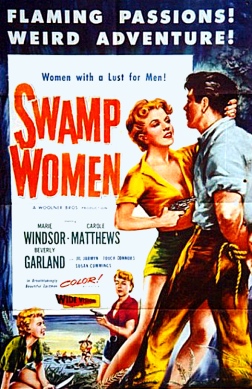
I admit that I’m a cheapskate.  When you grow up poor, that comes naturally.  For some of us the myth of scarcity is less of a fable than it is for others.  Perhaps that’s why I like Roger Corman movies.  Or usually do.  And it’s also the reason that I bought the Classic Features Horror Classics DVD set years ago.  50 movies!  And cheap!  Now, in my defense, I bought this collection before streaming was a thing.  I’d become somewhat addicted to horror movies and renting was pricey and hey, fifty movies!  Of course, they’re public domain.  Some of them are pretty bad.  You can stream most of them for free, but with commercials.  I was in the mood for my fellow cheapskate Roger, so I decided to try Swamp Women (it’s in the collection).  Now, why it was considered horror I don’t know.  It must be pretty difficult to find that many public domain movies in any category.  It was just over an hour and I thought of it as homework.

Three tough-talking cons break out of prison with the help of an undercover cop.  They’re all women, of course.  The cop is there to make sure the stolen diamonds they hid are found.  And to get out alive.  This was a very cheap movie.  The writing is puerile and there are plot holes large enough to row a boat through.  Still, it’s a Corman film.  The only real horror comes from an alligator and a snake—it seems that couldn’t afford more than one of each—and it ends up pretty much as you’ve pegged it will once the endless stock footage of Mardi Gras is over.  What I found interesting, after reading a history of American International Pictures, is that even though co-founder James Nicholson was helping Corman raise money for the film AIP didn’t serve as the production company.  After seeing it, it’s pretty clear why not.

The critics gave this a pretty tough time back in 1956, sometimes noting that it did at least attempt some female psychology.  Really the only psychology on display was who might end up with the one guy they decide to keep as a hostage.  When his girlfriend drowns after trying to steal the only boat, he barely frowns.  I was hoping (I try not to read about movies before watching them) that there might be a swamp monster or something.  I mean, swamps and monsters naturally go together, don’t they?  I guess even those putting together public domain movie collections might be a bit cheap from time to time.  All of us skinflints understand each other, I guess.


Pearl X

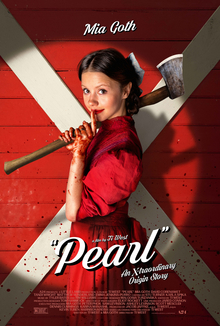
The danger to starting something new is that you’ll get hooked.  I watched the unusual horror film X because it was getting some good press, only to find out that by the time I saw it Pearl, the prequel, was underway.  It took some time before Pearl came to a streaming service within reach, so once it showed up I had to sit down and see it.  Like X, it has a strong element of religion in it but Pearl is really the exploration of a mental imbalance slowly taking over a life.  Set toward the end of World War I, Pearl lives with her parents while her young husband is “over there.”  Her father’s an invalid and her German mother is controlling and critical.  (My grandmother, also of Teutonic stock, had a similar outlook, I recall from her living with us.)  Pearl wants to be in show business, but down on the farm there are always chores and very little opportunity.

Along with her sister-in-law, she tries out for a dance troupe (auditions in the local church), but this is only after she has committed a triple homicide (one of them, arguably, accidental).  In her mind she’s brilliant, but the judges see it more like her late mother warned her.  Perhaps the most stunning shot is the long, uncut confession she makes to her sister-in-law.  Of course, she now has to kill her as well.  Her sister-in-law had won the dancing part, after all.  The progression of Pearl’s madness is set off against a retro filming style that borrows from The Wizard of Oz.  Bright colors and period costumes add to the feel and underscore that something just isn’t right.  In other words, it’s quite a disturbing movie.

I suppose this film might trigger those who feel uncertain of their grip on what we normally consider reality.  It also raises the danger of desiring something that is, in reality, out of reach.  For someone who’s longed for a career that those who know me have always declared the one best suited for me, I felt a tug or two.  My need doesn’t reach as far as murder.  As a pacifist and a vegan I’m not the best candidate for such things.  But I do know what it is to be denied a deeply held dream.  In fact, I do dream about it with some regularity.  (Teaching, for the sake of clarity, not murdering.)  The plot seems to line up a little crookedly with that of X, but the two movies are very different, yet similar.  I hear a third installment’s on the way, and that’s dangerous news.


Who Recommended?

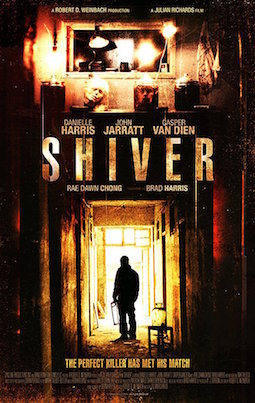
A couple of things: one-word titles can be confusing, and I need to start writing down where I get movie recommendations.  Trying to live reasonably on an editor’s salary, I can’t afford purchasing movies all the time, so I stream what’s free, now only when it’s on my list.  That’s how I had the misfortune of watching Shiver (2012).  I’m not sure it was the right movie, but I couldn’t find any others by that title near the top of IMDb and I couldn’t remember where I got the recommendation.  Although it uses many standard horror tropes, this flick veers a little too much into torture porn for my liking.  Also it’s very poorly written and many of the scenes are improbable (to put it mildly).  The police are totally incompetent (how many times can a serial killer’s intended victim be assured she’s safe by police when they can’t even get the perp to prison in good order?), almost to a Keystone degree.

And this isn’t some Hannibal Lector, either.  He’s kind of a psychopath that’s been making a living selling jewelry to his eventual victims.  Of course he’s a sexually frustrated guy who was bullied as a kid.  See, there are some moments of trying to establish some kind of social commentary, but the writing and most of the acting keep getting in the way.  The violence toward women goes unremarked, and that’s probably what most requires comment.  So I’m sitting here scratching my head trying to figure out who, or what, might’ve suggested this movie to me.  Or is there a different Shiver?  Did somebody leave the “s” off the end?  (I’ve already seen that one.)  I really do need to keep better records.

Bad movies come in many varieties.  This one was disturbing from any number of angles.  I don’t tend to watch serial killer movies.  Violence against women bothers me a lot.  Every main character had a bad childhood.  (One of the stories is simply told and then dropped.)  It’s a movie that might helpfully come with trigger warnings.  As I watched I wondered.  I wouldn’t been watching this if someone, or some respected publication, hadn’t recommended it to me.  Who and why?  Since I watch movies on weekend mornings, mostly, a bad one can start the day off on the wrong foot.  Someone, or some source, suggested Shiver.  Or maybe someone forgot a letter.  That’s the problem with one-word titles.


Outside Invisible

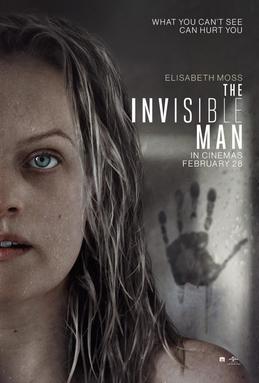
Some of us are fated, it seems, always to be outsiders.  I have no inside knowledge of the film industry.  I barely keep up with the movies I want to see.  Although I write books about horror films, the main players in the field don’t know those books.  It’s like being invisible.  I had hoped to see The Invisible Man some four years ago.  The reboot, I mean.  And having finally caught up, I was impressed.  This is a scary movie that hits all the right buttons.  Most of us, by cultural assimilation, know the bare bones of the story.  A guy has figured out invisibility.  What does he do with this?  Uses it to assert his will over everyone.  In the original, the monocaine made Dr. Jack Griffin insane.  In the remake, an already controlling, self-centered millionaire (Adrian), unknown to anyone but his brother, perfects an invisibility suit.  When his girlfriend (Cecilia) leaves him, he uses it to try to destroy her.

Everyone believes she’s insane.  More than that, criminally insane.  Cecilia knows he was an optics genius and he leaves her subtle clues that he knows where she’s hiding.  He hurts those close to her and they assume Cecilia is causing the harm.  Then it escalates to murder.  Placed in an institution for the criminally insane, she knows Adrian is there with her.  Nobody will believe her, however, since, well, he’s invisible.  This is a movie nearly as harrowing as The Dark Knight.   An unstable genius with unlimited resources and the ultimate alibi forces his abused ex to suffer for ever having loved him.  It’s pretty incredible.  (Has to be seen, I’m tempted to say, to be believed.)

Now, I’m no insider so I didn’t realize that Universal had been attempting to build a Dark Universe franchise based on the original Universal monsters.  I had completely missed that Dracula Untold was the first of the reboots.  I did watch it but fell asleep.  (Hey, I was watching with friends who started it too late for my outsider schedule.)  I never got around to seeing it with my eyes fully open.  Although it made money, it wasn’t, I hear, very good.  Then three years later, The Mummy bombed.  I confess that there’s so many Mummy movies that I’ve lost track of them and I didn’t know this one existed.  Or flopped.  Invisible Man was intended as the third and the movies were to be interlaced into a Dark Universe.  Plans for that franchise have been dropped, but individual movies will continue to be made.  I guess I need to go back to the beginning again.  It only took me a decade to learn this, as is the way with outsiders.


Night or Curse

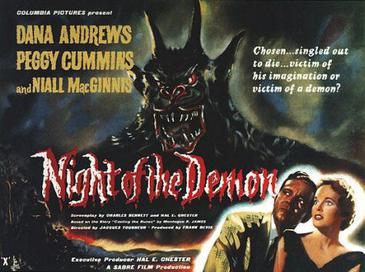
You just never know.  I’ve read lots of books about horror movies, but clearly not enough.  The field only gained academic respectability in recent years, but once the flood gates opened…  So I use my limited time off work both reading and watching horror movies—trying to catch up on what I’ve missed.  Lately I’ve been reaching back to the early stuff, movies from the forties and fifties.  Some of these are what we’ve been led to expect.  Others are not.  I’d heard of Night of the Demon (its American title is Curse of the Demon) but my sources suggested nothing remarkable about it.  As soon as I began watching, however, I realized that this story adapted from M. R. James would be worth the time.  This despite the fact that the monster is shown early and isn’t that great.  (The director, Jacques Tourneur, lost out on this one.)  After I saw it I read that it is considered by many the greatest horror film of all time.

I wouldn’t go quite that far, but I would say that it is very good and, as I learned, extremely influential.  So much so that I was rather stunned after a casual weekend viewing.  The story is about a Satanist whose true motivations are uncertain.  Those to whom he gives runes copied from Stonehenge are killed by the demon we’ve already seen.  The story plays out as a conflict between skepticism and belief—the supernatural is real, but alternative explanations are offered—you can see why the obvious demon scenes are so controversial.  The film makes effective use of jump startles and stingers.  And it’s one of those movies that, in its day wasn’t really appreciated, but reassessment polishes it as the gem that it is.

Proving later influence, such as the wind storm in The Omen, is difficult without a director revealing their sources, like a magician, but others are perfectly obvious.  Kate Bush’s song “Hounds of Love,” plays a clip of a line from the movie.  Richard O’Brien’s lyrics for “Science Fiction/Double Feature” (famous because of the Rocky Horror Picture Show) make reference to Dana Andrews passing the runes.  That line had always puzzled me.  And now I discover that I’ve been missing out on a foundational piece of horror history.  When friends recommend movies, not surprisingly, they tend to be relatively contemporary ones.  The thing is, to appreciate what’s popular now, one must do one’s homework.  And that might must mean hunting down the oldies.  You just never know when you might come across one worth the effort to find.


Wax Museum

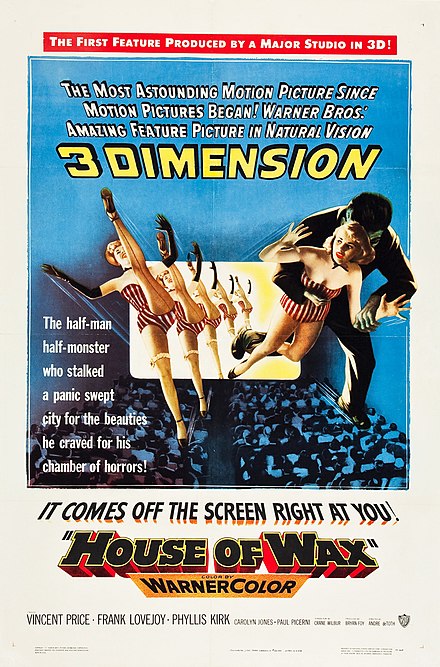
I admit to using Wikipedia and I even support it.  It’s the starting point for looking up things for which we’re not familiar.  Since most movies I watch don’t lead to discussion (ironically, I know very few people in person who watch horror), I often go to Wikipedia to find “conversation partners” about films.  One thing I’ve noticed is that a great number of articles on cinema have a section “Later Reception.”  In my experience, this usually appears on pages about movies initially panned but which have later been reassessed as being better than originally supposed.  In the case of House of Wax, the film was even selected for preservation in the National Film Registry because of its significance.  It’s interesting to read the sometimes boorish comments of the first critics.  Of course, the story had been around for some time then, so they were perhaps too familiar with the premise.

I can’t speak for the Library of Congress’ National Film Registry, but the notable features include its status as the first 3D movie with stereophonic sound, and the first color 3D movie released by a major studio.  For me, however, this was the film that launched Vincent Price to stardom.  He would go on to become the horror icon of American movies for the next two decades and many of the films would be, to use the National Film Registry’s language, “significant.”  The title already hints at the plot.  What horror film with such a title wouldn’t involve embalming a living person in wax?  Rather like Chekhov’s gun, if you title a picture like this, you need to make sure the gun, as it were, goes off.

The 3D gimmicks (I saw it only in 2D) are pretty obvious, but there are many interesting sub themes running throughout the movie.  Even in the button-down fifties there were directors who knew how to titillate.  In any case, the 3D aspect adds another detail to the story.  The director, Andre de Toth, was blind in one eye, which meant he couldn’t see the 3D effects.  This too makes the film worthy of note, and, again, significant.  Price plays his role of the urbane villain quite well, although this villain has cause to be wroth.  An artist forced to watch his work destroyed is likely to become unhinged.  As a horror film it also works well since wax museums are inherently creepy places.  I may have seen this movie in my younger years, but if so it didn’t stick with me.  I would have to agree with Wikipedia’s later reception, however.  This is an effective movie, even for a septuagenarian.


Horror Homework

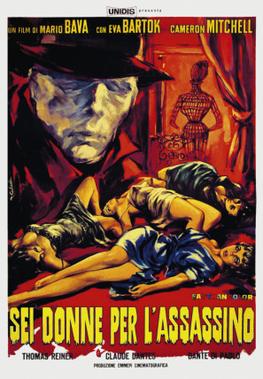
If you write about horror movies, you have to do your homework.  Of course, this means time away from house work (the weeds love all this rain and hot weather) and regular work (which can’t be compromised).  Mario Bava has often been cited as one of the influential horror auteurs, but until this year I’d not knowingly watched any of his films.  So, homework.  I saw a list of movies that made an impact, and one of them was Blood and Black Lace.  It’s horror of the giallo subspecies, never my favorite.  But it was free on a commercial streaming service, so, well that homework’s not going to do itself!  This isn’t generally considered Bava’ best work.  Besides, giallo is murder-mystery and I prefer monsters.  Who wouldn’t?

This film, with its lurid colors and stylistic cinematography, does make an impression.  The acting is poor and the script even worse—apparently it didn’t lose anything in translation.  A crooked couple run a fashion salon.  (There will be spoilers, so if you’re sixty years out of date, be warned.)  One of their fashion models is murdered, but when another discovers her diary the body count mounts.  The film lingers over the murders, which, I suppose, is one of the reasons it’s classified as horror.  With the film’s problems, however, at least this far removed, the whole thing begins to look rather silly.  The women have to die because of the first woman’s diary.  The police are singularly ineffectual, not even taking standard kinds of precautions.  Even with a run time of only 88 minutes it felt too long.

Horror in the sixties was still finding its way.  I’ve been watching a number of movies from that era—generally considered a dry spell for American-made horror—and the results have been interesting.  There are some gems tucked in amid the gravel.  What we’ve grown to appreciate in more contemporary horror cinema learned a lot of lessons from these early exemplars.  I could see foreshadowing of Suspiria here.  I’ll need to do more homework to find other direct descendants, though.  Blood and Black Lace suffers from having too few characters you get to know well enough.  The models, who all seem to have some secrets, die off before we get to know them.  Even the criminal pair behind the killings die in the end.  There’s a kind of nihilism to the story, and it’s all done for love of money.  The story could’ve been better, but you have to start somewhere when growing a genre.  And doing homework.


Deep Woods

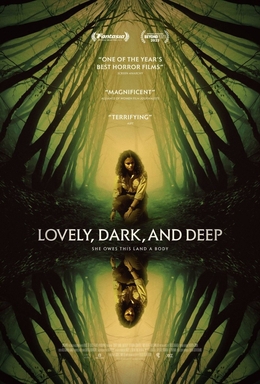
The output of female horror directors tends to be thoughtful.  And there are some legitimately terrifying scenes in Lovely, Dark, and Deep.  Nobody, however, has posted a Wikipedia entry on Teresa Sutherland.  At least not yet.  This movie is obviously aware of David Paulides’ work.  It went by a little quickly, but I think one of his books even made it into the film.  Lovely, Dark, and Deep is set in the fictitious Arvores National Park in California.  (Interestingly, the movie was filmed in Portugal.)  Lennon is a newly hired park ranger with what she thinks is a secret.  Her motivation is to search for her sister, who went missing in the park when they were kids.  If you like movies with flashlights in the forest at night, this is your film.  

Lennon discovers  that she’s not the only one with secrets.  Many people have gone missing in the park and the rangers know about it.  Some entity that they can’t identify requires people to be left behind.  There is a quid pro quo relationship involved.  If one of the taken ones is rescued, a substitute must be left.  Lennon learns that her sister was one of those taken, and once taken a person can’t come back.  They live in a nightmare world while their family and friends have to deal with the loss.  Lennon has trouble accepting this arrangement, but there is nothing to be done about it except pretend you don’t know it’s happening.

The movie gets its teeth from the fact that many people do go missing in National Parks.  And, as Paulides suggests, there is no public register kept.  Some who are found are often inexplicably miles from where they went missing, or their bodies are found in areas already thoroughly searched.  This is obviously a great concept for a horror film.  Sutherland, who wrote as well as directed the movie, has the makings of an art horror auteur.  Lovely, Dark, and Deep hasn’t received a lot of attention yet, but I think it deserves to.  Wilderness horror films have so much potential.  Particularly for people who seldom spend any real time in the forest.  Even those of us who have braved the wilds from time to time can find it frightening.  More than that, this is a movie that makes you think.  For anyone who likes to theologize films, it definitely has the theme of sacrifice running through it.  Deep is appropriately part of the title.


Lobo

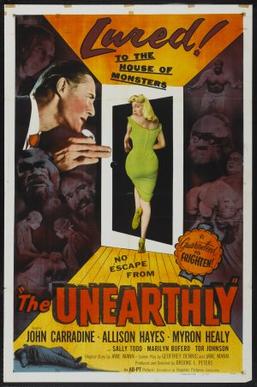
Tor Johnson—actually Karl Erik Tore Johansson—became famous but not rich.  Such was the fate of some early horror actors, including Bela Lugosi.  Johnson hung out, however, with the low-budget crowd, making the most of his size to take on a kind of “enforcer” role.  One of his recurring characters was “Lobo.”  Lobo served mad scientists and had very little of his own brain power.  He often had few, or no lines to learn.  Having watched The Beast of Yucca Flats, in which he starred, I decided to see if The Unearthly was any better.  The production values were certainly higher, but this was an earlier film by a different crew.  It’s more like the standard fare you expect for a late fifties horror show.  It features a mad scientist, and Lobo is, of course, the servant.

Dr. Charles Conway believes he has found the way to eternal life.  It’s attained by transplanting a new gland into a human being.  The problem is, it hasn’t worked so far.  Like a true mad scientist, Conway is convinced that it will work, it’s just a matter of try, try again.  And why advertise for willing subjects when you can have a local crooked doctor send you patients with various personality disorders, and no families, so that you can experiment on them?  With slow-moving Lobo as his only security system, Conway carries on until a sting operation catches him red-handed.  There’s really not much to this story.  It doesn’t have the inspired inanity of an Ed Wood production, but then, it hasn’t really grown a cult following.

My reason for watching was Tor Johnson.  Before I was born he’d attained the status of the model of a best-selling Halloween mask, based on his monster roles.  This seems to indicate that his oeuvre was well known, despite the kinds of movies he was in.  A large man who’d aged out of “professional wrestling,” Johnson had many uncredited movie roles before hooking up with Ed Wood.  He was featured in three of Wood’s films, including the infamous Plan 9 from Outer Space.  He’s part of a crowd surrounding the under-funded, independent filmmakers of an intriguing era before modern horror really came into its own.  The Unearthly, where his famous line “Time for go to bed” is spoken, suffers from banality and has become pretty obscure.  I personally wouldn’t have known to look for it had it not been for the fact that Johnson was in it, dragging it into the “must watch” category.  And that it was a freebie.


Opposites?

Not having the money to subscribe, I limit myself to the daily headlines of Publishers Weekly.  When physically in the office in New York City, it circulated among editors in print form.  I do miss that.  The weekly is a great place to stay informed of what’s going on in the book world.  Interestingly, the headlines—which are often linked together newsletter-style—noted that the annual preview of religion books was on the way.  This was followed by “On the exact opposite side of the publishing spectrum, Orbit has launched its fourth imprint, Run for It, capitalizing on the horror boom.”  So there it was staring me in the face.  Religion and horror are exact opposites.  Now, I can’t expect even experts in publishing to be aware of all the trends, but the religion-horror connection has been alive and growing for a few years now and those of us who publish books in it might dispute the “exact opposite side” designation.

Photo by Thomas Park on Unsplash

Horror and religion are closely related.  Many in the religion camp would want to deny that, but those who know horror know that religion quite often wanders in.  More than that, religion often drives the horror.  They’re not so much exact opposites as they are playmates.  Rather like the Bible depicts God being the chum of Leviathan.  (Who is, after all, a perfectly good monster.)  While my own humble efforts are frequently overlooked, the last four books I’ve written explore different aspects of religion and horror.  This includes my forthcoming Sleepy Hollow book.

Even if you’re not a fan of horror movies, if you pay close attention religion is not the opposite of horror.  We have this mental image of religion as a pure and holy thing in and of itself.  We don’t often stop to think that religions are invented by humans.  Yes, they are often in response to what believers see as divine stimuli, but the way that they are conducted is part of our human ingenuity.  They are considered good because of their emphasis on love and positive virtues.  If you watch enough horror you’ll notice that the menace is often a threat to love.  In other words, horror too emphasizes the value of love.  It’s a perception problem that sees horror as the opposite of religion.  Simplistic categories are often necessary to get through life—that’s why we stereotype.  Those of us who like to stop and think through things can gum up the works.  Even a headline in a magazine we like can lead us to wonder about the deeper implications and the biases they perpetuate.


Yucca

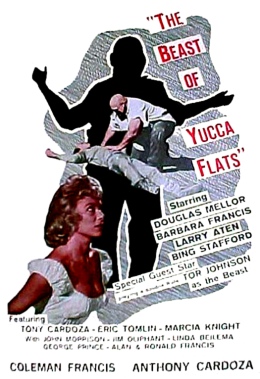
Yucca Flats isn’t the kind of place you’d like to vacation.  Not only is it highly irradiated by nuclear testing, it’s also a place where police shoot at innocent people.  The only salvation seems to be that they’re terrible shots.  Oh yes, and there’s a Russian scientist transformed into a beast by an atomic bomb blast.  As you can tell, I’ve just been to Yucca Flats.  In movie-land, of course.  The Beast of Yucca Flats, yet another candidate for the worst movie of all time, really worked hard to obtain that title.  The movie did make me curious about Coleman Francis, however.  Like Ed Wood, he tried to make his way in the rather unforgiving movie world with tiny budgets and even less native talent.  The number of scenes where guys had their butts to the camera alone raises all kinds of questions.

The numerous contradictions in such a short movie—less than an hour—and the long scenes that add nothing to the plot are signposts that we’ve entered the twilight zone of B movies.  Famously filmed without sound, the incongruous dialogue later added as voiceovers, adds to the surreal atmosphere.  The movie shares Tor Johnson with Ed Wood.  And also, apparently, a sincerity betrayed by lack of ability.  The cult status of movies like this signal hope for those who try to make their own way in a world enamored of big budgets and large crews.  It would help, though, if Francis had a clear story to tell.  He does seem to have Luddite tendencies, and he condemns violence even as he has a sheriff’s deputy literally “shoot first and ask questions later.” 

The movie has a couple of moments of cinematographic finesse.  The moment when Lois Radcliffe approaches the car, shot from the interior, when Hank lays his arm across the door, made me think something better might be coming.  Tor Johnson wasn’t the most gifted actor, but he always seems to have fun with his roles, being cast as a hulking monster.  It’s too bad he doesn’t have a bit more screen time in this, his last movie part.  He kinda makes me want to hunt down some of his other appearances beyond the Ed Wood films I’ve already seen.  There’s a story here, I expect, that really hasn’t been told.  There’s an entire world—a twilight zone—outside Hollywood where producers with no budgets but a passion for making movies plied their trade.  Their efforts, as paltry as the results may be, suggests there’s more to the movie world than it might seem.