Won’t Tell

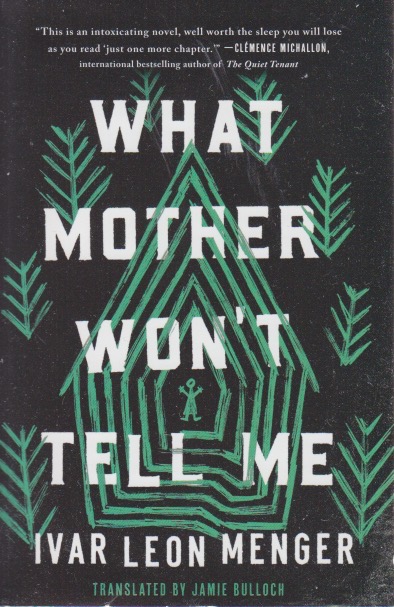
This one is pretty darn close to too tense to read before bed.  I don’t remember how I found out about Ivar Leon Menger’s What Mother Won’t Tell Me.  That’s usually a pretty good sign that I found it in a bookstore.  Those are still places to linger while trying to find something a bit different.  This one is a page turner, but also one that I’m not quite sure how to classify.  It may be horror but the “monsters” are all humans.  I almost don’t want to describe the plot because it is so exquisitely suspenseful.  When I’m reading to get sleepy, I often find myself trying to grasp pieces of a story that are floating away like dandelion fluff, unable to put them back together.  Then I know it’s time to close my eyes and re-read a paragraph or two tomorrow.  That never happened with this one.

I think I can say this much without giving it away: Juno lives on an isolated island in a lake with her parents and younger brother.  The parents warn them of the murderous strangers who are seeking them—the father was a states’ witness against a powerful criminal family—so the children must never be seen on the island.  If anyone happens to come, they must hide and remain quiet until they leave.  They have to practice drills in case this ever happens.  It gets pretty creepy, from nearly the first page.  I would also advise against reading the back cover copy, since it will give some of it away.  I tend not to read the copy until after I read a book—you just never know what they might let slip.

This is a story about perseverance and discovery.  Discovery that is full of tension.  It’s a reminder of how precarious childhood is.  There are plenty of twists in the story and chapters generally end with information that creates a tension that the next chapter will only partially resolve.  The end result is a story that pulls you along and is pretty chilling.  I’m not sure if I’d call this horror or not.  If there’s a good case for a thriller being a separate genre, this could be useful as evidence.  Even if it’s not horror, it is likely to appeal to many who read in that genre.  There’s nothing speculative about it.  Perhaps that’s why the story scares in the way that it does—this could happen.  What happens?  Like mother, I won’t tell you either.

Book or Movie?

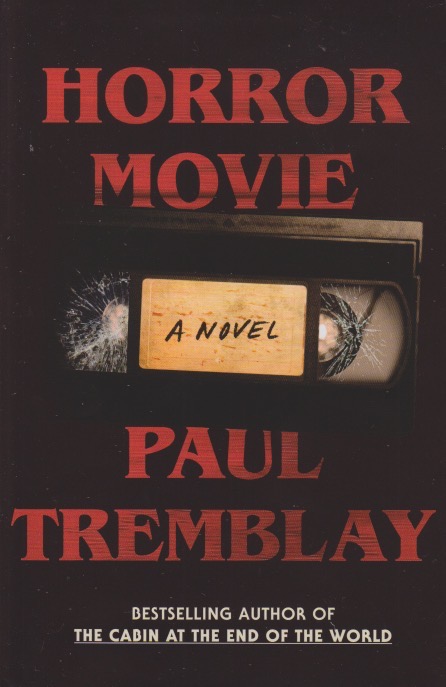
I’ve read a few of Paul Tremblay’s novels.  He’s a horror writer with literary style—often a tough sell (at least in my experience.)  Horror Movie is a compelling read.  The conceit is that a group of young people decide to film, well, a horror movie.  Things go awry, but not in a funny way.  The story unfolds interlaced with the screenplay and with the overlay of the modern remake in the works.  It’s easy to get lost between the narrative account of what happened in the original shoot and what’s happening in the script.  Tremblay uses this technique very well, blurring the reality and movie aspects in a way that’s got to be intentional.  I particularly like his asides about the redeeming value of monsters.  I won’t say too much about the plot since you may want to read it yourself. It does riff on the “cursed movie” trope.

The truly remarkable thing to my regular readers will be that I finished a new book within a month of publication.  Normally I run a couple to several years behind.  And this novel contains several winks and nods to other horror movies.  It pays to know the canon.  In that sense, it reminds me of the movie Scream, one of the more self-aware horror classics.  (I have had Scream out for watching again for several weeks now, but time has a way of slipping away.)  Tremblay, like Stephen King, taught before becoming established as a horror writer.  Maybe there’s hope for some of yet!  I started writing novels in middle school—perhaps there’s still time.  That seems to be one of the themes of Horror Movie, by the way.  It has many elements of a parable.

I found Tremblay’s first horror novel, A Head Full of Ghosts, about four years after it was published.  Indeed, I was working on Nightmares with the Bible at the time, so a book about possession was appropriate.  Horror Movie is more a monster tale but it’s also about movies and reality.  This is territory I often traverse since, it seems to me, movies are more than mere entertainment.  Good ones are, anyway.  And like some other books I’ve read lately, this one is also a reflection on fame (something I wouldn’t know about).  How it’s not what it’s made out to be.  In other words, if you’re willing, Horror Movie is the kind of novel that will make you think.  I appreciate that Tremblay is giving us thoughtful horror and I’m looking forward to trying to keep up.


Cryptid Caper

I don’t recall how it got on my fiction reading list—I probably saw it on Goodreads—but I picked it up because it was short.  And surprisingly, multiple copies were in Barnes and Noble.  Since James Daunt bought the chain out it has definitely improved.  In any case, Hunter Shea’s To the Devil, a Cryptid looked like it might be a fun romp, and if it turned out that I didn’t like it, well, it was short.  Ads in the back keyed me in that this was a part of a series of horror novels about cryptids.  Besides, I like to support publishers that aren’t part of the big five.  I’d just finished reading a five-hundred-pager, so something under two was very welcome.  The title seems to riff off the horror flick To the Devil a Daughter.  As much as I try to keep up on my cryptids, I was unfamiliar with the Goat Man.  And I did like it, by the way.

So, the real Goat Man is mostly associated with Maryland, but in Texas, where the novel is set, there is the Lake Worth Monster.  This seems a good fit for the cryptid part (whether intentional or not I don’t know).  A bunch of kids messing around with Satanism decide to sacrifice a goat in the woods where a Goat Man cryptid is said to live.  Something goes wrong and the goat fuses with a guy trying to break up the ceremony and mayhem ensues.  Lots of bodies torn apart in this version of the Lone Star State.  Still, the story is fun.  I’ve been writing cryptid fiction for years, and this may be a targeted demographic, but that doesn’t prevent this from being a good horror novel.  Particularly interesting is the resolution.  I’ll try not to give too many spoilers, but the next paragraph reveals something.

How do you stop a demonic, bulletproof Goat Man?  You call in a priest to do an exorcism.  The truly remarkable part of this is that the priest is treated sympathetically.  None of the characters are religious.  And of the two main young people who survive, you really don’t expect them to be found in church.  The story isn’t intended to be believable, of course.  The Goat Man is an urban legend.  Urban legends are often difficult to tease apart from actual cryptids sometimes.  Cryptids remind us that there’s still more to be discovered in the world.  And I may have just discovered a series of stories that work for a quick fix.


Shadow Half

Sometimes you just take a chance on a book you haven’t heard of.  You see, I keep a very active “to read” list.  The problem is that many books on it are a bit on the heavy side and it takes me a long time to get through lengthy books.  Every once in a while I go to a bookstore to browse for a book that’s short and speculative.  It seems that when I was growing up it wasn’t difficult to find fiction under 300 pages.  In any case, that’s how I found Sunny Moraine’s Your Shadow Half Remains.  It was in the “horror” section of a local bookstore.  (Even “horror” sections are now difficult to locate.)  It looked like it wouldn’t take me a month to read.  It was a good call.  It’s what I like in a scary story.

Not too gory and written with literary finesse, Your Shadow Half Remains is a pandemic story.  Well, not literally, but sort of literally.  It was published just this year and the story revolves around a pandemic in which people are infected by looking into each other’s eyes.  Nobody knows for sure how this happens, but people who are infected begin to act violently toward those around them before killing themselves.  Naturally, therefore, survivors begin to isolate themselves.  So Riley moves to a lake cabin where her grandparents got infected and died, but since there’s nobody else around the contagion can’t spread.  She lays in supplies and awaits, well, that’s just it—awaits what?  Her plan is interrupted, however, when she learns that she has a neighbor.  Maybe two.

One neighbor she starts to get to know, but they can’t look directly at one another and can’t really know each other’s motives.  Herein hangs the tale.  People are social creatures and the pandemic (in real life) caused much of its damage in the form of isolating ourselves from one another.  Other people, instead of being companions, were threats.  Especially in the early days when it wasn’t clear how the virus was spreading.  The safest thing was to stay home and avoid others.  It’s that aspect that Moraine really captures here.  A woman set to try to wait this thing out alone, but then, another person complicates things.  And how can you tell insanity from infection apart from insanity brought on by isolation?  Both seem to lead to the same results.  I took a chance on this unknown story, and it was a chance well taken.


Best King

I suspect most people have read one or two at least.  Most reading folk, that is.  I mean Stephen King novels.  He’s sure written plenty.  By my count I’ve read nine: The Shining, Carrie, ‘Salem’s Lot, Pet Sematary, It, The Stand, The Tommyknockers, Revival, and Cujo.  I probably have one or two more in me.  The dilemma is that I like King’s writing—I’m not one of those nay-sayers who call it clap-trap.  There’s real literary merit to much of it (sometimes just too much of it), and he integrates religion into horror really well.  The thing is, not all of his books are made equal.  I suspect that’s true of any writer.  I’ve consulted some lists to see which are the best and I’ve watched some movies before reading the books, but I’m starting a ranking of my own here—it will probably be revisited from time to time, as events warrant.

What’s his best?  Well, such lists are supposed to start with the worst and work their way forward.  I’ll cave to convention this time.  So, The Tommyknockers and Cujo are tied for least favorite.  Each has a reason: The Tommyknockers is too long and lacks sympathetic characters and Cujo is just too nihilistic.  The premise is good but the bleakness got to me.  The Stand comes next primarily because of the length.  I like the way that one ended up, though.  Revival, my most recent read, comes here, about in the middle.  It was enjoyable to read, even with its length.  I think King has a little trouble writing convincing kids, but the story was good.  Next I would put ‘Salem’s Lot.  Who doesn’t like a good vampire story?

Not that kind of book.

My top three are, perhaps predictably, generally among the top ranked.  My order is perhaps a bit different than most, however.  I really, really enjoyed The Shining.  The movie, I believe, is better.  That may be heresy, I know.  Carrie has all the freshness of a novelist breaking through, and it’s effective.  Better than the movie.  That leaves Pet Sematary as my current favorite.  The story there caught me up and it’s the only one of my top three that I read before seeing the movie (both of them).  The book is way, way better than the movies.  Compared with Revival, which also deals with what happens after death, Pet Sematary offers a commentary on grief that doesn’t involve everyone dying by suicide.  It’s on a much more human level.  As I read more, I’m sure I’ll form other opinions, but for the time being, these three of the King’s early novels, are, in my standing, the most deserving of the crown.


Fear of Spiders

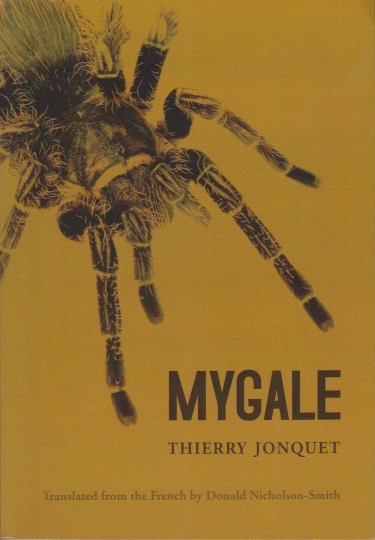
To anticipate, “mygale” is French for “tarantula.”  I learned about Mygale, also published under its English translation, or else Serpent’s Tail, from a Goodreads review.  It’s increasingly difficult to find good, short books.  I knew little about it other than it is a “thriller” by Thierry Jonquet.  The book contains one of the most cleverly drawn plots I’ve encountered in some time.  I also believe it could slip into the horror genre.  I’m reluctant to say much because the pieces are revealed so intricately that to summarize would be to ruin the effect.  I will say that if you’ve seen The Skin I Live in you know the basic idea already.

I will opine that this story demonstrates that a book need not be excessively long to be a good novel.  Some of us appreciate the economy of language that illustrates Pascal’s famous quote, “I have only made this letter longer because I have not had the time to make it shorter.”  My first relatively descent novel was about 230,000 words, or, in other words, well over 400 pages.  The publishers I half-heartedly queried said it was too long.  When writing short stories I quickly learned that many journals only take them if they’re under 3,000 words, some only under 2,000.  As a result, I began writing short.  That’s not exactly true.  I write the story as I want to tell it, then I cut it down.  Again and again.  Short seems to be the fashion in the internet age.  Ironically, the books on my too read shelf all seem to be quite long.  That’s why I decided to give Mygale a try.

I’m glad I did.  The story may not be for the most squeamish, but it’s certainly not blood and gore.  It’s a little confusing at first, but it comes to make sense.  And the ending is somewhat satisfying.  It’s not happy by any means, but it’s well told.  Some classify it as science fiction, but there’s nothing too impossible about it.  It’s set in France around the 1980s.  No space ships or ray guns to be seen.  Genres can be tricky in the face of creativity, but the final act, if you will, reveals this to have been horror all along.  Well, I hope I’ve been able to give a sense of this book without giving any spoilers.  Talking around a subject comes with years of classroom experience, I guess.  I will say the spider isn’t literal.


Clergy Problems

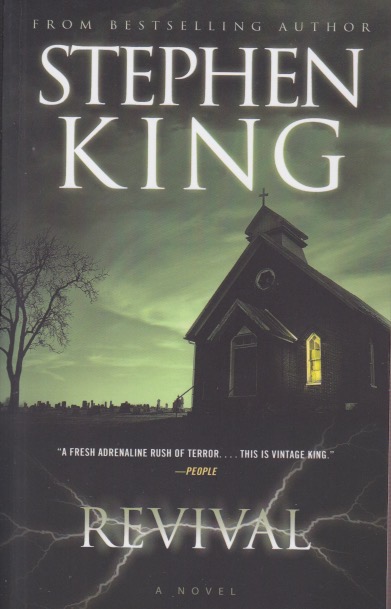
I believe Revival is the most recently written Stephen King novel I’ve read.  It was pretty good—it certainly scores high on the religion and horror scale, although it takes quite a while to get to the horror part.  Part of the problem for me is that I liked Charles Daniel Jacobs.  I tended to relate more to him than to Jamie Morton (the narrator/protagonist).  Perhaps this was because, like Jacobs, I studied to be a Methodist minister.  And like him, came to have a rather different view of what is really going on in the world.  He’s clearly King’s villain, however.  Or “fifth business” as he’s termed in the novel.  The secret lightning he seeks turns out to be a kind of MacGuffin.  I was curious to know more about it.  The novel, as is typical, has several subplots but the main one is how Jamie and Charlie face what’s after death in a tragic climax.

Charlie starts out as a Methodist preacher.  When his wife and son are tragically killed, he becomes a huckster who actually has tapped into an electrical power that can heal people.  It often, however, leaves bad aftereffects.  Jamie, who knew him as a kid, is cured by him from a heroin addiction.  Their paths continue to cross over the next fifty years or so—this is a longitudinal story—as Jamie comes more and more to distrust his childhood hero.  Charlie can use electricity to perform wonders and it make him rich.  He wants more, however.  He wants to see beyond death to assure himself that his wife and son are in a better place.  It seems to me that that motivation isn’t a bad one.  The only way he seems a villain is that he doesn’t really care for other people.

The story is well told but it doesn’t have the same “classic” feel as some of King’s earlier novels.  He well understands, however, that horror and religion belong together.  I haven’t read all of his novels—not by a long shot—but clergy aren’t rare and when they’re present they’re implicated in the horrors, or in this case, responsible for them.  These are important insights, as others have also noticed.  Revival is one of those books that requires some reflection.  It certainly feels like something written by a man facing the limitations of the aging process.  And not necessarily at peace with it.  Ministers sometimes do go bad—they’re only human—but they can also lead to real change.  I, for one, am interested to hear what King has to say about it.


One Another

Like much of the other information that I’ve managed to pick up in these six decades of wandering the planet, my knowledge of horror is self-taught.  In truth, I’m an eclectic reader—my various, periodic obsessions generally stem from books I’m writing.  For my unwinding time, however, horror stories seem to do the trick.  Nobody I know in person reads horror, so my recommendations are generally the results of other books I read.  That’s how I found Thomas Tryon’s The Other.  Although I’d only learned of it recently, it has been a classic in the field for many decades.  After having read it, I can see why.  And unlike many fiction works with an afterword, this edition has one worth reading.  Maybe you’re unfamiliar with the novel?  If so, in brief, it’s about twins.  It’s about twins.

Identical twins.  Holland and Niles Perry were born over the cusp of midnight, giving them different birthdays while still being the same age.  Unlike stereotypical identical twins, however, Holland is evil and Niles is good.  As the novel unfolds it contains some twists that, if like me you haven’t heard the story, really do work.  They live in a small town in Connecticut with their widowed mother, older sister and brother-in-law, maternal grandmother, and a couple of domestics.  An aunt and uncle, along with a cousin, settle in.  (It’s a large house.)  Family dynamics are strange and the locals grow increasingly impatient with Holland’s antics.  The Perry family is, however, long established and well respected.

Doesn’t sound very scary, does it?  That’s the genius of the work.  It’s a slow burn but when the fuse reaches the powder it leaves you trembling.  Nobody taught me how to find and read horror.  I’m still pretty much a novice and it seems that novels these days tend to have weight problems.  I was glad to find The Other wasn’t excessively long.  It shows that literary horror is possible as well.  Like Shirley Jackson, Tryon received acclaim for his work.  (And like Jackson, his novel doesn’t balloon out to over four hundred pages—something of a rarity these days.)  I guess I’m just a bit surprised it took so long for me to find out about this one.  I don’t want to give any spoilers because this is a beautifully constructed novel and knowing what happens might deter other readers.  I wouldn’t want to do such a disservice to a book I wish I’d known about when I was younger.


Who’s Knocking?

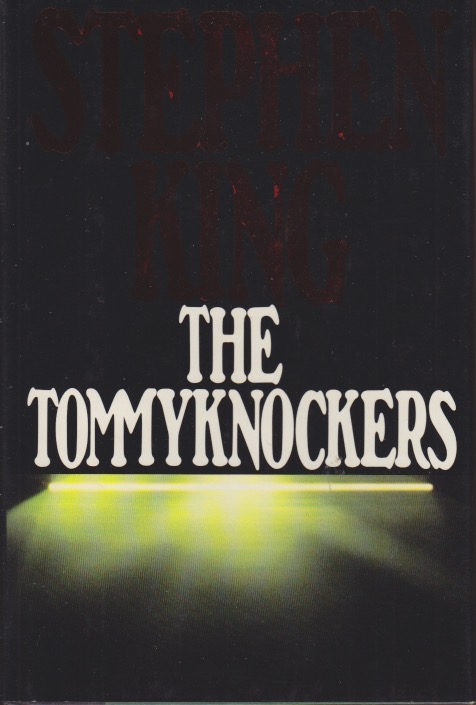
I’m by no means alone in enjoying Stephen King novels.  I’ve read a fair number over the years.  I was put on alert for The Tommyknockers by a scholar who pointed out some of the religious elements in it—again, not rare in King’s oeuvre—but I’d never heard of it before that.  I’m not really a good fan boy, I guess.  In any case, I saw a copy with the shiny copper of King’s name worn off at a library book sale for a buck.  It sat on my shelf for many months because, well, it’s long.  I finally pulled it down in October only to discover that it wasn’t my favorite King story.  For one thing, it’s simply too long.  For another, the characters aren’t the easiest to cotton onto.  If you’ve not read this one and you plan to, a spoiler of two might slip out but I’ll do my best not to ruin the ending.

I think horror when I think King, although I know it’s unfair to typecast authors like that.  Tommyknockers is more King’s hand at science fiction.  Well, at least it has a space theme, which is generally a cue for sci-fi in my book.  Bobbi Anderson discovers a buried flying saucer on her Maine property.  With the help of an alcoholic friend (Jim Gardener) she begins to excavate it.  The saucer, which has been buried for millions of years, is reactivated by their interaction with it and soon the entire town of Haven, except those with a lot of metal in their bodies—like Jim, are under its power.  They invent advanced gadgets (and weapons) using power from the ship and standard batteries.  They begin physically transforming into something less than human.  Jim, mostly immune, tries to help Bobbi out but he, along with a fairly extensive cast of disposable characters, are powerless to stop things.

Like most King novels, it’s well written.  Like some of his other material, it’s over-written.  Having had my own written work chopped down  (and, let’s face it, I’m now an editor), I see places where cuts could be made.  As with any long book, however, I’m left feeling a bit lonely now that characters I’ve read about nightly for many weeks are gone.  Even though I really had a difficult time evoking much empathy for them, hey, they’re people too.  Or so it seems.  Such is the magic of fiction.  Besides, there are bits of the old King horror still present in the book.  I know it won’t ever be my favorite King novel, but it won’t stop me from reading another, when I have the time.  Hopefully the next one will be a few pages shorter.