Other Worlds

There are any number of movies out there, and you find some that have evaded much comment by checking out the freebies on Amazon Prime.  That’s how I found Netherworld.  It’s not a great movie.  In fact, it’s about the opposite, but it is more southern gothic and since I’ve been watching Louisiana horror, well, why not?  It was free.  The story doesn’t make a whole lot of sense, which is a pity because the ideas seem to have some potential.  So, Cory Thornton has inherited his father’s Louisiana estate.  He didn’t know his father and the estate is run by an improbable staff of one.  (One suspects a low budget had something to do with that.  For the film, not diegetically.)  The estate abuts a brothel where one of the employees turns evildoers into birds with the help of magic.

Meanwhile, the young master finds hints how to raise his estranged father from the dead, which, for some reason, he decides to do.  There are dream sequences and perhaps shades of Papageno.  Lots of birds in this film.  Cory—not very bright—only discovers late in the movie that his father was evil.  Hm, no hints of that in his admitted sexual dalliances and his desire to be resurrected.  No siree, none at all.  By the end I wasn’t surprised to learn that it was released directly to video.  But I was led down the rabbit hole by David Schmoeller, the director.  Schmoeller has received notice of such people as Stephen King, and has given the world some notable cult movies.  It’s fair to say he never made it big in Hollywood, but he worked on some films of repute, even drawing in Klaus Kinski at one point.

There are several tiers to the creative life.  There are those who attain fame, and layered down from them, those who produce movies, songs, novels—any kind of creative output—to those most of us have never heard of.  I find this profoundly hopeful.  Nobody is known to every single person on this planet.  Even the famous aren’t known by everyone.  I like to think I’m reasonably informed, but I keep on hearing about celebrities in art forms I don’t follow and have no idea who they are.  So before watching Netherworld I never paid attention to David Schmoeller, but then I learned he’d nevertheless made a career out of doing what he enjoyed, without becoming a famous director along the way.  There are some practical obstacles, of course.  Getting that first book published, or first movie distributed, but if you can get over that wall there may be a possibility of doing what you like.  It may not make you rich, but you’ll have accomplished something important.


Not What It Says

The title sounds promising.  Gothic Harvest.  But the movie in no way lives up to it, even with its vampires vs. voodoo theme.  So, during Mardi Gras a group of four coeds decides to party in New Orleans.  Of course, this is the capital of American voodoo.  While drinking themselves to oblivion, one of them gets picked up by a local and taken back to the family home.  There, of course, she’s kept as food for the “vampire.”  An aristocratic woman who fathered a child with a slave has received a curse—she and her child remain alive, she aging, while the rest of the family is arrested at their present age.  (Really, the story makes little sense, so don’t ask.)  They need young blood to keep the aristocrat alive so that they can continue living.  In the right hands such a story might’ve made a passable horror film.  These weren’t the right hands.

It’s a good thing I’m trying to develop an aesthetic for bad movies.  The acting is bad, the dialogue is bad, the writing is bad.  Is there a moral here?  Don’t go partying during Mardi Gras since you might get picked up by a family under an ancient curse?  And  would it really hurt to do a second take of scenes where an actor stumbles over their lines?  I don’t know about you, but to me the title Gothic Harvest suggests that lissome melancholy of October.  You can start to smell it in the air in August and you know something is coming.  Honestly, I’m not sure why more horror films don’t capture that successfully.  I’m always on the lookout for movies that will catch my breath in my throat with the beauty and sadness of the season.  They are few and far between.

So, like a clueless coed during Mardi Gras, I’m lured into movies whose titles promise such things.  One of the movies that I, inexplicably, saw when I was young was the James Bond flick, Live and Let Die.  Roger Moore had taken the reins from Sean Connery but that film set my expectations for both the Big Easy and voodoo.  I’ve only been to New Orleans once, and that during a conference.  It was before the revival of my interest in horror.  Successful horror has been set there, of course.  The one thing Gothic Harvest gets right is the evocative nature of Spanish moss.  And the opportunity to try to learn to appreciate bad movies.


Teaching Horror

Critics who complain that Aislinn Clarke’s The Devil’s Doorway has nothing new really have no appreciation for parables.  An Irish found-footage film, The Devil’s Doorway is, as it clearly states, a lament over the Magdalene Laundries in Ireland.  I’d never heard of these institutions that existed until less than 30 years ago.  Founded by the Catholic Church, these “asylums” were places where women in trouble were essentially treated as slave labor.  Women, who often have difficulty hiding the results of sexual promiscuity (something men more easily get away with), were put to work in these reformatories.  I don’t know if the conditions were as bad as presented in the movie, but they provide a springboard into a perfectly serviceable horror film.  The horror tropes may be familiar, but that’s true of most horror of these days.

Two priests are sent to a Magdalene Laundry to investigate a reported miracle of a bleeding statue of Mary.  Please pardon my invocation of Alice Cooper here, but “Only Women Bleed” would be appropriate to consider.  Fr. Thomas, older and skeptical, doesn’t believe in miracles while Fr. John, the “techie” (it’s set in 1960) films the proceedings.  The priests uncover layer after layer of hypocrisy and deceit.  The Mother Superior, who shows no deference to the priests, insists that many of the pregnant women that have passed through the asylum were impregnated by clergy.  But there’s more.  As the statues bleed, a young woman, a pregnant virgin, is found kept in a dungeon.  Ghosts of murdered children cavort through the night.  A satanic niche for a black mass is discovered.  And the pregnant virgin is also possessed by a demon.  There’s a lot going on here.

To mistake all of this as “just a horror movie” is to miss the point.  Such is the way with parables.  Clarke, the director, was an unwed mother at 17 who realized that, had this happened a few years earlier, she could well have found herself confined to a Magdalene Laundry.  The movie doesn’t, it seems to me, condemn Catholicism per se.  For example, the two priests documenting the activities seem to be good people.  Fr. Thomas, as it turns out, had been born in this selfsame institution.  Raised as an orphan, he became a priest who, not surprisingly, doesn’t believe in miracles.  He too, was a victim.  Religious horror serves many purposes.  Often the very unfamiliarity of religion itself can drive the fear.  Another purpose, however, is to educate.  The Devil’s Doorway educated me, and I appreciate the parable.


Who Recommended?

A couple of things: one-word titles can be confusing, and I need to start writing down where I get movie recommendations.  Trying to live reasonably on an editor’s salary, I can’t afford purchasing movies all the time, so I stream what’s free, now only when it’s on my list.  That’s how I had the misfortune of watching Shiver (2012).  I’m not sure it was the right movie, but I couldn’t find any others by that title near the top of IMDb and I couldn’t remember where I got the recommendation.  Although it uses many standard horror tropes, this flick veers a little too much into torture porn for my liking.  Also it’s very poorly written and many of the scenes are improbable (to put it mildly).  The police are totally incompetent (how many times can a serial killer’s intended victim be assured she’s safe by police when they can’t even get the perp to prison in good order?), almost to a Keystone degree.

And this isn’t some Hannibal Lector, either.  He’s kind of a psychopath that’s been making a living selling jewelry to his eventual victims.  Of course he’s a sexually frustrated guy who was bullied as a kid.  See, there are some moments of trying to establish some kind of social commentary, but the writing and most of the acting keep getting in the way.  The violence toward women goes unremarked, and that’s probably what most requires comment.  So I’m sitting here scratching my head trying to figure out who, or what, might’ve suggested this movie to me.  Or is there a different Shiver?  Did somebody leave the “s” off the end?  (I’ve already seen that one.)  I really do need to keep better records.

Bad movies come in many varieties.  This one was disturbing from any number of angles.  I don’t tend to watch serial killer movies.  Violence against women bothers me a lot.  Every main character had a bad childhood.  (One of the stories is simply told and then dropped.)  It’s a movie that might helpfully come with trigger warnings.  As I watched I wondered.  I wouldn’t been watching this if someone, or some respected publication, hadn’t recommended it to me.  Who and why?  Since I watch movies on weekend mornings, mostly, a bad one can start the day off on the wrong foot.  Someone, or some source, suggested Shiver.  Or maybe someone forgot a letter.  That’s the problem with one-word titles.


Outside Invisible

Some of us are fated, it seems, always to be outsiders.  I have no inside knowledge of the film industry.  I barely keep up with the movies I want to see.  Although I write books about horror films, the main players in the field don’t know those books.  It’s like being invisible.  I had hoped to see The Invisible Man some four years ago.  The reboot, I mean.  And having finally caught up, I was impressed.  This is a scary movie that hits all the right buttons.  Most of us, by cultural assimilation, know the bare bones of the story.  A guy has figured out invisibility.  What does he do with this?  Uses it to assert his will over everyone.  In the original, the monocaine made Dr. Jack Griffin insane.  In the remake, an already controlling, self-centered millionaire (Adrian), unknown to anyone but his brother, perfects an invisibility suit.  When his girlfriend (Cecilia) leaves him, he uses it to try to destroy her.

Everyone believes she’s insane.  More than that, criminally insane.  Cecilia knows he was an optics genius and he leaves her subtle clues that he knows where she’s hiding.  He hurts those close to her and they assume Cecilia is causing the harm.  Then it escalates to murder.  Placed in an institution for the criminally insane, she knows Adrian is there with her.  Nobody will believe her, however, since, well, he’s invisible.  This is a movie nearly as harrowing as The Dark Knight.   An unstable genius with unlimited resources and the ultimate alibi forces his abused ex to suffer for ever having loved him.  It’s pretty incredible.  (Has to be seen, I’m tempted to say, to be believed.)

Now, I’m no insider so I didn’t realize that Universal had been attempting to build a Dark Universe franchise based on the original Universal monsters.  I had completely missed that Dracula Untold was the first of the reboots.  I did watch it but fell asleep.  (Hey, I was watching with friends who started it too late for my outsider schedule.)  I never got around to seeing it with my eyes fully open.  Although it made money, it wasn’t, I hear, very good.  Then three years later, The Mummy bombed.  I confess that there’s so many Mummy movies that I’ve lost track of them and I didn’t know this one existed.  Or flopped.  Invisible Man was intended as the third and the movies were to be interlaced into a Dark Universe.  Plans for that franchise have been dropped, but individual movies will continue to be made.  I guess I need to go back to the beginning again.  It only took me a decade to learn this, as is the way with outsiders.


August Thoughts

The other day I saw a headline on a BookRiot email blast: “August is Spooky Season Jr.”  I’ve often wondered why more horror fans haven’t emphasized this.  It’s not just that stores start putting out their Halloween merch, and it’s not that Summerween has taken hold.  No, it’s a feeling in the air.  When I was younger, August always seemed like the hottest month, the dog days of summer.  For many years now, however, I’ve begun to feel autumn’s approach in this month.  Some of the earliest trees begin to change (some start even in late July).  And if I take the time to smell the air when I step outside on an August morning, the first hints of harvest greet me.  The produce at the farmers’ markets should be a regular alert to that.  And my mind turns to the half of the year with which I most resonate.

It’s as if nature wears a mask, lulling us to suppose the weather will always be warm enough to sustain us, dropping rain in appropriate amounts at the correct time.  Yet we know that we have attacked our planet and it knows so too.  The true nature of all of this is change.  And change is scary.  A deep-seated fear accompanies autumn.  Did we store enough away for winter?  Is the house winterized?  What if the furnace breaks down?  What if the cold truly becomes too intense to stand?  I spend most of the year wearing multiple layers and fingerless gloves indoors.  Cloudy days make my office so chilly I can barely stand the lower thermostat setting until the end of the work day.  What if snow prevents me from getting to the store?  What if there truly is something scary in the dark?  All of this begins in August.

I watch horror movies year round.  I like to read creepy tales.  I even try my hand at writing a few.  Even so, I’m glad to learn that I’m not the only one whose thoughts turn toward Samhain even as Lughnasadh dawns.  A cool day in August is enough to start the chain-reaction going.  Some of us feel the respiration of fall even now.  Hear its slow heartbeat.  See its rictus grin.   Harvest tells us something about our own souls.  Our sins catch up with us as the nights grow longer.  The sun sets nearly an hour earlier than it did in late June, have you noticed?  And it rises nearly an hour later, I’ve noted.  Let spooky season jr. begin!


Horror Homework

If you write about horror movies, you have to do your homework.  Of course, this means time away from house work (the weeds love all this rain and hot weather) and regular work (which can’t be compromised).  Mario Bava has often been cited as one of the influential horror auteurs, but until this year I’d not knowingly watched any of his films.  So, homework.  I saw a list of movies that made an impact, and one of them was Blood and Black Lace.  It’s horror of the giallo subspecies, never my favorite.  But it was free on a commercial streaming service, so, well that homework’s not going to do itself!  This isn’t generally considered Bava’ best work.  Besides, giallo is murder-mystery and I prefer monsters.  Who wouldn’t?

This film, with its lurid colors and stylistic cinematography, does make an impression.  The acting is poor and the script even worse—apparently it didn’t lose anything in translation.  A crooked couple run a fashion salon.  (There will be spoilers, so if you’re sixty years out of date, be warned.)  One of their fashion models is murdered, but when another discovers her diary the body count mounts.  The film lingers over the murders, which, I suppose, is one of the reasons it’s classified as horror.  With the film’s problems, however, at least this far removed, the whole thing begins to look rather silly.  The women have to die because of the first woman’s diary.  The police are singularly ineffectual, not even taking standard kinds of precautions.  Even with a run time of only 88 minutes it felt too long.

Horror in the sixties was still finding its way.  I’ve been watching a number of movies from that era—generally considered a dry spell for American-made horror—and the results have been interesting.  There are some gems tucked in amid the gravel.  What we’ve grown to appreciate in more contemporary horror cinema learned a lot of lessons from these early exemplars.  I could see foreshadowing of Suspiria here.  I’ll need to do more homework to find other direct descendants, though.  Blood and Black Lace suffers from having too few characters you get to know well enough.  The models, who all seem to have some secrets, die off before we get to know them.  Even the criminal pair behind the killings die in the end.  There’s a kind of nihilism to the story, and it’s all done for love of money.  The story could’ve been better, but you have to start somewhere when growing a genre.  And doing homework.


Deep Woods

The output of female horror directors tends to be thoughtful.  And there are some legitimately terrifying scenes in Lovely, Dark, and Deep.  Nobody, however, has posted a Wikipedia entry on Teresa Sutherland.  At least not yet.  This movie is obviously aware of David Paulides’ work.  It went by a little quickly, but I think one of his books even made it into the film.  Lovely, Dark, and Deep is set in the fictitious Arvores National Park in California.  (Interestingly, the movie was filmed in Portugal.)  Lennon is a newly hired park ranger with what she thinks is a secret.  Her motivation is to search for her sister, who went missing in the park when they were kids.  If you like movies with flashlights in the forest at night, this is your film.  

Lennon discovers  that she’s not the only one with secrets.  Many people have gone missing in the park and the rangers know about it.  Some entity that they can’t identify requires people to be left behind.  There is a quid pro quo relationship involved.  If one of the taken ones is rescued, a substitute must be left.  Lennon learns that her sister was one of those taken, and once taken a person can’t come back.  They live in a nightmare world while their family and friends have to deal with the loss.  Lennon has trouble accepting this arrangement, but there is nothing to be done about it except pretend you don’t know it’s happening.

The movie gets its teeth from the fact that many people do go missing in National Parks.  And, as Paulides suggests, there is no public register kept.  Some who are found are often inexplicably miles from where they went missing, or their bodies are found in areas already thoroughly searched.  This is obviously a great concept for a horror film.  Sutherland, who wrote as well as directed the movie, has the makings of an art horror auteur.  Lovely, Dark, and Deep hasn’t received a lot of attention yet, but I think it deserves to.  Wilderness horror films have so much potential.  Particularly for people who seldom spend any real time in the forest.  Even those of us who have braved the wilds from time to time can find it frightening.  More than that, this is a movie that makes you think.  For anyone who likes to theologize films, it definitely has the theme of sacrifice running through it.  Deep is appropriately part of the title.


Lobo

Tor Johnson—actually Karl Erik Tore Johansson—became famous but not rich.  Such was the fate of some early horror actors, including Bela Lugosi.  Johnson hung out, however, with the low-budget crowd, making the most of his size to take on a kind of “enforcer” role.  One of his recurring characters was “Lobo.”  Lobo served mad scientists and had very little of his own brain power.  He often had few, or no lines to learn.  Having watched The Beast of Yucca Flats, in which he starred, I decided to see if The Unearthly was any better.  The production values were certainly higher, but this was an earlier film by a different crew.  It’s more like the standard fare you expect for a late fifties horror show.  It features a mad scientist, and Lobo is, of course, the servant.

Dr. Charles Conway believes he has found the way to eternal life.  It’s attained by transplanting a new gland into a human being.  The problem is, it hasn’t worked so far.  Like a true mad scientist, Conway is convinced that it will work, it’s just a matter of try, try again.  And why advertise for willing subjects when you can have a local crooked doctor send you patients with various personality disorders, and no families, so that you can experiment on them?  With slow-moving Lobo as his only security system, Conway carries on until a sting operation catches him red-handed.  There’s really not much to this story.  It doesn’t have the inspired inanity of an Ed Wood production, but then, it hasn’t really grown a cult following.

My reason for watching was Tor Johnson.  Before I was born he’d attained the status of the model of a best-selling Halloween mask, based on his monster roles.  This seems to indicate that his oeuvre was well known, despite the kinds of movies he was in.  A large man who’d aged out of “professional wrestling,” Johnson had many uncredited movie roles before hooking up with Ed Wood.  He was featured in three of Wood’s films, including the infamous Plan 9 from Outer Space.  He’s part of a crowd surrounding the under-funded, independent filmmakers of an intriguing era before modern horror really came into its own.  The Unearthly, where his famous line “Time for go to bed” is spoken, suffers from banality and has become pretty obscure.  I personally wouldn’t have known to look for it had it not been for the fact that Johnson was in it, dragging it into the “must watch” category.  And that it was a freebie.


Opposites?

Not having the money to subscribe, I limit myself to the daily headlines of Publishers Weekly.  When physically in the office in New York City, it circulated among editors in print form.  I do miss that.  The weekly is a great place to stay informed of what’s going on in the book world.  Interestingly, the headlines—which are often linked together newsletter-style—noted that the annual preview of religion books was on the way.  This was followed by “On the exact opposite side of the publishing spectrum, Orbit has launched its fourth imprint, Run for It, capitalizing on the horror boom.”  So there it was staring me in the face.  Religion and horror are exact opposites.  Now, I can’t expect even experts in publishing to be aware of all the trends, but the religion-horror connection has been alive and growing for a few years now and those of us who publish books in it might dispute the “exact opposite side” designation.

Photo by Thomas Park on Unsplash

Horror and religion are closely related.  Many in the religion camp would want to deny that, but those who know horror know that religion quite often wanders in.  More than that, religion often drives the horror.  They’re not so much exact opposites as they are playmates.  Rather like the Bible depicts God being the chum of Leviathan.  (Who is, after all, a perfectly good monster.)  While my own humble efforts are frequently overlooked, the last four books I’ve written explore different aspects of religion and horror.  This includes my forthcoming Sleepy Hollow book.

Even if you’re not a fan of horror movies, if you pay close attention religion is not the opposite of horror.  We have this mental image of religion as a pure and holy thing in and of itself.  We don’t often stop to think that religions are invented by humans.  Yes, they are often in response to what believers see as divine stimuli, but the way that they are conducted is part of our human ingenuity.  They are considered good because of their emphasis on love and positive virtues.  If you watch enough horror you’ll notice that the menace is often a threat to love.  In other words, horror too emphasizes the value of love.  It’s a perception problem that sees horror as the opposite of religion.  Simplistic categories are often necessary to get through life—that’s why we stereotype.  Those of us who like to stop and think through things can gum up the works.  Even a headline in a magazine we like can lead us to wonder about the deeper implications and the biases they perpetuate.


Yucca

Yucca Flats isn’t the kind of place you’d like to vacation.  Not only is it highly irradiated by nuclear testing, it’s also a place where police shoot at innocent people.  The only salvation seems to be that they’re terrible shots.  Oh yes, and there’s a Russian scientist transformed into a beast by an atomic bomb blast.  As you can tell, I’ve just been to Yucca Flats.  In movie-land, of course.  The Beast of Yucca Flats, yet another candidate for the worst movie of all time, really worked hard to obtain that title.  The movie did make me curious about Coleman Francis, however.  Like Ed Wood, he tried to make his way in the rather unforgiving movie world with tiny budgets and even less native talent.  The number of scenes where guys had their butts to the camera alone raises all kinds of questions.

The numerous contradictions in such a short movie—less than an hour—and the long scenes that add nothing to the plot are signposts that we’ve entered the twilight zone of B movies.  Famously filmed without sound, the incongruous dialogue later added as voiceovers, adds to the surreal atmosphere.  The movie shares Tor Johnson with Ed Wood.  And also, apparently, a sincerity betrayed by lack of ability.  The cult status of movies like this signal hope for those who try to make their own way in a world enamored of big budgets and large crews.  It would help, though, if Francis had a clear story to tell.  He does seem to have Luddite tendencies, and he condemns violence even as he has a sheriff’s deputy literally “shoot first and ask questions later.” 

The movie has a couple of moments of cinematographic finesse.  The moment when Lois Radcliffe approaches the car, shot from the interior, when Hank lays his arm across the door, made me think something better might be coming.  Tor Johnson wasn’t the most gifted actor, but he always seems to have fun with his roles, being cast as a hulking monster.  It’s too bad he doesn’t have a bit more screen time in this, his last movie part.  He kinda makes me want to hunt down some of his other appearances beyond the Ed Wood films I’ve already seen.  There’s a story here, I expect, that really hasn’t been told.  There’s an entire world—a twilight zone—outside Hollywood where producers with no budgets but a passion for making movies plied their trade.  Their efforts, as paltry as the results may be, suggests there’s more to the movie world than it might seem.


Singing Darkly

Euro-horror has become one of the more profound sub-genres of film.  I can’t recall who it was that recommended A Dark Song—set in Wales although filmed in Ireland—but it was immediately obvious I was in for a treat.  Dealing with Gnosticism, occult, and demonic manipulation (I wish I had the script!), it takes on the big issues of death, loss, and forgiveness.  The premise begins chillingly enough.  A woman rents an isolated country house for an entire year, paying in advance so there will be no disturbances.  She brings in an accomplished occultist to let her speak to her dead son again.  The two don’t know each other and this ritual will take many months, during which they will not be able to leave the house.  Neither really trusts the other, but Joseph (the occultist) tells Sophia that she must obey everything he says if she wants the ritual to work.  Once they begin they cannot stop until it reaches its conclusion.

Sophia hasn’t revealed the real reason she wants to summon her guardian angel.  She wants revenge on those that used the occult to murder her son.  The truth Sophia kept from Joseph requires them to restart, so he drowns her in the bathtub and then uses CPR to revive her.  As they grow increasingly tense, a fight breaks out where Joseph is accidentally impaled on a kitchen knife.  With only bandages and whiskey to treat the wound, they press on, but Joseph dies leaving the ritual unfinished.  Sophia can’t escape but after being tormented by demons, her guardian angel arrives.  Her request is actually wanting the ability to forgive.

This profound story has many twists along the way, but a scene that I would like to consider is where Joseph tells Sophia “Science describes the least of things… the least of what summat is. Religion, magic… bows to the endless in everything… the mystery.”  The suggestion that science is indeed correct, but limited.  Religion goes beyond science, however, to the world of possibility.  The movie suggests these two worlds intersect.  After Joseph dies Sophia can’t escape that other world until its rules have been met.  And when she does reenter the world of science, what happened in the world of magic has lasting effects on her.  A Dark Song is one of those movies that will haunt you after watching.  The Euro-horror of the last decade or so has been incredibly profound, showing the promise of what horror can be.


A Touch of Poe

One of the more somber aspects of our staycation in the Poconos occurred on our search for Tanners Falls.  It brought to mind a story by Edgar Allan Poe.  Here’s why:  Tanners Falls is not well signposted.  This is quite a rural area.  We were following our GPS when the signal died right after she said “arrived.”  The problem was there were no signs and although we tried a couple of tick-trails that ended up at a stream, nothing like a cataract was anywhere near.  Finally we realized that a tiny sign reading “Tanners Falls” was posted on a “Road Closed” barricade.  Since to road was actually open to the Falls, my wife brought the car but I wanted the exercise and went by foot. Walking along the way I found a roadside shrine and noted that in addition to the name Laura Lynne Ronning was a small plaque stating “Murdered July 27, 1991.”  Now, there was no signal out here, and I was alone on the road.  And I had no desire to bring my family down so I kept it to myself.

At the hotel (with wifi) I learned that Laura Ronning’s murder was never solved.  She was a counselor at a nearby camp walking to the waterfall on her day off when she was raped and shot and thrown into the woods.  The only suspect was a mentally unstable man (now since deceased) and the evidence was all circumstantial.  He was, unlike some known criminals of high profile, found not guilty.  The Ronning family moved out of the state, not wanting to be where someone could literally get away with murdering an innocent young woman.  This is where Poe came in.  His “The Mystery of Marie Rogêt” is the first detective fiction based on a true case—Poe was often, figuratively, first on the scene.  The murder of Mary Cecilia Rogers, whose body was found in the Hudson, was never solved.  Poe tried his hand at the by then famous unsolved case.

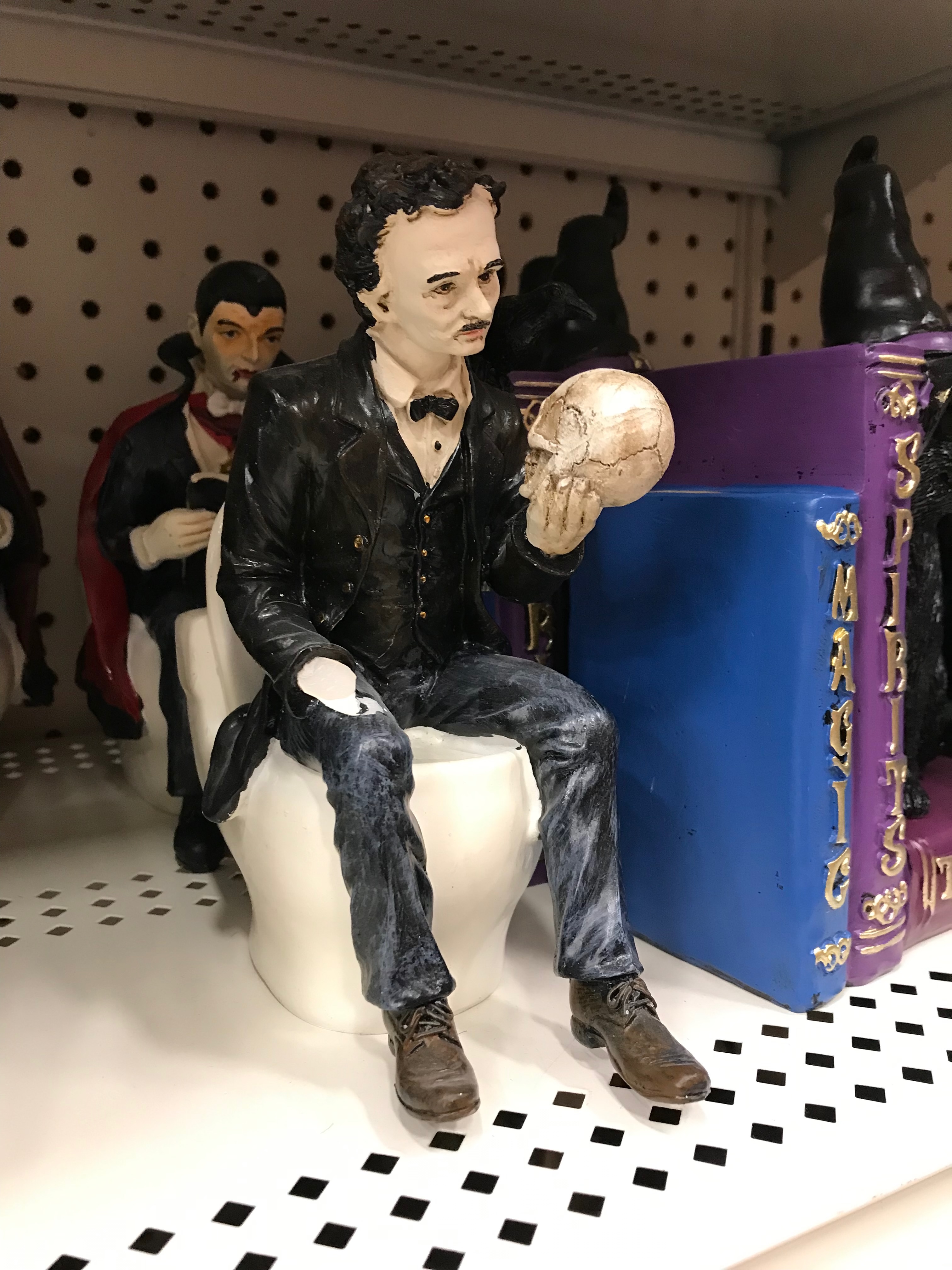
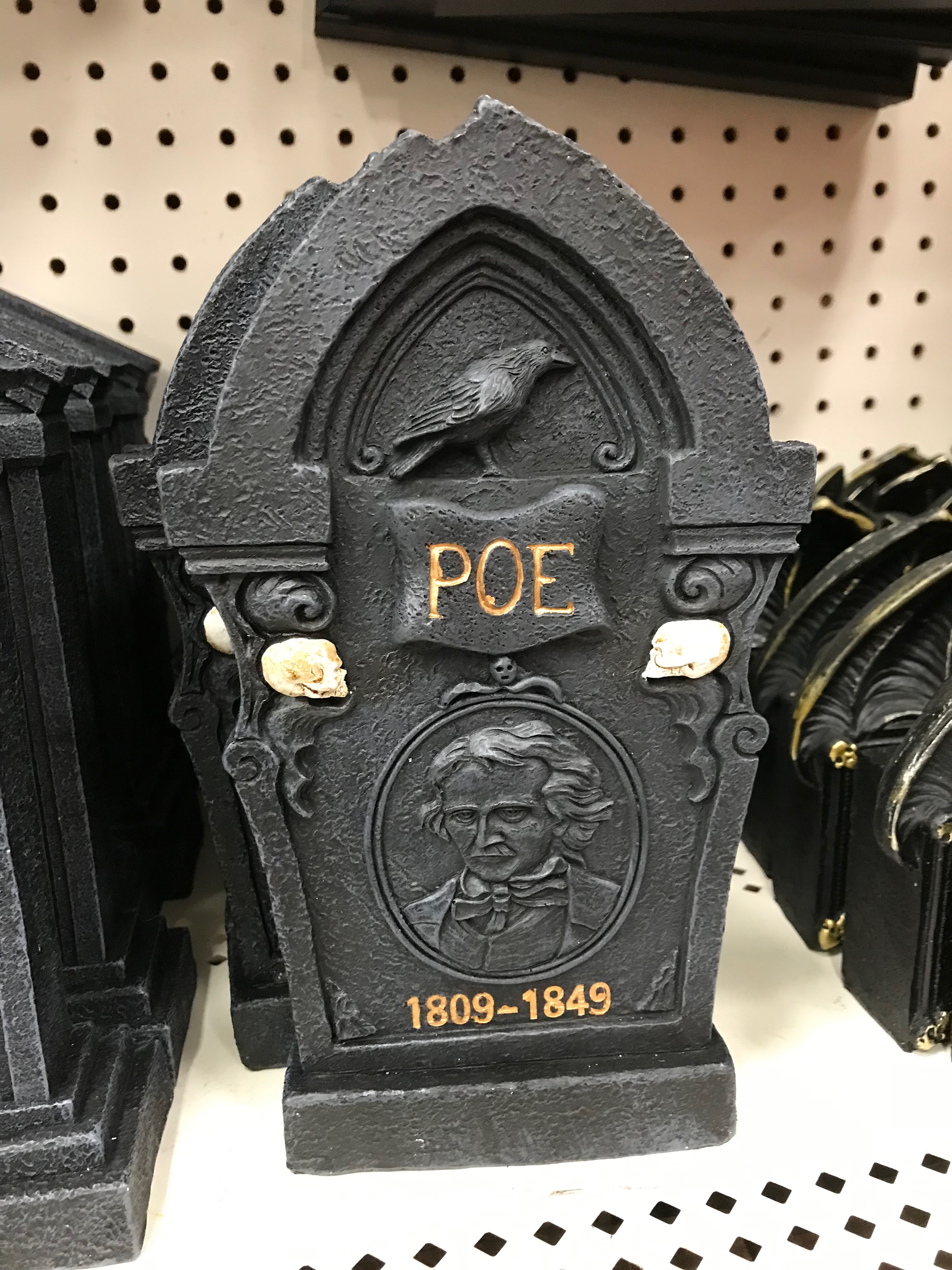
The murder of a young woman was a tragedy that Poe felt deeply, I suspect.  I took some academic flak for including Poe’s observation that the death of a beautiful woman was the most poetic theme in Nightmares with the Bible.  I realize this is a masculinist thing to write, but the fact is that some men feel very protective of women.  I know there’s a psychological name for this, but it isn’t chauvinism.  It is a sense of sadness, for what Goethe tried to express by writing “Girls we love for what they are; young men for what they promise to be.”  On staycations I try to look for literary angles, even when they are, from time to time, sad.


Fire Walking

Telinema is a strange place.  (This is my word for television and cinema, since apparently no such term exists.)  My wife and I have been making our way through Twin Peaks.  We missed this when it first aired, being somewhat preoccupied living in Scotland.  As with most telinema involving David Lynch, there’s quite a lot to ponder.  (I’m less familiar with Mark Frost’s oeuvre.)  The show only ran for two seasons, but as often happens with substantial short-run shows like this, it became classic in retrospect.  Lynch had made movies before, and the initial series was like watching a several-hour film.  Then the movie came.  Twin Peaks: Fire Walk with Me tells the backstory of what had happened before the series began.  Like the X-Files, you kind of need to interlace the movie in with the series.  So we have.

Knowing me, I’ll probably write up a reaction after watching the third season, but I want to reflect a little on telinema.  Visual media have been around at least since cave drawings were first made and their power recognized.  People are captivated by images.  When movies started, they were short and sprinkled in with other entertainments until the idea of a feature-length film developed.  If you were going to spend an hour or more with a movie, there had to be a story.  (Some of those stories, early on, seemed to involve quite a lot of pedestrian activities, of course.)  Then television happened.  Movies could be shown on TV and movies could be made specifically for TV.  Then impressive series, like Twin Peaks, required a theatrical movie to get part of the story across.  They became hybrids.

Lately I’ve been realizing just how much “how a story goes” matters.  We are story-telling creatures.  Our lives are the stories we tell ourselves about ourselves.  And some of us are obsessed with the true story.  What really happened?  Telinema sometimes makes this difficult.  Dan Curtis, for example, made House of Dark Shadows—a theatrical movie—as a version of what he’d already produced in television land as the daily Dark Shadows.  Since there’s no word doing the work telinema does for me, I’m not quite sure how to search to see what the earlier examples might be.  The point is a compelling story will draw fans.  And being visual creatures we’ll watch if the story interests us.  Sometimes we have to watch across “platforms.”  Get out of the house into a theater to see how the story goes.  Yes, we need a word for this and we need to study just how far we’ll go for a story.


Small Things Grow

I’ve always been fascinated with origins.  I guess I’m a kid who never grew up.  Now that I’ve turned my attention to movies, I sometimes wonder about the origin of the story.  For example, The Little Shop of Horrors.  I first saw the musical movie version of 1986.  It was cute, and employed horror themes like the Rocky Horror Picture Show from the previous decade.  Then, when Roger Corman died, I read that he’d filmed the story back in 1960.  Curiosity compelled me to watch the original.  Like its remakes, it’s comedy horror, or horror comedy.  But beyond that it’s a literal farce.  Roger Corman was a showman, and that means he tried different things to entertain.  One of them was Little Shop.  The idea of the plot you probably know, but I couldn’t remember the ending as I sat down to view it.  After all, it’s not meant to be taken seriously.

I have to say that the music makes it better in the remake.  The endless malapropisms and burlesque humor are funny, but really in the original they are presented as low comedy.  The Jewish humor was early on I feared might be anti-semitic, although not intended that way.  I empathize with Corman.  It took him nine months to find a company to release the film.  Ironically, it attained cult status after being double-billed as the B movie with Black Sunday, which was a quite serious attempt at horror.  Camp has a way of living on in cult status.  Of course, the early bit part for Jack Nicholson didn’t hurt.  It isn’t bad for a bad movie.

The idea of people-eating plants is a reasonable approach for a horror story.  (I’ve used it myself.)  Plants move very slowly, however, which is one reason that the idea’s hard to accept.  Even The Land Unknown had used the idea three years earlier.  But the seed was planted.  The idea of the film lead to an Off-Broadway show, which led to the more famous movie.  Then it reopened off-Broadway and a reboot was planned (but currently seems to be on ice).  Not bad for a movie based on a desire to reuse a set that was scheduled to be torn down, and then shot in two days.  Classic Corman.  The result was a bad film that is still fun to watch all these years later.  I did miss the musical numbers, however.  When you plant seeds, you never know what might grow.