Eternal Huckleberries

It began as a quest for immortality. Sometimes, however, you don’t recognize something even when it’s all around you. As an historian of religion, the quest for immortality is a familiar one. Certainly the ancient Egyptians believed they had found the keys, at least for royalty, and most religions haven’t given up trying since then. Some clonal plants have achieved extreme longevity. Since they grow by extending their roots, rather than by sexual reproduction, a single plant can remain alive as long at, at least 8,000 years. The specific plant to which I’m referring is the box huckleberry. I first learned to pick huckleberries for food in the Pacific Northwest. In that part of the country, I’ve learned to identify the plant from a distance and have spent many contented hours picking berries. Time, however, is something always endangered for those of us aware of its passing.

The box huckleberry colony in the Hoverter and Sholl Box Huckleberry Natural Area in Pennsylvania is about 1,300 years old. Summer is waning and my family wanted to see it. Indeed, for this particular colony, development probably destroyed parts of the system and so it has to be preserved. With that strange east-coast worldview, “just over there in Pennsylvania” comes to mean things are closer together in the imagination than they really are. Driving three hours just to see a huckleberry colony became more appealing when we combined it with the idea of visiting the National Watch and Clock Museum in Columbia, Pennsylvania. Both concepts were obviously related to the theme of time. They aren’t quite as close together as they look on a map. Map, after all, we are told, is not territory. The museum exists in a fixed location marked by a street address, so we went there first. There will be plenty to write about that later. As, ironically, we didn’t allow as much time as we should have for the museum, we had to head out further west and north to find the elusive huckleberry. All we had were the GSP coordinates and the name of a local town.

From the length of the line of cars behind me, the locals preferred to travel faster. Knowing only the relative direction and an approximate mile count, we stumbled upon Huckleberry Road and knew we must be close. Off into the woods we drove. As onetime manic geocachers, we had learned to both trust and distrust a GPS, but there was a trail head out here and a single parking spot. No one else was around. The signed indicated we were in the right place, but where were these ancient huckleberries? The ones we generally harvest grow knee-to-waste high with distinctive leaves. We walked the entire nature trail in frustration. How could a 1,300 year-old plant hide so well? Frustrated, we went back to the start. Fortunately, there were brochures. We found the box huckleberries. Indeed, they had been all along the trail, but we didn’t know what we were seeking. Just a few inches high, they cover the ground like a carpet. A few ripe berries poked through. We were in the presence of an entity that was older than Beowulf. Indeed, in the Middle Ages, this plant had been alive. Without the guide we’d never have realized we were standing in the midst of a kind of immortality.

DSCN5969


Life Everlasting

ThruTheWormholeThrough the Wormhole is one of those series that keeps me coming back. I’m currently working my way through the second season because it is a show that I take in small doses. The episodes require thought (and often, more importantly, time—something of which I have too little). Watching the installment “Can We Live Forever?” I was astonished by the optimism of the writers and interviewees. Among a cross-section of scientists, at least, there is the belief that we can, and will, dramatically expand human life. To biblical proportions. And that life won’t be a decrepit, declining feebleness. Instead, we can be, to quote one of the scientists, quoting Bob Dylan, “forever young.” Well, maybe not forever, but you get the picture. Of course, God came up quite a bit in this episode. Immortality is the stuff of divinity. The life-force, which much of science denies exists, is strong. No matter how weak or old, we don’t really want to give it up.

Of course, death is the price of life. We live on a finite planet with dwindling resources. If we don’t die, we run out of space for the next generation. Some have postulated that we need to colonize other worlds—just the thing that got Europeans in trouble in the first place—in order to make room. Room for us. The dominant species. No doubt, we are “programmed” to age and die. As far as we know, all animals are. Even plants. That is to say, life as we know it ends in death. If it doesn’t, can it truly be called life? I would be fascinated to live for a long while and see what we can make of this world. Not the greatest fan of technology, still, I’m impressed how far we’ve come in the brief time I’ve spent on this planet. And I do wonder where we’ll end up. In my mind, however, there always is an end. Even to this infinite universe, about the heat-death of which I’ve often read. What gives us the right to live longer than nature dictates?

It is, surely, a matter of degree. These glasses perched on my nose certainly have prolonged my life beyond what nature would dictate. The vitamin pills I swallow, the fabrics that keep me warm while wicking away perspiration, the things physicians can stop in their germy tracks. We already prolong life. Nevertheless, the century mark has always been symbolically our final goal and sign post that it’s time to hand things over. Thus it was in the beginning. The Bible makes clear that, although the antediluvians lived centuries rather than decades, this was never intended as the lot of the majority. No, we were born to die. We live through our children. The thought of eternity is scary. Especially when we think of how humans are. Those who can afford to live the longest are likely those who least deserve to do so. Do we want to live forever with the plutocrats in charge? Perhaps there’s a reason that we all take that final bow. Still, I can never listen to “Forever Young” without getting misty eyed and imagining the possibilities.


As a Child

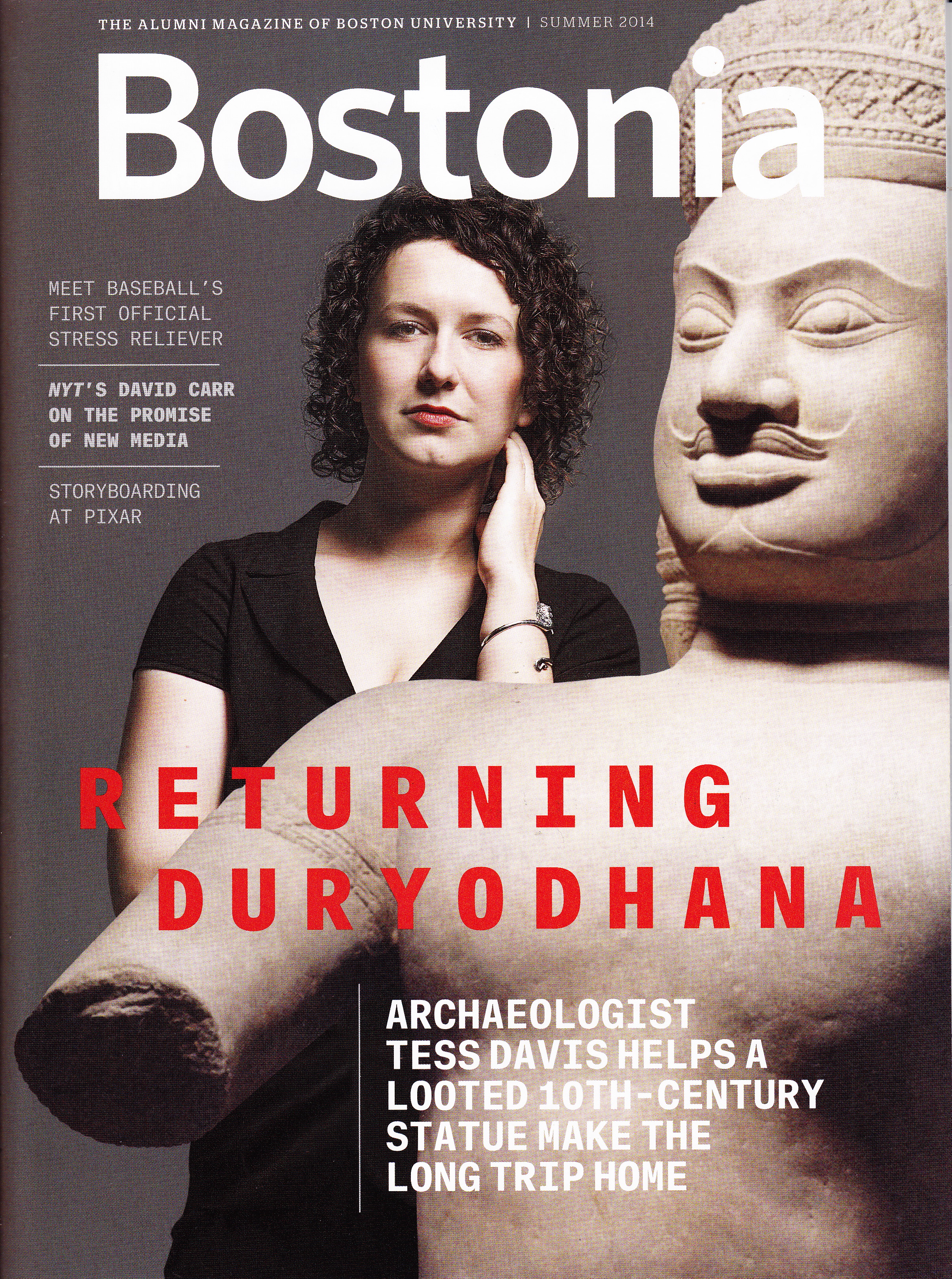
At a certain age, when alumni magazines arrive (and they will), one starts first by opening to the necrology. Who didn’t make it as far as me, after all? There’s a poignancy to it—knowing that at any age we’re vulnerable—but many of us felt a kind of immortality in our younger years that is only belied and effaced with the passing of time. The articles in the alumni magazines feature those who made it better than you, fellow students and faculty who made a genuine breakthrough. You should be proud of having the privilege, they seem to say, of having attended in her or his shadow. But once in a while, those self-serving articles do touch on the issues of the necrology where I always start. Boston University’s most recent edition boasts an article “You Are What You Feel” by Barbara Moran.

Bost

Intellectuals, in what I like to call the Spock Fallacy, frequently suggest that rationality is the whole story. Or at least the better part of it. If the left brain could only just subdue the right, and all decisions could be logical, wouldn’t this world be a better place? Better, maybe perhaps, but not human. We require our emotions for more than just feeling good. Studies suggest that thinking would be difficult, if not impossible, without them. So Bostonia profiles the work of Natalie Emmons, suggesting that ideas of immortality are more than just cultural relics. Perhaps our brains reason eternity for ourselves from some deep well we’ve not yet discovered. Emmons, and co-author Deborah Kelemen, are psychologists who study children’s idea of prelife—where we were before this. It is pretty difficult to imagine the world getting along without us. But the research suggests that intuition, rather than culture, gives us religious concepts such as immortality.

Substituting intuition for an actual essence, however, puts us in that odd place of using a word we can’t define. Scientists frequently fall back on intuition as an explanation for animal behavior that, in most instances, seems to suggest thinking that couldn’t have been acquired the usual way. How do salmon, fish that hardly seem like doctoral material, know to return home and swim upstream? How do newly hatched sea turtles know to crawl toward the water? Birds and butterflies to migrate? Instinct is a handy fallback, for sure. The research of Emmons and Kelemen suggest that children reason (note) prelife based on observations of actual life. The mind is the product of the brain. In my department at Boston University, another set of variables applied, focused mainly on surviving through the other end of the journey. It is with those in mind that I thumb through the necrology and hope, irrational as it may be to do so, that maybe the children are right.


Shadowy Futures

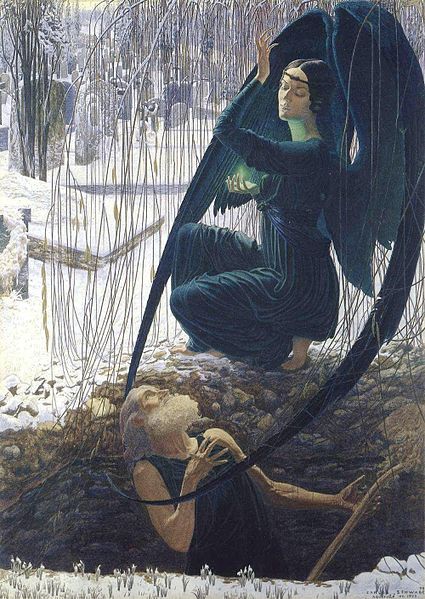
A thoughtful, if prescient commentary by Andy Crouch in this week’s Time magazine takes us into the uncanny valley. Despite the boastful protestations of the materialists, most people are not very brave at facing death. With the passing of Ariel Sharon and the sad story of Jahi McMath, the question of keeping the practically dead practically alive takes on a particular poignancy. It’s not that the dying are the ones protesting, but it is the living. We rage against the dying of the light, and, as Crouch notes, it is often the most religious that protest the loudest. Religion, ironically, is the framework that many use to cope with the ultimate inevitability. Death is scary. That’s why so many pray and others watch so many horror movies. We have trouble finding uncannier valleys than that of Crouch’s shadow of death.

Religion, in addition to putatively renouncing the fear of death, has often introduced the denial of life’s goods along the way. What ascetic would not have truly welcomed death? A starving belly day after day and crushing loneliness in the most barren environments earth has to offer should change one’s perspective. Not all of us have such heroics, however, hardwired into us. We may see the illogic of a religion that states death is release into a better world while creating even greater terrors of the other side of that veil. We dance between the horns of a dilemma where neither side will really sustain our weight. As Crouch notes, what we truly want is the assurance that somebody loves us at the end.

425px-Mort_du_fossoyeur

The materialist simply falls asleep for one last time. The faithful prepare to pass through a portal through which nobody has reliably come the other way. It is the ultimate test of faith. In the nineteenth century, when the death of a loved one at home was a common occurrence, an acceptance, perhaps morbid, pervaded the era. Who can think of Victorians without pondering the grave? Technology has cheated death both in small ways and in large. We are grateful for the salvation from small issues that once meant almost certain premature death, but we are scratching at the biggest door of all—immortality—begging to be let in. Will that head in a jar really be me? I have an uncanny feeling about that. Religion, for all its problems, should help us through this valley, if we really believe.


Without a Hitch

I’m not really afraid of dying. All those years of being taught that “to die is to gain” have obviously done their work. At the same time, it is a poignant exercise to read the posthumous memoirs of a dying man. I remember my first funeral. Although I don’t recall the name of the poor, deceased honoree, I still see the reactions of the living vividly. I was under ten at the time, and the funeral home in Franklin, Pennsylvania was in a very somber mood. The man, who had been a friend of the family, “was not a Christian.” Having been buffed and rubbed in the Fundamentalist tub from my earliest days, I didn’t realize that what was meant was actually that he hadn’t been an active member of our particular church. Nevertheless, as a child, you get deeply impressed with these kinds of things. “I’ll never go to the funeral of a non-Christian again,” I remember my mother telling a friend. “The minister couldn’t find anything comforting to say.” While funerals are sad occasions by definition, this one left a crater that is still fresh over forty years later.

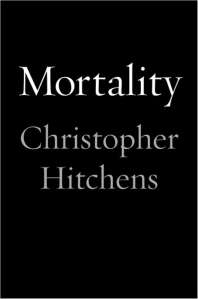
MortalityChristopher Hitchens is someone I found through his book God is Not Great. I don’t have time to read magazines, and I hadn’t read any of his previous works, but he raised some extremely valid points in this diatribe. My wife recently bought me his final oeuvre, Mortality. I felt as if I were back in that funeral home. It is not that I still hold to the odd belief system of Fundamentalism—of this my regular readers will have no doubt—but it is the forlorn feeling of reading the words of someone dying who hopes for nothing. Yes, it may be Stoic, and even noble. Certainly it seems far more worthy than visions of living in opulence with lots of available virgins with whom to toy while angels strum their harps overhead, but the certitude that one’s final days will be nothing but prolonged suffering—ouch! Maybe there isn’t a heaven, and if there’s a hell there’s something morally wrong with the universe, but doesn’t some residue of a human life remain? Even if it’s just the memories, the marks that we’ve made on others’ minds, don’t we somehow survive? Dying without hope nevertheless feels like milling about in that doleful crowd of specific Christians years ago.

Hitchens does offer a chapter in his final words devoted to those Christians who responded to his cancer with an unholy Schadenfreude, trying to torture the thoughts of a dying man with the promise of an eternal hell after experiencing a temporary hell of cancer treatments. This chapter made me sick. Anyone who so completely misses the message of compassion that suffuses the Gospels can hardly claim the designation Christian, I would insist. No one, no matter what their eternal plans, has the right to try to fracture anyone’s tenuous tranquility to make their own crown shine a little brighter. Such weekend warriors likely imagine that they are defending their fragile God, but in reality they are demonstrating that some of the criticisms of Hitchens were very well placed to begin with. No religion will live up to its full potential until it succeeds in the most basic practice of all—treating all people with respect and dignity. Until then, death has the final word.


Your Brain on Plastic

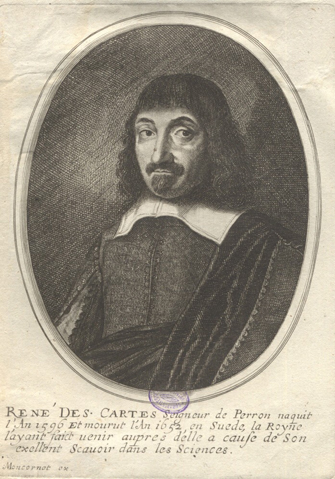
“Cogito ergo sum,” Descartes famously, and apparently erroneously, wrote. As technology races wildly ahead, those of us of biological origin are left feeling somewhat insignificant. An article in Monday’s Chronicle of Higher Education on “The Strange Neuroscience of Immortality” touches on many of the issues that are the very pulse of religion. Revolving around the theory of Dr. Ken Hayworth that a preserved brain, sealed in plastic instants before death, may in the future be thoroughly mapped and resurrected, Evan R. Goldstein explores the idea of immortality. Hayworth’s belief is that a thoroughly mapped brain, reconstructed artificially, would be the ego of cogito. The self. Despite all our advances in science, we don’t know what it is.

As Goldstein makes clear in his article, this transfer of consciousness and possibility of immortality is not mainstream science. In fact, most scientists rapidly distance themselves from it. Many cite the unscientific nature of the very enterprise, but I wonder if it might not have a more religious basis. Immortality is the ultimate of religious ideals. Christians generally recognize it as resurrection, and other monotheistic traditions offer a heaven after death (sometimes, to some people). Is that not all at stake here? If we manage to assure some kind of human immortality, have we not just robbed ourselves of heaven? Quite apart from the technological hurdles and uncertainties about what the self/mind/soul is, is not immortality what separates gods from humans?

The problem with gods is that they don’t get to go home at the end of the day. Would Heaven be so great if you just left another tough day in the universe full of sadness, violence, and pain? Hayworth suggests that a reconstructed brain placed in a mechanical body (robotic, probably) would have the potential of lasting forever. It will, however, be expensive. That means that only the very wealthy will be able to afford the procedure, if it ever works. Imagine that world: a planet full of immortal, wealthy entrepreneurs who can spend eons without sleep, trying to acquire yet more for themselves while knocking the competition on its metal rump. It really doesn’t sound like Heaven to me. But then, what would I know? To me cogito sounds like a snack food.


When Machines Fall in Love

When I want to have a good scare, I seldom think to turn to Time magazine. This week’s issue, however, has me more jittery than a Stephen King novel. One of the purest delights in life is being introduced to new concepts. Those of us hopelessly addicted to education know the narcotic draw of expanding worldviews. Once in a while, however, a development changes everything and leaves you wondering what you were doing before you started reading. A change so profound that nothing will ever return to normal. Singularity. The point of no return. According to the cover story by Lev Grossman, we are fast approaching what theorist and technologist Raymond Kurzweil projects as the moment when humanity will be superseded by its own technology. The Singularity. Noting the exponential growth of technology, Singularitarians – almost religious in their zeal – predict that computing power will match and then surpass human brain speed and capacity by 2023. By 2045 computers will outdistance the thought capacity of every human brain on the planet (more challenging for some than for others, no doubt). The software (us) will have become obsolete.

A corollary to this technological paradise is that by advancing medical techniques (for those who can afford them) and synching tissue with silicone chip, we may be able to make humans immortal. We will have finally crossed that line into godhood. Kurzweil notes laconically, death is why we have religion. Once death is conquered, some of us will be left without a job. (Those of my colleagues who actually have jobs, that is.) We have empirically explained events as far back as the Big Bang, and no deities need apply. The evolution of life seems natural and inevitable with no divine spark. And now we are to slough off mortality itself. O brave new world!

There was a time when mythographers created the very gods. They gave us direction and focus beyond scraping an existence from unyielding soil. We have, however, grown up. There are a few problems, nevertheless. Scientists are no nearer explaining or understanding emotion than they were at the birth of psychology. We might explain what chemicals produce which response, but we can’t explain how it feels. Emotion, as the very word indicates, drives us. Until Apple comes out with iMotion and our electronic devices feel for us we are stuck falling in love for ourselves. Computers can only do, we are told, what they are programmed to do. The mythographer steps down, the programmer steps up as the new God designer. Having dealt extensively with both, I feel I know which I trust better to provide an emotionally satisfying future.

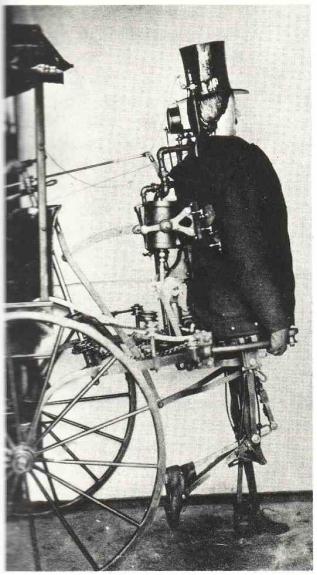
Zadoc P. Dederick's Steam-Man