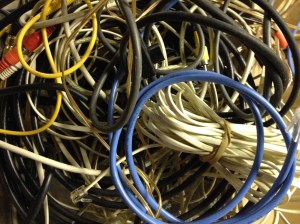
Internet of Nothings

In the vast internet of things, it’s surprising that you can’t order some specific things.  This became clear to me recently when there were two separate things I was looking for.  I know these things exist.  You can find them on the internet, but they are not available in this area.  One of them is very mundane.  Lath.  You see, the previous owners of the house wired up the attic, which is handy.  To do so they had to break through the plaster and they removed several sections of lath.  Like a squirrel digging for a forgotten nut, they did this several times, leaving holes in the wall with exposed insulation.  One of my projects since moving in has been to plaster over these holes.  The gaps are so large, however, that you need lath to replace the discarded pieces.  

Our local big box hardware stores don’t carry it.  If you find it in a large urban store, they can’t deliver it to a local branch, and shipping isn’t available for this item.  I realize drywall has triumphed—I prefer it myself—but doing the entire attic is a major expense.  I just want to plaster up the holes.  No lath, no how.  At the same time I began to look for Top Ramen soy flavor for quick lunches.  It is the only inexpensive vegan option with the much coveted flavor pack.  I know it exists and that it is available in Ithaca, New York, the last place I bought it.  Although the brand is in our local grocery stores that variety is not.  It’s listed on Amazon, but as unavailable.  (Amazon, by the way, insists that you want to buy a lathe if you type in lath.  If it finally accepts “lath” it’s clear it has no idea what it is.)

So I went to the website of the Top Ramen parent company, Nissin.  They list the product as available.  They don’t ship themselves, not to small customers, but they helpfully tell you stores nearby where you can buy it.  Their vegetarian varieties are “not available in your area.”  Not even Amazon can get them.  This to me seems odd.  Nearly every day I read about the greatness of the internet of things.  Anything can be had in this market.  If you’re looking for something specific, whether it be thin strips of cheap wood or thin noodles without beef broth for your lunch, you can’t get those in an area within about 250 miles of one quarter of the US population.  Of course, I have until lunchtime to sort this one out.


Internet of Happiness

Are we really happier for instantaneous news?  Has the internet brought us paroxysms of ecstasy with the quality of information?  Wouldn’t you just rather wait?  I don’t think we should go to extremes, or go backward.  Samuel Morse, it is said, developed the telegraph in part because he was away from home and only found out about his wife’s death after her burial, for which he could not return in time.  More rapid communication was necessary and the telegraph provided the means.  No, I’m not suggesting that happiness lies in being uninformed, but perhaps I lingered long enough among the Episcopalians so as to believe in the via media, the middle way.  Some of the happiest times of my life have been spent without a screen glowing in my face.  There is, however, good stuff here.

One example is blogging.  I wish I had more time to read blogs.  Verbomania, for example, showcases writing that sparkles.  The weekly posts set me up for a good weekend.  There are many more that I could name as well—and for me blogging has become a way of life.  Marketers call it “platform building” but I think of it as fun.  And the practice I get writing this blog daily has made my books much more user-friendly.  A family friend with no college education tried to read Weathering the Psalms, with “tried” being the operative word.  There’s no comparison with Holy Horror.  (Weathering the Psalms was written to be my “tenure book,” and it may well be my last technical monograph.)  I have this avocation of blogging to thank for that.

But instantaneous news—does it make us happier?  Sometimes perhaps, but often the opposite.  It’s a phenomenon I call the internet of unhappiness.  (There’s a whole field of study emerging called “the internet of things,” which, no matter how much I ponder I just can’t comprehend.)  News, after all, tends to focus on negatives, as if there’s too much happiness in our lives.  Just yesterday there were early morning helicopters hovering not far from where I live.  Within seconds I could learn of some kind of domestic dispute about which I’d otherwise have been none the wiser.  The next few hours I spent occasionally reloading the page for updates.  They didn’t make me happy.  Add to that the three-ring sideshow that the American government has become and you’ll soon be wanting just three channels from which to select before turning off the TV and going outside for a walk.  And when the 1970s start to look like happy times, you go to your closet and start digging for the semaphore flags.

They must be in here somewhere…