Snowballs in Spring

Things snowball sometimes, even in the spring.  Weekends are among the most sacred of times when you work a 9-2-5.  They do double-duty as recovery time as well as prep time for the coming week to do it all over again.  I’m a proponent of the three-day weekend; life has grown so complicated that two days hardly cover it any more.  So in April I had a Saturday that snowballed.  I awoke vaguely thinking I might have to cut the grass.  It’d actually been dry a few days and the sun was out.  Then things started to get out of hand.  A letter arrived from the IRS.  Now, this is seldom welcome, but although it wasn’t scary it involved having to go back to our tax preparer’s office and, since tax day was just a couple days off, scheduling that was tricky.

Photo by benjamin lehman on Unsplash

Then the power went out.  Under a clear blue sky.  Being the middle of the day, we couldn’t tell if neighbors were affected or not.  After leaving a message with PPL, I walked to a local store about a block away and they had power.  The owner and I chatted a little, then I went home to await the PPL call or visit.  Since the power was out I was keeping a close eye on my phone’s battery level.  It was our only means of communication with the outside world.  Meanwhile, all of what we’d planned to do that Saturday had to be put on hold.  The house was quiet with no fridge hum or any other sound.  Suddenly I heard a kind of airplane buzz, but it seemed to be coming from inside.  I followed my ears to the kitchen where a big old bumblebee was trying to get outside.  I grabbed one of our ubiquitous peanut butter jars and waited for it to land.  The phone rang.  PPL said everything was fine on their end and we had to call an electrician.  It was now 4 p.m. on a Saturday, I was being buzzed by a bee, and I had to find an emergency electrician with my phone charge dropping.

I called a company I’d used before.  After explaining everything they decided they no longer serviced our area.  I called a second 24/7 electrician.  They could get someone out to us on Friday.  This was Saturday.  My wife took the jar from my hand and went after the bee.  The third company, which I will gladly use again, said they could get someone out by 9 p.m., at the latest.  By now the entire afternoon was gone.  My wife let the bee go outdoors and when we came back into the kitchen she said, “Isn’t that the fridge?”  It was humming.  Lights were out elsewhere so I made my fifth trip to the breaker box in the basement, using a flashlight, and tripped all the switches again.  Power was back on.  The electricians were good about canceling but suggested a follow up visit, just to check things out.  The grass didn’t get cut.  It was a snowball in April.

Irrational Revelation System

In an article on Obamacare in last week’s paper, Kathleen O’Brien pointed out an interesting dilemma. Some religions, such as the Anabaptist traditions (Amish, Mennonites) must comply with modern regulations on healthcare or face a fine. Under pressure, the Internal Revenue Service grants exemptions to some such religions, but those religions have to have been established before 1950. Maybe I’m paranoid, but just having read about Scientology, I have to wonder about two things: what is the IRS doing defining religions, and why 1950?

Photo credit: Ad Meskens, Wikimedia Commons

Photo credit: Ad Meskens, Wikimedia Commons

1950. Like the Roman Empire, frustrated with new religions (like Christianity) popping up all over the place, governments sometimes default to a religion’s age as a sign of its validity. Rome required conformity, but Judaism, demonstrably already an ancient religion, was granted an exemption from some of the regulations. We have a tendency to think that if a religion is valid, it must have been discovered/revealed long ago. All religions, however, were new at one time. Even the first shaman offering the first propitiatory gesture to the first recognized nature spirit, was experimenting a little. Did that stop in 1950? That line in the sand must stand for the cutoff date for new religions. Why? Well, you see, it has to do with money.

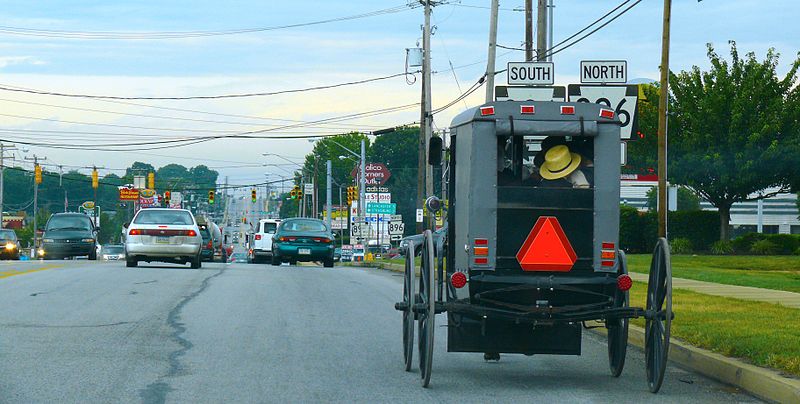
The IRS, as an organization, doesn’t really care what you believe. As long as it includes paying your taxes. One of the burdens of citizenship, too quickly forgotten, is that life together in a complex society is not possible without incurring considerable costs. Religions have long claimed tax-exempt status under the rubric of disestablishment. If they pay the government, then it is like the government is receiving kickbacks from the Almighty. The biggest donor should get the biggest favors. Soon you have a state church. So it is just easier to let religions be tax exempt. But since nobody has ever adequately defined what a religion is, the doors have been wide open for entrepreneurs in the faith industry. Instead of letting religious experts decide how to define a religion, that has become a government job. I picture a simple, bearded Amish man pulling his buggy up outside the IRS headquarters in a frenetic Washington, DC to go argue his case. Don’t worry, Bruder. Divine revelation, whatever that is, apparently stopped in 1950 and you’re clearly pre-McCarthy era. Suddenly a whole lot of things seem to start making sense.


Clearly Religion

GoingClear“There is no point in questioning Scientology’s standing as a religion; in the United States, the only opinion that really counts is that of the IRS;” so Lawrence Wright partially concludes Going Clear: Scientology, Hollywood, and the Prison of Belief. This is an important book, and one which once again demonstrates how seriously religions should be taken. New religious movements offer a ringside seat to how orthodoxies are born. Facts may be distorted or covered up, but there is information to be had on L. Ron Hubbard, Joseph Smith, and Mary Baker Eddy. We can learn from the way their ideas may move from fiction to fact, and how intelligent people still feeling spiritual yearning can turn to a religion invented recently as well as those invented millennia ago. As Wright points out, all religions make improbable claims. Fact-checking, however, is much more difficult for periods long gone that left only meager records. The distance in time may lend ancient assertions the benefit of the doubt, but the real decision-maker is money.

Given universities’ interests in lucre, one might logically conclude that religions would be of great interest. It is telling that, especially in the case of Scientology, that the factor most important to the status of the church is its money. Religions may claim tax-exempt status, setting them apart from purely commercial enterprises. This gives religions an advantage when they are careful with their finances, and the whole question of whether a religion is a religion is not left to scholars but to the lawyers of the Internal Revenue Service. The truth of religion lies in its bank-books, not its holy books. No doubt in the case of Scientology this is because of the high-profile court cases in which the status of the religion was challenged by government agencies. Nevertheless, when it comes to the laying down of the law, only money really matters in defining a religion.

As Wright discusses, one of the problems we face is that religion is poorly defined. Nobody can really assert much beyond that religions involve belief of some kind. Beliefs, in this case, about L. Ron Hubbard and his ideas. Although facts about his life are disputed, there can be no doubt that Hubbard was an intriguing man. He was a prolific writer with great imagination, and he clearly had keen insight into psychology. A religion used to be measured by the good it produced. Now it is measured by the dollars. As Going Clear illustrates, trying to construct an unbiased account of Scientology is a fraught enterprise. Like many modern religions, Scientology is very secretive. Even the early Christians knew that if everybody could join, then the club loses its appeal. Apart from belief, religions also must have outsiders and well as insiders. In a world measured by consumerism, wealth is the surest sign of blessing. No one should be at all surprised, therefore, that it takes the IRS to decide that which used to be taken by faith alone.