Presumption Be Thy Name

I once dashed an email off to a colleague in a hurry. The email concerned, in some way, the Judeo-Christian deity, known in the Hebrew Bible by the tetragrammaton YHWH. Quite unintentionally, my harried fingers tapped out YWHW—an honest, if impious, mistake. My colleague, who happens to be Jewish, immediately pointed out my unintentional blasphemy—one more casualty of the computer age. Naturally, I apologized and life went on. (I try not to spin out the larger implications.) The point is, based on the third (some would say “second”) commandment, Judaism has strongly preserved the taboo on using the divine name at all. God’s name is spelled without vowels to prevent anyone from trying to say it, and when written with the vowels of the word “lord” (adonai) gives us the false form Jehovah. Casual use of the divine name is considered offensive, and some would say it’s swearing.
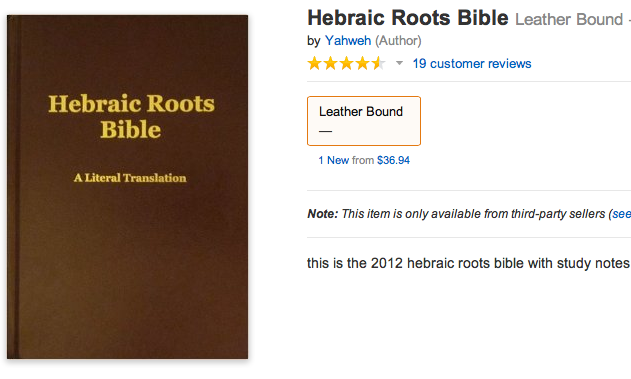
HebraicRootsBibleWhile on Amazon.com the other day—it is the site to which I go for solace; so many books! So many books!—I came across the Hebraic Roots Bible. Subtitled “A Literal Translation,” it was clear that this was yet another well-intentioned, but ill-fated attempt to make the definitive English translation of the Hebrew Bible. True, literal translation is a chimera. Languages are thought-systems and can only be approximated in other languages. Those who wish to read the Bible literally must become proficient in Hebrew and Greek, with a smattering of Aramaic. In any case, none of that caught my attention. Without a hint of irony, the author of this book was listed as Yahweh. In case you’ve been wondering why some prayers are going unanswered, you may have your answer here—the Almighty has been busy writing a book!

My first reaction was a coy smile. That is kind of a cute selling point. But then I realized there was likely no humor to it. This was probably understood to be read literally: Yahweh wrote this book. I wonder who he got to write the Foreword. My error to my Jewish colleague was, literally, unintentional. This was literally scary. Who would be bold enough to claim that their own interpretation was the word of I Am himself? Why did he wait until 2012 to publish it? Blasphemy comes in a variety of forms. While still at Routledge, one of my Jewish authors insisted that I strike the blasphemy clause (standard for many publishing contracts) from his agreement. “Who can write anything that isn’t considered blasphemy by somebody?” he reasonably asked. The thought comes back to me, looking at the Hebraic Roots Bible. The author’s name, after all, didn’t even make it onto the cover of the book.

Jehovah Jireh

They came again this week. I was, conveniently, not home when they rang the bell. One thing with which I must credit the Jehovah’s Witnesses, however, is that they do recall the identity of their targeted converts. My neighborhood missionary always addresses me by name, and although she often has different associates with her, she knows I teach Bible courses at Rutgers and when we actually talk she tries to convince me of the Witnesses’ more exacting grasp on the truth of Holy Writ. When I returned home I found a copy of Awake! tucked in the door handle. Not the current issue, but the November 2007 edition entitled, “Can You Trust the Bible?”

The Jehovah’s Witnesses resemble many of my Fundamentalist friends in that they assume if you don’t share their view of the Bible that you somehow “distrust” or “disrespect” or “disbelieve” it. Too many disses! This mono-directional view of a complex document devalues the content and power of the biblical narrative, but most people are not trained to view subjects from multiple perspectives. This is clear from Awake! One point that the magazine makes regards science: “when it comes to scientific matters, the Bible is noteworthy not only for what it says but also for what it does not say.” The writers acknowledge that a scientific worldview conflicts with the flat-earth outlook of the biblical world, but oh, what the Bible doesn’t say! This enormous argument from silence speaks volumes. When we approach the question from the point of view of what mistakes the Bible does not make, we’ve got a universe entire in which to roam.

On the question of biblical authorship, the principle of pars pro toto is utilized to justify divine authorship. The Awake! article begins, “The Bible is frank about who penned its contents.” Among the first lessons of 101 is just how much of the Bible is anonymous. The next statement, however, is wrong on several points: “Most Bible writers acknowledged that they wrote in the name of Jehovah.” Almost never does the Bible claim direct divine guidance in its writing. The credit for this goes to Pseudo-Paul in 2 Timothy – only there does an author placing in the Bible make any claims about his fellow composers having been inspired. Jehovah as a name for Yahweh is documented for the first time in the 13th century (C.E.).

I am touched that a woman who knows so little of who I really am keeps coming to my door to save me from an unpleasant afterlife. She has taken the time to find an appropriate piece of literature for my teaching interests. But, like my Fundamentalist friends, she has missed the forest for the trees. After over forty years of reading and teaching the Bible, I have my own answer for “Can You Trust the Bible?”


Lessing Down Your Kierkegaard

The Jehovah’s Witnesses stopped by again yesterday. They were very friendly and polite, and even remembered my name from the last visit. One of the missionaries was new to me, and she assured me that God’s name is Jehovah. She said the Bible proved this. The missionary who’d spoken to me before knew I was a former professor of religion. Nevertheless, they both worked at trying to get me to see the light. I extended to them the courtesy I extend to my students and blog readers, namely, of not revealing my own personal religious convictions. It must be really frustrating to try to convert someone when you don’t know what they already believe!

The point I never have the heart to bring up is God’s name. In fact, no one is certain as to what the divine name is in the Judeo-Christian tradition. “Yahweh” is the closest approximation, based on present conventions of transliterating Hebrew and reconstructing vowels that were never recorded. The word “Jehovah” is historically well understood. It begins with the Jewish reticence to speak God’s name aloud during the second temple period. In order to assure that a reader didn’t accidentally blurt out the divine name when reading Scripture, the Masoretes took the convention of writing the consonants of Yahweh (yhwh – Hebrew has no capital letters) with the vowels for the epithet “lord,” adonai in transliterated Hebrew. The initial J comes from the fact that to get a “y” sound in German a “j” is used. So we get the “J” from yhwh, the “a” from adonai, and alternate from there “h-o-v” (again, because of the Germanic origin of the word, a “v” was used instead of “w”) and finally, “a-h.” All together, this word, which was never used in biblical times, becomes Jehovah, a new name for God.

I admire the conviction of those who stop by a stranger’s house and present their views. When pressed to accept, however, I threw them Lessing’s rings. Gotthold Lessing once suggested that God gave humanity three golden rings: Judaism, Christianity, and Islam. What God did not give was the answer to which religion was the true one. I placed this conundrum before my earnest guests, but they already had the answer that had flummoxed Lessing. I suggested that if one’s conviction is strong, now borrowing from Kierkegaard, then one must follow that conviction. No, I was told, for the Bible reveals the whole truth. I mentioned that not all religions utilized the Bible in that way. I was told the Bible reveals the whole truth. About that time I had to run off to administer a final exam in a Bible class. The exam covered Ezekiel. And I knew, with a shudder, that Ezekiel had been told to look out from the watchtower!

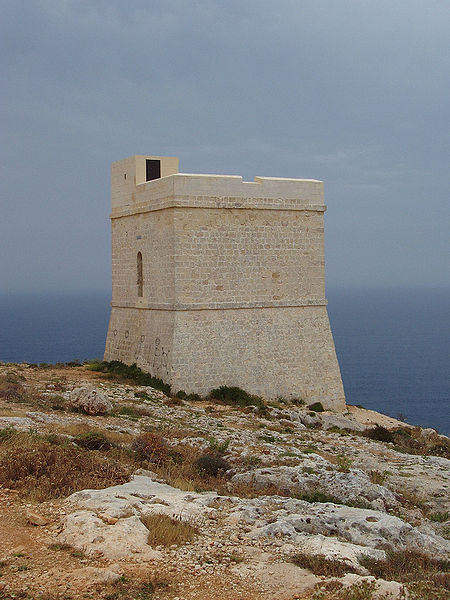
Ezekiel or Charles Taze Russell's watchtower?