New Salzburg

For some reason Austria is on my mind. It been more than two decades now since I have been there, but I recently decided to read a little of the history of Salzburg. My interest revolved around a case of religious intolerance that took place well before the days of political correctness, but after the idea of religious freedom was being promoted in New World colonies. Two centuries after Martin Luther’s theses stirred the world (perhaps the last time in history a religious thesis has received such attention), the Roman Catholic Archbishop—and Count! (rank has its privileges)—Leopold Anton von Firmian decided to expel the Protestants from Salzburg. Religious diversity was frequently seen as a threat to civil authority. Either Protestants would recant or be forced from their homes in the winter, often losing everything they had in the process. A substantial number of citizens were exiled and found little in the way of refuge. Prussia finally offered some quarter and others made their way to England or to a then religiously tolerant Georgia.

Religious imperialism is a funny phenomenon. Religions, as sets of teachings, often emphasize the just and fair treatment of other people. When powerful people (or power-hungry people) become religious they find a great mind-control technique available in it. Popes, for instance, very quickly ceased being pastors and instead styled themselves as princes. This was a safe move since Jesus was king, and since he’s in heaven any attempts at usurpation are bound to be suspect. As a co-regent, however, various privileges apply! This is something Protestant reformers very swiftly learned as well. John Calvin was practically in charge of Geneva, and who can think of Lynchburg, Virginia without accounting for Jerry Falwell or Virginia Beach without Pat Robertson? Religion, by its genetic nature, seeks to take over and control.

In this it is not so different from other aggressive ideologies such as capitalism or communism. The problem is that religions claim sanction from the highest authority, and once a believer is convinced of that no amount of reason is sufficient to dissuade him or her. So it was that an Austrian Count, also an Archbishop, decided to turn out members of his own putative religion (Christianity) into a harsh winter where many would die and others would live the remainder of their lives in exile. Were this the hallmark of one religion alone we might have united together as a species and cast it out. Unfortunately history has repeatedly shown us that even the most placid religions can quickly form the dark face of a demonic storm front if certain of their privileges are threatened. No one likes to be wrong. In the game of religions, however, there must be losers if anyone is right. Where is the New Salzburg? It may be going by a different name these days.
A Long Way to Go

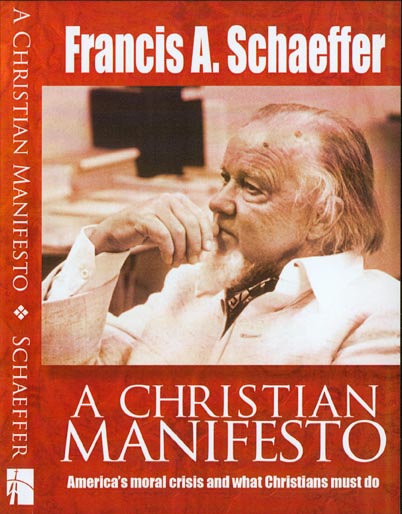
“One of the greatest injustices we do to young people is ask them to be conservative.” The words are those of Francis Schaeffer. The Francis Schaeffer. Among evangelical circuits, Schaeffer has a status right up there with James Dobson, Ronald Reagan, and Saint Paul. At Grove City College he was viewed with such veneration that hagiography would be an understatement. Few realize that Schaeffer was a mover and shaker in the hippie movement until Roe v. Wade caused what might have been akin to a breakdown. Schaeffer transformed into what he once despised, the ultra-conservative trying to protect the unborn. While Catholic groups had been unsuccessful at capturing Jerry Falwell’s sympathy for fetuses, Schaeffer would win. His book, A Christian Manifesto, published the year I started college, was required reading for religion majors. Abortion had now been taken on as an “evangelical” issue.

Fast forward a few decades. Karen Handel, erstwhile Georgia gubernatorial hopeful, becomes senior vice-president for Susan G. Komen’s The Cure. Handel ran for governor on a pro-life platform. The Cure (temporarily) withdraws funding from Planned Parenthood—the idea that every child should be loved and esteemed is less important than every child should be born. With those little tiny feet. And as it turns out, hopefully with little tiny penises as well. Divide and conquer. Women against women. The Margaret Thatcher syndrome. Call it what you will, but abortion as a religio-political issue revolves around women’s rights. Anti-female legislation has had a long and sordid affair with Christian theology, reaching back to medieval witch-hunts and Catholic sacerdotal declarations. What is sometimes excused as ignorance in less developed societies where women are routinely brutalized is given a Gospel air brush job and called “anti-abortion” in the United States. The real issue, the literal elephant in the room, is women’s rights.

The evidence on this is incontrovertible for anyone who is willing to open their eyes. In order for our culture—men hurling themselves at each other during the Superbowl while women are preparing food in the kitchen—to survive, outmoded gender expectations must be kept firmly in place. Even if you want to cure breast cancer—largely a plague against females—you do it so they can live to produce more males. Being raised with an absentee father, I learned very early that women had every right to equal treatment with men, but I also learned that it did not happen. The trick has been to get women on board to vote against their own best interests. Raise them up to think their religion, their God, demands them to be subservient. And if a man wants sex, it is a woman’s duty to comply. And abortion undoes all a man’s hard work in the bedroom, or backseat, or dark alleyway. Yes, these issues are complex and myriad aspects play into them. I say we call a quorum on the debate until one-half of the human race is truly given a chance to find its voice.

What does he have that half the human race doesn't?


Empty Pews

An insightful op-ed piece by Robert D. Putnam and David E. Campbell in yesterday’s paper asked the question “why youths are losing their religion.” The authors, professors at Harvard and Notre Dame, respectively, answer with the suggestion that religion and politics just don’t mix. The truism that religion and politics are taboo subjects of polite conversation was widely accepted in my younger years. During the Reagan campaigning era, however, it became clear that some unprincipled louts were drawing religion into the political mix to garner votes. Those who actually research Reagan’s religious convictions are often surprised to find that they are not as “George W. Bush” as everyone thought. It was a ploy, and a vastly successful one at that. A new avenue had been paved, however, for hotly contested elections: use the Bible. The fawning attitudes of many Americans toward the Bible they seldom read is a powerful political tool.

Putnam and Campbell note that adults coming of age in the 1990s and later have been alienated by this paring of religion and politics. The results have tended to be the rejection of organized religion that is seen as hypocritical and intolerant. The interesting factor is that it is the political agenda that is hypocritical and intolerant, but organized religion is paying the price for going along with the Ralph Reeds, Jerry Falwells, and Pat Robertsons of the early religious right. One guy from an old book once said something like “what you sow you also shall reap.” The political use (abuse) of religion has only and always been about power.

The authors are able to provide statistics to back up their models, but their reasoning is clear enough on its own. Some of us have experienced first hand the ugly, hideous agenda behind the angelically smiling evangelistic face. Those who hold to it may be naïve enough to believe that it is actually religion that they are serving, but the sad truth is their positions are cravings for power. There are those who actually relish the days of imperial Christianity when, despite its Roman Catholicism, the church made Europe tremble. They forget that pilgrims and colonists moved to this land to flee such tyranny. Americans, reluctant to elect Roman Catholics to the presidency because of the latent fear of a hierarchical religion — so close to kingship — now bow down before political rulers in religious garb. Decidedly Protestant. And the Tea Party continues to crank out candidates who do not even realize that the separation of church and state is a founding principle of this nation. If there is a backlash coming, it is a well deserved one indeed.


Papal bull?

In world news, yesterday’s paper ran an article entitled “Pontiff praises Africa as font of spirituality” (New Jersey Star-Ledger). This brief piece concerning a clerical meeting about Africa (held in Italy), dredged up some interesting concepts: that the African continent is a font of spirituality, but it suffers from materialism and fundamentalism. Having never been to Africa, I am not in a position to assess how materialistic the continent is, but from the images seared into my brain of barely clothed, starving children who own nothing, having this comment come from the opulence of the Vatican is jarring. Teaching by example is far more effective than, well, pontificating. Perhaps if some of the art and Christian swag were sold to invest in the poor, there might be reason to listen to rebukes from foreign potentates.

Catholics and Fundamentalists sometimes share political agendas and cooperate to get their holy candidates elected, but clearly they clash when it comes to issues of religious praxis, and especially, authority. I watched with horror over the last two decades as Roman Catholic bishops paired up with the likes of Pat Robertson and Jerry Falwell to support the Bush family legacy because they agree on the same conservative side of the issues. I even saw this on a small scale at Nashotah House. Once the victory is won, however, the honeymoon is over and the claws come unsheathed and fangs are bared.

Religious fundamentalism is an extremely dangerous force, and Rome is right to call it a “virus.” Like Catholicism, however, it is based on fear of dissing the almighty. If we dare probe deeper, underlying all the obsequious servility towards the divine, both forms of Christianity thrive on their own power. Being able to control the masses with claims of sole spiritual authority — sorry, only one set of keys to the kingdom — is also a dangerous thing. Benedict IX, meet Jimmy Swaggart; Jimmy, meet Bennie.

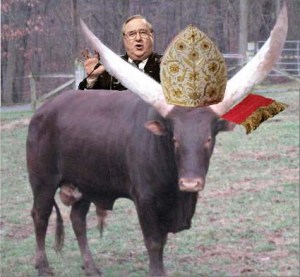
Jerry blesses a papal bull

Jerry blesses a papal bull