Not So Gnostic

A certain, amorphous indignation comes over those of us trained in history when we encounter abuses of the same. In my case, some thought me conservative when I argued in my first book that Asherah as Yahweh’s wife wasn’t nearly the slam dunk some scholars were making it out to be. Don’t get me wrong, I wanted to see Yahweh as happily married as the next deity, but it was a matter of the evidence being weak and not thoughtfully examined. That is to say, I sympathize—maybe even empathize—with Philip Jenkins. His book, Hidden Gospels: How the Search for Jesus Lost Its Way, is an historical dressing down of many in the New Testament scholarly community who’ve perhaps let a bit of historical rigor slip in order to understand the world of early Christianity.

You see, once upon a time, scholars took the Gospels as, well, the gospel truth. Contradictions were simply harmonized or glossed over. When newer ancient material began to be discovered, however, adjustments had to be made. Perhaps the “orthodox” story of Christian origins wasn’t the only option available. In the twentieth century some spectacular manuscript finds were made, including the “library” of Nag Hammadi—largely Gnostic—and the Dead Sea Scrolls. New understandings of early Christianity were possible when these texts were considered. Some scholars engineered sweeping theories about revolutionary ideas concerning Jesus and his buds. Jenkins laments the lack of historical precision that many of these reconstructions demonstrate, and he comes across as somewhat annoyed.

Sensationalism, as we all know, sells publications and gets presidents elected. We all like a good story. In the case of Jesus, this means that the reconstructions of scholars often challenge traditional views, and popular publications love it. Jenkins finds it distasteful. Although this book is well written, as all of Jenkins’ material tends to be, it probably doesn’t do his arguments any favor to have retained the tired trope of heresy. Heresy means nothing without a supernatural bias, something that historians must avoid. Heresy, after all, assumes that one and only one version is correct (orthodox) and the four Gospels demonstrate that such a simple dichotomy is more difficult to sustain than it might appear to be. Yes, the Gnostic texts may not be as early as the traditional Gospels, but the ideas may have been circulating from near the beginning. We know surprisingly little about Jesus, so it’s not unexpected that rumors would’ve flown, even in antiquity. A solid source of information on some of the early “other gospels,” Jenkins’ book serves as a useful reminder that history is almost never as simple as it seems it should be.

Filmy Substance

It’s all about Jesus. Well, that’s an overstatement, even in context. One of the amazing things to me about books addressing the Bible in film is just how often Jesus movies come up. If it’s not Jesus movies, it’s movies that have a “Christ figure” or some such Christian trope. Don’t get me wrong—I have no issues with Jesus. It’s just that the Bible and film have so much more in common than this. David Shepherd’s edited collection, Images of the Word: Hollywood’s Bible and Beyond, has some insightful pieces in it and some of what has become “standard fare” already in a field that’s so new. I found Richard A. Blake’s response fascinating. Maybe this was because he doesn’t approach the topic from a biblicists’ point of view.

I’m not really complaining about scholars who look to cinema for a rich source of reception history. I do it myself from time to time. Most of the books on this topic are collections of essays and collections are, by default, uneven. There’s an amazing amount of biblical material in movies that simply goes overlooked. Also, I would suggest, movies offer valid interpretations of the Bible. Somewhere along the development of the discipline we seem to have slipped into thinking that only certain people can legitimately interpret the Good Book. If it is a sacred text, however, it is as much in the public domain as any text can be. And texts in the public domain can legitimately be interpreted by hoi polloi. That’s the nature of being a text with universal assertions, I suspect. Directors and writers, therefore, are legitimate interpreters. We could learn a lot about the Bible from going to the theater.

Like many who’ve taught Bible to undergrads, I sometimes discussed films with them. I always believed students were legitimate interpreters of Scripture, too. This is a dialogue. One of the more interesting aspects of Shepherd’s collection is the pieces that focus on non-Hollywood movies. I don’t see a problem discussing Hollywood since we can assume a larger body of those who’ve seen the film. It is nice, however, to be reminded that “foreign” films also delve into what is sometimes treated as propriety material by Christians. Hindu representations of the life of Jesus? That’s a very interesting idea! Of course, not everyone likes to know how “outsiders” see them. That’s one of the beauties of using cinema as a means of interpreting the Bible. Those of us who study it don’t have the money to influence movies enough to make them in our image. It’s fun to watch someone else’s interpretation.


Heal Thyself

One thing we can say about the misguided leadership of this country is that they’re taking the Bible seriously. As the Republicans roll out a “healthcare” plan that would leave the elderly and poor at the mercy of the rich—known for their compassion—they’ve clearly displayed their belief that the followers of Jesus who voted them into office will once again rely on the carpenter from Nazareth for their healing. Those of us who’ve spent more than a few devotional hours with the Good Book may be a little less sanguine about the prospects for our aging parents (and let’s be honest, none of us is getting any younger). I guess we can call “Trumpcare” a blatant trumpet blast for the Second Coming.

It truly amazes me that Trump supporters don’t see the shady practices of the age-old business deal at work here. Cut my costs, offer you something that you don’t really want, and walk away looking like the guy who was only trying to help. As Kenny Rogers reminded us decades ago, you’ve got to “know when to hold ‘em, and know when to fold ‘em.” Only folding’s not on the table any more. If enough dissatisfied people die off in the next couple of years you won’t even have to worry about midterm elections, I guess. As a member of the human race who’s watched my elders age I don’t see how anyone could ask to have the healthcare taken away from their parents. But then again, this will save the uber-rich in this country quite a bit of money, so there must be a silver lining after all.

It’s unfortunate that nobody seems to care that irony is in such short supply. Presidential campaigns waged on hate deliver when it comes to taking away the services of those who voted them into power. Swamp dwellers all. A healthcare bill to make our country sick and weak—who could’ve thought of such a stroke of genius? You’ve just got to trust the rich to have everyone’s best interests at heart. Isn’t it clear that they always do? I often see them hobnobbing with the people who live in cardboard boxes on the streets of Manhattan. I seem to recall a guy with a reputation for healing once saying something about it being easier for a camel to pass through the eye of a needle than for a rich person to get into his hospital. Only he didn’t come up with a healthcare plan before he left. Does anybody have Jesus’ smartphone number?


Seeing Thinks

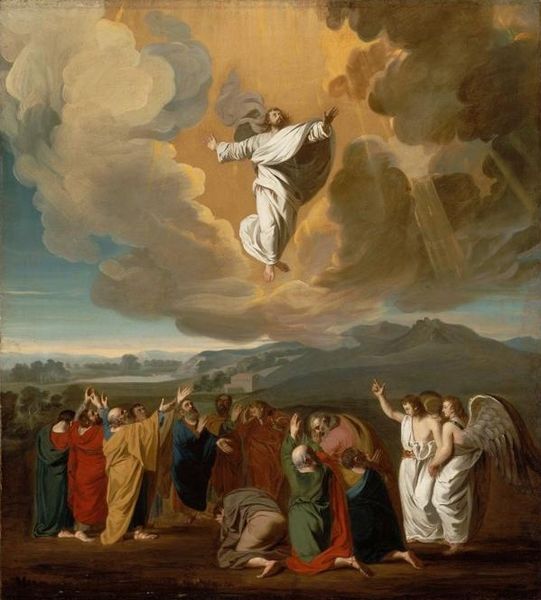
Look, up in the sky! It’s a bird! It’s a dude! What what is it? It’s actually a cloud. I enjoy the entries on Mysterious Universe, but sometimes a cigar is just a cigar. It seems like decades since I laid down on the ground and looked at the clouds, seeking shapes. The sky is nature’s cerulean canvas and although they’re just water vapor, clouds take on endlessly fascinating shapes. Since religion has historically been projected onto the sky, many people take signs in the sky as somehow divine. The photo on Mysterious Universe is of a cloud that some thought was Jesus and others thought was Mary. Herein lies the rub of pareidolia. You see what you want to see.

There is, in traditional Christian thought, a world of difference between Jesus and Mary. You really don’t want to mix the two up. I mean one is divine and the other is only venerated. Don’t want to cross that line into worship because idolatry leads to all kinds of trouble. So who’s in the sky? Someone that we should perhaps think sacred: water. In a world quickly running out of fresh water (of course since now, officially, there is no global warming we’ll have to find another way of explaining our disappearing ice caps) we should all perhaps worship our clouds. The harbingers of fresh water. It won’t last forever.

I, for one, complain when it rains too much. I suppose that’s because I’ve lived most of my life in the rainy climates of the eastern United States and Scotland. Days can pass without a glimmer of sunshine. I get depressed and truculent. Yet the freshwater falls. Water tables are replenished. In much of the world—indeed, in much of the United States—it is not so. Water shortages are bad and are growing worse. We use far too much and when the ice caps are gone, the largest reserves of freshwater on the planet will be empty. Then again, capitalists have never been too keen on saving up for the future. Most of us alive today, at least in the rainy climes, will have our lifetime supply. The future, however, looks pretty hot and thirsty. So who is it in the sky? Could be either gender—wearing robes makes it hard to tell at this level of detail—but whoever it is, let’s hope they’ve brought plenty of friends with them.

Look like anybody you know?

Look like anybody you know?


Lily White

The funny thing about being “white” (I’m more of an anemic pink myself) is that my race seems to think all the gods share our ethnic traits. I’ve seen Thor, so I know. The Daily Kos ran an article recently about Crystal Valentine, a black poet, and how she responded to Megyn Kelly’s 2013 statement that Jesus is a white man. I won’t say what Valentine’s apt response is, but I will say I feel a lot better knowing that I’m not the only one who’s a couple years behind the news. I remember 2013 well. It was a year of transition, some would say enforced exile. If you could pull that trick off 2500 years ago, you’d have no end of books written about you. Just check out the offerings on The Exile and you’ll see what I mean. But I digress. Is Jesus white?

Historically all we can say is that Jesus was Jewish. We don’t have any Jewish men from two millennia ago to ask about their skin tone. One of the problems of having an only child, especially for a deity, is that you have to decide on the race (and gender; perhaps twins would be better?). Other religions sometimes make similar claims, but the problem persists. Especially when one race claiming God’s ethnicity develops an industrialized military economy. Who’s going to argue with that? So if Jesus is white, it stands to reason that his dad is too, right? If you listen to the sidewalks of Manhattan you’ll have your answer. Or the question.

IMG_1558

All of this makes me wonder about the image of God. Theologians like to make it sound academic by calling it imago dei. If you can read Latin then you obviously know the truth. With monotheism and imago dei, you’re gonna run into problems. Nobody likes to be told they’re adopted. Since this theological construct has caused no end of pain and misery, I have to wonder if we’re better off thinking that we’ve not had a case of mistaken identity after all. We all evolved out of Africa. We should, it seems to me, treat our parents with more respect. And that, dear reader, is straight from the Bible.


The Problem with Love

As far as we can tell, historically there is no Saint Valentine that is particularly connected to February 14. Even if there were, it is difficult to imagine a saint promoting what we know as love. Love is a slippery topic. The ancient Greeks (who did not marry for love) were so perplexed that they came up with three different words for it, and the nascent Christian community tended to prefer agape-type love. Love that expresses well-being for the community and has little to do with the physical attraction that people everywhere find so compelling. It is safe to say that Christianity has always been uncomfortable with the kind of love that Valentines Day celebrates. The holiday, because of its associations, has often been removed from the liturgical calendar a time or two. People are already prone to express their biological urges, so it is best not to give them an excuse, sanctioned by the church.

This is an odd situation, thinking love is wrong, or at best, tolerated. As far as we can tell, the earliest Christians had no particular concerns in this way. We can’t measure, of course, how people loved their spouses, but there was nothing inherent in the new religion to suggest physical attraction was bad. By the time Paul of Tarsus started writing his letters a couple of decades after Jesus’ life, at the earliest, some doubts had crept in. They seem to have been largely personal. We know little of Paul’s life, but we are aware that he saw the kind of love known as eros to be a problem. Concession had to be made to those who couldn’t control themselves, but otherwise, in good stoic fashion, love was to be ignored. By the time of Augustine of Hippo, some three centuries later, sex passed on original sin and love had become decidedly dark.

St-Valentine-Kneeling-In-Supplication

Attitudes change with time, of course. After two millennia a certain practicality sets in. We have moved through the troubadours and courtly love to psychology and deep human needs. Arranged marriages are, for the most part, considered like shackles from the past. And love, that feeling that we never completely outgrow, is believed to be a positive thing. Saint Valentine (and there were at least two of them) would likely have disagreed. While the Romans celebrated sexuality, they also believed in restraint most of the time. Valentines Day, however, still has something to teach us. Despite the commercialization of the holiday, in a world with a surplus of hatred, any kind of love is, as long as it’s mutual, is worth celebrating.


What You Pay For

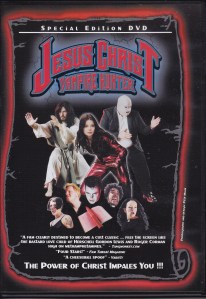
VampireHunterWhen a friend pointed out the easily missed 2001 film, Jesus Christ Vampire Hunter, (well before Seth Grahame-Smith came up with the same role for Abraham Lincoln) I knew I was duty-bound to see it. As regular readers know, although I’m not a fan of gore or violence, I have a soft spot for vampire movies. Vampires, although often evil, are frequently presented as conflicted characters. As former humans they have some level of sympathy for their victims, while at the same time, all people are objectified for the vampire. We are food. This low-budget, independent film didn’t promise to deliver on many levels, but as the end credits show, they did shoot enough film to be able to cut out a few bloopers. The story, in as far as there is one, has Jesus fighting lesbian vampires in modern-day Ottawa (where the film was shot).

Not that the film was serious enough to invite critical dialogue, I did wonder what Jesus had to do with the whole thing apart from the shock value. There were a few cute moments, as when the “atheists” pile, clown-like, out of a car for an extended fight scene, but the lead could have been any character apart from one scene where a miracle does occur. Jesus fights with his fists, not with supernatural power. Tossing in Mary Magnum and “professional wrestler” El Santo, the movie came close to the screwball level of Attack of the Killer Tomatoes. It’s difficult to critique a film where logic isn’t held accountable for the plot—the only thing to keep the film going is the action of a particular scene. And that, as I’ve intimated, can’t be counted on.

Interestingly enough, Jesus is treated throughout the film in a positive way. Although he doesn’t use supernatural powers, he is the “good guy” and is even tolerant of alternative lifestyles as long as love is the basis of relationships. The movie is biblically literate, using the Good Samaritan in a scene that underscores the accepting nature of the new millennium Jesus. The vampires don’t add much to the lore of the monster. They can be out in daylight because it is cheaper to shoot film that way, but the plot does come up with an explanation for it. Vampirism, at the end, can be healed by prayer, and when Mary Magnum, El Santo, and Jesus go their separate ways at the end, we are left wondering what all the fuss was about.


Away in a Manger?

The holidays are a time for getting together. At a friend’s house over the weekend, we were talking about nativity scenes. I mentioned a story about how a nativity scene had been missing the infant Jesus and he said he’d be right back with a solution. I have to admit that I’ve never seen Sweet Baby Jesus porter before. “Place that in your manger,” he said. I assume this is a seasonal brew, intended to draw the semi-religious toward a kind of holiday cheer. Now, blasphemy in a bottle is nothing new. In fact it’s quite common, I expect. Nevertheless, a bottle that says “One sip and you’ll claim the name” might be offering a salvation that it simply can’t deliver.

IMG_2642

Growing up, Christmas never had any connection with drinking. My father was an alcoholic, and inviting this particular spirit to the holidays seemed misguided. Still, I recognize that in many cultures tipples were a way of coping with the excessive periods of darkness. Even in these days of ubiquitous artificial lights, I find that the darkness just outside bears a considerable weight. We festoon our houses with colorful lights to ward off the night. We prepare special foods to take our minds from the bleakness outside the window. And yes, some turn to Sweet Baby Jesus to offer its own kind of shine.

The holidays mean many things to many people. The commercial aspects appeal less and less as the years go by, but having some time off work to be with family and collect my thoughts grows more important each year. What makes a day holy, I expect, is that you have things that are otherwise difficult to find. Life, for many, is a long series of denials of what they really want. When the holidays come, they indulge. Who am I to begrudge someone else of what makes their ordinary days sacred? Who indeed?


Monumental Time

One of my nieces works on the 10,000-year clock (aka Clock of the Long Now). I’ve written about the project before—the object is to build a clock that will run a myriad of years. For comparison, 10,000 years ago we were only beginning to tamper with this concept we call civilization. Clocks have been my muse this week. Monumental clocks have long fascinated people. The Engle Clock, in the National Watch and Clock Museum, was completed about 1878. In those days, these large clocks (it literally weighs half a ton) toured the country as technological marvels—something that fails to impress, I suppose, in an iWatch age. Nevertheless, this is a clock with all the whistles and bells—literally. Figures come marching out at various fractions of the hour, culminating with a skeletal death chiming the end of each sixty minutes. The figures are both secular and sacred, a mix that the people of the days just after the Civil War no doubt appreciated.

IMG_2464

At the top of the clock, at quarter to the hour, Jesus appears. Doors above him open and the “three Marys,” including, of course, his mother, come out. Meanwhile the twelve disciples process in front of their Lord, each respectfully turning toward him. The devil appears, shifting from window to window, and one disciple does not turn to greet Jesus. This is Peter who instead turns his back, and immediately, to borrow a Gospel trope, the cock above their heads crows. Finally, as the apostolic procession winds down, the Devil appears last in line. It is all quite elaborate. The clock took Stephen Engle two decades to build—time he would never recover. The religious message, I suspect, was taken much more seriously then than it is now. After all, the clock is a museum piece.

Throughout the museum, references to Christianity abound. Not only Galileo, but many Medieval time-watchers saw God literally in the face of time. Clocks were embossed with religious figures. Hours were kept to remind the faithful to pray. The time, as the New Testament insists, was short. Ironically, we still build monumental clocks. Some are based on the 9-billionth of a second vibration period of cesium, while others are made to last ten millennia. We have secularized time. Now its purpose is mainly to tell us when to go to work. When to wake up to go to work. And when we might eventually leave work. I might enjoy building clocks myself. The fact is, however, I don’t have that kind of time.


Chain Gang

When I first joined LinkedIn, the notes about adding connections you didn’t actually know were pretty dire.  People could trash you behind your back, ruining career opportunities.  It turns out that I don’t really need any help ruining career opportunities, so after a couple of years on the social network I started adding people if they had a legitimate reason for wanting to know me: they were academics, they were religion specialists, they were in the book business.  I still wonder why investment bankers and others who must have better things to do with their time bother to ask me to connect.  It’s not like I have anything to offer beyond adding a number to their 500+ connections.  It stokes my perpetually low self-esteem to think that maybe 500 people would like to be connected to me, at least electronically. Low risk friendship—I’m not going to bad-mouth anyone.
 
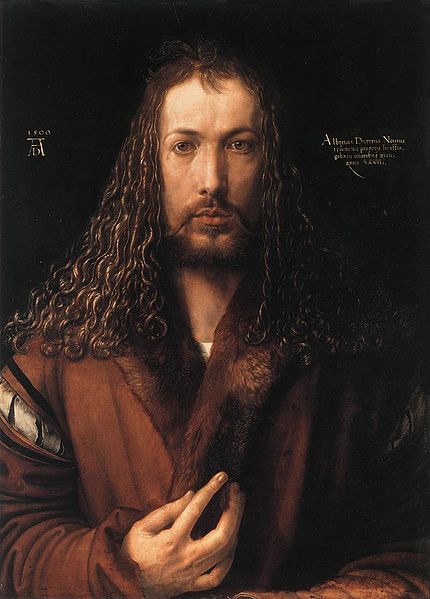
LinkedIn, like most social networks in this highly visual age, offers the opportunity to post a picture.  I don’t have many pictures of myself, and even fewer that I like.  Still, I picked a selfie I snapped in Herald Square after an overnight flight from Phoenix to New York.  I was meeting someone in town and I look a little worse for wear, I suppose, since I can’t sleep on planes.  Nevertheless, there’s enough of my character there to give people the idea of who they’re linking up with.  The other day I was scrolling through suggested people with whom I might want to link.  A surprising number of people blur their pictures, so they look like just about everything did after that flight from Phoenix.  Then there are those who select an image that is meant to be funny, or whimsical.  I was surprised when I saw Jesus’ face above the name of a priest.

430px-Durer_selfporitrait
 
Don’t get me wrong; I’ve got enough theological sophistication to know that many clergy wish people to “see Jesus” when they look at them.  To set Jesus as your personal image, however, seems a bit presumptuous.  Of course, I may be missing something.  Perhaps Jesus sent a connection request to this priest, with the offer to use his likeness.  Still, I find it ironic to suppose that anyone would consider themselves worthy to use the image of their deity as their own.  Growing up, I was taught that people shouldn’t name their kids “Jesus” (we knew no Hispanics in our small town), but then I learned that “Jesus” is just the Greek form of “Joshua” and I realized there were an awful lot of Angelos in trouble too.  Don’t mind my rambling.  It’s probably just sour grapes.  I haven’t received any invites from any deities on LinkedIn, so I’m feeling rather like any guy who has only 500+ connections.


Pauline Resurrection

271px-Bartolomeo_Montagna_-_Saint_Paul_-_Google_Art_ProjectPaul is dead. Has been since the first century. In biblical studies, however, he is undergoing a kind of resurrection. Studies of Paul are coming thick and fast, with many claiming, with some justification, that Christianity was his invention. Biblical scholars have long realized, however, that many New Testament letters do not come from Paul. Some never made that claim (Hebrews), while others seemed to have played on the popularity of the epistle genre and added Paul’s name to gain authority. Or maybe they were written by somebody else called Paul. Far more intriguing to me is the fact that in the authentic Pauline letters, the apostle from Tarsus mentions other letters he wrote that were not preserved. This should strike no one as unusual; would Luke’s grocery list have been preserved as scripture if it had been found? Probably not. Still, these missing letters do raise an issue that might crinkle brows with thought. What have we been missing?

Paul, like other scripture writers, had no idea he was writing “the Bible.” In fact, the Bible is one of the most obviously cobbled together holy books in world history. It is inspiration by committee. We have known for many many decades that there were other Gospels, for example. Some scholars treat the Gospel of Thomas as canonical, while others have reconstructed Q down to chapter and verse. The Hebrew Bible cites some of its sources that have gone missing. Some of the existent biblical books in their current state are obviously somewhat garbled. An imperfect scripture. And I’m wondering what Paul might have written in those missing letters.

The process of constructing a Bible has been examined time and again by scholars. Mostly they accept the material we have to work out some scheme of how Christianity decided “thus far and no further” and these books only will be Bible. Isn’t there, however, a problem when we know that other bits of parchment were floating around out there with the apostolic stamp of approval? What if Paul changed his mind over time? His current letters, the ones that survive, aren’t always consistent. It’s the job of exegetes to try to tell us what Paul really meant, but the fact is we know that this founder of Christianity sent more advice to more people and nobody bothered to keep a copy. Those bits that were preserved are not systematic or comprehensive, making me wonder just how solid a foundation a theology built on such small bits might have. Nobody, it seems, wrote a life of Jesus in real time. It took a couple decades at least before people started to sketch out his life’s story and teachings. By then Paul had already been killed. His letters, slowly gathered over time, formed a nucleus of a faith that grew to be the world’s largest. And, despite all that, we don’t know what he fully said. And we never will.


Ancient History

In the white heat of rhetoric, my word processor froze up. I don’t have much time for writing with my commuting schedule, so the full forty-five minutes lost between the typing of a letter “s” that apparently caused the meltdown and being able to access my text was lost in a prayer that my work hadn’t been lost. I remember the days when everyone used Microsoft Word and there was this joke going around about the Devil and Jesus being tested on their computer skills. I can’t remember the joke but I do recall the punchline: “Jesus saves!” So it was in those days that you had to hit “save” every few minutes or your work would be lost. Many laments could be loudly heard of students having lost an entire paper because they’d forgotten their prophylactic “save”s. I found that working on a Mac that such problems weren’t always so bad. But then, system upgrades became more frequent. Two programs that you needed open simultaneously, Word and Internet Explorer (called something else in those days, but I can’t remember what), were a sure recipe for mutually assured destruction. The memory required would freeze even an Apple to its core, and so the systems gurus made improvements and things got better.

Of course, those of us who’ve spend the Gross Domestic Product of a small country on Apple devices have been lulled to complacency. Over the years (since the fiasco of the original iMac) we’ve come to learn that Apple will save our work, and that crashes, while infrequent, will bring our files back onto the screen after recovery. You really don’t need to save since autosave is capable of being the messiah of all computer files. Then the gurus upgraded the system. For the past several months I can’t run a word processor and internet browser simultaneously on my computer without freezing up the system. Imagine my chagrin when, having less than an hour to write, copy, paste, and post my blog entry for the day, my word processor decides that it doesn’t recognize the letter “s.” Of course, Apple long ago stopped being compatible with Microsoft Word. Those of us who used both Macs and Word cheered when the two finally became compatible about a decade ago, but in the battle for computer supremacy, we no longer have that option. My Mac can open Word files and save documents as Word files, but it can’t run Word. Instead it runs word processors that don’t recognize that most rare of characters, the insidious “s.”

So I went to back up my files over the weekend. I keep some files on a memory stick (so called) because they take up a lot of space and I don’t use them that often. The memory stick failed in the middle of a save (doesn’t Jesus save anymore?) and I spent an entire Saturday trying to recover files that were already saved. According to some Christian traditions, once saved, always saved. You can’t be unsaved. After losing an enormous amount of work that equated to many hours of precious weekend time, I’m beginning to have my doubts about my faith. Using Pages, Apple’s version of Word, is sure to lead to a crash. This has been happening since at least September. I get systems upgrades more frequently than calls from telemarketers. I really don’t ask for much. I’ve got about an hour to get my writing done in the morning and I would really, really appreciate it if forty-five minutes of that hour weren’t taken up by Pages trying to recognize the letter “s.” After all, not even Jesus can save without it.

In the beginning was Word...

In the beginning was Word…


Get Me Jesus on the Line

The letter is the greatest casualty of the internet. I sometimes obsess about how little time people put into their emails, often coming across as gruff or short. I always start mine with a greeting and end them with a closing followed by my name. Of course, I’m from an older generation where communication was initiated with respect. Getting an actual letter is now, however, occasion for great wonder. A friend recently mailed me a couple of fascinating articles from the Prescott Journal, a Wisconsin newspaper. Dated to 1868, the articles actually post-date Nashotah House, but still count as when Wisconsin was rather more pioneer than Pioneer territory. Both articles involve what might be termed “scams” today. Newspapers in the nineteenth century were notorious for sometimes perpetrating hoaxes, and at other times falling victim to them. Still, as the only sources we have for some of these delightful tales, it is difficult to check them out beyond the fact of noting that the amazing stories have been subsequently forgotten.

One of the stories was wired in from San Francisco, the article claims. A certain F. Wilson was applying for copyright on a letter he acquired near Iconium, written by Jesus. As my friend noted in her letter, this is perhaps the earliest case of a rock inscribed “turn me over,” promising some kind of reward. Wilson claimed to have found, under a large (implied) rock, a letter written by Jesus. The rock could not be turned, despite reading “Blessed is he that shall turn me over,” even by a group of men. Then, according to folkloristic protocol, a small child turned it unaided. The letter underneath, although written by Jesus, was signed by the angel Gabriel. The letter contained the ten commandments, a note from Jesus answering a missive from King Abrus, an account of Jesus’ miracles, and a description of his person. The story doesn’t tell if the copyright application was successful.

Newspapers were a form of entertainment a couple of centuries ago. Of course, some four decades earlier than this story Joseph Smith had claimed to have found documents to which he was led by the angel Moroni. He published them and, although lynched some 24 years earlier, had nevertheless done pretty well for himself, as his followers would continue to do. Why not cash in on the new religion craze? After all, this was California, and even in the woods of Wisconsin some religious zealots had started an institution that would grow strong enough to displace dreams and livelihoods. What struck me most reading this story was just how little things have changed. Outlandish religious claims are still credulously accepted by the gullible. And the web encompasses the entire world. This story though, must be true, because it came to me in that most magical of forms—an actual letter.

"Don't forget to look for my letter!"

“Don’t forget to look for my letter!”


Dry Nation

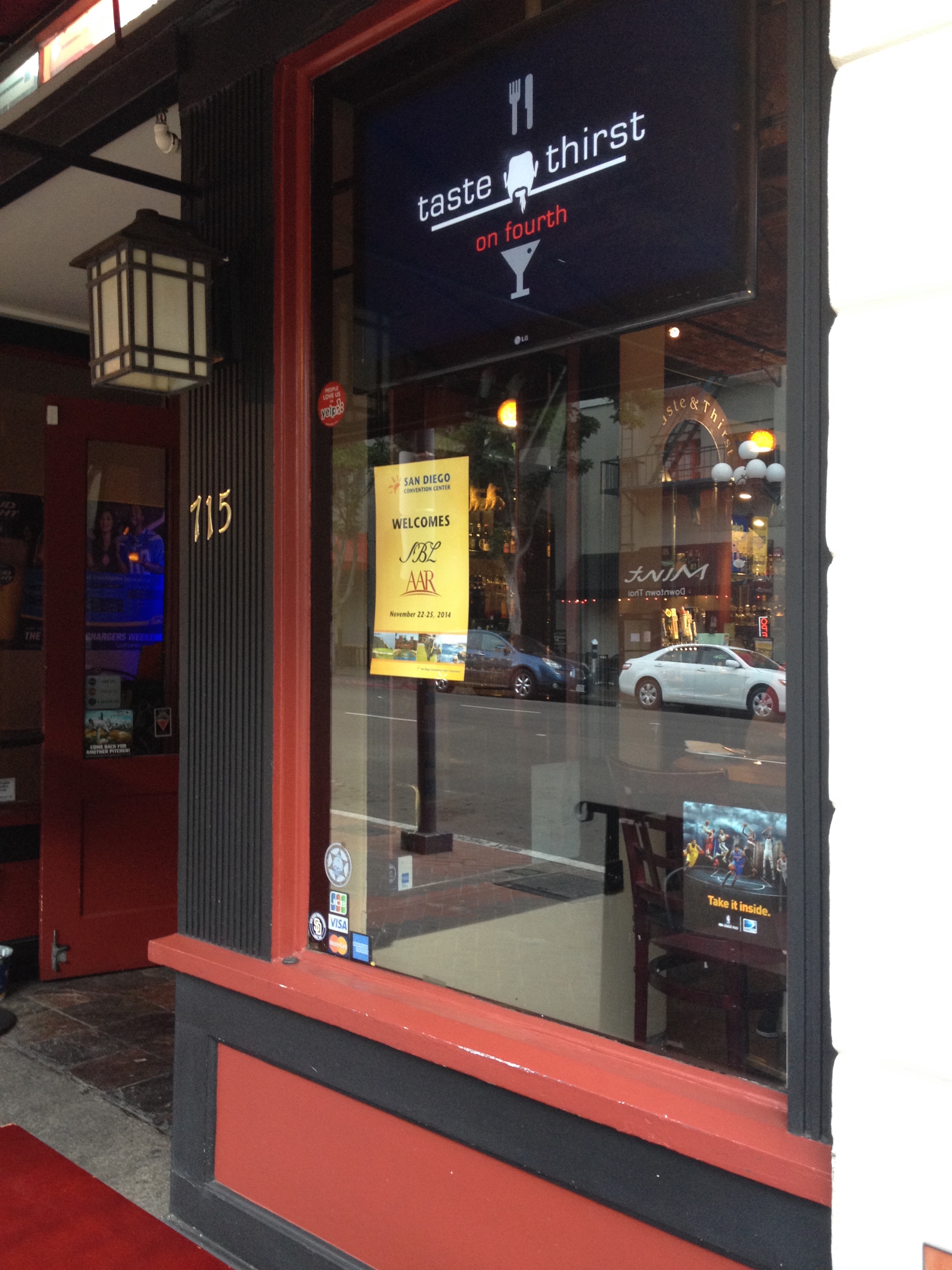
The American Academy of Religion and Society of Biblical Literature annual meeting is a big thing. It draws a myriad (literally) of scholars together every year and invades a fair sized city that may or may not be a religious haven. San Diego feels like a pretty Catholic city to me. My cab driver from the airport was a Muslim, but many of the churches and place names around here reveal a natural comfort with Catholicism. My first night in town, on my own and somewhat weary from awaking at 3:30 on the other coast to get ready to catch my flight, I wandered through the Gaslamp District looking for some authentic Mexican food. It is surprisingly tricky to find, although I’m only twenty miles from Tijuana. Along the way I passed a bar that had a welcome AAR/SBL poster in its window. Now here was a vender that recognized their client!

IMG_1814

Many of those outside the profession assume such conferences as this are like higher education Sunday schools. Undoubtedly, there are those who wish they were. For some, perhaps, the annual meeting allows for the indulgence of personal peccadillos far from watching administrative eyes. Others are more sanguine about it all. Religion scholars are just as human as the next guy. As I looked at this bar window, I reflected on how Christianity (in particular) came to regard alcohol as an evil. Wine and beer were known from ancient times, and even the New Testament has Jesus presented as an imbiber. Temperance, however, grew out of American Fundamentalism that seemed to have forgotten its scriptural roots. I remember learning, as a child, that the wine Jesus drank was really only grape juice with a little kick. Who wants an inebriated God running around the Middle East?

Still, I realize that drinking has its consequences. As the child of an alcoholic, I know the damage that this can do. On the other hand, I know many religions view “controlled substances” as gateways to alternate realities. Other planes of existence. There are even cases where Native Americans have been arrested for using their traditional ceremonial substances in a nation not quite Christian, not quite not Christian. Even on my way to the Gaslamp District, I was saddened to see so many homeless about the city. I knew that as evening fell and the scholars arrived, the bar would come alive. And I knew that when the rain came, some would get wet while others stayed nice and dry.


Christian Computing

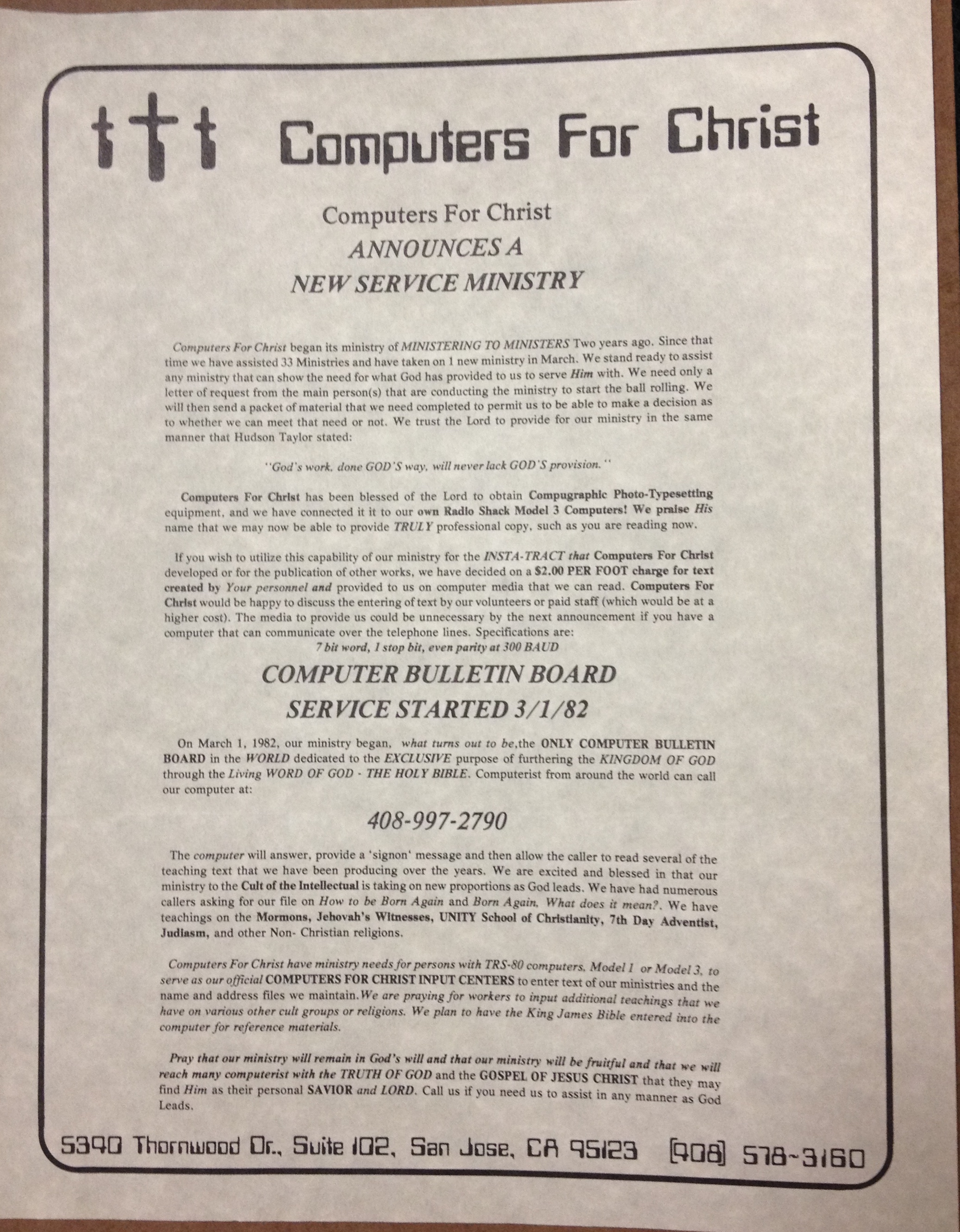
Science and religion are often portrayed as fighting like dogs and cats. Both claim superiority and a comprehensive worldview that should make sense of everything. With reality television probing deep into the lives of rural folk who still hold to the old ways, it is easy to think that religion is awkward and backward and an embarrassment to the technologically sophisticated. In electrons we trust. As with most simplistic views, however, this dichotomy is overly dramatized. I recently found a flier for Computers for Christ. I didn’t have time to read it carefully, but the space-age font immediately told me that this was vintage 70s or 80s, back when computers were still so new that most of us had never seen an actual exemplar and we had to guess what the future might hold. Would these things catch on or not? A little closer reading revealed the date of 1982, back when I was a college freshman. I had, by that point in my life, never knowingly glimpsed a computer.

IMG_1644

Sitting here with a computer on my lap, and another in my pocket, I wondered what ever happened to Computers for Christ with its space-age crosses and early embracement of technology. I didn’t find anything that really matches it with a half-hearted web search, but it did make me realize that some enterprising Evangelicals had latched onto computers long before I ever did. I recall making a pact with a couple of friends my senior year in college that we’d never give in and use computers. Since I can’t find them online, my guess is that they kept their end of the deal. As usual, I caved. By 1985 computers had found their way even to Grove City College. A strange thing called a “server” allowed people to access it via multiple “terminals.” The computer science professor wore a large cross around his neck. I would go on to seminary and graduate with a second degree not ever having used such a device.

Dogs and cats are both mammals, and neither regularly preys upon the other for food. Although Computers for Christ may no longer exist, the internet has been fully exploited by some of the religious. Jesus was an early meme. I remember when “the winking Jesus” was all the rage since an image on screen was actually animated! The savior virtually moved an eyelid! Now we can find Jesus doing everything from walking on water to riding on dinosaurs. The son of God has adapted to life on the web quite well, and often with a sense of humor. There are those who would argue that this is a travesty of true faith. There are others who would argue that it is a silly use of serious technology. I grew up with both dogs and cats and learned that when domesticated together they seldom fight. As I file away this aging paper, I wonder how the world might change if people behaved so sensibly.