Addenda

In retrospect, I suppose I wrote Holy Horror a bit prematurely.  Back when I started writing it, I had thought that the Bible in horror wasn’t as common as I’ve since found it to be.  I still stand by what I wrote, but I could’ve included a lot more movies that I’ve watched over the years since.  The Sacrament is one of them.  Based on the Jonestown massacre, the film sets the movie in the early twenty-tens.  A reporter for VICE is going to find his sister who’s joined a religious commune in some unspecified country.  In an effort to get him to join, she invited him to visit.  She was unaware, however, that he brought another journalist and cameraman with him.  The movie gives creepy vibes right away since they’re greeted at the helicopter landing site by men with guns.  Eventually they’re allowed to enter.
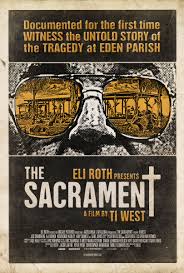
“Father,” the leader of the commune bears a resemblance to Jim Jones and soon it’s clear where this is going.  Along the way, however, Scripture gets quoted to justify their communal lifestyle.  There are many fictional aspects thrown in—the young women seduce the journalist whose sister invited him.  She makes no bones about saying they do it to convince him to stay.  The camera crew is almost convinced that this is the paradise it claims to be, but they start getting requests for help.  The writers clearly did their research on Jonestown since several details of the final weeks of the Peoples Temple are fictionalized here.  The mass suicide is shown in graphic detail.  The number of the dead, however, is only about a fifth of those who actually died in Guyana in 1978.

The movie clearly shows that the commune is problematic, but it also raises uneasy questions.  If it weren’t for the murder of Leo Ryan, would Jonestown ever have happened?  Probably, but the film shows “Father” making the point that nobody was being harmed.  That’s belied by the introduction of an abused girl and the number of people who want to leave.  It’s true of Jonestown that mind-control tactics were used and people weren’t permitted to leave, especially as Jones’ paranoia grew.  The movie leaves the viewer wondering whether utopian communes can ever work, people being what they are.  We crave our freedom, even when things look great.  The movie condemns the exercise, but not so much that it leaves lingering doubts about whether, had things been different, it might’ve worked.  And it would’ve worked, had I seen it earlier, for Holy Horror.

The Cargo of Cults

Among religious studies scholars “cult,” in the popular sense, is a swear word. Professionals in the field don’t use it because it implies that a belief system—usually modern—is somehow less important than an established religious tradition. Instead, we’ve been taught to call these “New Religious Movements,” or NRM for short. Looking around it seems that political correctness is now gone and open advocacy of white power is the new norm. After all, the minority of the American electorate voted for it so we can change the rules on that basis. Even before the election, however, Rebecca Nelson wrote an important article on GQ about the cult of Trump. As a person, what’s there not to dislike? A long history of shady business deals, lawsuits, and sexual harassment (we just couldn’t get beyond Bill Clinton and Monica Lewinsky just a couple of decades ago, but all that’s water over the dam) such a man couldn’t have been elected even in the W era. Well, cult thinking explains that.

Nelson cites the work of Rick Alan Ross, an expert (back from in the days when we still had those) on cults. The rise of Trump followed exactly the pattern of how cults work. A single man (nobody voted for Pence) who is able to fix this great broken machine called America. He can do it by referring to a black box that nobody may open to examine, but yes, believe me, the solution’s in there. Stir the muck and tell people things are awful when life expectancy is better than it’s ever been, everybody has health care, and the economy’s finally starting to stabilize, and you’ve got yourself a cult leader. As Nelson insinuates, the Kool-Aid is in the future.

We learned a sum of zero from Jim Jones, David Koresh, and Marshall Applewhite. We wrote them off as weirdos getting off on a power trip. Swept away by the mere fact of being followed. Mentally unstable with delusions of grandeur. Narcissistic to a fault. Wait, what? We ignored them so well that we’ve elected a candidate who took not just a page from their playbook, but an entire chapter. Back in the days of political correctness, when there was still such a thing as experts, I sensed that things were pretty good. As horror movies should’ve taught me, too good. Caligula insisted that his statue be set up in the Jerusalem temple next to where Yahweh resided. The temple may be gone, but the desire to be worshiped will always be with us.

Wait, that's not the Washington Monument is it?

Wait, that’s not the Washington Monument is it?


Under the Influence

A news story over the weekend—when oddball stories of religion are welcomed by the media—revealed that a judge in Muskogee County, Oklahoma sentenced a youth to a decade of church for a serious DUI crime. An underage drinker, the defendant committed the unforgivable sin of killing another youth while driving under the influence. It is a sad and tragic case. Law makers in Oklahoma are challenging the church decision, according to the video blurb on Newsy, but there is a much deeper flaw in the logic of Judge Mike Norman here. Had the lack of compassion and common sense so blatantly on display during the recent presidential campaign come from other than committed “Christians” it would have been considered downright shocking. We tend to excuse misanthropy when it comes wrapped in doctrinal packaging, a Twinkie in a Cliff Bar wrapper. The judge himself maybe needs a little churching.

There was a time when the moral values of a good, Protestant upbringing were unquestioned. The problem is, we live in a much more diverse world now. What is particularly telling has been the evangelical response to this growing siblinghood of humankind. It is seen as a great evil, perhaps the reverse of Babel itself. We are bringing people of different religions together in what is comprehended as an unholy mix. Thing is, many of these people participate in religions far older than Christianity that have no Babel story to put themselves in proper context. How can they know they’re inferior unless we can get them to read our Bible, attend our churches, learn our religion?

Timothy McVeigh went to church during his youth. Reverend Jim Jones started his own church. Would time in Westboro Baptist Church in nearby Kansas count? There is a reason that church and state should be kept separate. As an institution the church is nearly as diverse as the human race that invented it. Religion has seldom been the solution to crime. Law enforcement officials used to wear a pentagram for a badge, not a cross. But that was back in the days when Oklahoma was the wild west and white-steepled churches didn’t exist to inveigh against the evils of a satanic symbol worn by the representatives of the territory. And since Oklahoma doesn’t believe in evolution, we’ve got to wonder if some things will ever change.

Would this church be all right?