Dr. 2 P 2

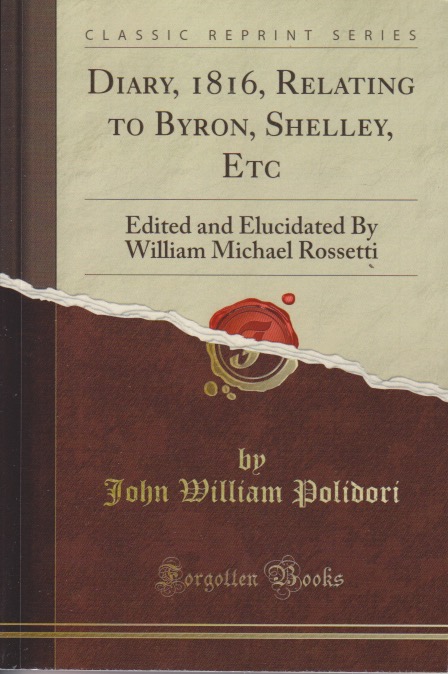
Before reading Lord Byron’s Doctor by Paul West, I started reading John William Polidori’s diary.   This is freely available online, but I need a book in my hands to truly read.  A little backstory: before his trip to Switzerland in 1816 with Lord Byron, the poet’s publisher paid Polidori to write this diary.  After Polidori died by suicide, his sister edited out what she thought reflected badly on the family, and destroyed the original.  The diary was published in 1911, edited by Polidori’s nephew William Michael Rossetti.  The edition I read was a reprint by Forgotten Books, containing the University of Toronto’s Library’s edition for scanning.  While not the most exciting reading, it is revealing.  Polidori appreciated the finer things in life (he qualified as a medical doctor), but he sometimes missed the point.  For example, being paid to write about Byron’s travels, his mentions of Bryon are relatively few.

You get the real sense that Polidori was jealous of the Lord with whom he traveled.  Then, when Percy Bysshe Shelley and his party arrived in the neighborhood, it becomes clear that Polidori was jealous of Byron’s attention to Shelley.  I sympathize with the author; both Byron and Shelley were already famous and infamous for their writing and lifestyles.  Both were from aristocratic families and had no profession other than writing and traveling.  For Polidori this was a working trip.  His mood seems to be reflected in that, just after the famous ghost story contest, entries begin to focus mostly outside the gathered writers until they stop altogether.  Much of the summer is left blank.  In September Byron sent Polidori packing, and the remainder of the diary is about his, often penurious, travels through his ancestral Italy.

Polidori is now known as the author of “The Vampyre,” which he wrote during the period covered in the diary.  He doesn’t talk about it much.  For me, Polidori is a sympathetic figure.  A lonely man, he was intimate with the most famous English poet of his day.  He often, however, in his own accounts, wasn’t in control of his emotions, particularly when he felt he’d been slighted.  Jealousy can be a very difficult monster with which to wrestle.  But reading this diary does lead to the uncanny sense that the most interesting parts were the things he didn’t discuss.  The diary has been used as the basis of more than one fictional treatment of the events of the summer of 1816.  And since some of the juicy bits are left out, free rein is given to the imagination.

Dr. P.

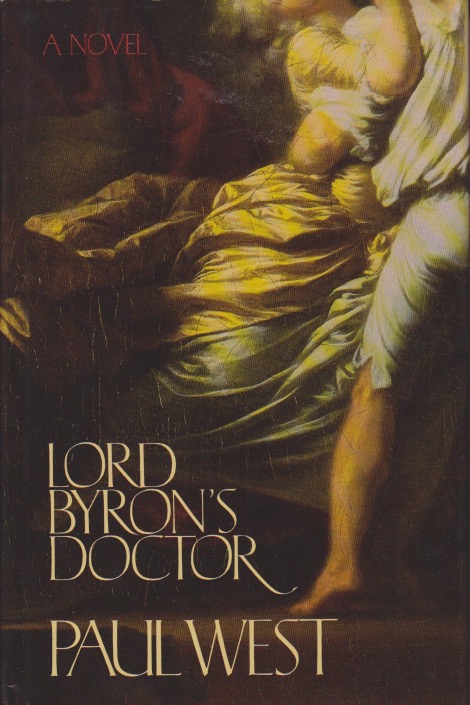
My recent fascination with the meeting of Lord Byron with Percy Shelley’s party in 1816 led me to read Paul West’s novel Lord Byron’s Doctor.  In case this meeting isn’t familiar to you, it involved five English travelers gathering for a few months outside Geneva.  Those present, beyond the two already named, were Mary Godwin, soon to be Mary Shelley, Claire Clairmont (her step-sister), and John William Polidori, who was, well, Lord Byron’s doctor.  Polidori, when not being completely overlooked, is a bit of an enigma.  He aspired to literary renown and produced a few works.  His most notable piece, “The Vampyre,” was initially attributed to Byron.  He wrote at least two plays and a novella, as well as some nonfiction.  He had been hired by Byron’s publisher to keep a diary of their travels, which, it turns out, leaves Byron out most of the time.

It’s clear from the historical sources that Polidori was quite jealous, both of Lord Byron and Percy Shelley.  They were both aristocratic and had achieved fame through their writing, but Polidori not so much.  He also seems to have been jealous that Shelley received Byron’s attention unstintingly.  Byron was a lord and Shelley the scion of an aristocratic family.  Polidori, while not exactly what we’d call “middle class” today, did not have nobility in his family and, perhaps worse  among the English in the period, he was half Italian.  Paul West takes the story of Polidori and tries to flesh it out.  I haven’t read any other of West’s works, but given this novel I’m unlikely to.  He does do a good job of probing the inner feelings of being left out and excluded from what one really wants to do with one’s life.  (Some of us know this firsthand.)  He overdraws, however, just about everything.

For anyone with an idea of what happened among the English party that summer, and the fact that Byron dismissed Polidori when the summer was over, the basic shape of this narrative will be familiar.  As an extended character study it seems to do passably well.  Some of us, however, find trying to think like someone else might have a bit of a fatuous fictional folly.  My mental image of Polidori, apart from the feeling left out part, is quite different.  In other words, attempting this kind of novel is sure to put some readers off from the start.  I gave it a good faith effort.  Some parts of it I enjoyed.  The whole, however, felt tedious and too long.  It may, however, give some readers a sense of who Polidori might have been.


The Vampire’s Father

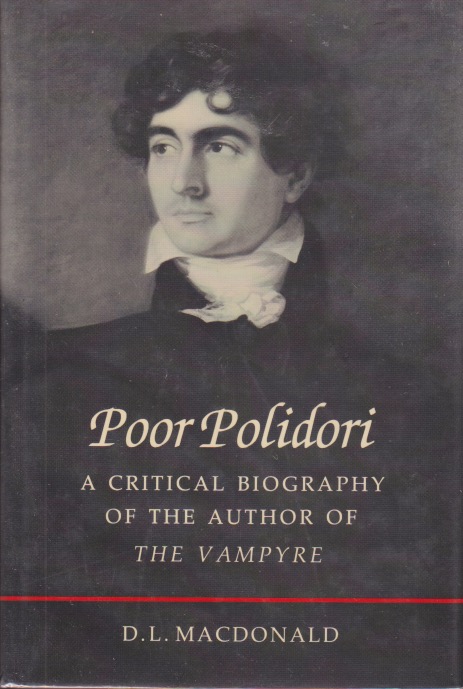
I’d been very curious about D. L. Macdonald’s Poor Polidori for several years.  This is not an easy book to find.  (I have noted before that I find university press book pricing illogical and unconscionable.)  John William Polidori was, as the subtitle states, the man who wrote “The Vampyre,” treated sometimes as a novel, at other times a short story.  Polidori, apart from being treated as a fictional character, is a difficult man to get to know.  This critical biography contains much useful information.  There are sections, however—and probably the reason for the pricing—, that interest only scholars of literature looking to find an exegesis of works of Lord Byron and Polidori himself.  My curiosity about him derives from the fact that “The Vampyre” was a very influential story and yet its author is somewhat consistently considered insignificant.  This seems to have predated his association with Byron; Macdonald points a finger at his father.

So who was Polidori?  Born in England of an Italian father and English mother, he was raised with literary aspirations but his father (who was a writer) had other plans for him.  Catholic in a period of strongly Protestant sentiments, John was sent to Catholic school and considered the priesthood.  His father eventually sent him to Edinburgh University to become a medical doctor.  Clearly this wasn’t John’s interest, but he complied.  Finishing his qualifications, he found setting up practice difficult because of both his foreign-sounding name and his Catholicism.  Lord Byron, about to exile himself from England because of scandals, wanted a personal doctor and settled on Polidori.  He knew of Polidori’s literary ambitions and frequently belittled them.  Polidori was present in the summer of 1816 when Percy and Mary (soon to be) Shelley visited Lord Byron along with Claire Claremont, Mary’s half-sister pregnant with Byron’s child.

Famously, the group read ghost stories and at Byron’s suggestion each started writing their own.  Byron’s fragment led to an idea Polidori later wrote out, after Byron had dismissed him, as “The Vampyre.”  Mary Shelley’s story, of course, everybody knows.  “The Vampyre” was published without Polidori’s knowledge and was attributed to Byron.  Even Goethe read it and thought it Byron’s best work.  Polidori was eventually credited with the story and tried to make a living as a writer.  He produced other works, but no real success.  He decided to become a lawyer.  Unable to establish his independence from his father, he died at 25 by ingesting prussic acid.  Even during his life, which was quite interesting, he was called “Poor Polidori” by more than one acquaintance.  His literary output isn’t bad, according to critics.  To me, he’s a kind of patron saint of those who would write but who are overshadowed by Byrons and Shelleys.