Resurrectionists

“Resurrectionists” was the name given to those who supplied the black market for human bodies when medical science had scant access, back in the eighteenth and nineteenth centuries.  They’d rob graves, and sometimes kill their own victims, for the money medical schools paid for cadavers.  It’s just business, some would say, I suppose.  It was illegal, however, and carried its own death penalty at times, if a resurrectionist were caught.  I was surprised to learn that somehow the United States has learned to do large scale resurrection.  Clergy, hang up your stoles—the government’s got it covered!  I discovered this in the most unlikely of places, the World Health Organization’s daily situation reports.

Like many people I wonder when COVID the 19th’s reign of terror will end.  I don’t trust anything that comes out of the White House, so I look to WHO.  The daily situation reports give the recorded number of cases of the virus, which, despite progress, keep going up.  The US, as always, is the world leader.  In addition to giving the number of cases, the website also records the numbers of deaths.  This is a sad and sobering statistic.  Additionally, it informs reader of how many new cases and how many new deaths have been recorded in the last 24 hours.  Here’s where I learned of our godly ability.  On Tuesday the number of new deaths in the United States was -1696.  This represents a mass resurrection indeed.  If only we’d share the knowledge with the rest of the world.
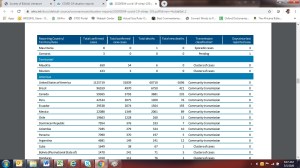
Here’s the insidious nature of statistics and governments who abuse them.  Stalin famously noted that one death was a tragedy but a million deaths are a statistic.  The US isn’t the only nation to play with the numbers—we’re all just statistics after all—but it is a matter of record that the Trump administration wouldn’t let the Diamond Princess land, although in American waters, because it didn’t want those cases listed as part of our stats.  So it still stands.  They are listed, of all the nations of the world, as “Other.”  Lest there be any doubt, the Tuesday WHO situation report ended with a note that American authorities “retro-adjusted” the figures.  You’d think that we’d want to announce with trumpet blast that we’d figured a way of retro-adjusting 1696 deaths.  For those of us listed as non-essential employees this is perhaps meant as a ray of hope.  Our work may be just icing, and we may be a single digit in our uncaring government’s eyes, but we can be brought back from the dead by political fiat.



Watch, and Pray

Religion is a lucrative business. There is likely a deep, evolutionary urge for fair play nestled somewhere in primate DNA. Monkeys and apes seem concerned about it, and certainly nothing gets people more upset than a cheater who does prosper (unless he, less often she, is the protagonist of some gangster movie). Most of us work pretty hard to make a living, often doing tasks that push us beyond our comfort range in order to ensure some kind of success. The same is true of clergy. Yes, stories of lazy or lackadaisical ministers abound, but many work long hours under often stressful conditions. Most are not paid very well. Their eyes, according to unwritten writ, are turned toward a larger prize. In an economy that has become a nearly universal capitalism, everything has a price. People want to feel that they are pleasing God but there are oh so many rules and regulations! The Hebrew Bible alone has 613, and then add the Christian Scriptures and two millennia of ecclesiological dogmatism and you’ve got one hefty bill. We don’t mind paying a bit of that for a religious specialist to take care of the details while we get on with the real business of life.

Now add a little math. How many people does it take to add up to a small fortune? Already by the Middle Ages the Catholic Church, really the only show in town across Europe, had amassed a real treasury. Although individually the clergy could claim to own nothing, collectively they were flush. Even today the wealth (and therefore power) of the Vatican is nearly beyond comprehension. A colleague recently pointed me to a story I had missed back in April. This involved the computer age and lucre in an unexpected place. Russian Orthodox Patriarch Kirill I was photographed sitting at a high-gloss table, wearing a Breguet watch valued at $30,000. There was an outcry. The Russian Church, long under the pressure of a communist state, could hardly be described as opulent. Well, liturgical vestments and accouterments are expected to be costly, but personal items such as watches, are expected to be modest. Thirty-thousand dollars is a lot of money to be reminded of when to show up for mass.

In response, some church leaders turned to technology for a solution. The watch was Photoshopped out of the picture and, as if a miracle, the scandal disappeared! Except they forgot the glossy tabletop—the reflection of the watch, like Dorian Gray’s portrait, remained as evidence. (The story may be found here, along with the damning photos, if you can stand the snarky writing.) Owning such a watch may be considered bad form among the humble clergy, hiding it, however, is even worse. I don’t mean to single out Patriarch Kirill—the Russians have had a pretty rough go of it, what with Stalin and Reagan and all—but religions seldom like to have their coffers examined. The laity will pay handsomely to avoid the extra work salvation demands. Herein lies the rub: salvation has become less tangible as material wealth has expanded. Many people have mistaken one for the other. It’s just that they don’t want to get caught enjoying a little too much of the one at the expense of the other.

Now watch this, for time is fleeting


One Percent Solution

A colleague just pointed out an article in Vanity Fair that should be required reading for all Americans and it should be offered with a generous quaff of nepenthe. Please pardon any excess indignation you may find in today’s post. Whenever I’m teaching my course on the Hebrew Prophets I tend to get swept into the spirit of their oracular outrage. The latest statistics reveal that 40 percent of American income goes to only 1 percent of the population. Despite protests to the contrary, wealth does not trickle down like milk and honey (even though the latter takes its sweet time). The disparity between the ultra-wealthy and the middle class, as suggested by the article, has its closest analogues in Russia and Iran. Once the top is reached all political systems begin to look the same. Even President Obama’s budget will continue the legacy of tax cuts to the wealthy.

Where is the outrage? Americans are among the most complacent people in the world. Kept at the cusp of sufficiency, most people will not complain. Louis XVI himself could waltz into congress and be heartily greeted by his peers. All things being equal, if we the bottom 99 percent have enough then complaint is only sour grapes. All things being equal, however, is always hypothetical. All things are not equal. While many hard-working people are caught in a cycle of diminishing returns the bloated oligarchs help themselves to performance bonuses lofty enough to support hundreds of suffering families for a year. “Let them eat fake,” one can almost hear them say.

In the idealistic world of the Bible a pipe-dream was touted. Wealth itself is not evil, but it comes with an obligation. Trickle-down is a dried wadi in summertime. The wealthy are obligated to make certain that their fellow citizens all have enough. No one gets two houses before everyone has one. Once this level of fairness is reached, go ahead and get stinking rich. But that principle has never been realized. Those who have always require more. From those in such stratospheric positions magnanimity cannot be expected; for others to benefit some of their astronomic wealth must be taken. What are taxes for? Josef Stalin is laughing in his grave and shaking hearty hands with P. T. Barnum. They share a cigar and neither one of them need speak the motto they both know to be as true as the gospel.

Trickle-down economics