Paranormal Pilgrimages

Although the Allegheny Mountains are hardly the Rockies—they’re much older and gentler on the eye—they harbor many tourist locations.  Even before my daughter attended Binghamton University, I’d been drawn to the natural beauty of upstate New York.  Prior to when college changed everything, we used to take two family car trips a year, predictably on Memorial and Labor day weekends, when the weather wasn’t extreme and you had a day off work to put on a few miles.  One year we decided to go to Sam’s Point Preserve (actually part of Minnewaska State Park) near Cragsmoor, New York.  It features panoramic views, a few ice caves, and, as we learned, huckleberries.  What my innocent family didn’t suspect is that I’d been inspired to this location suggestion by the proximity of Pine Bush.

A friend just pointed me to an article on Smithsonian.com by my colleague Joseph Laycock.  Titled “A Search for Mysteries and Monsters in Small Town America,” Laycock’s article discusses how monster pilgrimages share features with nascent religion.  People report strange encounters with all kinds of creatures and objects, and science routinely dismisses them.  Odd encounters, however, leave lasting impressions—you probably remember the weird things that have happened to you better than the ordinary—and many towns establish festivals or businesses associated with these paranormal events.  Laycock has a solid record of publishing academic books on such things and this article was a fun and thoughtful piece.  But what has it to do with Pine Bush?

Although it’s now been removed from the town’s Wikipedia page, in the mid 1980s through the ‘90s Pine Bush was one of the UFO hot spots of America.  Almost nightly sightings were recorded, and the paranormal pilgrims grew so intense that local police began enforcing parking violations on rural roads where people had come to see something extraordinary.  By the time we got to Pine Bush, however, the phenomena had faded.  There was still a UFO café, but no sign of the pilgrims.  I can’t stay up too late any more, so if something flew overhead that night, I wasn’t awake to see it.  Like Dr. Laycock, I travel to such places with a sense of wonder.  I may not see anything, but something strange passed this way and I want to be where it happened.  This is the dynamic of pilgrimage.  Nearly all religions recognize the validity of the practice.  It has long been my contention, frequently spelled out on this blog, that monsters are religious creatures.  They bring the supernatural back to a dull, capitalist, materialistic world.  And for that we should be grateful.   Even if it’s a little strange.

Modern Vampires

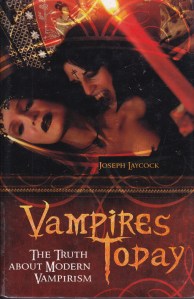
VampiresTodaySometimes I feel guilty. A grown man reading about vampires? Then I think of such puerile things as television and the stock market over which other adults waste their time and my pituitary gland releases endorphins and I carry on. I must say, however, after reading Joseph Laycock’s Vampires Today: The Truth about Modern Vampirism, that I’m not a vampire. Nor have I ever wanted to be. I am fascinated by the idea, however. The more I read—as is the case with most good academic books—the more I questioned definitions. Laycock does a good deal of that questioning himself in this book, and I came away wondering what indeed defines a vampire? As a child it seemed pretty clear. The vampire was a blood-sucker who came out at night. Fangs, a thirst for blood, and a faded aristocracy seemed to be the essential characteristics. But I was only a child.

Before you get the wrong idea about Laycock’s book, I need to say that his is a serious study of modern day vampires. Yes, they exist. No, they’re not easy to define. As an academically trained scholar of religion, Laycock is keenly aware that self-definition is crucial to categorization. Religious believers self-identify. We have no way of categorizing an adult (and some would say no way at all of children) without their own affirmation of what they believe. Vampires Today, however, raises the pointy question of whether those who self-identify as vampires constitute a religion. Or if vampire communities may be considered religious groups. In case you’re confused: many people identify themselves as vampires—sanguinarian and/or psychic. They believe they require the life energy of others to live and prevent illness. They sometimes drink blood—with permission—or siphon the life force of other people. Like all adults, they should be treated as self-identified. Probably not, as Laycock carefully spells out, a religion.

As in his other books, Laycock takes seriously groups that would, based on numbers alone, be considered fringe. Nevertheless, these groups are a part—sometimes an influential part—of larger society. We live in a world where we’re authoritatively told there is nothing but matter and energy, and as biological beings our purpose is reproductive success and then death. Is it any wonder that vampires and others are seeking something more? I’m no vampire. I read the occasional, thoroughly pulp, Dark Shadows novel to recapture a little of that after-school wonder I felt watching the waves pounding on the Maine cliffs while Barnabas Collins lurked inside. And he bore a strange truth that was perhaps instilled in those young years. Age is only partially a biological matter. Defining it any other way is, I have to believe, immature. So I read about vampires and wonder.


Call for Papers

The following is a call for papers from my colleague Dr. Joseph Laycock. Anyone interested and qualified, please contact him directly:

Dear Colleagues

I have recently been given the privilege of guest editing a special
issue of Nova Religio on the paranormal. In the last few years,
several good books have appeared that consider so-called “paranormal”
beliefs, discourses, and experiences as an object of inquiry for
religion scholars. Like the category “religion,” the category
“paranormal” is poorly circumscribed and may potentially include a
wide milieu of supernatural and pseudo-scientific beliefs and ideas.
We seek papers that address the place of paranormal discourses within
the larger context of religious and cultural studies. We also invite
papers on religious aspects of specific paranormal discourses such as
UFOs, psychics, hauntings, etc.

Submission Guidelines
Potential authors should first review Nova Religio’s website to get a
sense of the aim and scope of the journal. Authors should follow the
guidelines for authors on the website for the format of the paper and
its citations.

Submission queries, including abstracts, should be sent to Joseph
Laycock: jlay@bu.edu. Completed articles are due August 1, 2012, and
should be approximately 8,000-10,000 words including all documentation
and critical apparatus. As the guest editor, I will make the initial
determination about which papers are suitable for publication, and
work with authors to improve their draft papers before forwarding them
to Nova Religio’s co-general editors. The co-general editors, Eugene
Gallagher, Joel Tishken, and Catherine Wessinger, will make the final
decision about whether or not a paper can be accepted for publication
in Nova Religio.