Made of Clay

golemInvestigating a new field, at least on an academic level, involves a little disorientation. Part of this derives from the fact that academics didn’t use to write about monsters. Another part of it, however, is that those who do such writing have been doing so while my attention was elsewhere. It’s not easy to learn dead languages reasonably well. I didn’t pay much mind to the golem, being as it is, a “modern” monster. Probably responding to early modern pogroms, the golem was considered a defender of persecuted Jews. He was, however, a mindless defender. Made of animated clay, the golem was brought to life by magic and could only be killed in the same kind. Maya Barzilai has written a masterful account of how this monster relates to war. Golem: Modern Wars and Their Monsters explores how modern golem stories (and there are many) tend to relate to situations of conflict.

I had read about the golem before, and had trouble locating many academic resources on the creature. Barzilai demonstrates how much there is to ponder. It seemed, prior to reading her book, that the golem was mostly obscure, but it turns out that many writers, artists, and filmmakers have appropriated the clay giant over the years. Those who trace the history of comic books suggest that Superman was originally a kind of golem figure. I hadn’t realized that the golem had his own short-lived comic book series. When a people are persecuted repeatedly, having a secret weapon may not seem a bad thing. But the golem is difficult to control. It rampages. It can kill the innocent. Barzilai raises the question of whether a people with an unstoppable weapon are ever justified in using violence.

That question hangs pregnantly over the present day. The rich white men that run this country feel that they’ve been oppressed. Not willing to admit that it’s morally reprehensible to treat women as objects (they’re “hosts,” we’re told), blacks as inferiors, or hispanics as illegal, they bluster away about family values that aren’t consistent with anything other than threatening those who are “different” into submission. And yes, the Jews are among those these white men scorn. I wonder where the golems have gone. It could be that, like those of us self-identified as pacifists, that those who know how to make golems simply can’t justify violence. Barzilai didn’t intend for this in her book, I’m sure. Still, each new era brings new perspectives to these monsters made of clay.

Possessed by Work

Now that I’m safely ensconced back in the daily work routine, I spend some time thinking of the scary movies I had time to watch during my “free time.” Well, I actually thought about them then, too, but I had so many other thoughts to write about that I kept putting it off. That, and the fact that some of the movies were about demonic possession and the juxtaposition of holidays and demons just didn’t seem to fit, kept me from expounding. Why watch such movies at all? It’s a fair question. I tend to think of it as part of a larger thought experiment—wondering what such movies might tell us about being human.

stanthony

A few weeks back I wrote about The Exorcism of Emily Rose, based on the true tragic story of a young woman who died after a prolonged exorcism. After that I watched The Last Exorcism, The Rite, and The Possession. (I’m such a cheerful guy, as you can see, and this may be why I inhabit an isolated cubicle at work.) This array of movies, held together by the common chord of the reality of demonic possession, also brought together the standard sociological division of Protestant, Catholic, and Jew. The Last Exorcism is a Protestant-based treatment of what is generally considered to be a Catholic subject. That connection is affirmed in The Rite. The Possession, however, gives us a Jewish demon and a rare representation of a Jewish exorcism (acted by Matisyahu, no less!). What emerges from watching all of these films together is that demons are an inter-denominational problem, even in a scientific world. Carl Sagan wrote about the demon-haunted world, and it continues to exist, it seems.

But these are movies we’re talking about. Not reality. Nevertheless, The Rite and The Possession are also said to be based on true stories. We do live in a mysterious world. Evolution has developed reasoning as a practical way of dealing with life in a complex ecosystem. It is a survival mechanism. So is emotion. We sometimes forget that both thought and feeling are necessary for survival in our corner of the universe. Neither one is an end in itself. We can’t quite figure out how these two features of the human brain work together. There are, in other words, some dark corners left in our psyches. I suspect that’s why I find such movies so interesting. They’re not my favorites, but they do serve to remind us of just how little we know. And that’s a scary thought, given how we’ve learned to possess this planet.


The Religion Code

People have strange ideas about what religion can and cannot do. Yes, many religions face the past—founders of various sorts gave dictates and statutes that were appropriate for all time. At their time. Few religious visionaries can see very far into the future, so their rules have to be massaged over time. When we see an Amish buggy clopping along next to a highway we suppose that this is a religion mired in the past, but we could be wrong. The BBC ran a story the other day expressing some surprise at “ultra-Orthodox Jews” and their getting into tech fields. What hath the Talmud to do with coding? Stop and think about that.

One of the aspects of this dynamic unaddressed by this story is how unescapable the internet has made learning tech. Your religion may have you following outdated principles at home, but unless your community can get on without the outside world, like the Amish, you’ll need to learn to negotiate technology. As the article points out, learning Torah and Talmud are transferrable skills. People genuinely seem surprised when what we might broadly call “the humanities” come in handy. Religion, when it requires serious reflection, builds critical thinking skills. It is only the blind adherence to principles that haven’t been thought through that leads to trouble. Even a Fundamentalist knows that this all has to make some kind of sense or something’s wrong. In fact, the article doesn’t suggest that a Fundie as a tech expert would be any cause for wonder. A humanities education might have helped with that.

Photo credit: Musée d'art et d'histoire du Judaïsme, Wikimedia Commons

Photo credit: Musée d’art et d’histoire du Judaïsme, Wikimedia Commons

One can’t speak of Judaism as a monolithic religion. In fact, religion scholars regularly speak of “Judaisms” just as they speak of “Christianities.” The various branches of Judaism hold study of scriptures in common, and the BBC article makes the point that this kind of thinking helps with problem solving. The great irony here is that when the problem solving comes in the form of getting computer glitches worked out it is considered valuable. When the problem solving merely helps people figure out how to get along in the world it is backward and parochial. Such is the strangeness of a world impressed by its own creation. The internet has brought a great many religions together. It has, I would suggest, created new religions as well. It is a myth to suppose that the rational rules of any hypertext markup language are that different than sages and rabbis arguing over the best way to make progress in a confusing world. No matter what our religion, we all need to make money, don’t we? And isn’t that the most truly ecumenical enterprise of them all?


Holy Girdles

Religions, it seems, come in belts. Or at least elements of religions do. Although we may not all agree on what constitutes the “Bible Belt” we all have a pretty good idea that it includes several southern states, and parts of the Midwest. It doesn’t really resemble a belt that I can tell, but its convenience and assonance keep the phrase alive. Over this past weekend I was in the “Borscht Belt.” I’d heard the term before, but had no idea where this supposed belt was, or, indeed, why it was called this. Historically, three counties in the southern Catskills, so I learned, were attractive locations for summer homes for Jewish families from New York City. All within a easy day’s drive of Gotham, they provided the low mountain, resort feel of much of New York State and Pennsylvania. According to Wikipedia (surprisingly, I had no books on the Borscht Belt in my library) this designation is less descriptive now than it had been, back in the day.

BorschtBelt2

One of the immediately obvious features of the region, at least as recently as last weekend, were the number of orthodox Jews walking beside the roadways throughout these counties. I’m using “orthodox” here not as a technical term since I have difficulty identifying the different brands of conservative Jewish belief (there I go again!). Another obvious indicator was the number of billboards written in Hebrew. Just a hundred miles down the road west and these markers tend to disappear. By the time you reach the central part of “the southern tier” you come back to what was once called “the Burnt Over District” from the “Second Great Awakening.” Distinctively Christian in orientation. Religion is endemic in these hills.

The internet tells me that the Borscht Belt began to unbuckle with the relative ease of air travel. I have many Jewish colleagues who pop over to Israel on a fairly frequent basis. I suppose the Catskills just don’t compare with the Holy Land. Further south, along this same rocky spine, you come to the Poconos. I grew up hearing about this vacation paradise in my own state, but, like the Catskills, the region has been largely abandoned for higher mountains, bigger thrills. Having grown up in the foothills to the Appalachians, I learned in school that these are ancient mountains. Old ways are naturally preserved here. The religion I grew up in was old-time, for sure. There’s an agelessness to these weathered hills that seems to invite those with old religions to form enclaves and imagine that little has changed, despite what Wikipedia might say. And maybe it’s time to get a bigger belt, since conservative religion seems to be growing rather than shrinking.


Freezes Over

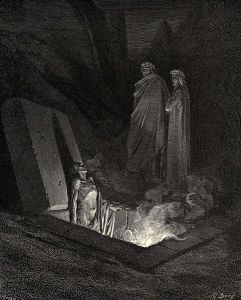
A good metaphor gone bad can do a lot of damage. Like a loose cannon. Hell is a bad neighborhood for metaphors. Taken literally Hell can be hell. So it is that many evangelical Christians are abandoning the concept. Jumping ship on the Manichean outlook that has policed bad behavior for two millennia now. A recent article on National Geographic by Mark Strauss discusses why many leading conservatives are now casting Hell into the pit and looking for ways to make God look better. Like many metaphors, Hell best resides in a world of black and white. A dualistic world where there are no shades of gray (certainly less than fifty of them). A world where any behavior can be understood as good or bad, forward or retrograde, never neutral. You’re either for us or against us. There’s no Switzerland in this geography. That’s precisely why so many people want to keep Hell on a leash.

Dore_woodcut_Divine_Comedy_01

Hell probably never would’ve become such a motivator for good had Jesus not mentioned it. Prior to its encounter with Zoroastrian beliefs, Judaism held that the dead quietly resided in Sheol, a dreary place, true, but hardly fiery real estate. You worked out justice here on earth because that was the only chance you had. The dead were sleepier than early morning commuters and they received neither rewards or punishments. It was a much more egalitarian view of things. The dualistic Zoroastrians saw paradise and torment as a great image to explain evil in the world. The sorting takes place after this life is over. Jesus used such language as well, and the image became canonical.

Evangelicals are now starting to think through the implications of all this. A God with the kinds of anger issues that condemn people literally forever might be problematic. Sure, we may get angry at our enemies, but only the most truly heartless person has no pity on their suffering. What does it say about God if his anger lasts for eternity? Some, therefore, are trying to put the metaphor back into Hell without losing the strict divisions for which the good news crowd is famous. Instead of full-time Hell, perhaps there’s part-time Hell with time for repentance. Or simple annihilation. Metaphors lose their power when they come to be taken literally. Hell is such a loose canon. Doctrine among the doctrinaire is often non-negotiable. Although some may try, as a whole, the fires of Hell can never be extinguished. At least to those who understand figures of speech as statements of fact.


Comic Culture

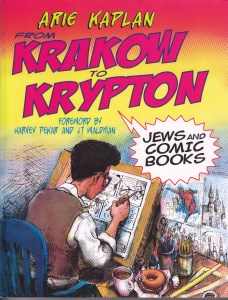
KrakowKryptonPerhaps the most obvious deviancy in my otherwise conservative childhood was MAD Magazine. I honestly suspect my parents didn’t know that it wasn’t just another comic book. I read it—like I read everything—religiously, and I was fluent enough in the lingo to discuss it intelligently with my sixth-grade teacher, a fellow fan. Having made that admission, my reading of comic books was muted since we lived in a town with no literary aspirations or conveniences. There was no book store, or even magazine shop, let alone a public library. We were one of the towns Carnegie left behind. Still, I was draw to MAD contributor Arie Kaplan’s From Krakow to Krypton: Jews and Comic Books. Over the past few years I’ve been reading academic treatments of comics as, with my beloved monsters, the high-brow academy has come to view low-brow as “culture.” (I learned the term “high-brow” from MAD, by the way.) As I grew into an Episcopalian, I tended to leave these markers of my shameful past behind, but now I’ve come once again to embrace them.

One of the odd things I’ve noticed about Jewish (and other “outsider”) analyses is just how deeply felt the anti-semitism of our culture is. This always strikes me as odd as, although it is hard to believe, I was raised to be non-prejudicial toward anyone else. (Poor folk are often that way; we know our place, beneath others.) I never felt superior to Jews, African Americans, or women. I was in awe of them. Maybe MAD helped. As Kaplan points out in his treatment, much of the comic industry was Jewish in origin because so many Jews were kept out of other businesses in New York. (Well, there is Diamond District, but let’s stick to publishing.) With few options, poor immigrant kids turned to cartoons. As a child in a humble household I often took out my frustrations by making my own comic books. I can understand the catharsis.

With the current glut of superhero movies, it may be hard to imagine a time when comic books and their denizens were considered utter foolishness. Now they’re big money. It’s not so much that the mighty have fallen than it is the humble have been exalted. I haven’t really read comic books since I was maybe fourteen. Up to that point, however, they got me through many a difficult time with the belief that there was someone out there watching over me. No superheroes ever delivered me from my troubles, but belief was sometimes all I needed. I can understand why those who are discriminated against would turn to this medium for release. Faith and fantasy share more than an opening syllable, for those with eyes to see.


Come Sail Oy Vey

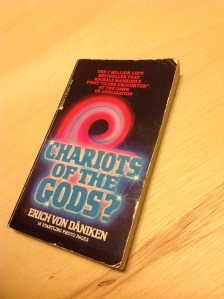
Nothing says unorthodox like a headline that reads “Smart Jews? Thank the Extraterrestrials.” Breaking Israel News ran the story recently and, being constitutionally unable to pass up anything so strange, I had to take a look. The article, by Adam Eliyahu Berkowitz, is really just a half-century retrospective of Erich von Däniken’s Chariots of the Gods?. I remember fifty years ago—not well, mind you, I was only three—but even when I was a teenager and the book had its second (of many ordinal) gasp(s), and a movie came out. People, even those not traditionally labeled as “crazy,” flocked to theaters to see it. The book went through multiple printings. The era of “ancient astronauts” was born. Von Däniken, it seems, is alive and if not exactly kicking, still making people uncomfortable.

IMG_0038

In this news story von Däniken suggests that Jews are more intelligent because of their alien DNA. Don’t quote me on this, but I’m pretty sure that was the plot line of the X-Files season 10. Isn’t Fox Mulder Jewish? Maybe I’m getting myself mixed up in some kind of plot here. I have to admit, however, to having a touch of nostalgia for Chariots of the Gods?. There was a kind of innocence to it. Nobody seemed to be inseminating anyone else, or stealing babies. It was good, clean fun.

Something bothers me, however, about the assertion that aliens are, indirectly perhaps, responsible for holy writ. I remember thinking through the implications of this idea (already floated four decades ago) that God might be more Captain Kirk than Jesus Christ. It is inherently disturbing. Especially when von Däniken says in the interview that the Jews are the chosen people, but they just got the chooser wrong. ET instead of I AM. The really interesting part is that ancient astronauts have become a somewhat accepted cultural trope. I don’t know whether they were there or not (I wasn’t around at the time), but they sure do make Saturday afternoons much more interesting. One wish I hold is that people writing about this old idea might find a new opening bit. Ezekiel seeing the wheel has been done to death. Surely a bit of creative thought might suggest a new, undiscovered ancient truth.


Religious Laughter

Reader’s Digest famously runs a feature, “Laughter: the Best Medicine.” I’m not a Reader’s Digest reader, and I’ve generally only seen it on coffee tables and bathroom cabinets of friends. Still, that’s the feature to which I always find myself turning. The jokes, this being Reader’s Digest, are always inoffensive. Safe subjects that are nevertheless funny. Usually. As adults we come to know that the taboo subjects of childhood are often the funniest. Off-color jokes about sex or religion, sometimes both together, elicit the most boisterous laughs. We don’t use them, however, because someone will surely be offended.

A recent article in The Guardian by Gary Sinyor raises the question of religious humor. Sinyor, who is Jewish, wrote a comedy play called “NotMoses.” As he farmed the idea and advertising around to advisors and friends, he was warned how he might be putting his life on the line for his humor. Reflecting on this, he comes to the conclusion—spot on, in my opinion—that the religions that don’t laugh at themselves are somehow insecure. His parade example is Scientology, as humorless a religion as exists. As he points out, although widely banned, many Christians found Monty Python’s Life of Brian very funny indeed. Of course, some branches of Christianity weren’t, and still aren’t, laughing.

Photo credit: Richard from Canton, Wikipedia Commons

Photo credit: Richard from Canton, Wikipedia Commons

The world can be a humorless place. There is so much to worry about: the ill treatment of women, starvation, horrific diseases, Donald Trump. What right have we to laugh? I once had a close friend with cancer. Most would agree that this is no laughing matter. During treatment this friend lost all her hair and at one point another friend encouraged her to laugh about it if she could. “If there’s nothing you can do about it, you might as well laugh,” was the advice. In poor taste? Perhaps. Nevertheless, there was some truth to it. My friend recovered. The disease is not something she cares to talk about. Nevertheless, humor helped her get through it. The most serious things, in other words, sometimes cause us to laugh. Religious comedy, after all, is not laughing at religion, but at how seriously we take religion. There is a difference. And laughter can, even if I got it from Reader’s Digest, be very good medicine indeed.


Who’s God?

There shall be wars, and rumors of wars. The Bible says nothing about being able to declare what future people might have to say about God. According to a story on the Washington Post website, Larycia Hawkins, a political science professor, was suspended from Wheaton College for claiming that the God of Islam is the same as the Christian God. Administrators felt this was one of those cases where the famous statement of faith required of Wheaton faculty was violated. Seems to me the administration might want to sit in on a class in history of religions. Everyone knows that Wheaton takes great pride in its Evangelical heritage, bordering on a kind of extreme conservatism. Even so, this seems extreme.

There is much we don’t know about the early history of most religions. Probably one of the resons for this is that, apart from the founder, we’re never sure if a new religion will take off. Many religions have started and then quietly (or not so quietly) died away. At the earliest stages nobody really knows which way it might go. We do know that by about the time of the Exile, the early Jewish faith was fast becoming monotheistic. Christianity, although disputed by some, also followed in that mold, accepting the God of Jesus of Nazareth (himself a Jew) as the one God. Here many Evangelical histories grow a little weak when focus is shifted to Arabia. The cultural context that led to Islam involved a world of pantheistic worship, but Mohammad was well aware of, and appreciative of, Judaism and Christianity. Recognizing that his faith shared the same books as the other two, his understanding of Allah was clearly the same God as the one worshipped by the Jews and that Jesus had called “Father.” The three monotheistic religions of that region, historically, have always shared the same God.

IMG_2472

Disowning a deity, I suspect, comes with some anxiety. As Islam expanded and Christianity itself became an imperial religion, clashes were bound to happen. Invective included calling the enemies “pagan” or “infidel” (technically two separate things), and as so often happens, rhetoric became mistaken for fact. Since Islam and Christianity were different religions, so the thinking went, they must recognize different gods. Triumphalism is seldom subtle. Fact checking wasn’t so easy back in those days. Suspending a professor for stating the truth is, I fear, nothing new. Some schools require statements of faith so that they may ensure academic freedom is a myth. Ironically, they seldom have trouble with accreditation. The ideology of a war between religions offers a doleful prognosis for a world where religions really need to try to understand each other and where obvious historical facts should count for something.


What’s a Bible?

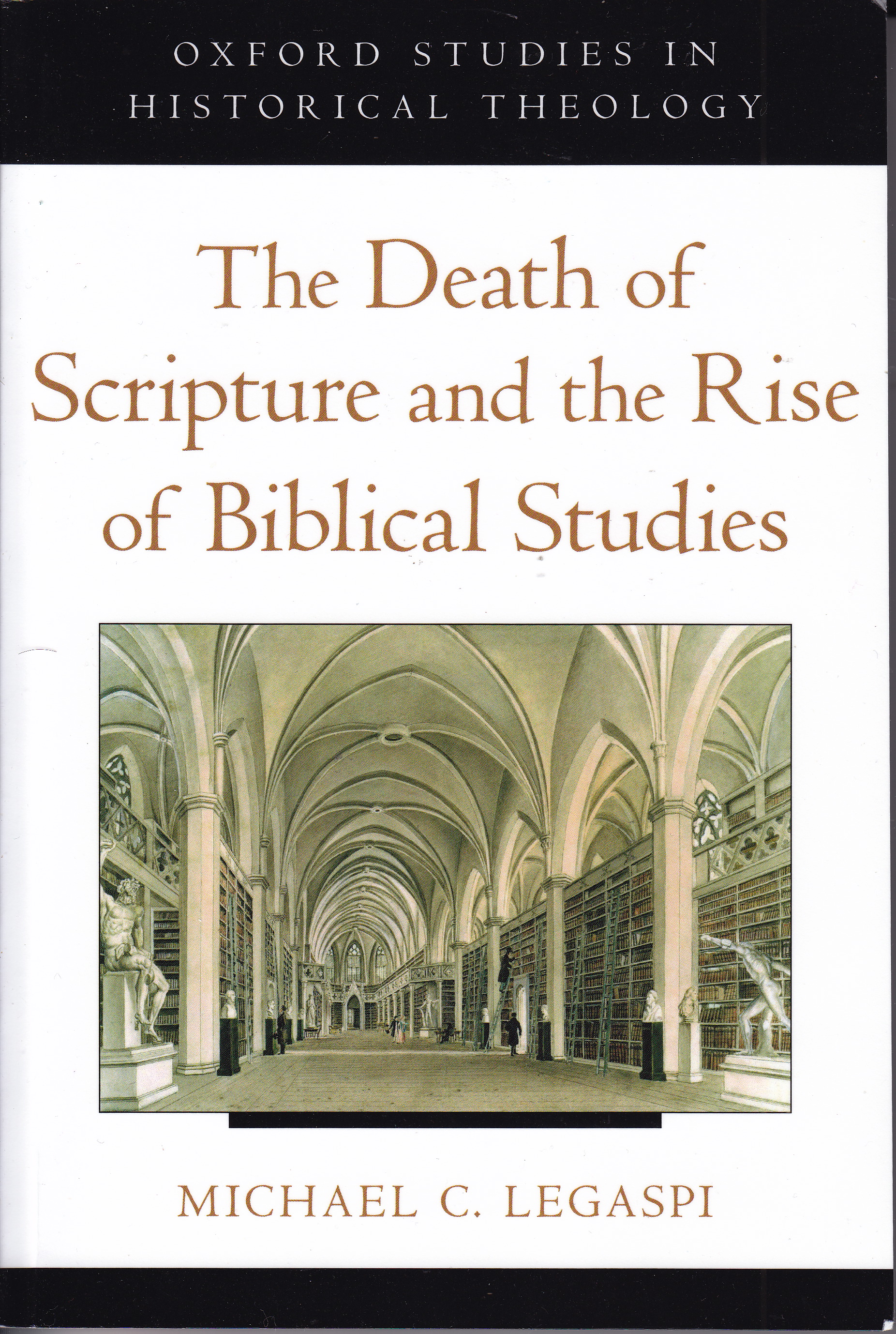
LegaspiWhat is the Bible? This might seem a strange question coming from someone who holds a doctorate in what has sometimes been characterized as biblical studies. Still, it is a valid question. The fact is, very different things are referenced by the word “Bible.” This is made abundantly clear in Michael C. Legaspi’s The Death of Scripture and the Rise of Biblical Studies. Legaspi points out that the Bible hasn’t always been the central force of Christian identification that it seems to have become. Martin Luther was largely (but not solely) responsible for the view that the Bible alone is sufficient for eternal well-being. Historically it had been much more complicated than that. The church had traditions and sacraments, Judaism had Talmud and rabbinic interpretation. The idea that the Bible alone was necessary was more radical than it might seem in today’s secular world. The problem was, the Bible isn’t an easy book to understand.

It has long been recognized that the Enlightenment and the Reformation went more or less together. The mysticism and mystery of “superstition” were bound to fade in the brilliance of pure reason. The Bible, however, still held a revered place, and it had to be studied. The sea change of the scriptural Bible to the academic Bible took place largely in Germany. No surprises there. What Legaspi demonstrates is that this study was closely bound with the university as an organ of the state. Germany didn’t boast the oldest universities in the eighteenth century, but it could claim the most intellectually rigorous. Among its biblical scholars, indeed, perhaps the one who led to the creation of the academic Bible, was Johann David Michaelis. The book is mostly about Michaelis and his influence and background in biblical studies. Clearly, applying university treatment to an ancient text was not going to be Sunday School.

By the time people like me began advanced study of the Bible, the “academic Bible” was about all there was. Many of us with serious training in the field watch in wonder as some (many) theologians take the Bible literally. They use ideas and concepts that biblical scholars have long recognized as artifacts of antique understanding. The problem is once you’ve gone down this path, there’s no going back. You can’t unlearn the academic Bible. So, what is the Bible? Obviously, it’s going to depend on who you ask, but it is clear that no one answer will satisfy all takers, even if they all claim to share a single faith. And should you venture to those hallowed halls of higher education, you’ll find the Bible is studied here, as are dinosaurs and an earth that is a few billion years old.


More Blessed to Give

Religions, we are told, are in violent opposition. There’s no denying that sometimes it’s true. It is a sad commentary on belief structures when one way of looking at the world only finds validation in the destruction of other perspectives. Despite all that, religions can, and do, reach beyond their parochial interest to assist others. Recently I mentioned a story in The Christian Century of an Islamic effort to raise funds to rebuild vandalized black churches in the US south. The idea of Muslims helping Christians reestablish their, by nature, heterodox teaching is, I believe, newsworthy. The most recent issue of The Christian Century has a story of a Jewish group in Israel raising funds to help repair a damaged church in the Holy Land. These two stories have made me wonder why we so seldom hear of Christian groups raising funds to help rebuild mosques or synagogues. Surely it must happen, but we, who rely on the mainstream media, so rarely read of Christians helping others that it becomes a surprise when they do. Is this reality or just what we’re taught to see?

Please don’t misunderstand—I’m not suggesting that Christians don’t help others. Indeed, one of the founding principles of the Christian movement was the care of others, be they pagan or orthodox. Still, in my own life I’ve experienced the heartless, cold treatment doled out by “conservative” groups who believe that maintaining their idiosyncratic view is the highest possible mark of faith. Well beyond reaching out a hand to those in need. Far and above the care of fellow human beings. This distortion of any kind of historical Christianity has become what the mainstream media presents as normal. Meanwhile, millions still attend church every week, trying, in some measure, to make the world a better place.

Carnegie-1903

This isn’t the same, all politics aside, as supporting Israel as a nation. Many Fundamentalist groups do. In fact, they insist that our national budget include aid for Israel. Not because they particularly care about the Jews. In some viewpoints, the end of the world cannot come without Israel regaining a status that some read into obscure Gospel passages and the book of Revelation. This is not the same as donating to rebuild a torched synagogue. It is worlds away from restoring a vandalized mosque. It is naive to suppose that there is one normative Christianity. Historians inform us that such a monolithic entity never has existed. Temples, synagogues, churches, mosques—these are all expressions of the deepest of human longings to find and be in communion with that which is beyond the everyday. Any religion can become radicalized. All, however, also have the potential to look beyond themselves. When they do it is newsworthy indeed.


Biblically Business

Bibles are business. I recently read that the first book of which Oxford University Press sold a million copies was the Scofield Bible. The Scofield is incredibly resilient to the advancement of scientific thought, and, although large print editions seem to be gaining, it is nevertheless an icon. Conservative Bibles still make good business sense. Still, the Bible originated in a rather more Catholic context. As Christianity was being born, and growing up, there were many sources of information on what it mean to be a member. Initially, being Jewish was a prerequisite. When that was dropped, you would have needed to be able to find an enclave. This wasn’t always the easiest thing to do since Roman emperors sometimes made a quasi-Olympic sport out of killing Christians. Once a church was found and joined, you just participated in the fellowship and listened to the leader. Reading from “Scripture” was likely part of worship services, but the Bible we recognize didn’t exist.

Well, parts of it did. Torah and Prophets were around. The Writings were written. Paul’s letters—several of which are still missing—were still circulating. The Gospels and Revelation would come somewhat later. About the fourth century there was general agreement about which books we meant when the word “Bible” was used. There was some fuzziness around the edges, though. Books like Tobit and Maccabees were accepted by the church, but had never been part of the Jewish canon. Judaism never officially closed its canon, so putting a limit around what would become the “Old Testament” was not as easy as saying it was just the “Jewish Bible.” No books have been added, of course, but nobody bothered to set the list in stone. Now Catholic Bibles, largely because of the counter-Reformation, included the Deutero-Canonical, or Apocryphal books. Protestants soundly rejected them. And Protestants were the champions of personal Bible reading.

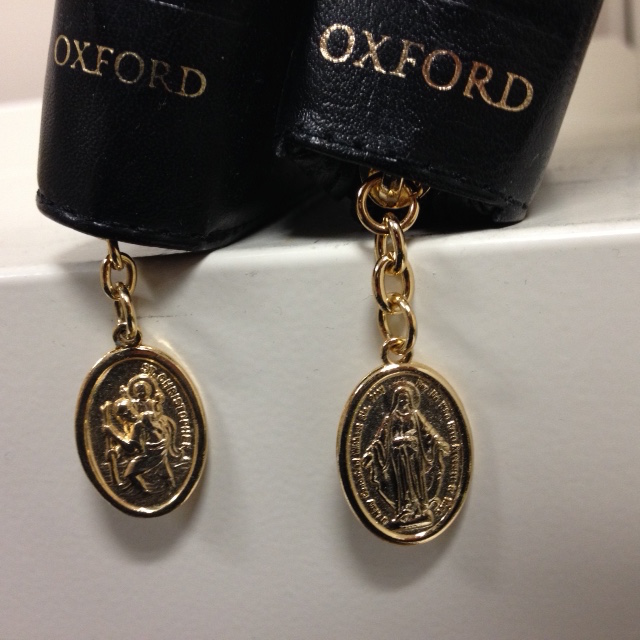
About the midpoint of last century, both Roman Catholicism and Judaism began to show a renewed interest in what had largely been a Protestant (and somewhat Teutonic) endeavor: critical study of the Bible. Bibles specifically directed toward these new readerships began to be produced. With metaphorical bells and whistles. The zipper Bible has always intrigued me. I never owned a zipper Bible. Once I had a zipper case, but never a zipper Bible. What was the message here: the word of the Almighty had to be protected? The other day I came across two zipper Bibles with saints’ medals as fobs. One was St. Christopher (who protects travelers) the other was for St. Mary (generally overall saint). These symbols of tradition interact with the more textual tradition that has come to be known as Bible. Religion is seldom monolithic, and even saints can watch over what is hidden by a zipper and regarded as the ultimate truth among those for whom Bibles are business.

IMG_2404


Growing Green

It was bound to happen sooner or later. I married into a family of singers, and when we gather at a cabin in the woods, singing breaks out. In the drought-tormented northwest, under an extreme fire ban, there was no campfire, but that doesn’t stop the music. Once campfire songs begin, “Green Grow the Rushes, O,” always appears. I’m no singer, but I spent a couple years as a camp counselor, and many years before that as a youth conference attendee in the United Methodist Church. I know the song by heart. Usually it is now a sign for the adult males to sneak back to the cabin rather than endure the twelve repeating verses. Nevertheless, the question invariably comes up: what do the words mean? We have a couple of lists, here and there, explaining the lyrics, but the fact is the origins and meaning of the carol are obscure. It’s origins appear to be England, but the countdown of twelve verses contain imagery that is Christian, Jewish, and pagan. Over time, many of the verses have, like most oral tradition, undergone corruption. In many respects, it is almost biblical.
While it might be fun to run down all the verses and discuss their potential meaning, that is a task best left to a day when I have my computer working again. With limited internet access and an iPhone from which to post, full-scale exegesis is a daunting task. One aspect of the song, in any case, is clear—it is generally accepted to be a Christian catechetical tool. Repetitive and, especially before adulthood, fun, the song rewards those with strong memories for such obscure phrases as “April rainers,” “symbols at your door,” and “bright shiners,” in the proper order. After the song is over the teaching begins.
I have a book of camp songs from my counseling days, and it suggests a hermeneutic key to the song. My wife studied musicology, and she provided a somewhat more authoritative source. Then, of course, there’s Wikipedia. On some of the verses there is a general consensus, but most are open for debate, with some seeming to point to pagan origins. Tied up with the fact that the song is, in some places, connected with Christmas, this blend of Jewish, pagan, and Christian ideas comes as no surprise. The age and origins of the song are unknown, but it features references to Greek deities, Jewish laws, and Christian miracle stories. Musicologists have had a crack at the song, and surely will examine it again. The strangeness of the lyrics suggest a mystery to explore. Some mysteries are still to be found around the campfires of the north woods on a summer’s night.


Work Weekend

It’s a Saturday and my wife’s at work. She’s worked five days already and will still be at work tomorrow. I’m lazing in bed until 5 a.m. when I hear the neighbor’s alarm clock from upstairs. An hour later I see him headed to his car, dressed for work. I think about the concept of weekend and how it apparently means nothing any more. Well, I’m not at work, so it must mean something, but it’s not what it used to be. Don’t get me wrong—when I was a professor I gladly worked through weekends. Indeed, I was working pretty much all the time. I was paid to be a thinker, and I can’t shut this thing in my head off. My current job, however, is a 9-to-5 with expectations of more, but not entailing any extra compensation. Overtime? You lucky one, you’re “exempt!” And don’t forget to take your laptop home, in case something comes up in the middle of the night. (I do read the timestamps on my emails.)

The weekend is a religious idea. Ideal, even. We have the biblical concept of the Sabbath to thank for our free Saturdays, when they come. Christian beliefs about resurrection to account for Sundays. Days originally set aside for worship. Time off work is worship now. When else will we get the laundry done? Groceries bought? Floors swept? I leave before six each day and arrive home near seven at night. To keep up my Manhattan lifestyle I have to awake before four and head to bed at eight. If I had an extra minute to access my memories I might think this a little odd. I used to have time to write books. Where did that go? Vacation time? You have to be at the airport two hours early so you can be frisked for a plane that’s inevitably late. You get five days off, and two will be spent traveling. Work waits for no one.

1912_Lawrence_Textile_Strike_1

I guess it’s no surprise that those who argue that we should abolish religion have jobs that either they love or that don’t require weekend hours. They have time to examine this gift horse minutely in the mouth. You know, we don’t have to have days off. In olden times, or even today on farms, the concept of a weekend is only academic. Those whose jobs are just work to keep an imprisoned soul in its weary body are, after all, expendable. Perhaps I’m just too weak. The occasional three-day weekend rejuvenates me to a degree that’s almost frightening. I wonder why we can’t add holy Fridays to our list of days to worship. There is a price to be paid for neglecting time to reflect. I can’t imagine Pharaohs and kings wanting to grant any more time off, however. We all know who we’re really working for, and it’s not the one who gave us our weekends in the first place.


Truly Educated

Binghamton University looms large in my consciousness, for rather obvious reasons. Although it sits in a small corner of upstate New York not particularly near anything famous, it has its own culture. Having taught at several schools, and having studied at many along the way, I’ve always been particularly struck by the genuine nature of Binghamton. For example, it is the only school—apart from a hazily recalled “Bible Study” led by the then president of Grove City College—at which the president has made himself available to be met and chatted with by hoi polloi. I’ve met and talked with him twice, and although I taught a phenomenal number of courses at Rutgers, and conveniently solved a crisis in the religion department for a year at the University of Wisconsin Oshkosh, I never found a time or place when the president was available to the likes of mere mortals. Not only that, but at a time when other universities are cutting whatever faculty they can to make more administrative posts, Binghamton is actually hiring faculty and expanding. I feel renewed when I visit the campus. You can tell they care about people.

A story in the Washington Post underscores this. One of the graduation speakers at the Watson School of Engineering is an Orthodox Jew. His commencement ceremony fell on Saturday—the sabbath. According to the dictates of his faith, speaking through a microphone system that passes through a soundboard is considered work, and could not be done on the sabbath. In today’s climate, I would expect most universities to say, “too bad.” Religion is not to be taken seriously, right? So just get over it. Here’s where Binghamton, however, shines. They taped the address beforehand, allowing the speaker to take the stage and have someone else broadcast his speech. This isn’t about picking apart the logicality of anyone’s personal Torah, it’s about recognizing the human.

DSCN4915

Our very religious society has a way of compartmentalizing religion so that we can still get away with what we want to do. We can be religious when our clergy so dictate, but otherwise we’re pretty much free to look out for number one. This story is one that makes me proud to have once been a part of a system that includes a school that can truly lay claim to the designation “higher education.” We learn about the world to become, ideally, better citizens of it. Any university that is able to take what might seem to be a petty problem and recognize its human dimension deserves to have our admiration. It restores my faith in the future. At least in a small corner of upstate New York.