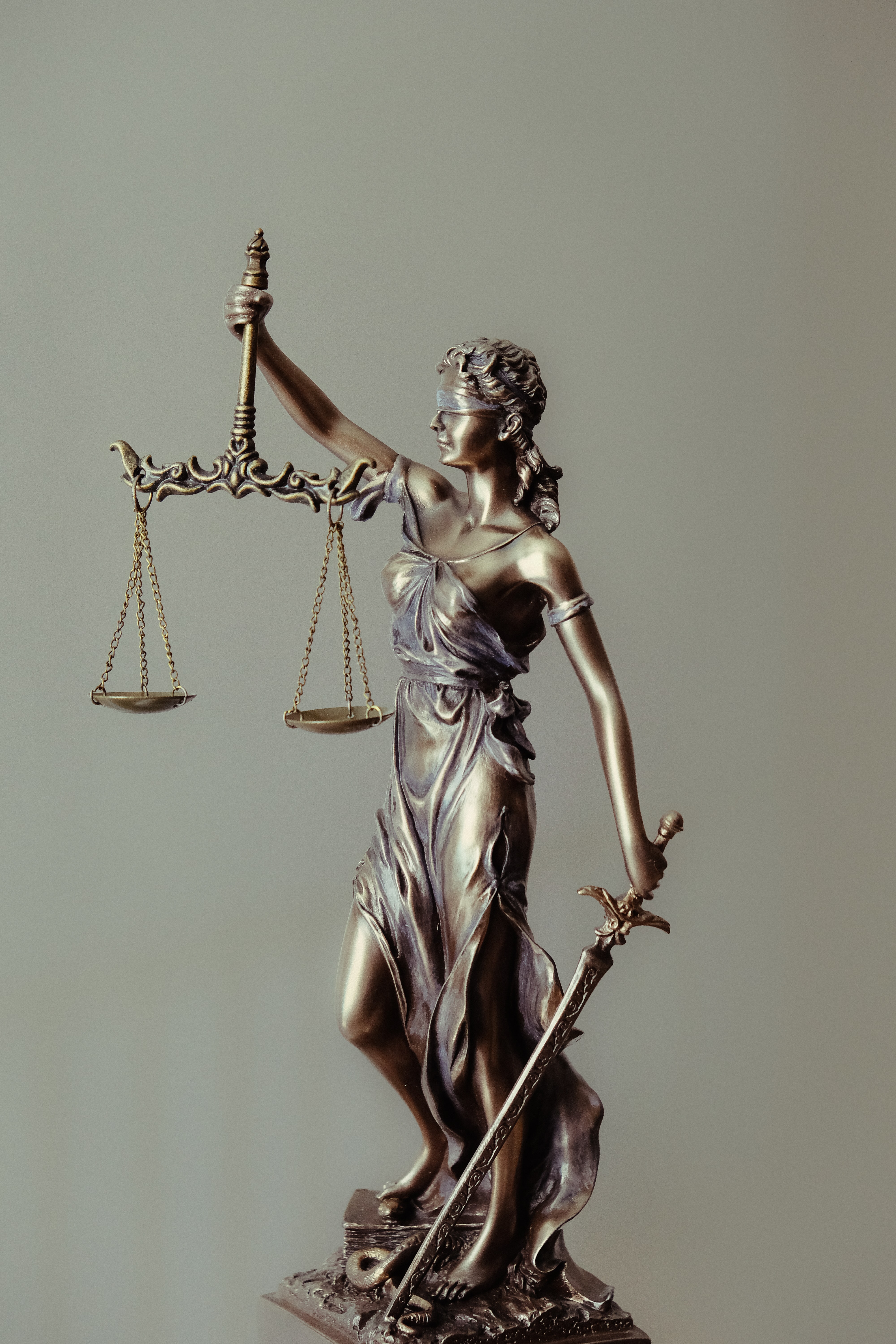
Just Justice

Like many people raised to believe in democracy, I’m distressed to see that the right wing, worldwide, has taken to a full-on attack against it in an effort to keep power.  In the United States Republicans that stood up against the cult of Trump (who was no architect, but a figurehead only) are now being run out of Dodge by their own party.  Meanwhile a friend in Britain sent me an article about the open and obvious corruption of Boris Johnson and how the Tories are completely overlooking it in an effort to keep “democratic authority.”  It wouldn’t be so bad if the right wing came right out and said “we want to run things, no matter what it takes,” but instead they appeal to religious ideas and try to make it seem like their side alone appeals to “justice” while doing the exact opposite.  Paging Mr. Orwell…

The best test case is Jesus.  Have you noticed how Jesus has fallen out of right-wing Christianity?  Apart from occasionally taking his name in vain, the principles they stand for generally go against the core teachings of the Gospels.  The fascism of the right wing has taken what good there was in Christianity and jettisoned the kernel to keep the shell.  It’s like a bag of pistachios where all the nuts have been discarded, leaving only the hard casings behind.  The really sad thing is that both in the US and in Britain, these power-mongers are in the minority.  They use political loop-holes to make their strong-arm tactics look like the will of the people.  Things like restricting voting access, made possible by courtroom politics.  Isn’t Justice supposed to be blindfolded?

We know for a fact that many of these same people are fully cognizant that fascism led to World War II.  They know Hitler used the same tactics to gain power.  They know that millions and millions of people died.  And now they trumpet the one thing that brought this nation together—the recognition that fascism was evil—as the way of true Christianity.  I’m sometimes asked if I believe in demons, having written a book on the subject.  Demons are, if you look closely, are considered the source of evil in the world.  Quite often stories about them have them possessing good people by pretending to be something that they’re not.  Can demons take over entire political causes?  Did we not see naked evil in the Nazi regime?  How do we not recognize it now that it has taken root in one political party that has claimed the name of “Christian” while simultaneously discarding the teachings of Christ?


Women and Mothers

This is our first Mother’s Day with a female Vice President.  After four years of a female-groping administration, it feels like we’ve made a turn in the right direction.  Ironically, it’s often religions that keep women oppressed, even while women are often more faithful to them.  Religions like to claim to have the answers, and for the monotheistic traditions an origin myth with Eve—the first mother—as the first picker of forbidden fruit, has suggested one answer that has held women down for centuries.  Taking origin stories too literally can cause so much suffering in the world that we’re confronted with the question of their morality.  Religions are for people.  If they exclude half the human race we need to pause to ask if we got something wrong.  It’s Mother’s Day, always on a Sunday.  It’s a chance to think about such things.

Many churches will have sermons honoring mothers today.  Will they work for the wellbeing of women for the remaining 364 days of the year?  Our society, purely on the basis of biology, routinely puts women at risk and underplays the need to help them when that happens.  I’ve seen this firsthand.  We’re finally starting to get some female representation in Congress, yet less than a quarter of the seats are held by women.  Isn’t government supposed to represent its constituents?  Why has half of humanity had to struggle for so long to be treated as equal?  Mother’s Day cannot be a salve to ease our consciences about mistreating women for the rest of the year.  Equity should not be a goal, it should be reality.

We’ll be thinking about our mothers today.  Still under a pandemic, we’ll be Zooming them or calling them.  Those fortunate enough to live close may even get to see them in person.  These mothers sacrificed a lot to take on that role.  Our society could not continue without them.  We’re starting to come to the realization, I hope, that it is male-devised forms of government and business that are the problem.  They protect the wealth and power of a few.  They jealously guard against letting men offer the true justice of equity.  Some religions have begun to address the obvious injustice they have largely originated.  The story of the Garden of Eden was meant to teach a lesson.  That lesson has been abused for centuries as a way of making women seem somehow less than men.  It’s Mother’s Day.  Let’s see if we can’t learn to read more deeply and apply what we have learned.


Up in the Sky

Superman stands for truth, justice, and the American way.  Or least he did when I was a kid.  One out of three ain’t bad.  Considering the many exposés that have come out about Trump in the last few weeks, many of them by intimate family or very close friends he’s recently betrayed, are a pretty amazing example of a liberal hoax, I guess.  Witness after witness after witness comes out saying that truth, justice, and the American way simply aren’t important to 45, and yet the evangelical bloc insists differently.  They can’t seem to see that those who like Superman don’t object to your garden variety Republican (although we prefer the other alternative), we object to Duperman saying he’s Superman.  When in history have we had several party members advocating that people not vote for their own party’s candidate?  And yet the true follower can’t accept the witness of closest friends and fixers that they’ve been lied to for four years.

Like many people I would rather not be political.  When it becomes an issue of destroying democracy, however, it suddenly seems like I have to add yet another thing to my already full plate.  For four years now I haven’t been able to trust the government to do its job.  Trump admits that he ignored how serious he knew the Covid-19 crisis to be back in the spring.  Six months later and we’re all still confined to our houses and businesses are suffering, and his supporters say he read this one just right.  Over 200,000 of our fellow Americans have died from a virus that our “president” won’t admit is a problem, even as the White House has taken over writing guidelines for the CDC.  Boy, are we ever great hoaxers over here on the left!

I recall Superman flying around Metropolis actually fighting crime.  Ensuring that the truth was upheld.  Justice was essential.  People adored him.  What happened on the way from Super to Duper?  We’ve come to praise a man who is a sworn enemy to justice unless there’s something in it for him.  Whose number of documented lies by any measure staggers the imagination, and yet whom “true Christians” support.  The Superman of the New Testament had quite a bit to say about truth and justice (the American way was a bit beyond his experience).  Those who lived in lies were considered friends of the Devil.  But times have changed since then.  Heck, they’ve changed since I was a kid.  We used to look up to Superman in those days.  Now we apparently prefer lies, injustice and what is apparently becoming the American way.


Horse Senses

If a horse can be made a senator, surely an ass can be made a president.  History can be unkind to those who think too highly of themselves.  It’s a horse of a different color than Incitatus that’s on my mind today.  This past week I read a news story in the Washington Post about Justice (there may be some double-meanings here, so hold onto your horses).  Justice used to be called Shadow, and Shadow was an abused horse.  Justice is now suing his former owner.  The story explores the question of whether animals can sue.  As a vegan for moral reasons I can see the point, but I also have to wonder how you defend those who have no voice to be heard, kinda like the electorate in the sham of a democracy.  How do we know what a horse really wants?

If horses could draw or sculpt, Xenophanes quipped, their gods would look like horses.  Asses, it stands to reason, worship one of their own.  Animals should have rights, but the difficult question falls onto our species—how do we know what they want?  Anyone whose spent time with animals knows that they think.  I can see a cat in a neighbor’s yard from my window.  Separated by a flimsy-looking hurricane fence is the next yard over where two large dogs often prowl.  If the cat and dogs happen to be out at the same time, there will be barking and braying but the cat will not appear to show concern.  The way my heart hammers at those barks, however, I have to suppose my feline friend also feels a bit of fear at the threat.  The cat must decide how to act, but it also must know that a barely visible fence keeps the canines at bay.

What does Justice want?  It’s a loaded question, for sure.  As much as we wish there might be, there is no Lorax to speak for the trees.  Or horses.  Nevertheless it’s obvious that horses think.  Perhaps like Job, Justice wondered why he was being punished after being a good horse.  The church magnanimously grants that animals cannot sin, after all.  One must wonder, however, about breeds developed by human engineering to be destructive, but that’s another parable.  While Justice might be given a day in court, and might win a cozy stall and protection from the elements, those of use bound by language will never know if justice has been served.  The limitation is our own.  Just ask Balaam.


Loving It

Given my remarks on occasion, some readers may conclude I dislike science. Nothing could be further from fact. Ever since I was a child I’ve been fascinated by science and secretly—or not so secretly—wanted to be a scientist. Complex mathematics, however, has always been beyond me. My brain simply doesn’t think that way. My gray matter is more inclined towards literature and abstracts, ideas. I am, it is true, distressed by a type of science that starts making philosophical claims as dogma: materialism. Those who make this claim have no scientific basis for doing so—it is a belief. They are entitled to their beliefs, of course, but to belittle those who suggest that maybe we don’t know everything there is to know about the unseen world seems poor sportsmanship to me. Case in point: IFL Science is a fun website. I enjoy the articles I read and it is refreshing to have those who stand up to creationists and other posers get such limelight. Interestingly, a recent article strayed into the uncanny valley.

Clown

Leading with the questions “Why Are So Many People Afraid of Clowns?” the article is categorized The Brain. Or psychology. This is one of those fields where we’re really out of our depth. We don’t understand the way that we think, and even raising the question of clown phobias seems a little odd. History can help to answer some of the questions, but IFL Science does a nice job of suggesting a scientific approach. Historically clowns were outcasts. They are liminal figures who create unease by their very existence. Those who didn’t feel accepted came to do what those who don’t feel accepted often do: try to get others to laugh at you. Sad comedians are more than a stereotype. Those who’ve clowned already know that.

Since I was a clown in college, I’ve read quite a bit about the history of the craft. Clowns were a way of laughing at misery, but also of gaining some sympathy. By exaggerating human features, they become caricatures. We aren’t allowed to discriminate against those who are different, but clowns exist to be excoriated. And deep inside, I think we all know, that those who are ill treated will eventually demand payback. It is a lesson that the world could stand to learn even today. Of course, we don’t want to be told that those who are different share something as personal and important as human feelings. Clowns make natural targets for our fears because they represent something that we know shouldn’t exist—inequality. If you can’t get accolades through hard work, making others laugh provides its own reward. The phobia may arise, I suggest, because we know that every laugh comes with a price.


The Reveal

SmallScreenRevelationsThe end of the world as we know it is far more common than reason might suggest. As I’ve been researching the way the apocalypse is represented in popular culture, I’ve been impressed at just how prevalent it is. James Aston and John Walliss have brought together some intriguing essays on the topic in Small screen Revelations: Apocalypse in Contemporary Television. As one contributor notes, it is far more common to find the apocalypse in science fiction, horror, and fantasy programs, but it clearly visible in other genres as well. It is primarily an American phenomenon, although it may also be found elsewhere. It’s pretty hard to pin down the end of the world. On television it comes in both fiction and non-fiction varieties. The constant here is that we know it’s out there.

What I found most revelatory about the subject was a persistent question: why? Why are we so fascinated by the end of the world? I’m no sociologist, so I can’t give any kind of statistical answer. As the owner of a gut, however, I can offer a feeling. It seems to me that a culture of privilege ought to have a measure of guilt. While apocalyptic belief is most common among the poor (sorry, no statistics to back me up here) it also commonly occurs among the affluent as well. At the same time, we know that, as a society, we have far more than our share of the world’s goods. We have a massive military to make sure nobody else shares those goods. We must know, at some level, this is wrong.

At the same time, how can we give up what we’re so used to? An apocalypse wipes the slate clean. The essays in Small Screen Revelations offer more sophisticated theory than my simple observation, but academics have an obligation to muddy the waters. Considering the sheer number of shows cited: Buffy the Vampire Slayer, Battlestar Galactica, Lost, The Simpsons, Supernatural, Angel, The Walking Dead, Jericho, Doctor Who, Terminator: the Sarah Connor Chronicles, in addition to television news anchors and televangelists, the apocalypse is very easily found. So easily found, in fact, that one can become inured to what is supposed to be the ultimate end of everything. It’s related to what I’ve called elsewhere the crisis of superlatives. The fact that it’s television, however, provides a ready answer for what happens next. After the apocalypse we simply wait until the next season. After all, there’s a market for post-apocalyptic entertainment as well.