Remember November

I didn’t get his name.  I could have, because he was wearing a name tag.  I was too busy thinking, “that won’t be me.”  I ended up being wrong about that point.  He was sitting in that depressing place at the AAR/SBL meeting in Kansas City.  That room for those waiting to see if they’d scored any interviews.  “I’ve got publications,” he told me, “I’ve got years of teaching experience, but no interviews.”  Our capacity to fool ourselves should not be underestimated.  I was just sure that once I was in that place—publications, teaching experience—I would be able to find a professorship.  I did find one that lasted about fourteen years, but after that, my nameless friend, I have to say “you were right.”

I can’t help but think of that when I attend this conference.  It’s a place of lost dreams for me.  I can see my books on display here.  I can see literally hundreds of people that I know.  I’ve gone from a vocation to a job, and there’s no going back.  Sometimes I wonder if adjacent careers are a good idea or not.  I’ve put some books under contract from new Ph.D.s who eventually decide to disappear.  Not to be found anywhere in academia, their books left unpublished.  Perhaps they met my mysterious prophet.  Maybe they came to realize that working in a job right next door to where they want to be will only ever remind them of loss and regret.  We continue to the glamour of a conference that reminds many of what they never found.  El Dorado.
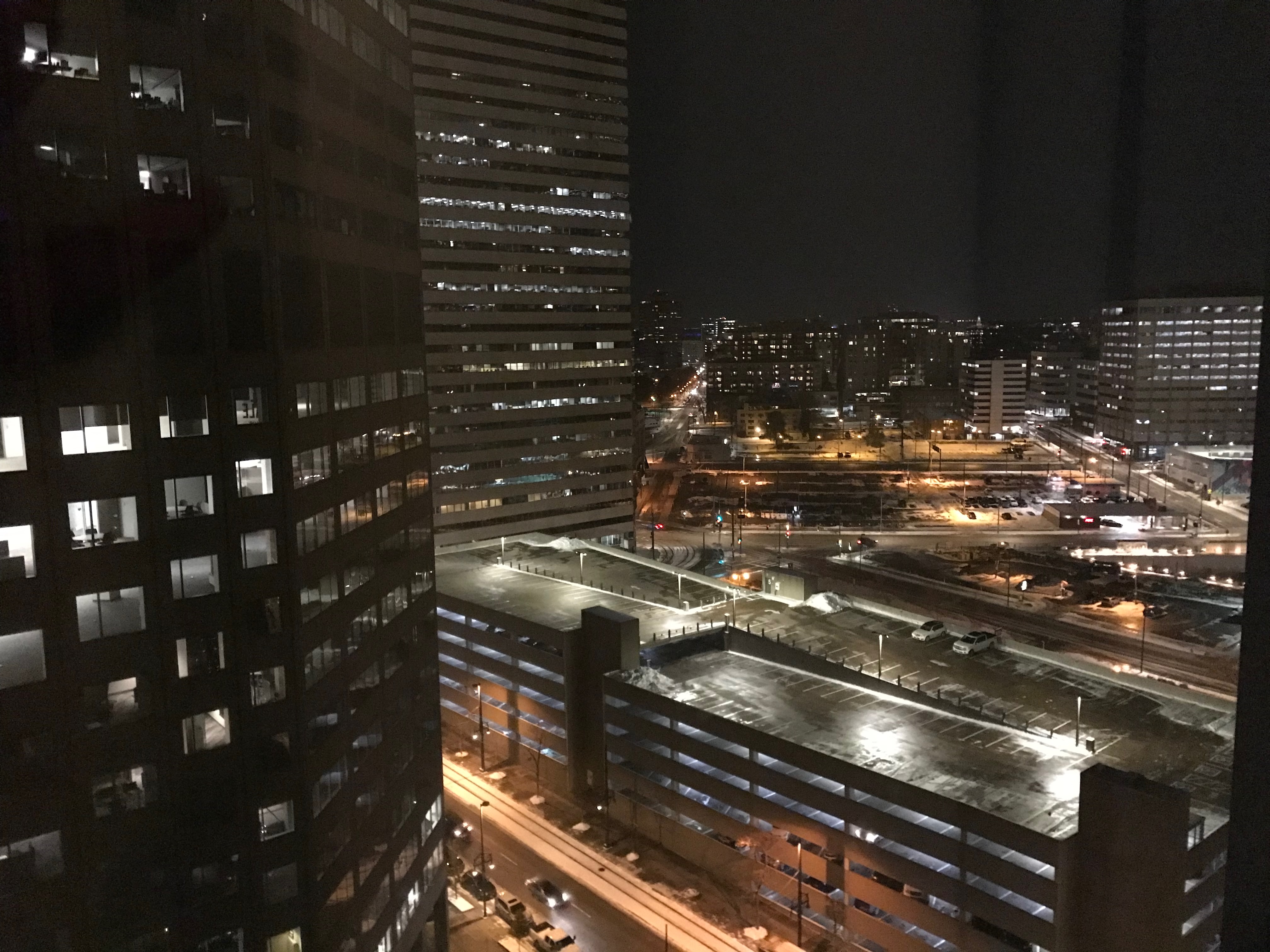
So as I sit here in Denver with my past.  I actually made it to Denver, which is, I suppose an improvement over last time.  There was snow, in Denver, but the locals seem to be fine with it.  Not many people are wearing masks these days, I’ve noticed.  There were a few stalwarts on the plane(s) and a few here at the conference who did.  The pandemic doesn’t bend to the will of people, not even religion scholars.  Viewing Denver from the airport (it’s a considerable way out), it looks so small and insignificant backed by the front range of the Rockies.  Maybe that’s what all of this is about: significance.  My association with this conference spans 31 years.  Perhaps there’s a bit of weariness here too.  The pandemic may never really end, not in any meaningful way.  I do wonder if my nameless friend ever found a job and if he still attends.  If he does I wonder what he would say about all of this.


Reentry

Image credit: NASA/ISS Expedition 28, public domain from Wikimedia Commons

They call it reentry, I suspect, because of the perils and stress experienced by astronauts reentering the earth’s atmosphere.  If the calculations are off, you either burn up or bounce back into the void.  Neither is a pleasant prospect.  It is also the feeling many of us experience at returning to work after the holidays.  We’ve had a taste of life without gravity, then suddenly you’re back into the thick of things.  It didn’t help that among my accumulated emails (I do not check work emails during my few allotted vacation days or holidays) was the notice of the sudden death of fellow scholar Gary Knoppers.  Gary’s interest early on included Ugaritic, before shifting to Second Temple Studies.  I once asked him over breakfast if he recalled the question I posed as a grad student when he presented an Ugaritic paper back in Kansas City.  Of course he didn’t; I don’t recall any questions I was ever asked either.  (With one exception.)

Gary died prematurely, just back before Christmas.  The usual venues for finding out such news, like the Society of Biblical Literature portal, were also on vacation.  It is maybe best that I didn’t learn about it until reentry.  Still, it didn’t make it any easier.  I can’t claim to have known Gary very well, but the suddenness with which someone you know dies can lead to shock.  Not so much the fact of death itself, but that it has claimed someone you knew.  I was working with him on a book idea for my employer.  We had traded health complaints about not being young men anymore.  It’s all so very human.

On Ash Wednesday a couple years back one of my colleagues asked if I was going to get ashes.  I replied that I thought about death every day and that I didn’t need ashes to remind me.  She thought it was a funny response, but it is actually true.  One benefit of my religious upbringing is that it early took away the fear of dying.  Since all people have to face mortality, it never made sense to me to fear it.  That doesn’t mean the same thing as wanting to die, but the price to pay is frequent visits to the valley of the shadow in my mind.  I was merely being honest that Ash Wednesday; my interest in horror is, by the way, related to that constant awareness.  Gary was a productive scholar and a kindly man.  Learning of his death so soon after the holidays became its own kind of reentry.  And a reminder that January looks both forward and back.


Extra Baggage

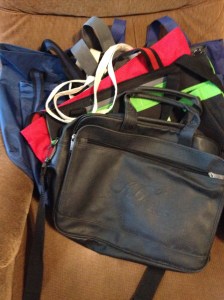
So, I’m packing.  Have been, on and off, since January.  One of the most dreaded moments of packing is the closets.  You know how in horror movies the villain often hides in closets?  We have no danger of that.  Any monster foolish enough to try it would be suffocated under tons of stuff.  Some houses may have walk-in closets, but I am inclined to call a mining company whenever I need to find anything in ours.  Our closets have led full lives.  It’s almost 100 degrees outside and I’m excavating.  We’re at that stage of “absolutely need to keep?” instead of “do we want this?”  Then I came upon it.  The layer of SBL tote bags.  Like a paleontologist of ancient academia.

If you’ve been a member of the Society of Biblical Literature you know what I mean.  Every year the Society wants you to realize value for your money, and they give you a tote-bag to help you haul home the books you’re going to buy.  Long-time attendees know to pack an empty suitcase inside their regular one just to accommodate the books.  (That could also account for about ninety percent of my packing—we have more books than a small town public library.)  But it’s not the books that are the problem today, it’s the bags.  I’ve been attending SBL since 1991.  Do the math.  I seem to recall that they didn’t do tote bags back in Kansas City, but soon after they became part of the agenda.  And I have an impressive pile of them in my closet.

Too small for groceries—especially in the early editions, back when we could meet in smaller venues—and too impractical for anything other than books, they multiply in our closets.  What professor doesn’t have his or her iconic briefcase already?  Reduce, reuse, recycle they say.  At least half of my totes have never been reused.  Zippers?  Who thought of that?  Pulling handfuls out of the closet, I marvel at their colors.  I can’t remember everyone walking around with a red bag—what year was that?  (San Francisco, 2011.)  The black leather edition—remember that one?  (SBL, n.d.)  The bags aren’t really useful for packing, on a movers’ scale.  You can imagine the burly guys outside their truck scratching their heads at this impractical conveyance.  Like so much else in life they’ve become mere souvenirs.  From the French word for something like “remembrance,” souvenirs are meant to take us back to the place in vivid detail.  I fear that many past meetings have run together into a blend of biblical arcana.  I’m sure that’s just me.  Still, I’m responsible for this new discovery.  I’d I’ll need shortly to decide whether these totes go into the museum or back into the landfill that moving inevitably creates in a throw-away world.


Sacred Places

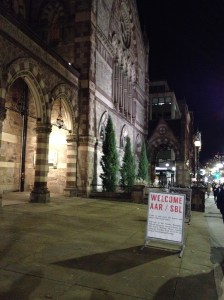
Boston Brahmins, lock up your doctrines—AAR/SBL’s come to town. Boston always has special associations for me. My first home away from home. Where I met my wife. Where I learned what you can only learn at seminary. Coming back is like coming home. Of course, I’m here to work. As I was getting ready for this trip I recalled that the conference met in Boston when I was studying for my Master’s degree at Boston University. Unlike many graduate schools these days, no overtures were made for students to attend. In fact, I didn’t know what all the in-joking among the faculty was all about. I relearned the existence of the conference as a grad student in Edinburgh a few years later. Few traveled across the Atlantic for it, at that point. In fact, none of the Edinburgh faculty who’d eventually become regulars had ever considered going. My first meeting was in Kansas City.

The meeting has grown since those days. Now regularly expecting about 10,000 scholars (can one help but think of 10,000 maniacs?) a year, the venues are limited. Atlanta, Boston, San Antonio, San Diego. Chicago and Denver once in a while. Personally, I’m glad it’s close enough for a train ride. New York City and Boston, two peas in a pod. My only regret is that I won’t be able to get out to my old stomping grounds. Some colleagues (few read this blog) contact me at the last minute asking if we can get together. My schedule’s booked from breakfast through supper each day. Those who attend as participant-observers have no idea. These are the longest working days of my entire year. Still, they’re in Boston.

I often muse about place on this blog. We’re attached to the place where we’re born—it’s our personal sacred space. In life we grow attached to other places, whether we can settle there permanently or not. I wanted to live in Boston. I did so for a year after attending seminary here, making a living doing this and that. Having a master’s degree in religion doesn’t get you far in life. In those heady days of sleeping on the floor and finding out what life was really like for the unconnected, I learned an awful lot. And when the woman I wanted to marry came back for a visit, I proposed. I’ve only ever visited Boston since. But whenever I manage to do so, even if it’s just for work, it’s like coming home.


Go to, Let Us Make Brick

Next year marks a quarter century. It’s a sobering thought. A quarter century of attending the Society of Biblical Literature annual meeting. A lot has changed over the years. Much of the loss, I fear, has been of innocence. When I first flew into Kansas City, naive at 29, and still believing the world offered opportunities for those who would work hard enough, the academic job market was tight. I had no interviews whatsoever, and spent many hours in the employees’ hopeless lounge, dreaming that someone might call my name. Although no jobs came of it, I could hardly blame the academy for “market conditions” outside their control. An economy based on unadulterated greed and emulating the worst practices of the business world was eating higher education alive, from within. I had no way of knowing. For a couple of decades I attended more often than not, optimistic that the lies I’d been told might yet turn out to be false. That those who had the gifts and abilities would be recognized for what they were. I was so terribly young then.

Through a variety of roles I have continued to attend this conference for all these years. I have not seen so much hopelessness until this. Colleagues come to me, barely holding back tears. Conditions in our universities are bad and are getting worse. We have no students, but clients. The hours of preparation for the classroom are now being measured in metrics like “return on investment.” The basic vocabulary of higher education has evolved to the point that it is a new Tower of Babel. It sits on Wall Street and considers what is offered to our young as commodities. Nobody worries if they learn anything or not. The exchange of goods at personal advantage is the only way that one can exist in a market economy.

IMG_2610

The only hope any culture may dare to claim for its future lies in education. Those economies that have not suffered as much as our own are those where education is still revered. Where you don’t have to hold a MBA to speak with authority. Where truth might just be an abstract and where not all things can be measured in shekels. I have been attending this conference for a quarter century and never I have I seen despair such as this. I have to wonder about a nation that takes those highest achievers and those with the most initiative and slaughters their hopes on the altar of the angry deity of vain baubles of self-aggrandizement. We bet on futures that are no futures at all. My beard is whiter now, and my glasses stronger. I am still able to see, however, the folly of launching into the North Atlantic in early April before any kind of radar has been invented with lifeboats made only of money. I only hope I’m wrong.