Animal Spirituality

I had little scientific basis for my claims.  It wasn’t that I didn’t have evidence, but it was more one of those “if you see something say something” kinds of scenarios.  I have been claiming for many years that animals experience some kind of spirituality.  My evidence was drawn from disparate scientific materials I’d read, along with ancient religions.  Egyptians believed baboons worshiped the sun.  Chimpanzees make threatening gestures toward the sky during thunderstorms.  Penguins grieve.  Human spirituality, it seems to me, is part of our kinship with other living creatures.  Then I found an article by none other than Marc Bekoff titled “We’re Not the Only Animals Who Feel Grief and Spirituality,” in no less a prestigious place than Psychology Today.  Bekoff, some of whose books I’ve reported on here, has studied animal emotions professionally.

Our ideas of human exceptionality, it seems to me, often get us into trouble.  Arrogance is perhaps the most dangerous of psychological states.  When we see ourselves as part of a continuum, and realize that it can go on beyond us—yes, there are likely greater intelligences—humility should be an expected response.  Those who are arrogant frequently experience their comeuppance, even if they have to get elected to high office for it to happen.  We share emotions with our fellow creatures, and, now according to at least one expert, we share spirituality.  What is spirituality?  It seems to be an awareness that the body isn’t everything.  In my lexicon it’s listed there right with consciousness, mind, and soul.  We know it because we feel it.

The interconnectedness of the world, and beyond, is something many want to take exception from.  Looking around, such folks say, “Hey, we’re different than all of this.”  Yes and no.  We’re different, but that makes us no less a part of it.  Nature is our matrix.  We build fancy houses, but so do bower birds, and they do it without benefit of opposable thumbs, or even hands.  Of late we seem reluctant to admit that even human beings have spirituality.  That doesn’t stop us from feeling it, however.  I’m glad that others see it in the animal realm also.  Anyone who’s “owned” a dog knows what it’s like to receive worship.  We’ve selectively bred these wolves to adore us.  Is it so much of a stretch, then, to suppose that other animals also feel a sense of admiration for what’s beyond themselves?  Only the most arrogant wouldn’t pause to consider it.

Ethology Theology

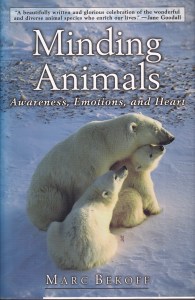
MindingAnimalsProminent public intellectuals, we’re used to hearing, often lament the survival of religion into a rationalist age. As an obscure private intellectual—if I may be so bold—I am always pleased to see when a credentialed scientist asks if we are being too hasty. No, but actually says we’re misguided to dismiss the evidence of our own observations. Marc Bekoff’s Minding Animals: Awareness, Emotions, and Heart is an encouraging study by a balanced individual. Bekoff, unlike many scientists, realizes that emotion does play into observation and reasoning. More than that, materialistic reductionism does not account for human or other animals’ experience of life. Historically motivated by religions to separate ourselves from animals, we have only come to know slowly—painfully slowly—that the distinctive markers of humanity are shared in degree by other animals. Bekoff is bold enough to give the lie to the belief that animals have no emotional life. Traditionally science has said that we cannot know what goes on in animal brains so it is best to take animal emotions off the table. Then scientists go home and love their dogs, who love them in return. When’s the last time I read a scientist writing about love?

Minding Animals is a manifesto. We have, in our arrogance, made unwarranted assumptions about both animals and our unique status on the earth. We drive other species of animals to extinction at a rate that required an asteroid collision or some other catastrophic event in the past. And we use animals as if they had no interests of their own, even such basic interests as avoiding pain and suffering. “They’re just animals,” we’re told. Bekoff is an ethologist—someone who studies non-human animal behavior. As common sense, both the sine qua non and bête noire of science, reveals, animals experience and express happiness, anger, and love. They can be depressed. They can be overjoyed. And we treat them as if they were objects to do with as we please.

Bekoff admits some of his fellow scientists treat him as if he’s gone soft. Like Diogenes, however, I search for an honest man and I think I have found him. Instead of castigating religion, Bekoff ends his book with a chapter on theology. Not to make fun of it, but to show that even scientists must integrate different kinds of knowledge. Not only is the science that Bekoff describes appealing to the emotions, it also makes sense. No scientist is completely objective. Even Mr. Spock breaks down once in a while. We all have perspectives. And that includes our fellow earthling animals. We evolved from the same ancestors and yet treat them as if we own them. Minding Animals will—or at least should—make us feel guilty about that. Being human and being humane, after all, are only a silent e apart.


Inhumane Society

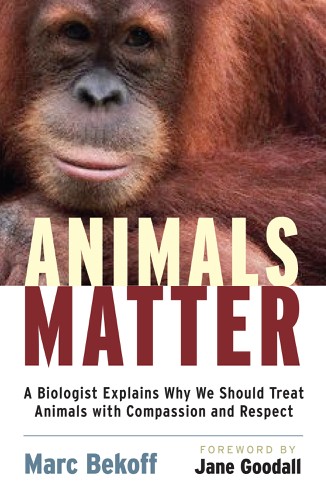
AnimalsMatter“I’m a member of PETA,” I’ve had more than one wag say, quoting bumper sticker wisdom as if it were profound, upon learning I’m a vegetarian. “People Eating Tasty Animals,” they then spell out with a smirk. I stopped eating animals at about the turn of the millennium, and since then I’ve discovered more and more reasons that it was the correct decision. I’ve just read Marc Bekoff’s Animals Matter: A Biologist Explains Why We Should Treat Animals with Compassion and Respect. It saddens me that in our world where nothing escapes being posted on Facebook, people still tend not to notice the suffering we impose upon animals as a matter of course. I’ve always been inclined to look closely at things, including animals. Watching them, it is clear that humans are indeed animals only differently evolved. Our mannerisms, our emotions, even our expressions, can be found among our animated kin. We share a planet on which we all evolved together, so why do we find it so easy to exploit other creatures?

One of the reasons Bekoff notes, without being judgmental, is that some religions inform us that people alone are special because we bear the image of God. Although God is supposed to be altruistic, we don’t wish to share that exalted status with any other species, apparently. Even in the twenty-first century many otherwise intelligent people still claim that animals feel no pain. Can’t reason. Are mere machines. We’ve been taught to distrust common sense that informs us that if an animal in distress acts like a human in distress that it experiences the same anxiety. The more we study animals the more human they become. The theology of Genesis has much for which it will be called to answer.

It seems, however, that the Bible is used as a mere excuse here. We exploit other animals because we can. We have taught bovines and ovines to trust us so that we may more easily slaughter them. Perhaps this is an exercise in divine image bearing, but somehow I doubt it. Reading Animals Matter in many ways felt like listening to a scientist who has taken the message of the Lorax to heart. We treat animals the way we do because we don’t understand their language, but we are morally obligated to speak for those who have no tongues. Although accessible to younger readers, Animals Matter is nevertheless a profoundly disturbing book. What does it say about the highly evolved when they exploit their relatives who’ve not learned the language of humans? Or, more accurately, who’ve not learned to vocalize like humans. Other animals speak, just like people sometimes, if we would only translate their actions into words.