Nostalgic Shadows

Nostalgia is a funny thing.  Although it can strike at any age, somehow after the half-century mark it’s particularly easy to get swept into it.  As I written about many, many times, I was drawn into the Marilyn Ross Dark Shadows novels as a tween.  In my mid-to-late forties, when the internet made it possible, I started to collect all the volumes from 1 through 32.  It took several years.  I had to find them via BookFinder.com and our level of income didn’t support buying more than one every few months.  Then in 2022, having difficulty locating the last of the original series, I found a seller on eBay offering up the whole set.  The price for that set was less than the least expensive final volume I could find.  I did what any nostalgic guy would do.

We don’t really buy antiques, but I’d been looking for an office desk (this was before the scam).  I’d been using a craft table for a desk for years and it seemed that I really needed something with a better organizational range.  This led me to stop into a local antique shop.  They ended up not having much furniture, but they did have aisles of nostalgia.  A few weeks later when it was too hot and humid to be outdoors, I revisited the shop.  This time, relieved of the burden of seeking a desk, I was able to browse at leisure.  It’s like going to a museum but not having to pay admission.  I turned a corner and I saw something I’d never seen before.  A collection of Marilyn Ross Dark Shadows books.
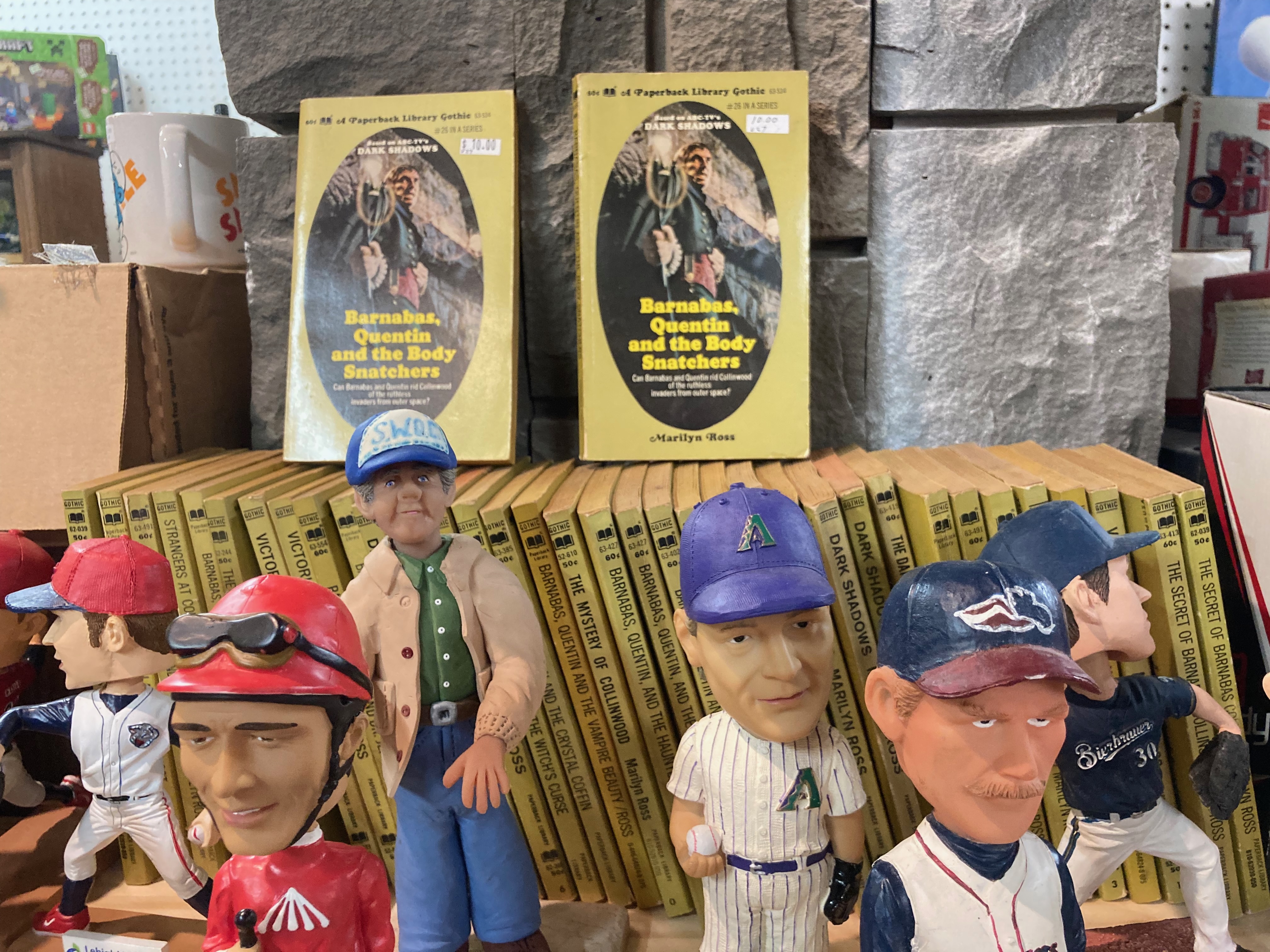
It wasn’t a full set, but I had, prior to finishing my own collection, never seen more than one or two together in any single place.  As a child I’d buy them at Goodwill.  As an adult, on BookFinder.  All those years in-between, I always looked for them when visiting used bookstores.  I visit said shops whenever possible.  In decades of looking I’d only found one in the wild once or twice, and always by its lonesome.  This was a completely new experience for me.  It was also quite odd to be seeing them and not having any need to buy them.  I have a full set.  The nostalgia was almost overpowering.  I couldn’t help but think of how even a few years ago I’d been pawing through to see if there were any I hadn’t yet found.  All for reliving a bit of my childhood.

Dark House

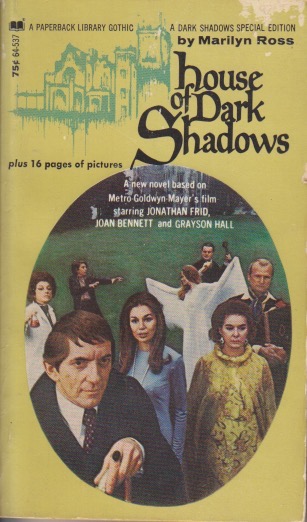
Last year I completed an odyssey that began over a decade and a half ago.  I finished reading the Dark Shadows serial novels by Marilyn Ross.  Not because they were great literature, but because they were an important part of my childhood.  Slowly, over the years, I regathered the books and read them until the whole series was done.  One of the used book sellers was offering a collection of the books, and although the collection had some duplicates of what I’d already found, it contained some of the more difficult to locate titles.  When it arrived, I found it also included House of Dark Shadows.  This novelization wasn’t part of the series, and like most things in my life, I can’t claim to know everything about Dark Shadows.  As a child I didn’t know there had been a movie, let alone a novelization.  (I bought the books as I happened to find them, at Goodwill and watched the TV show.)

In the present, I’d just finished Octavia Butler’s Parable of the Talents and felt that I needed something lighter for my next fictional project.  House of Dark Shadows proved a better read than most of the series books, perhaps because it was based on a movie script written by the screenwriters.  Marilyn Ross was actually William Edward Daniel (W. E. D.) Ross, and he wrote more than 300 novels.  His Dark Shadows oeuvre became repetitious in its dialogue, across the series.  His characters always seem to say “at once” instead of “immediately” or “right now.”  I’m pretty sure the word “mocking” appears in each of them—certainly the latter ones—multiple times.  Having the script must’ve really helped keep those trademarks to a minimum.

Of course, now that I’ve read the novelization I need to go back and watch the movie again.  It’s been almost two years and some of the details escape me.  It’s largely because the movie goes “off script” from the long-running daily show (and the other novels).  I also realized that Tim Burton’s Dark Shadows movie was really a kind of reboot of House of Dark Shadows, unfortunately screen written by Seth Grahame-Smith as a comedy.  I’m no expert on Dark Shadows, just a reasonably enthusiastic fan in search of a lost childhood.  The movie makes the premise of the series untenable—both can’t exist in the same world, so it’s kind of a Dark Shadows multiverse, rather than a simple universe.  And it’s very complex.  I’d need to start again at childhood to become an expert in it, but at least now I’ve read all the books.


Beautiful Vampire

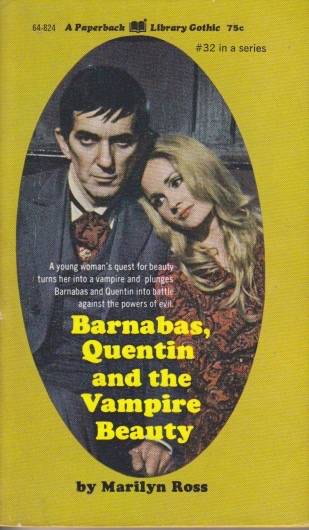
It’s been a quest years in the making.  I first found the Dark Shadows novels by Marilyn Ross at the Goodwill Store in Seneca, Pennsylvania.  The series had recently finished its television run and, as this was a used book bin, and limited in size, you could never tell what you might find.  My teenage self, fascinated by vampire lore, eagerly read those I could find.  I got rid of the volumes I had when I attended college and began to miss them when I was old enough to admit such things.  It took at least fifteen years to locate all of them, and now, for the first time in my life, I have read the entire series.  Barnabas, Quentin and the Vampire Beauty isn’t always easy to find.  I certainly hadn’t read it before.  Not that it’s high art—the campiness shows through the gothic setting from time-to-time—and yet it’s an accomplishment.

This particular story again shows some development from what had gone before.  The vampire beauty is a young woman tricked into having weight reduction surgery in Switzerland.  The surgery, naturally enough, transforms her into a vampire.  She needs help so she seeks out Barnabas Collins, which leads her to Collinwood.  From there a set of adventures head toward the typical climax of this series of books.  Nevertheless, W. E. D. Ross seems to have shown some improvement over the thirty-two novels in the series.  This story seems less similar to others in the series as a whole.  Quite a bit of effort is spent on trying to find a vampire cure, but for Adele Marriot rather that Barnabas Collins.

I have to wonder if Ross knew this would be the last Dark Shadows book he would write for the series.  He did write other gothic fiction, and even a novelization of the movie, House of Dark Shadows, but the initial series ends with a kind of knowing that we’ve reached the end of something.  Was he told by someone at Paperback Library, “Hey, we’re pulling the plug on the series” or did he simply run out of steam?  The daily television show ran for about 1225 episodes.  This original novel series had far fewer.  Still, the thrill of hunting all of them down, lining them on my shelf, and then reading them in order was a rare pleasure.  It was a recapturing of, perhaps even a completing of, part of my childhood.  It may have taken decades to accomplish, but an accomplishment is an accomplishment.


Hidden Improvement

I believe in improvement.  Even for a journeyman writer like W. E. D. (Marilyn) Ross.  At least in his Dark Shadows books.  For much of the series the plot is largely the same: a young woman is threatened and finds herself in Collinwood.  Often the threat comes in the form of a mysterious stranger.  The woman falls in love with Barnabas Collins, but in the end it doesn’t work out.  The bad guys are stopped, however, whether they’re supernatural or not.  In Barnabas, Quentin and the Hidden Tomb things have moved on somewhat.  The main female character, Ellen, a southern belle from just after the Civil War, doesn’t fall for Barnabas.  She is attracted to him, of course, but not really in love.  That’s a plus.  And Barnabas is temporarily cured of his vampirism in this story.  Quentin is, despite earlier story lines, really pretty good, if misunderstood.

This installment begins in the Hudson Valley where Ellen’s intended lives.  Unbeknownst to her, her fiancé has died and has been substituted with his identical twin vampire brother.  This northern family lost their fortune during the war and need the marriage to bring Ellen’s cash into the coffers/coffin.  Ellen is rescued by Barnabas, who is a family friend.  He takes her to Maine, figuring she’ll be safe there.  Unlike other women in the series, she has already fallen in love with someone other than Barnabas, so the tension is focused elsewhere.  The disguised enemies come, of course, but this story feels a bit less formulaic.

As I’ve confessed numerous times regarding this series, these are guilty pleasure books from my childhood.  I don’t read them expecting belles lettres, but rather a rush of nostalgia.  They seldom fail to deliver on that front.  There are a limited number of them.  They hearken to a different time when the ability to crank out book after book (Ross published at least 24 novels the year this one appeared—that’s the rate of two per month) didn’t hurt your ability to find a publisher.  Some of his fiction, I’m told, is quite good.  Others, such as the Dark Shadows books, are of a different purpose.  They were meant to supplement the income on an unexpectedly successful soap opera that would go on to become a cultural icon.  It will be no surprise that Barnabas and Ellen prevail in the end.  The enemies are unmasked and, strangely for the series, the vampire is destroyed.  And the legend lives on.


Insane Illusionist

The Dark Shadows novels supplemented my early watching of the television series.  It’s funny, but when I remember watching the show, in my mind I watched it alone.  During a conversation with one of my brothers recently, he assured me that he had watched the show too, pointing to the selectiveness of memory.  What I do know is that I was the only one who read the novels.  I bought them when I could find them used, and I kept them in an old pasteboard suitcase (we had no bookshelves and my parents didn’t read).  I didn’t have the entire collection by a long shot and I can honestly say I don’t know which ones I read back then.  I am now, however, two novels from finishing the entire series—a project I began around 2006.

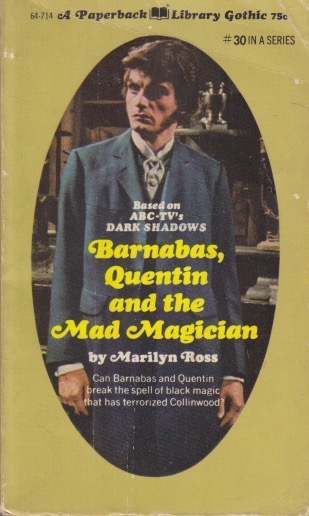
Barnabas, Quentin and the Mad Magician follows the usual formula, although this time around Barnabas is temporarily cured of his vampire curse and Quentin doesn’t turn into a werewolf at all.  They are on friendly terms and both are being set up by the rather obvious antagonist, the mad magician.  I guess you can begin to see the series winding down.  Most of the thirty-two stories are broadly similar and the writing is that rushed, breathless kind that seems characteristic of those who make a living delivering pulp fiction.  There have always been people like me who will buy it.  That’s the reason I typically use the phrase “guilty pleasure” when describing these novels.

As I note in my YouTube video on the phenomenon, Dark Shadows was quite popular in its day.  It’s what we might now call a cultural meme.  Television series, novels, two movies, comic books, lunch boxes—the whole coffin.  The monsters were likable.  That was true of some of the greats—you felt sympathetic toward them.  As horror began to “grow up” the monsters often became entirely reprehensible, with no redeeming qualities.  So as Barnabas and Quentin do their best to expose the true monster, their supernatural powers currently on hold, they have to rely on their money and connections.  Even at the end the “confession” is made suspect by the longer tacked on ending.  If you’ve read enough of these, you grow suspicious when there are ten pages left after the antagonist dies.  Stories such as this aren’t great literature, but they do fill a gap in the world of monsters that nostalgia leaves for those who knew Dark Shadows in the late sixties.


All Wet

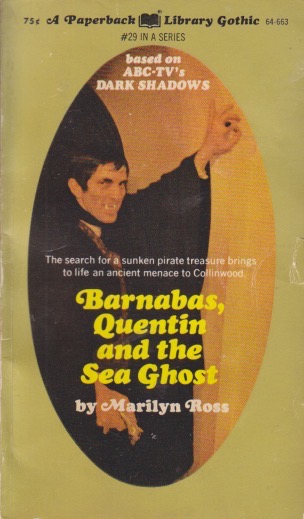
If I keep up this pace I’ll finish next year.  Reading the full set of Dark Shadows novels by Marilyn Ross, that is.  Since they tell me I’m an adult, this might seem a strange avocation.  Driven by nostalgia, and frankly, a love of gothic literature (the latter defined loosely), I’m revisiting my childhood reading.  Long ago I ditched the copies of these books that I originally found in a haphazard way, and it is possible—in this universe of improbabilities—that I have repurchased one of the exact same books I had as a child.  No matter.  I don’t think I read Barnabas, Quentin and the Sea Ghost before.  If I had, no memory of it is within easy recall.  It does seem that W. E. D. “Marilyn” Ross was making some slight progress with his writing as the series went on, but this one isn’t great.

An undersea salvage operation, run by Claude Bliss—accompanied by his daughter Norah (someone has to fall in love with Barnabas, after all)—comes to Collinsport to find the treasure of Jenny Swift, a ship named after its pirate captain.  There is, however, a ghost that haunts any who try to attain the treasure.  In one of the “Scooby-Doo Effect” versions of the Collinwood estate, the ghost turns out to be a man, a neighbor, literally in a rubber mask.  The salvage operation had been a bust from the beginning and Quentin shows up just to stir up trouble and then suddenly leaves before the story finishes.  This particular fascicle feels unfinished to me.  Who was the woman with Quentin?  What happened to the daughter of the man pretending to be a ghost?  Did Norah and Jim Donovan ever get together?  And what of Dr. Hoffman and Professor Stokes?

I’m not naive enough to expect belles-lettres from these books, but the last couple in the series built some hope as they seemed to have been making progress.  The stories were tighter and more innovative, even if still formulaic.  Some seem more cookie-cutter than others.  Since I have only three more novels to go (having read five of them this year), I see no reason to stop now.  I know there are other Dark Shadows fans out there.  I’ll probably put a YouTube video out on the topic down the road.  I did watch many of the episodes, but my memories come primarily from the novels I managed to find back in the seventies.  And like back then, I wasn’t really accurately called an adult, I suppose.


Grave Robbers

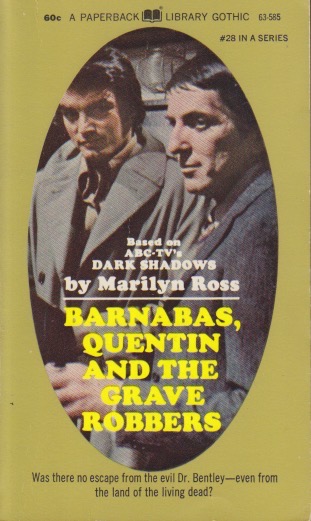
My personal reconstruction of the Dark Shadows universe was made by connecting the books by Marilyn Ross that I could find with the episodes of the television show that I saw.  I’ve always been one to try to make a logical storyline out of such things so that I could connect them when they came at irregular intervals.  (I’m still a fan of linear storytelling.)  So it’s a bit of an eye-opener to read the series of pulps in order.  There are continuities and discontinuities.  Barnabas, Quentin and the Grave Robbers again has Quentin, in 1830, portrayed as a good guy.  When he was first introduced in the series some books back, he was a satanist and very nearly evil.  And this was in a more recent era.  You get the sense that Ross was responding to fan requests.

As I noted regarding the last book in the series, the stories do seem to have grown more complex, and sophisticated over time.  The writing remains labored, but the story aspect improves.  Barnabas, Quentin and the Grave Robbers comes the closest to standard horror so far.  This is a dark story with problematic race issues thrown in.  The first two-thirds or so are set in England and are tied into the story by Barnabas Collins being there.  It is distanced from the usual moody setting of Collinwood where, despite all the haunting and troubles, you tend to think things turn out alright in the end.  Here the antagonist grave robbers kill people close to the heroine and the corpses sent to gruesome ends.  And there are zombies.

To flee the evil ringleader, Barnabas takes Paula Sullivan to Collinwood where Quentin is introduced to the story.  In 1830 he’s an unpredictable trickster, but good at heart.  He and Barnabas team up, as last time, to take on the grave robber when he moves, you guessed it, next door to Collinwood.  Then something unusual happens—Paula discovers zombies are afraid of crosses.  This leads to a strange episode of Barnabas—a vampire, remember—chasing a zombie with a cross.  In general religious imagery is scarce in these novels.  A vicar or two may be mentioned, but vampires aren’t menaced with crosses.  That does happen in one of the movies, but here it seems that because Barnabas is a good vampire he’s not bothered by a cross.  Or it could be a consistency issue.  Either way, this is a moody addition to the series, appropriate, as always, for autumnal reading.


Jekyll and Jekyll

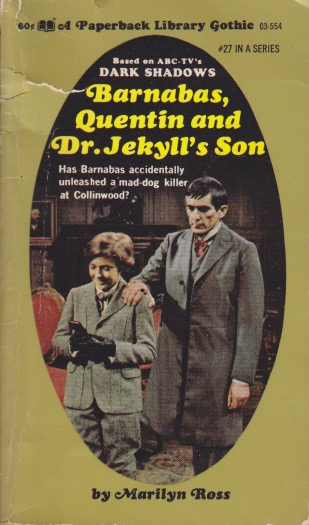
W. E. D. (“Marilyn”) Ross was a journeyman writer.  Prolific, he produced more than 300 pot-boilers, and he only started writing at mid-life, which kind of lends hope to me.  (He, however, didn’t always pay attention to literary niceties.)  I’ve made a determined effort, over the past decade or so, to collect and read all of his Dark Shadows novels.  These aren’t great literature, and I generally have to space them out to recover from them.  I just finished number 27 (of 32), Barnabas, Quentine and Dr. Jekyll’s Son.  Although I watched Dark Shadows as a child, it’s pretty clear that my cosmology of Collinwood was primarily shaped by Ross.  Living in an area without a regular bookstore, and without the cash to regularly buy books, I found what volumes I could at Goodwill and read them avidly.

Barnabas, Quentine and Dr. Jekyll’s Son is now a rather rare item on the used market.  It’s pretty clear that as Ross went on and on in the gothic fiction genre, he tried new things and these generally improved his work.  This story, set in the past, involves Dr. Jekyll’s grown son accompanying Barnabas Collins to Maine in order to escape his father’s reputation and, as a sidebar, to try to cure Barnabas of his vampire curse.  This means that one of the Collins girls, Emily in this instance, falls in love with Jekyll rather than Barnabas.  It also marks the point at which Ross tries to make it clear that both Barnabas and Quentin are good guys, but being under their own curses, they have to follow their vampire and werewolf natures, respectively.

I think I may have read this one as a child.  Although each book was stamped with its number in the series, I was dependent on when my mother decided to go to Goodwill and what they happened to have on hand in their book bin.  Some scenes from this book came back to me in the reading—although it was perhaps forty or more years ago—and one of the most important of these was one where Barnabas and Quentin collaborated on capturing the criminal.  Among the true fans of the series, they are known as the immortals (and Quentin isn’t always a werewolf), and they revisit Collinwood over the centuries.  Quentin can be both good and evil, but Barnabas is generally a sympathetic character.  Dr. Jekyll’s son isn’t such a strange guest at Collinwood, and the stories do seem to have improved over time.  It’s still Ross writing, but this one was more than a surface refinishing of a classic tale.


Secret Formula

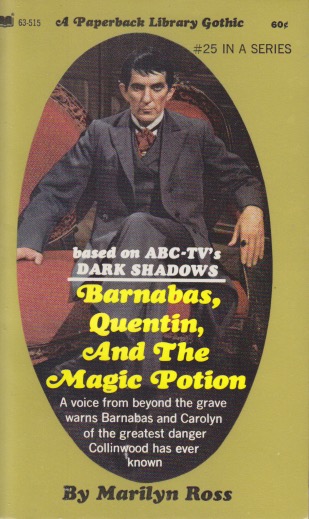
When writing fiction, I’ve never tried a series.  Some, such as Harry Potter, can set a writer for life.  I’ve always had the sense that the Dark Shadows novels were more potboilers.  There was a built-in fan base, and somehow in the sixties and seventies we didn’t expect Rowling-level writing.   It was the entire package: the Gothic, the recurring characters, the moody setting of Collinwood.  And of course, Barnabas Collins.  These novels may be journeyman writing, but here at number 25 in the series, Barnabas, Quentin, and the Magic Potion, there are some signs of literary improvement.  They are slight, rather like the first tinging of leaves with yellow as August begins to settle in, but they are there.  The series is nearing its end for me (provided I can actually find the last few books), but maybe it’s getting better.

What’s my reason for such a burst of enthusiasm?  Well, in this episode we see some features of Quentin that are more in line with how I remember him.  First of all, Ross tries some misdirection.  Quentin is presented as a master of disguise in the series and here there’s some clever hinting that, if you’re trying to think it through, leads you to mis-guess early on.  Not only that, but there’s a more positive view of Quentin here.  He’s not the evil satanist that he is earlier in the series.  Perhaps Ross had figured out by now that if people liked the idea of a Barnabas who is a conflicted victim, the same might apply to Quentin.  He’s not evil, but when you’re a werewolf, well, what can you do?

The “magic potion” is just as contrived and sketchy as most of the plot devices in this series—Harry Potter this is not.  It’s just a get rich quick scheme for a reprehensible old man and serves to move the plot along without really adding anything to it.  Carolyn here discovers that Barnabas is a vampire and, it seems to me, some of the plot devices for the Tim Burton movie might’ve been picked up from this particular novelization.  Although still not belle lettres by any stretch, the story here seems to have made some progress over the previous 24.  As a child, of course, I didn’t read these in order.  I relied on what I found at the bin in Goodwill, when I could find them.  I never had the whole series.  While trying at times, reading them may be a worthy exercise as an adult.  Perhaps series too grow up.


Not Quite Quetzalcoatl

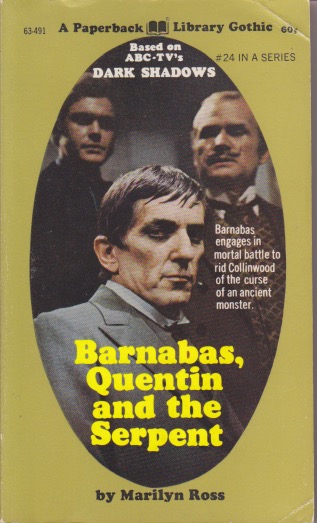
It must be difficult to write the same basic story over and over.  And nostalgic adults like me can be tough critics as we try to recapture faded childhood glories.  Those memories fade like afternoon shading into evening, but still I can’t help myself.  Marilyn Ross wrote 33 gothic tales of Dark Shadows in the spinoff series from the long-running television program, and I’m determined to read them all.  In small doses.  The one, Barnabas, Quentin and the Serpent is actually a bit distinct.  The writing is still journeyman, that of a tired potboiler author, but the plot offers something a little different.  As in the last volume reviewed, Barnabas is free from the vampire curse for a time, allowing him to emerge in the daylight.  And his arrival at Collinwood is actually dramatic and well-timed.  The story is set in the nineteenth century.

Gerald Collins, a professor of archaeology, unexpectedly inherits Collinwood along with his daughter Irma.  They head to Maine from Mexico taking exotic creatures with them, including a dimetrodon that escapes and tries to eat them.  The story revolves around rumors that the professor caught and transported back a flying serpent.  At Collinwood (and let’s think about this a minute—if you add up the body count from all the novels you’ve got to wonder why there’s been no federal investigation) people start to die and reports circulate of a flying snake.  The professor’s going to be driven out of town because angry villagers think he brought this creature back with him.  It’s all very melodramatic.

As in the last novel, Barnabas acts as a detective.  Quentin, who is the werewolf cousin, manages to allude detection by disguising himself.  Even Barnabas is fooled.  The story tries to avoid invoking the supernatural—there’s no such thing as flying serpents—while allowing a werewolf to perpetrate a hoax.  It’s all good fun (except for that body count).  There’s a bit of vim here from our weary journeyman writer, but there are nine novels yet to go in the series.  Writing a series seems to be smart money.  Children (and I first read several volumes of this series as a child) like to complete things and can be loyal series fans.  I never read the full series when I was younger; they were haphazard finds at the local Goodwill book bin.  Of course they were still being published at that time.  I have to admit that I’m curious where it will go from here.  And I do miss Barnabas as a vampire.


Mental Health

Dark Shadows was a formative part of my childhood.  I don’t recall specifics, or even how I found out about it, but I do recall watching it after school and being completely taken by it.  When I do the math I realize I had to have been watching it primarily before I was ten, and then after that I started reading the books when I found them in the used bin at the local Goodwill where they usually cost a quarter or less.  Now they’re collector’s items.  That fact doesn’t change the reality that they are journeyman writing through and through.  William Edward Daniel Ross, under the pen name Marilyn Ross, wrote thirty-three novels in the series as part of his oeuvre of over 300 books.  The stories are formulaic and feature odd word choices, but they are gothic.  Sometimes gothic is just what you need.

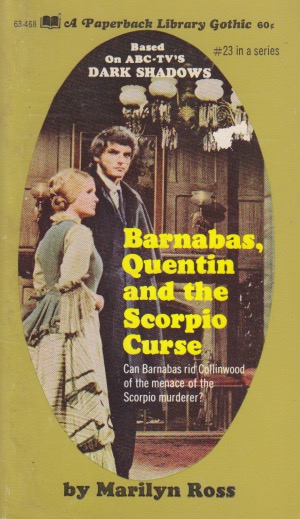
Barnabas, Quentin and the Scorpio Curse is a fun romp through a period when Barnabas has—with no explanation in the novel—overcome the vampire curse.  It introduces some Collins cousins who come to an asylum conveniently located next door to Collinwood where murder breaks out and mayhem ensues.  I have to keep reminding myself to put my critical faculties aside when I read these guilty pleasures.  There are gaps and incredulities that are simply glossed over, and that’s part of the world in which they take place.  Astrology plays a part in this episode, as the title indicates.  It features a psychologist who, it would seem, doesn’t know how to do background checks.

The truly scary part of this Scooby-Doo tale is that the protagonists, Diana and Barnabas Collins, aren’t believed because they’re voluntarily admitted to the asylum.  Mental illness is a serious matter, of course, and it can be difficult to diagnose.  The difficulty here is that it’s used simply to dismiss what Diana observes.  Time and again, as the Scorpio murders continue she’s dismissed as “a mental patient.”  It’s all part of a plot, of course.  It does raise serious issues, though.  In the late sixties and early seventies there was a real stigma attached to mental illness.  There still is, in fact.  Ironically, the more we learn about mental disorders the more common they become.  Just about everyone has some neurosis or worse.  In our efforts to define the “normal” we dismiss those with actually diagnosed conditions.  We’ve come a long way since then, but we still need to work at dispelling the stigma.  One way to do it is, I suppose, to put conflicted vampires into the mix.


Potboilers

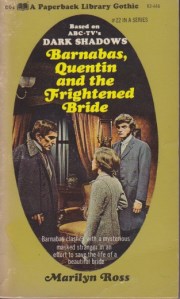
“Potboiler” is used in publishing to describe a book written merely to keep a writer going.  Full-time authors are comparatively rare, and many occasionally resort to churning out books simply to generate income.  I have no doubt that most of them start out as most artists do—creative, and looking for a career that allows them to be so.  If you want to earn money, to keep your pot boiling, you need to follow the formula.  Those are my thoughts on having finished the last book for this year’s Modern Mrs. Darcy’s Reading Challenge.  One of the categories was three books by the same author and I had three unread Dark Shadows books by Marilyn Ross.  Barnabas, Quentin and the Frightened Bride, number 22 in the series, was clearly a potboiler.

As I’ve confessed before, these books are guilty pleasure reads for me.  My literary tastes have changed over the years, however, and such journeyman writing sometimes betrays itself.  Even if a book has vampires and werewolves.  Dark Shadows was a melodramatic soap opera of my youth.  Still, it was moody and gothic—something these books manage to convey, even if the stories don’t live up to their promise.  Some of the plot elements in this particular installment don’t even line up, and having read Jane Eyre I’d guessed the ending shortly after the beginning.  I often wonder how the book series might have turned out with a truly literary attempt to tell the story.  Writing takes time.  Good writing takes a lot of time.  But even writers have to eat.

I’m not a Dark Shadows connoisseur.  I haven’t bought the original television series on DVD and I haven’t watched it since I was about ten.  Early memories, however, are formative.  With a remarriage, a death in the family, and a move, childhood got swept away rather swiftly, and along with it, watching Dark Shadows.  The series ended in 1971 after over 1200 episodes had been filmed.  Ross’ serialization began during the six-year run of the series, and, I suspect, he had to keep up a hectic pace.  Books 13 through 24 were all published in 1970, a rate of over a book a month.  I’ve suggested before that academics ought to take pop culture seriously.  Even before this era of fandom becoming mainstream, Dark Shadows spun off a small media empire and it continues to retain public interest.  The daily show struggled, despite being partially modeled on Jane Eyre, until the supernatural was introduced.  Although the Ross novels may not always show it, the hunger remains for supernatural explanations.


Patina

When reading three books by the same author, most of the time, it seems, it’s good to spread them out.  For the past few years my wife and I would visit an independent bookstore in January to pick up a few books for the year’s looming reading challenges.  We slipped behind this year and I happen to have three unread Marilyn Ross books at home.  Barnabas, Quentin and the Haunted Cave was the second of them.  Since, unbelievably, I didn’t have books to fit into the other categories, I read my second Dark Shadows book of the season shortly after the first.  It is a revealing experience to come back to a childhood influence as an adult.  I’m pretty sure I hadn’t read this one as a child, and as much as I like Barnabas Collins, this particular story was somewhat tedious.  And that’s saying something, considering how formulaic the series is.

One of the reasons I found it slow going—especially for a book of less than 200 pages—was that Ross relied too much on dreams to move the plot along.  I read quite a bit of fiction and I always find writing about dreams tricky.  Even within the diegesis of the story you don’t know whether to believe what’s going on in dreams or not.  Just as in real life, dreams are a break from the tedium of consciousness and they permit the mind to wander.  The dreamer can go anywhere, do anything.  Generally without consequence.  You awake back in the more continuous narrative of your life and the dream is forgotten.  In fiction, which is largely made up, dreams often act as filler.  Given the number of times Ross repeated himself in this particular book, it seems that he had to pad the story out quite a bit.  It would’ve worked just fine without the dreams.  Might’ve fallen short of contracted length, though.

It also continues the conceit of Quentin as a Satanist.  I have to confess that the original series was so long ago I don’t remember much about it.  The theremin music of the opening, with the waves crashing against the cliffs of Maine, yes.  Barnabas, tortured but not evil vampire, yes.  Much beyond  that, no.  I’ve had friends discover Dark Shadows as adults.  I watched it on commercial television during its first run and I haven’t seen it since.  I certainly don’t have time for soap operas in days crowded with other demands.  Still, these little books can take me back to a dusty corner of childhood that has a pleasant patina over it.  But it is best to keep such experiences separated a bit in time.


New Year Reading

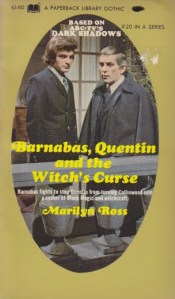
Childhood has a powerful draw.  I first started reading Dark Shadows books when they were published for (I kid you not) 60 cents.  I got them for cheaper than that at Goodwill.  Every time I read one I wonder what my young imagination found so compelling in them, but in an effort to trust my younger self I keep on.  So I read Marilyn Ross’ Barnabas, Quentin and the Witch’s Curse.  The book doesn’t really say anything about a witch’s curse, providing as it does some of the backstory for Quentin.  If you aren’t familiar with that background, and you want to be, Barnabas is a vampire and his cousin Quentin is a werewolf.  Both were made so by curses, a plight the Collins family has long faced.  

In recent years I have read the 19 volumes in the series preceding this one.  They tend to be formulaic, and often show the signs of having been written quickly.  W. E. D. Ross is sometimes listed as the most prolific Canadian author ever.  He wrote over 300 books, mostly in genre fiction.  It’s no wonder many of them sound the same.  Still, I have to admit that both from watching Dark Shadows and from reading these novels as a kid, I liked Quentin.  Yes, he was smug and self-confident, but as a werewolf he had the ability to become someone else.  Unlike other books in the series, this one focuses on Quentin and points a pretty heavy finger to him being a Satanist.  That seemed pretty harsh to me.  There’s a difference between being the victim of a curse and being a Devil worshipper.

Now I know I shouldn’t take this as belles lettres.  Ross is not remembered as a great stylist, master of character development, or for being all that creative.  Dark Shadows was a soap opera—one of the more intelligent of the genre—and there’s only so much you can do with it.  Satanism was a cultural concern in the 1970s.  In the following decades it would bloom into an outright panic.  I’m pretty sure that I never read this particular volume when I was young.  Even now as a relatively mature man I found the implications somewhat disturbing.  The Scooby-Doo ending doesn’t do much to ameliorate the undercurrent of evil.  Quentin always seemed like such a sympathetic character to me.  Maybe it just goes to show what happens when you go for a quick read rather than choosing a book of substance.  Childhood can be that way.


Premature Burial

I have recently finished writing an article for a collection of essays on the Bible and horror.  Have no fear—I’ll pass along details once it’s published.  I do have to wonder, though.  All those years I was teaching and publishing regularly in ancient Near Eastern studies nobody ever approached me about contributing.  It took coming out of my monster closet for that to happen.  Monsters, you see, are a guilty pleasure topic.  They’re so much fun that they hardly seem like work to write about.  Or read about.  I was a child when Dark Shadows aired as a daily soap opera on ABC.  For reasons about which I’m beginning to speculate I found this series strangely compelling.  Marilyn Ross (W. E. D. [William Edward Daniel] Ross) based some 32 of his over 300 novels on the series.  I collected them as a kid and then got rid of them when I went to college.  I’ve been collecting them again in a fit of nostalgia over the past several years.

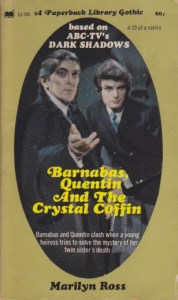
I just finished Barnabas, Quentin, and the Crystal Coffin.  The story was actually quite different than typical Collinwood fare.  What drew me to these novels as a child was their atmosphere and, if I’m honest, the fact that Barnabas was a vampire.  Memories of youth are fleeting things at my age, but it may be that Barnabas Collins was my introduction to vampires.  I was four when the series first aired, and I’m not sure if I discovered it before I came across Dracula or if it was the other way round.  Dracula, once I was experienced enough to have an opinion on such things, was my favorite monster.  I liked the others as well, but he was rich and immortal—the things sickly kids in poverty idealize.

In my fascination with Dark Shadows I’m not alone.  Despite Tim Burton’s movie version, Johnny Depp (who is my age) admitted growing up wanting to be Barnabas Collins.  Friends about my age have discovered PBS’s recent re-release of the original series in all its campy glory.  For whatever reason, however, it is the books that always draw me back in.  They, for me, defined the Gothic novel.  Ross’s writing is formulaic and predictable.  His adjective choices feel forced and subtleness was never his strong point.  Still I can’t stop myself from occasionally dropping into the world he manages to recreate in the woods of Maine.  Afterwards I move on to more profound writing, but then, his work is the very definition of a guilty pleasure.