
Scientific Belief

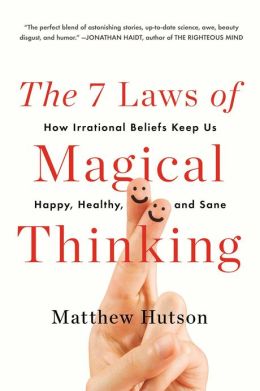
AtlanticThe human brain is a marvelous thing. Neuroscientists find all kinds of surprises as they probe the gray matter in our heads. One of those findings is that we don’t always believe what we say we do. Some time ago I read Matthew Hutson’s Seven Laws of Magical Thinking. Scientists didn’t like the book too much since it caught them with their empirical pants down. Really, there’s no shame in that. We are at the mercy of our own minds. In this month’s Atlantic magazine, Hutson has a brief piece entitled “The Science of Superstition.” In the space of just over two columns he runs down the evidence that even those who claim materialism is the answer to all life’s mysteries, even those scientists can’t escape superstition. Friday the thirteenth, a couple of weeks back, I walked under a ladder on my way to work. What happened? I had to go to work. Is that bad luck? I suspect it’s a matter of opinion. I’m the first to admit, however, that I did have fleeting reservations.

Study after study, as cited by Hutson, shows that physiological measures indicate anxiety when those who don’t believe in God say bad things about him/her. We all attribute cause to natural events, even those steeped in the hard sciences. Thinking about death reveals subconscious beliefs about God. It’s the way we’re hardwired. Hutson himself, if I recall correctly, doesn’t really attribute much credence to the supernatural. This is all a matter of what our material brains believe. Interestingly, we are evolved to be open to religious ideas. Many choose to believe, despite our brains, that we are evolutionarily deceived. Screwed by natural selection, as it were.

Far more interesting, in my deluded opinion, is that we don’t really choose what to believe. At least not at first blush. Our brains tell us to believe in the invisible causation that just doesn’t fit in a material world. To get beyond that takes some effort. It does give one pause, however, to consider that blind evolution has puckishly kept all this in the mix. Does evolution have a sense of humor? Perhaps we are all taking all of this far too seriously. Or maybe, just maybe, our brains are smarter than we think.
The Power of Magic Again

7laws Magic is everywhere. It may not be real (or it just might). There’s no doubt that Matthew Hutson believes the supernatural has nothing to do with it. The 7 Laws of Magical Thinking is a provocative book in that regard. An atheist who argues that we shouldn’t discourage magical thinking because it is so darned human, Hutson is a rare kind of treasure indeed. The 7 Laws of Magical Thinking begins by pointing out that we can’t psychologically accept what is really real. Reality always eludes us. Our brains are hardwired to accept what Hutson calls magic (including what I call religion). Those who enjoy provocation can take some satisfaction in knowing that either side can add another layer to the shell: physics explains everything, but maybe magic is responsible for making the universe conform to the laws of physics. And so it goes.

Although I enjoyed Hutson’s book–and he’s clearly a gifted writer—I couldn’t help but wonder at a very deep parity between the determinism he believes is really real and the magical view that is implied by such self-help manifestos as The Secret—the things that happen to you are meant to happen. I know, I know—Hutson’s point is that there’s no agency involved in determinism, but my point is that the end result is still the same. You end up where you are. I’m not so sure. Determinism has always left me cold. But since I’m no God I guess I can’t change that, yet I wonder if there might not be something outside this closed system after all. No one can peek and tell.

Neurology may tell us more than we want to know about the mechanics of the brain, but consciousness is reality. Science may some day lay its cold hands on consciousness, but it will always be someone else peering into my head wondering what I’m thinking. I’d have it no other way. I was strangely cheered to note that Hutson ends his whimsical study with a “stab at a secular spirituality” (a good stab, that is—not the malicious kind). I’m sure that many materialists will find such an a gesture as pandering to the masses. I think Hutson is sincere, however. Even the über-rationalists, as he points out in the book, slip into magical thinking and metaphors. It is the human condition. Those who watch Star Trek (original series, please!) know that the most tormented crew member of the Enterprise is Mr. Spock. The rationalist who can’t connect with emotion is a soul in torment. Even if that soul is a myth. The rest of the crew, I am certain, believes in the power of magic.


Random Science

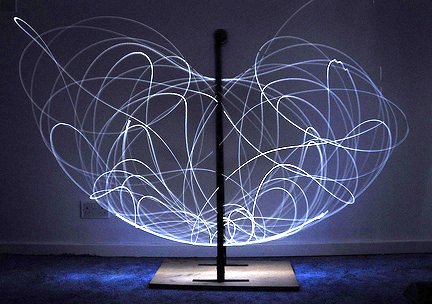
Our world is defined by science. Empirical method demonstrates again and again and again that physical properties follow the same tired pattern without any divine intervention. Saturday was Rutgers Day. Instead of our usual visit to College Avenue to sample French cheeses, we went to the Busch Campus of science and engineering. There we were treated to a 90-minute physics lesson that consisted mostly of demonstrations for the kids with things blowing up, glowing, and being broken after being dipped in liquid nitrogen. Outside the building we watched a chaos pendulum which a grad student explained never followed a predictable pattern. Back in the day when I was subjected to religious rules stricter than any laws of physics at Nashotah House, I used to read about chaos theory. It is the most biblical of scientific ideas. As anyone who’s watched Jurassic Park knows, it means that ultimate predictability is futile. Well, there’s more to it than that, but I’m merely an amateur.

Returning home, I read an interview with Matthew Hutson, about his new book The 7 Laws of Magical Thinking: How Irrational Beliefs Keep Us Happy, Healthy, and Sane. It is now on my wish-list, but I haven’t read it yet. Despite the fact that Hutson is an atheist, he recognizes that magical thinking is both healthy and unavoidable. A door creeps open for the scholar of religion here. We are able to see that non-rational thought is human, so very human. We don’t often think about how driven we are by our emotions. When we see a friend we ask, “what do you feel like doing today?”, not, “what do you think like doing?”. Visiting someone recovering from hard times we ask how s/he is feeling, not thinking. Emotion is, after all, built on the root of “motion”—it is our motivating factor. Seldom is it scientific.

Not to demean science. I have read science books and magazines on my own since I was a teenager. The truths that have been revealed through science are endlessly fascinating and pragmatic. They work in a way religions seldom do. Nevertheless, I became a scholar of ancient religions, studying them scientifically. In the Middle Ages it was said that philosophy was the handmaid to theology. Truth was revealed, not discovered. Reason, thankfully, began to show the way forward. The epithet Dark Ages gained currency for a reason. Science is our means of comprehending our universe, and yet, superstition is hardwired into our brains. I am glad for the scientific worldview even when the chaos pendulum still swings crazily, unpredictably before me. Seldom do those in my field get to consider themselves Renaissance women and men. The pendulum swings where it will.

George Ioannidis' chaos pendulum