October’s Poetry

October is a beautiful, melancholy time of year.  Edgar Allan Poe died on October 7.  Two years ago today, my mother died.  This was brought home to me forcefully yesterday.  A colleague had invited me to address her class at Princeton Theological Seminary about Weathering the Psalms.  I had vacation days that have to be used up or lost, so I took the day off.  My wife and I drove to Princeton, a town we know well.  When we lived in Somerville, about 15 miles north of there, we’d visit Princeton not infrequently.  I wasn’t really familiar with the seminary grounds, however.  My colleague informed me that her class, on the Princeton Farminary (where a program in ecology and theology is housed) would be meeting in a barn so I should dress appropriately for the weather.  A cold front had come through, so I went for the tweed and turtleneck combo.

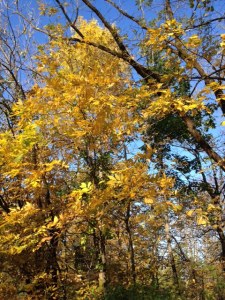
So we set off on a beautiful drive along the Delaware.  The leaves aren’t at peak yet, but there was plenty of fall color as we navigated our way toward Frenchtown, where there is a bridge across the river.  The GPS also told us this was the way to go.  On River Road, still in Pennsylvania, a flagman refused to let us on the bridge, although the signs did not say it was closed.  He impassively waved us on.  The GPS insisted we “return to the route.”  We soon found out why.  The next crossing is seven miles further down, along winding roads with a 25 mph speed limit.  The drive was beautiful, but suddenly I was going to be late for my appointment.  The new route added 45 minutes to the estimated travel time.  After uttering some choice words about unplanned bridge closures on a road where there are only a very few ways to emulate Washington’s crossing, we eventually arrived.

The weather beautiful, if a little chilly, the class decided to meet outdoors.  I hadn’t forgotten how much I love teaching.  It was brought back to me with force.  With the trees reminding us that winter is not far off, and the students eagerly asking questions, I felt at home for the first time in many years.  It was a temporary shelter, I knew, but it was a kind of personal homecoming.  Carefully avoiding the Frenchtown bridge, we drove north, crossing to River Road at Milford.  If the GPS had known that to go forward you sometimes need to go backward, it would’ve sent us to Milford that morning.  We arrived home tired but glowing from a day out of the ordinary.  As I put my tweed away that evening I found a pencil from the the funeral home where I last saw my mother in the pocket.  It had been the last time I’d worn this jacket, two years before.  October is a beautiful, melancholy time of year. 

Sad Joy

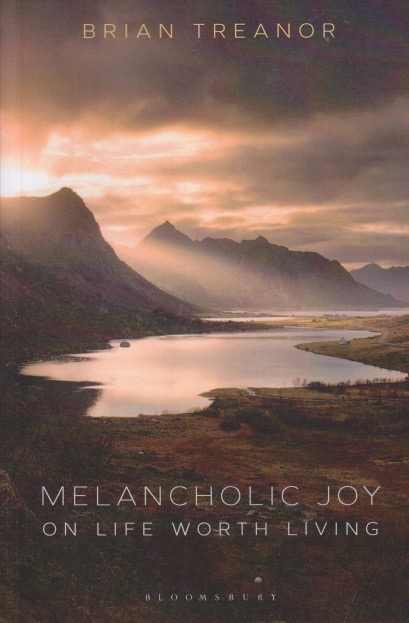
I sometimes make the mistake of thinking a short book will be a quick read.  Melancholic Joy is a case in point.  Every time I indulge in a book of philosophy I wonder if I missed my true calling.  As my wife is well aware, I’m prone to philosophical musings about the meaning of life although I tend to place myself among the existentialists.  As soon as I saw the title of Brian Treanor’s book it went on my reading list.  It’s short and I thought maybe a week would be enough.  But it wasn’t.  I do hope I can remember much of it.  A word to the wary, the first chapter is very depressing.  Treanor doesn’t sugarcoat the world in his quest on a Life Worth Living.  Those of us who ponder things deeply tend toward melancholy, in my experience.  But stick with it.  There is gold in this book.  Starting with chapter two I was reminded why I took so much philosophy in college.

The world is full of depressing facts.  By the time I was born we’d already devised ways to wipe out the entire human race.  Many, far too many, people live lives of suffering, much of which could be prevented if we didn’t have people like Donald Trump running things.  The political situation is so bad that I’ve disengaged.  Yet still, amid my melancholy, I do feel joy.  You need to parse words carefully here.  Treanor knows that joy and happiness aren’t the same thing.  For those of us predisposed toward melancholy, joy is probably much more common in our lives than happiness.  This book is one that led me to start underlining again.  I do hope to come back to it when my outlook becomes too bleak.  Treanor interacts with both other philosophers and other writers, even some who aren’t always classified as philosophical.  It is a nepenthe.

Some of us think incessantly and can’t help doing so.  It’s a bit difficult to be cheerful if that’s the case.  Melancholic Joy, if I can keep it in mind, may help with that.  There are sections where I had to go back and re-read because my attention had wandered (it happens to us all), but to do so was rewarding.  For anyone who finds many aspects of the world oppressive, and depressing, and who has a philosophical bent, this book is for you.  Just be careful with that first chapter.  Whatever you do, don’t stop there.


Shortchanging Halloween

In a local mall over the weekend where Christmas decorations were being uncrated, I felt cheated.  Now I’m not naive enough to suppose retailers can get by without the black season around Christmas, but as a writer of books Halloween themed I felt as if my thunder were stolen.  The normal person, I suspect, thinks of scary things only about this time of year.  Monsters and horror films are on people’s minds in fall, even though a good horror flick will make a few bucks even in spring or summer.  Halloween has a very small window of appeal, however, followed on closely, as it is, by Thanksgiving and Christmas.  Why can’t we give Halloween its due?

My wife pointed out that Halloween is a big retail event.  Indeed it is.  I started noticing Halloween paraphernalia on the shelves fairly early in August.  I know that even without capitalistic prompting I start to sense the season then.  It’s in the air.  Certain early August mornings you can smell a faint whiff of autumn on a breeze slightly cooler than expected.  The first leaves start to change and fall before September.  It will be another couple of months before the season makes itself felt in full force, but the early hints are there.  A believer in delayed gratification, I hold back.  I  don’t buy, but I absorb.  The melancholy grows through September until as the calendar tells me it is now officially October I can begin to exhale.  This is the time when those of us who are horror misfits can seem somewhat normal.  I walk into a store and “Ho, ho, ho!”  The joke’s on me.

Autumn already slips by too quickly.  Every year before I know it the ephemeral beauty of changing leaves is gone and the subtle chill in the air turns frigid.  Damp leaves are raked up to make room for snow.  The swiftness of this season is perhaps one reason so many people value it.  Summer can stretch long with its uncomfortably warm days and winter can linger for nearly half the year with its opposite feel.  Halloween is a holiday that intentionally falls in the midst of transition.  That transition has been commercialized, however, into buying seasons.  Only halfway through October the price of Halloween goods drops to sale rates.  Corporate offices are chomping for Christmas cash.  What I really need is a walk through the fallen leaves and a few untrammeled moments to consider where we are rather than what we might earn.


Divine Monsters

Monstrosity and religiosity are sacred siblings. Both are focused on that which is outside—the Other. Now, I have to confess being a bit rusty in my philosophy reading, and I sometimes wonder how I made it through three degrees without ever really encountering post-modernism in all its complexity. Reading Richard Kearney’s Strangers, Gods and Monsters (Routledge, 2003) was therefore a challenge. Like many of those raised in an uncompromising religion, I am innately attracted to monsters. Maybe it was the vivid images of Hell and its denizens; one of the earliest nightmares that I remember was of being dragged to Hell. Some authors suggest Revelation gave Christianity its monsters, but, as Kearney suggests, the connection goes back much, much further.

We fear what we embrace. It is the old division of sacred and profane—a line that has blurred considerably over time—that gives us our monsters on a separate plate from our deities. Otherness contains within itself both bane and blessing. People fear that which differs from them, a fact demonstrated every day by racism, sexism, and homophobia. At the same time, many look to the ultimate alterity for salvation from the mundane. God is just as “other,” more so even, than any human or monster is. Any creature/creator beyond the reach of our feeble grasp should be considered dangerous in our view of the world. And yet the further we get from the middle, the more the ends seem to come together in an ouroboros of divine monstrosity. Those who read Kearney need to be prepared.

While not taking on monsters as I expected he would, Kearney does address them with a sensitivity appropriate to the recognition of the closeness to deity. Nowhere is this clearer than in his superb chapter on melancholy. Being caught between the monstrous and the sublime, the melancholic learns to cope with a disinterested sadness that at times borders on insanity, yet produces flashes of light often more brilliant than those who think their way through problems. This is the affliction of Hamlet who stands on the cusp of being or non-being. For all who believe in a divine power, a strong divide must separate that realm from ours. That same realm, however, also contains our beloved monsters and strangers of every description.