Dryad?

There are so many movies out there.  The prudent horror fan knows not to be nickeled and dimed to death by renting/buying everything available, so you stick with a streaming service and take what they offer.  That’s how I find many of the movies I discuss on this blog.  It’s how I found Ayla.  You won’t find much information on this indie, art-house horror beyond IMDb, and it doesn’t say much.  Although the ratings are low the premise is good and it is beautifully filmed.  It is a little weird, though.  Elton, a mentally disturbed man, has never gotten over the death of his sister when she was four.  He supports himself by working in a bookstore and has a regular girlfriend, Alex, but he hasn’t let his sister go.  Going to a remote, dilapidated house that Alex showed him, he digs under a tree until he finds an adult Ayla.
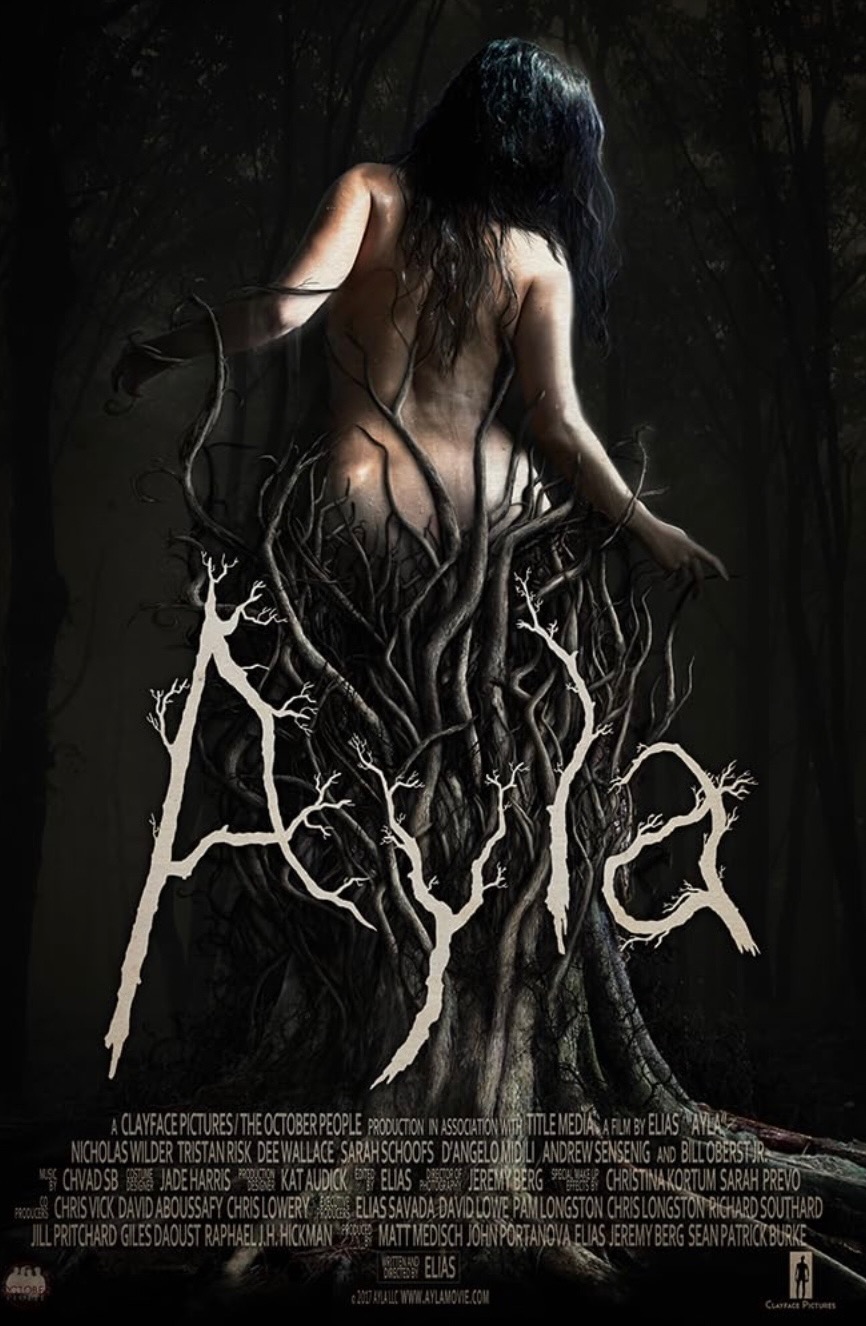
Ayla’s alive but she doesn’t talk and can’t tolerate solid food.  She seems to be part of the tree where Elton found her.  His brother and mother tell him this woman isn’t his sister.  Alex, who lost a brother when she was a child, doesn’t say whether Ayla’s Elton’s sister or not.  Accepting that this woman now lives with him, she’s just not sure if the dead do come back.  Elton quits his job and tries to move home with his mother, but it doesn’t work out.  While driving at night, Ayla, ahem, distracts him, and his car hits a tree.  Elton understands that Ayla has returned to the tree and begins digging for her, but doesn’t find her.  Alex finds evidence that Elton has begun to turn into whatever it was “Ayla” is.

Apart from being a study of grief—very much like A Ghost Story in that way—Ayla also explores mental illness and incest.  This is done with a high degree of artistry, however.  Those who rate the movie poorly probably haven’t considered metaphors much.  To me, there’s a lot going on in this film.  It’s the kind of movie where you want to talk to somebody about it after it’s over.  Was Ayla really a dryad?  She’s found in a nymph (insect variety) state and quickly transforms to, apparently, Elton’s missing sister.  Meanwhile, his family doesn’t give him the affirmation he requires.  Metaphorically, it seems, like Outpost, to be a movie about dealing with trauma.  Such films are well worth watching and pondering.  And they make me thankful for streaming services that occasionally bring good, if obscure, movies to light.

Toil et cetera

Few items are as necessary for modern day life than a functioning toilet.  If you live in town and don’t have an outhouse your other options are pretty limited.  Religion scholars tend to know quite a bit about what goes on in toilets, so I’ve repaired my fair share over the years.  When we had a leak in a fill valve, I had to wait for a weekend to do the repair.  I figured half an hour and thirty dollars at most.  I left it for an afternoon project.  Once I got the new fill valve installed, there was a problem.  The tank wouldn’t fill with water.  It had been clear that the faulty part was the fill valve, as it was hissing and sputtering and there were no leaks into the bowl.  I made a late trip to Lowes for another valve, following the logic that the one I’d bought earlier must’ve been defective.  It didn’t work either.  We had to flush by buckets of water.

Sunday after church I rushed to Lowe’s since, logic dictates, it has to be the flush valve that was the problem.  These are the only two parts inside a toilet tank that require repair.  So I got the tank off, and after running to the hardware store to buy a specialized tool to get the nut of the valve off, I learned that “fits 99% percent of toilets” left that troubling 1 percent for a reason.  Our toilet was special.  The parts were not standard size and neither my local hardware store nor Lowes had the parts in stock.  If we wanted a working toilet that day we would need to replace the entire thing.  So we went toilet shopping.  Hauling a toilet up the stairs is something I hope never to have to do again.  By late Sunday afternoon my half-hour, thirty-dollar project had turned into a multi-day, three-hundred dollar project.  I followed the installation instructions religiously, but, of course, it leaked.

I ended up having to call the local plumber we’ve got on speed-dial.  We’re in our fourth year in our house and we had plumbers here at least six times.  I picture their office assistant grimacing each time our number comes up on their caller ID.  The plumber came and, apart from generating serious tool envy on my part, demonstrated how everything from the soil pipe up had been misinstalled by over-confident DIYers.  I try not to cut corners with plumbing or electrical.  Despite how easy it is to install, or even repair, a toilet, you have to have the correct foundation.  And even scholars of religion need to admit when they’re in over their heads.

Read the fine print.

Kafkaesque

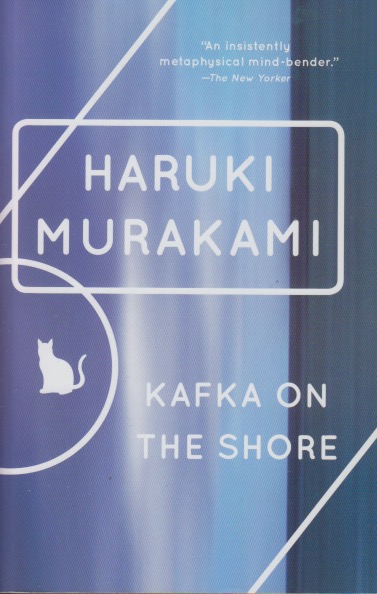
Although it’s a bit early—it’s never really too early—I just finished a banned book.  One of the main reasons I do annual book challenges is to help keep myself well rounded.  The categories often include books I might not otherwise read, although banned books are among those toward which I gravitate.  Lists of banned books are quite long, and so the choices are many.  I read Haruki Murakami’s Kafka on the Shore for this particular category this time around.  As the name Kafka in the title implies, there will be some surrealism here.  It was banned, as many books are, because of the sexual elements.  Anyone who made it through their teenage years without having struggled with that, however, is truly fiction.

Kafka is, in this instance, a fifteen-year-old Japanese boy running away from home.  On his journey, interlaced with that of an older, disabled man, he begins to discover what it is to grow up.  A number of unexpected things happen along the way, and pretty soon you’re not able to tell which world you’re really in.  The story refuses to be tied down to the ordinary.  The writing draws you in, however, and reminds the reader that being a teenager is indeed a liminal state.  Almost larval, to use a Kafka metaphor.  And yes, the metaphor is extremely heavy here.  There’s no denying two worlds bleed into each other as the story progresses.  Becoming an adult, it seems, involves having to make difficult choices.

Woven in with the base story is the Oedipus myth.  American cultural figures also appear.  Questions are raised but never really answered.  I’m not sure that I was fully ready for the mind-bending nature of the narrative.  Especially in these days when it’s considered okay, with a badly distorted moral compass, to hate those who are different, it’s important to read books like this.  There are characters you simply can’t figure out.  There are situations that seem unlikely, but that match some of the inherent strangeness of life itself.  I’m trying hard not to give away spoilers here, but this is a profound book.  I can’t tell if it was written for teenage readers or not—there’s clearly a lot of life experience behind it, and we were all teens at one time.  It was banned for being honest about sexuality, but perhaps, as is the case with most, if not all banned books, the real problem is that it’s simply too honest about being human.


Campbell’s Swansong

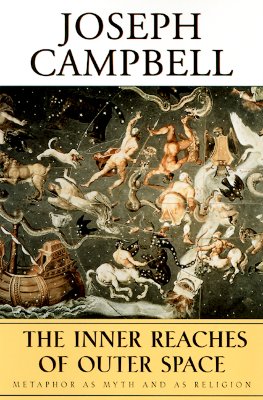
InnerReachesofOuterSpace Joseph Campbell may not be the best reading for the bus. Despite the many signs and placards gently suggesting to passengers both in the Port Authority Bus Terminal, and on the buses themselves, that keeping quiet is courteous, we are a people in love with noise. We are used to annoying electronic beeps, squawks, and farts. People find it difficult to sit more than 20 minutes without talking. I’m trying to read. At the Hunterdon County Library Book Sale I picked up Joseph Campbell’s last book, The Inner Reaches of Outer Space. It requires some concentration. Campbell was a brilliant comparative mythologer. I was reared in the scholarly hermeneutics of doubt, however, especially when it comes to comparing myths from different cultures. Campbell has a great appreciation for Jungian concepts, and soon minor details are blurred and the similarities stand out in stark relief. Still, as I always do with Campbell, I came away with plenty of rich concepts over which to mull.

Campbell, the great inspirer of Star Wars, the original series, was that rare breed of scholar who appreciated without participating. He is recorded as stating he was no mystic, and certainly not any kind of conventional religionist, but he couldn’t get enough of mysticism or mythology. Religion, he implies, is just mythology taken literally. He is, I believe, very close to the truth here. What we know of indigenous peoples today is that they don’t have that sharp and hard line between literal reality and story that marks much of western civilization. We tend to think fact and fiction cannot be of a kind. Looking around, we find no gods, so our choices are not to believe, or to believe too literally. And those who believe literally differently, we tend to want to kill. This is the history of religion in the western world, in a Campbellian nutshell.

Apart from the little gems I located scattered throughout The Inner Reaches of Outer Space, the main theme I found applicable was the driving force of chapter two, Metaphor as Myth and Religion. Metaphor is our way of interacting with a reality we just can’t experience directly. As human beings, we experience the physical world through the mediation of our senses, filtered by our brains. If there is something deeper, more profound than nature, we are even further removed. Our experience of meaning is metaphor. Joseph Campbell may have been a little too swift to spot congruities that are probably best left apart, but he clearly recognized the fact that our religions are not so different from our mythologies, and that both are narrated in the form of metaphor. This is not to devalue them, for metaphor is one of the most potent substances in our chemistry set. Now if only I could find the vial that has the stuff to make people want to keep quiet on the bus, we might all be able to get a bit more reading done.


Seedless

“And Onan knew that the seed should not be his; and it came to pass, when he went in unto his brother’s wife, that he spilled it on the ground, lest that he should give seed to his brother” (Genesis 38.9). During the conference last week the Routledge booth stood across from that of an evangelical publisher. One of the realities of conference life from the point-of-view of an exhibitor is over-exposure to what is fresh, clever, or cute upon first blush. Harper One’s continuous loop video, however, demonstrated that N. T. Wright, Desmond Tutu, and Bart Ehrman can sound repetitive, and even Colbert loses his punch when you hear the jokes for the twelfth time. The evangelical publisher across the way, however, had a large cartoon drawing that mapped out the believer’s life, book-by-book through the Bible. As probably anticipated, I can’t get that silly cartoon out of my head. After four days of exposure, I finally succumbed to asking for a flier. It was the usual evangelical fare, and the warning against adultery on back used the traditional term “seed” for “semen.” I found myself pondering the implications.

Since the King James Version shares the pre-scientific worldview of the ancients, the term “seed” has been preserved in the literalist mind. Even Alice Cooper uses it in his lyrics (his father was, after all, a preacher). Well, since the Bible is Holy Writ, it seems that semen has been transubstantiated into seed. The seed, as biologists tell us, contains all the genetic material to grow a new plant. Just add water, warmth, and a little light. Presto! Life sprouts. Since evangelicals tend to be fluent in biblicalese, even today men—the default, fully equipped model of humanity—come complete with abundant seeds. Agway should be so lucky. It feels, however, as if half of the equation is missing. If the Bible-writers had raised chickens, perhaps men would be full of eggs.

Thinking life cannot exist without metaphors. Metaphors are very dangerous in the hands of religion where they get taken literally. Too easily imagery slips into facticity. The male seed demonstrates a diabolical gospel truth: men alone provide the next generation. Women, as usual, are largely superfluous. The biblical male dominates the biblical female. The man owns the wife and must be enticed to share his precious seed. If conception fails, it is inevitably her fault. The metaphor has become a thumb-sized rod. Let us speak plainly here. The Bible has betrayed womankind. Judas Immaculate. In ancient times this was accepted fact. The microscope and biology should have buried this seedy metaphor centuries ago. But once again, the unthinking promulgation of a biblical trope survives at the expense of women. I have no seeds. No man since Adam has.

An obscene photograph?


Out of the Depths

You’d think that a lifetime of theological study would be excellent training for repairing a toilet. If, however, you live in an old rental unit that has been ritually neglected for decades and that has a plumbing system designed by the Marquis de Sade’s evil twin, you’d soon think otherwise. All I tried to do was replace the flapper—something I learned how to do before leaving home. When the overflow tube snapped off, corroded all the way through at the bottom, I figured I’d just replace the unit. The bolts holding the toilet tank, however, were installed before Noah even built the ark and therefore wouldn’t budge. The leverage room for a wrench, is, of course, negligible. So it was, temperature about 100 degrees, no air-conditioning, no working toilet (bad combination) on a weekend, that I came to face the human condition once again.

As biological creatures, humans have constructed themselves a grand, spiritual universe that kindly overlooks the basics of daily living. Religion, in origin, seems to have had a survival value. Psychologists have suggested that the sense of hope that religions often project might have led to a stronger desire to thrive. Others have suggested religion is part of the curse of consciousness—aware of our own mortality, we attempt to overcome it like any other obstacle. Religion gives us the leg-up over pure biological existence. Unlike other creatures, many western religions assert, we survive our own deaths to face a (hopefully) better world beyond.

In the meantime, however, we are faced with a messy biological existence. Some of our compatriots in this venture stumble along the way and cannot meet the expectations like those who know how to work the system. Religions have traditionally dictated a moral imperative for those who are in positions of power to assist those who are weak. Of late, however, that has somehow shifted—at least in popular Christianity—to the overarching objective of looking out for one’s self. As a species we are all, rich and poor alike, constrained by the same biological necessities. It would speak well of our religious constructs should they reflect the same. As the temperature climbs once again, and I must face my plumbing nemesis, I realize that the metaphor may go deeper than I originally surmised.

The theologian's best friend


Tackling the Tabernacle

Over the weekend a student question led me to think about the inconsistencies of ancient thoughts of holiness and how it fits into a naturalistic world. The question concerned the tabernacle as described in the Torah. The Levites were responsible for the grunt work of physically breaking down and carrying the holy furniture such as the menorah, table, incense altar, and ark of the covenant. One of the reasons for this was that the holiness on a sacred object clung to anything or anyone that touched it, causing a potentially catastrophic mix. At the same time, there were also prohibitions against touching the furniture or even seeing it. By the time the poles were inserted to avert the former danger, the latter prohibition would have already been violated. How did they do this?

Overall, the Israelites did not push ideas to logical extremes. In other words, the extension of holiness to other objects (and people), while it clearly happens, does not always follow a logical direction and culmination. If special ritual precautions were taken, the danger of approaching holy objects was removed or at least temporarily neutralized. Since there is not logical way out of this conundrum, the Bible itself simply doesn’t address the issue. “Don’t ask, don’t tell” also apparently applies to the holy. When describing set-up and take-down procedure for the tabernacle, the Bible simply ignores this puzzling issue.

Probably the most salient point of all concerning ancient texts is that concerning intent. If the Torah is describing literal, historical events then this is a scientific problem to be resolved. If, however, the tabernacle is a foreshadowing of the temple in the wilderness, a literary metaphor reflecting Israel’s history back into a non-historical setting, then the question becomes a literary one. No archaeological evidence exists for the exodus or wilderness wanderings of the Torah, causing many to suggest they were not so much historical events as they might have been theological explanations. They are “foundation stories” like those all nations have. These stories helped to explain why the monarchy failed to achieve perpetuity – the chosenness of the Israelites only lasted so long but not forever – according to those who are theologians.

I appreciated the question. It is only by thinking seriously about the implications of Bible stories that we are able to get a handle on what might have been originally in mind for those who gave us our religious heritage.

Gabriel L. Fink's tabernacle from WikiCommons


True Metaphors

I have a bad habit of taking road signs metaphorically. Not that I ignore the instructions, it is just that I consider their wider implications. While I was a tormented layman at Nashotah House I was pleased to see a road sign go up along the county lane that led directly to the main campus entrance. “Detour Ahead” it read in its reflective orange glory. I knew immediately that it was a metaphor for my life.

Yesterday as I drove to New Brunswick (New Jersey) for a student’s thesis defense, a large traffic sign that allows its message to be programmed and changed easily sat beside the road. “Expect Delays” one screen read. The next tersely stated, “Church Services.” Yesterday was, naturally, Good Friday, but I couldn’t help reading a bit more into this curt nugget of truth. My mind wandered to Galileo, Bruno, and Darwin. And to thinkers who nudge conventions outside the sciences. In fact, to societal progress itself. I thought of how often human good has been blocked by the agency of religious believers. When something new and beneficial is discovered it has to go through an approval process longer than that of the FDA – by the Church. Is this new information dangerous to doctrine, to preconceived notion? Will it damage our power structure? Can it be permitted?

Back to Joseph Campbell. Raised in the context of a Christian culture, Campbell did not believe any one mythology – he believed all mythologies. He keenly felt the loss that society incurred when it forfeited its mythic heritage and jettisoned its gods. Are we better off without them or not? The answer is still unknown. Perhaps the most appropriate traffic sign of all is “New Traffic Pattern Ahead,” and the most damning is “One Way.”

The ultimate heresy