Hunting Vampires

Many years ago some friends took us to the Mercer Museum in Doylestown, Pennsylvania.  Bucks County is one of those places where oddities persist, and I was very impressed by the fact that the museum had an actual vampire-hunting kit.  Now this was before the days of sophisticated cell-phone cameras and my snapshot, through glass, wasn’t very good.  There was no way to know, at the time, that a few years later Vampa: Vampire and Paranormal Museum would open up just a few miles down the road.  And that the latter would have a whole room full of actual vampire-hunting equipment (advertised as “Largest collection of vampire killing items ever in one location”).  A very real fear of vampires existed in Europe up until the technologies of the last century showed that humans don’t need the undead to create fear.  In any case, many chests of vampire-banishing implements line the first room.
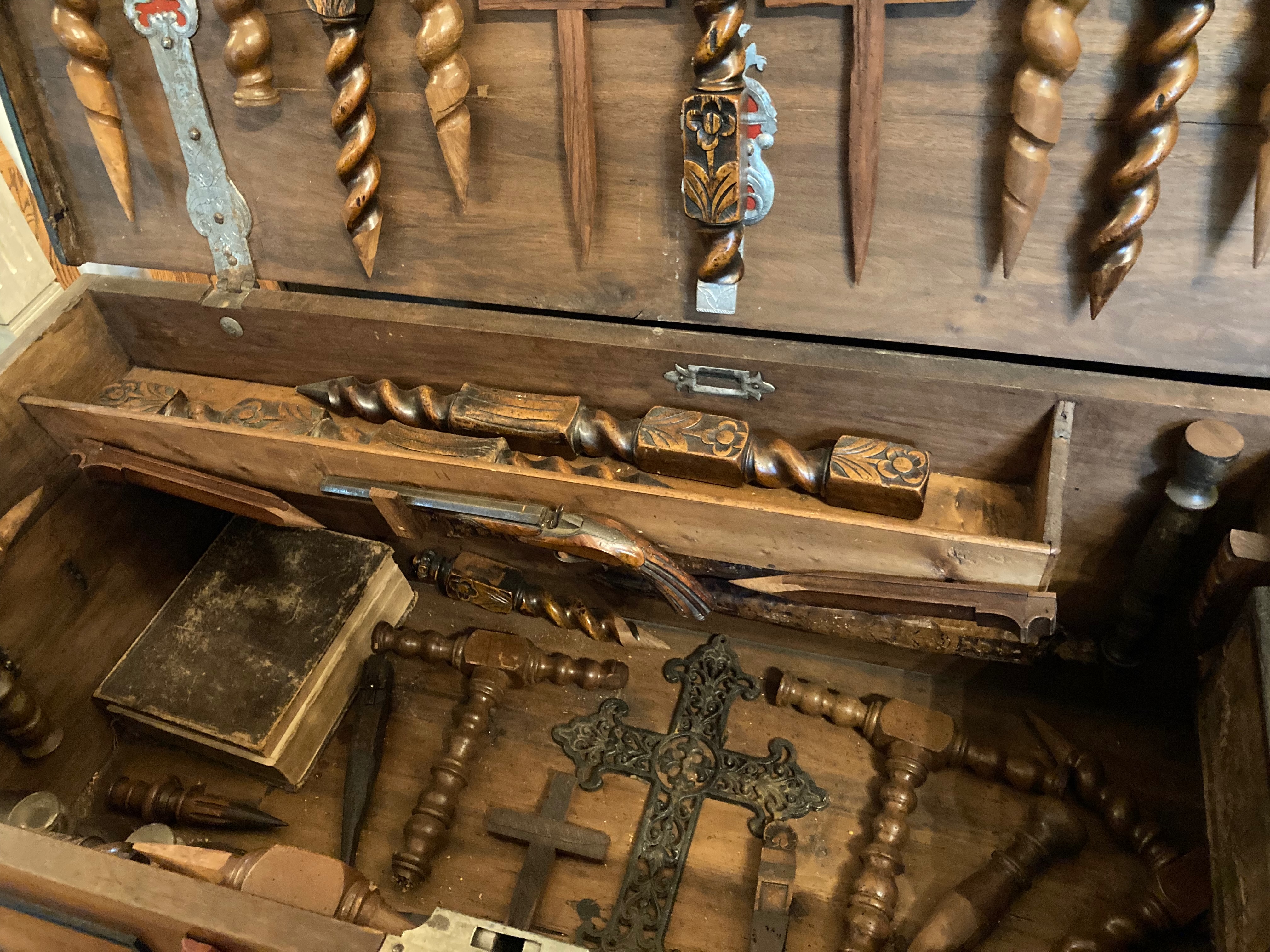
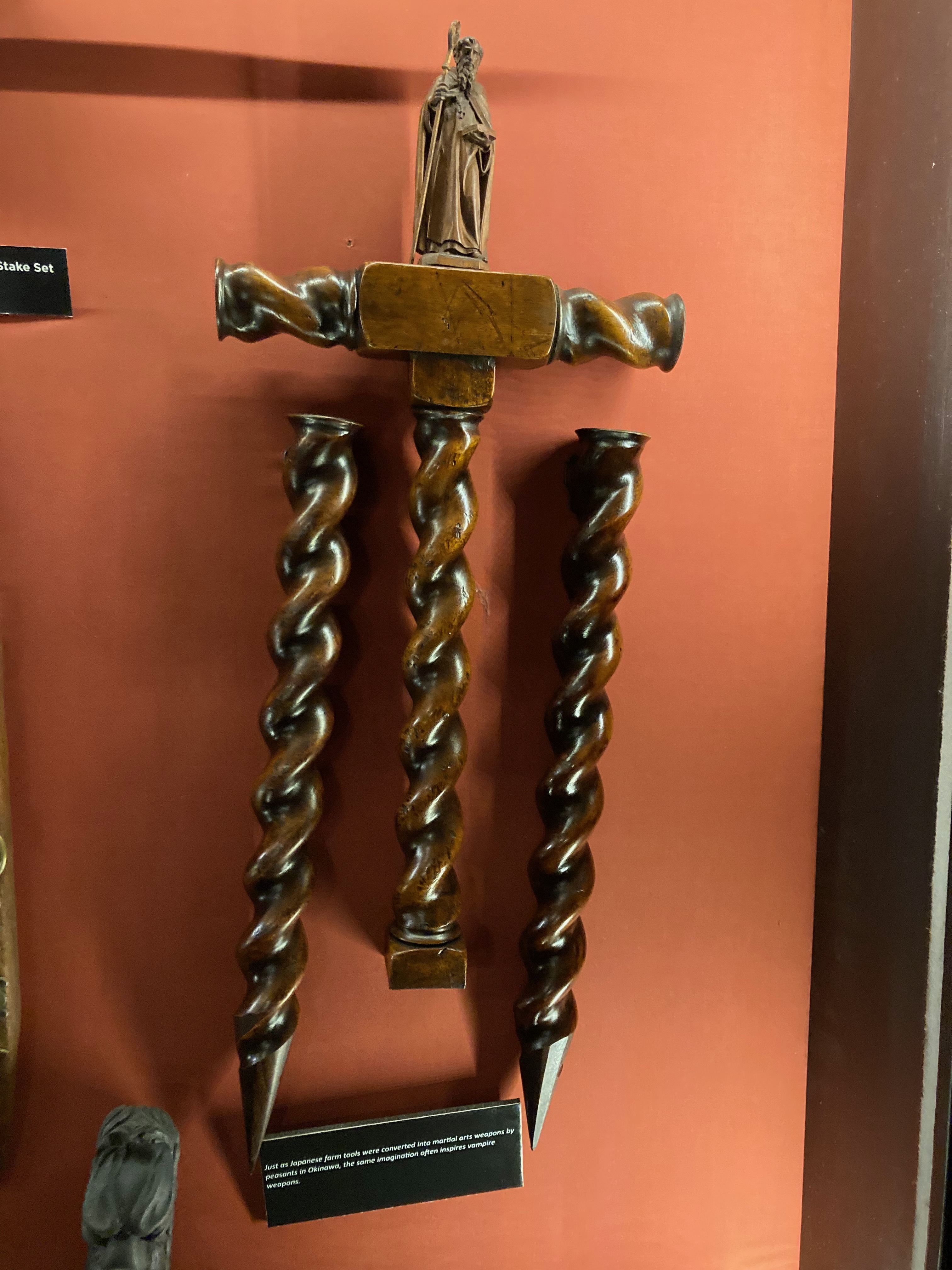
And stakes.  As my wife noted, in the movies they just grab a stake and mallet and get to work.  These were stakes made by craftsmen.  Many of them intricately carved, and, one suspects, officially blessed.  Matching sets of stakes and mallets seem like they were for display, rather like some firearm collectors these days proudly show off their guns.  The odd thing, to my mind, is that most of these artifacts weren’t medieval, but from the early modern period.  The earliest I saw was from the seventeenth century.  I had to remind myself that Europe was undergoing a very real vampire scare the decades before Bram Stoker wrote Dracula.  John Polidori, Lord Byron’s associate, had written a vampire novel in the early nineteenth century, well before Stoker’s 1897 classic.
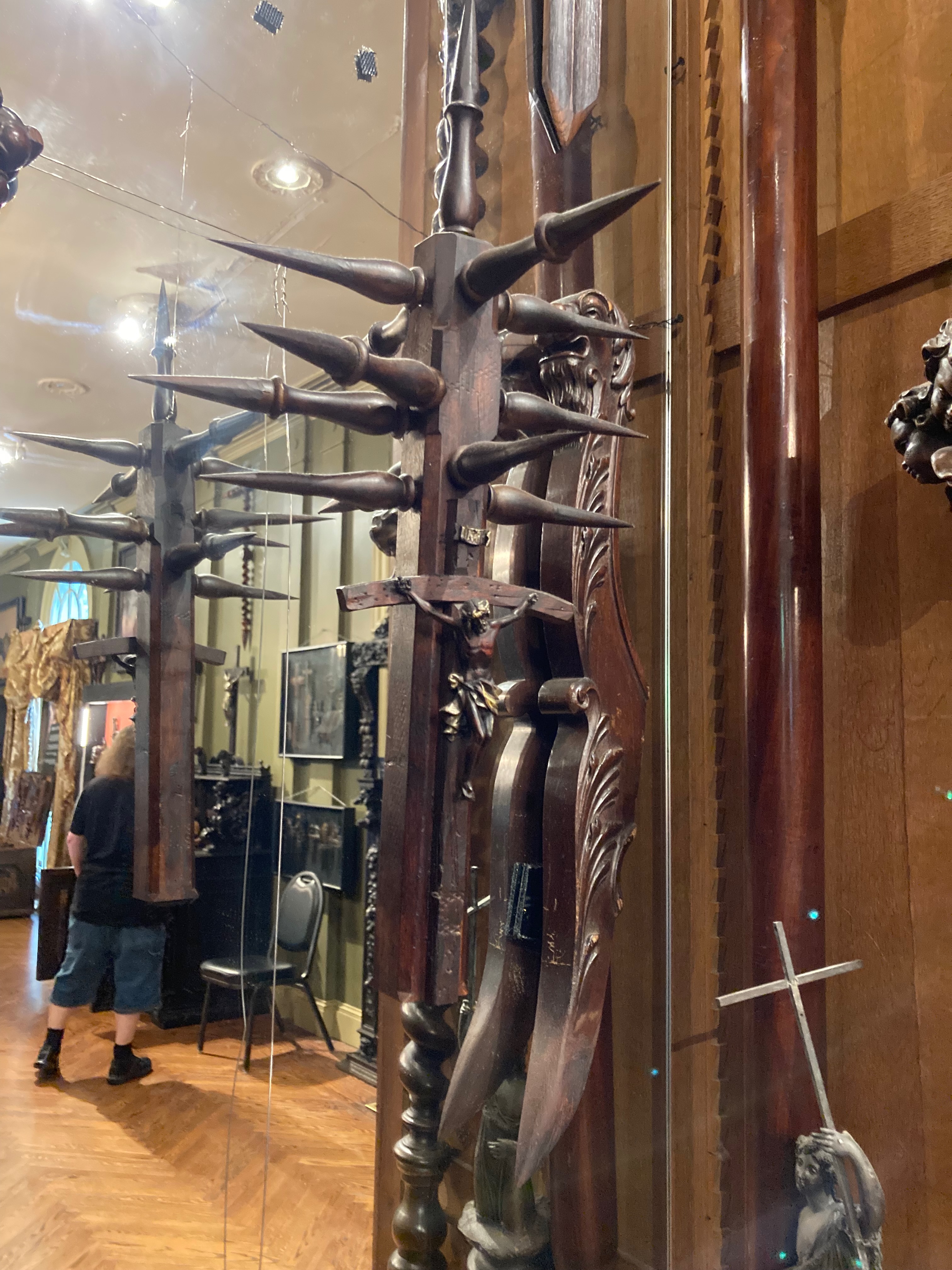
Vampire maces were of a higher magnitude.  The spiked mace, with crucifix, shown here, is an impressive piece of woodworking, as well as enough to make any vampire think twice before biting any necks in this house.  The idea of the Prince of Peace adorning such an instrument of violence encapsulates the contradiction of being human.  And the depths of our fears.  This museum is a testimony of our collective phobias.  Few people in this electronic age really believe in physical, supernatural, vampires.  There are people who do, of course, but most of us are so entranced by our phones as to completely miss a bat flitting through the room, let alone a full-fledged undead monster with fangs.  The fact is, over the centuries many people did gather what was needed to protect themselves from vampires in chests and cabinets, all in the name of fear.  
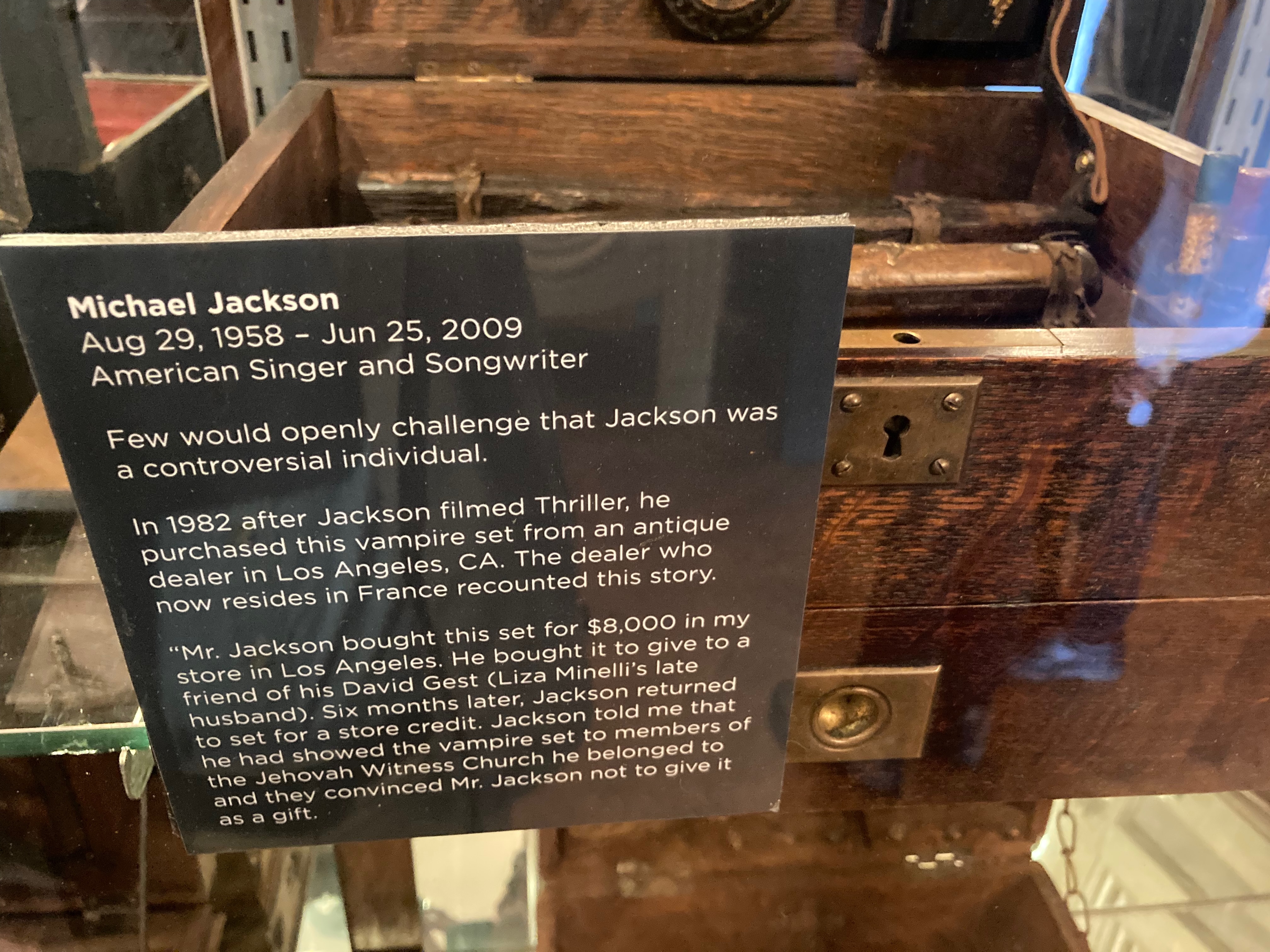
One final note: one of the vampire hunting kits was owned by Michael Jackson.  As the sign (with a typo) notes, the Jehovah’s Witnesses (to which both he and Prince belonged) convinced him not to give it as a gift.  Belief, it seems, persists even into the late twentieth century.

More Rats

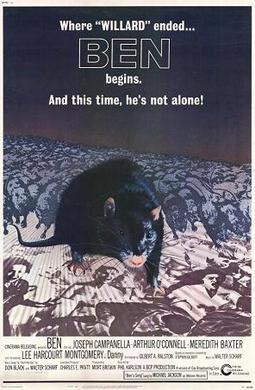
I’ve asked other survivors of the 1970s if they knew that the Michael Jackson hit “Ben” (his first solo number one recording) was written about a rat.  Most had no idea.  The song is the theme for the sequel to Willard, namely, Ben.  Now, I have a soft spot for seventies horror movies.  Before the days of streaming I repeatedly looked for Willard in DVD stores and never did find it.  I eventually found it on a streaming service and even wrote a Horror Homeroom piece on it.  One winter’s weekend with not much going on, I finally got around to seeing Ben.  Neither are great movies, but I’ll give them this—people in my small hometown knew about them.  Everyone I grew up around knew that “Ben” was a song from a horror movie.  In case you’re part of the majority, Ben is the chief of the intelligent rats who turns on Willard at the end of his movie.

An incompetent police department and other civil authorities can’t seem to figure out how to exterminate rats when they begin attacking people.  A little boy, Danny, has no friends.  He is apparently from an upper-middle class family, and he has a heart condition.  Ben finds him and the two become friends.  Danny tries to get Ben to lead his “millions” of rats away from a coming onslaught, but for some reason Ben decides to stick around and nearly get killed.  In the end, badly injured, Ben finds his way back to Danny.  Cue Michael Jackson.  It really isn’t that great of a movie—the number of scenes reused during the tedious combat scene alone belies the pacing of a good horror flick.  I felt that I should see it for the sake of completion.  Check that box off.

It’s a strange movie that ends up with viewers feeling bad for the rats.  They’re not evil, just hungry.  They do kill a few people (poor actors, mostly) but it’s often in self defense.  The best part is really the song, and the premise behind it—boy meets rat, boy falls in love with rat; you know how it goes.  Michael Jackson famously loved horror movies, and as many of us have come to realize there’s not much not to like.  This movie is pretty cheesy (with the rats attacking a cheese shop, but only after an unintentionally hilarious spa scene) but it has heart.  And it has a fair bit of nostalgia for those of us who grew up in the seventies.


Black Sabbath

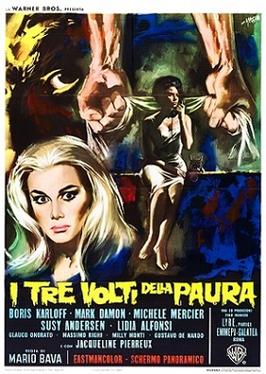
I used to be afraid of them.  The band Black Sabbath, I mean.  I heard the songs from Paranoid wafting from my older brother’s room (separated from mine by only a curtain) and was secretly intrigued.  But the name of the band—wasn’t that satanic?  To a young Fundamentalist there was much to fear in the world.  More than once I bought Alice Cooper’s Welcome to My Nightmare only to replace the copy I’d thrown away in evangelical terror.  I recently learned, however, the the band name Black Sabbath was taken from a 1963 horror movie.  And I also learned that the film was, in part, based on a Russian vampire story by Leo Tolstoy’s second cousin Alexei, titled The Family of the Vourdalak.  And that this story was published decades after Tolstoy’s flop, The Vampire.  That novel was inspired, in turn, by John Polidori’s The Vampyre.

Polidori’s work was inspired by a fragment by Lord Byron, which he contributed to the ghost stories putatively told among friends a stormy night in Geneva that also led to Mary Shelley’s Frankenstein.  Connections such as this are immensely satisfying to me.  Although I taught mainly biblical studies, my training was in the history of religions—it just happened to focus on ancient semitic examples.  Finding the history of an idea is one of the great pleasures of life.  But we’ve left Black Sabbath hanging, haven’t we?  The band realized something that Cooper would run with, namely, horror themed songs and metal go naturally together.  Such dark things led evangelicals to condemn the whole enterprise, claiming the band name was satanically inspired.  (Michael Jackson, raised as a Jehovah’s Witness, was famously fond of horror, although Thriller is perhaps the least scary horror-inspired album ever.)

I’d never seen Black Sabbath before, so now I had to watch it.  Of course, there’s nothing satanic about it.  An Italian, French, American collaboration, it’s a set of three stories bound together by Boris Karloff’s narration, and it’s all in Italian.  One story is about a woman double-crossed but saved by an estranged friend.  The second, the one featuring Karloff, is the one based on Alexei Tolstoy’s Russian vampire tale.  The third is about a poor woman who steals from a dead patron and is haunted until the inevitable happens.  Not particularly scary, the film title was the inspiration for the band, not the content.  They were therefore labelled satanic because of a movie that has nothing to do with satanism.  The song “Black Sabbath” was actually inspired by Dennis Wheatley novels, which do, of course, deal with satanism.  The song itself isn’t satanic.  They decided to make songs like horror films in music.  And it all goes back to Lord Byron and the night near Geneva that inspired both Frankenstein and Dracula.


The Werewolf in Summer

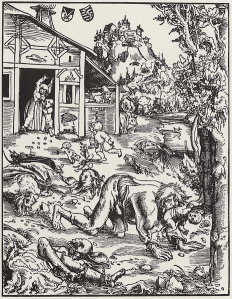
464px-Werwolf

It must be incredibly difficult to write a truly scary song. I don’t mean the kind of scare that most heavy metal can innately deliver, but I mean the kind of thrill that a classic horror movie gives. I’m constantly looking for the movie that can recreate the chills without getting blood all over the carpet. Music, however, soothes the savage beast. I remember when Michael Jackson’s Thriller came out. Now, nothing about Jackson’s musical style shows any hint of being scary. It’s too upbeat. In the end the ghost will be a mere reflection in the mirror, and the zombies will fade with the sunrise. I had some people tell me back then that it gave them the chills just listening to it. Amateurs. A couple weeks back I wrote a post on Radiohead’s “Burn the Witch.” It’s kind of scary, but it doesn’t keep me up at night. I haven’t heard Paul Simon’s new album Stranger to Stranger, but when I learned from NPR that it has a track called “The Werewolf,” I knew I’d eventually add it to my growing stack of MP3s.

Like Thriller, the musical style of the song isn’t inherently scary. The organ in the final minute is pretty effective, though. What’s scary about “The Werewolf”? The lyrics. Simon is, to this child of the sixties, the foremost lyricist of his genre. Rich, complex, nuanced, his words tell a story and that story is scary. While I prefer my werewolves with different baggage, it’s pretty clear that like most shapeshifters the werewolf stands for hunger. There’s violent rage, of course, but like the wendigo, hunger drives those who can’t fulfill their desires in human shape. The Howling, for example, shows how lust can make a werewolf. There is a lust more dangerous than that of the flesh, and that is the greed that leads to societies with one-percenters who just can’t stop eating.

When we see Trump-clones who pay no taxes at all, due to the good that being uber-rich offers the economy, we should listen for howling in the night. Too many an April has rolled around where those of us called “middle class” stare in wonder at just how large a cut our government takes. The werewolves don’t wait for October to come around. No, those who are hungry eat all the time. I don’t find Simon’s music to be particularly scary. The tempo is upbeat and his voice just can’t feel threatening. Still, I’m shivering after listening to “The Werewolf” even though the shortest night of the year is fast approaching on padded paws.


Random Faces

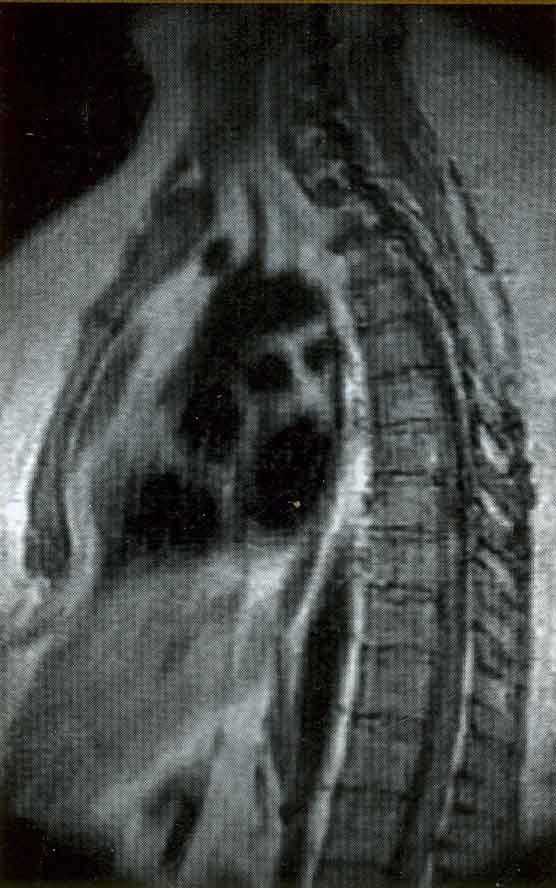
A friend recently sent me an issue of the Annals of Improbable Research that featured an instance of pareidolia on the back cover. Pareidolia, or the brain’s tendency to read patterns in random input – especially faces or human forms, has been a subject addressed on this blog before. Nevertheless, the phenomenon has continued to find wider exposure on the internet, and its implications continue to grow. The Cheezburger folks who brought us LOL Cats now have a site dedicated to pareidolia entitled “Happy Chair is Happy.” The question is not so much why we see faces everywhere, but what do we do about it.

Photo credit: C. Vittore, K. Tribble and D. Savala, Ann. Improbable Research

Perhaps the most prevalent uses of pareidolia in natural phenomena (human-made objects are often funny or uncanny, but the faces may be there by intentional design) revolve around the supernatural. Would-be ghost hunters find what looks like a face in a window or shadowy corner and interpret it as a disembodied spirit. Religious believers of various faiths find the faces of their founders or leaders in natural noise. A tract I saw as a child told the heart-wrenching story of a woman who’d given up hope. She randomly took a photograph of her garden and when she developed it (this was back when film was actually still in use), she found the face of Jesus in among the leaves. Her angst alleviated, she went on to face life with a fresh sense of possibilities.

We often see what is not really there. On a visit to my niece last year, while waiting in the car outside her dorm, I saw a shadow on the wall that looked exactly like the recently deceased Michael Jackson. The shadow was cast by security lights through a bush, but the face was unmistakable. To test my observation, I asked my niece – who knew nothing of the fleeting rock star on the side of her building – if she could see it. Immediately it became obvious to her. An epiphany of Michael Jackson may be a religious event, or at least a supernatural one, to some. In reality it was a temporary arrangement of leaves aligned just right to catch a security light to form a public icon. Putting faith in pareidolia is a very haphazard source of security. However, if it helps someone deal with the stresses and strains of life, what harm is there in seeing Jesus (or Michael Jackson) where he really isn’t present?