Making Monks

Now that I’m an antique, antique stores have a special draw.  They’re kind of like museums with free admission where you can buy the artifacts.  There’s a particularly large one in Allentown that I’ve visited a few times.  It’s the kind of place that, if you want something you see, you buy it right away because it’s not likely to be there next time you go back.  Back in March I saw a pair of bookends that caught my attention.  They were carved in the shape of monks reading books.  The reason I was fascinated by them is that I had bought my wife a very similar figurine (too small to be a bookend) when I first started teaching at Nashotah House.  We didn’t have much money, but I thought it was a whimsical reminder of where I was when I had to be away all week so that we could keep our academic couple dreams alive.
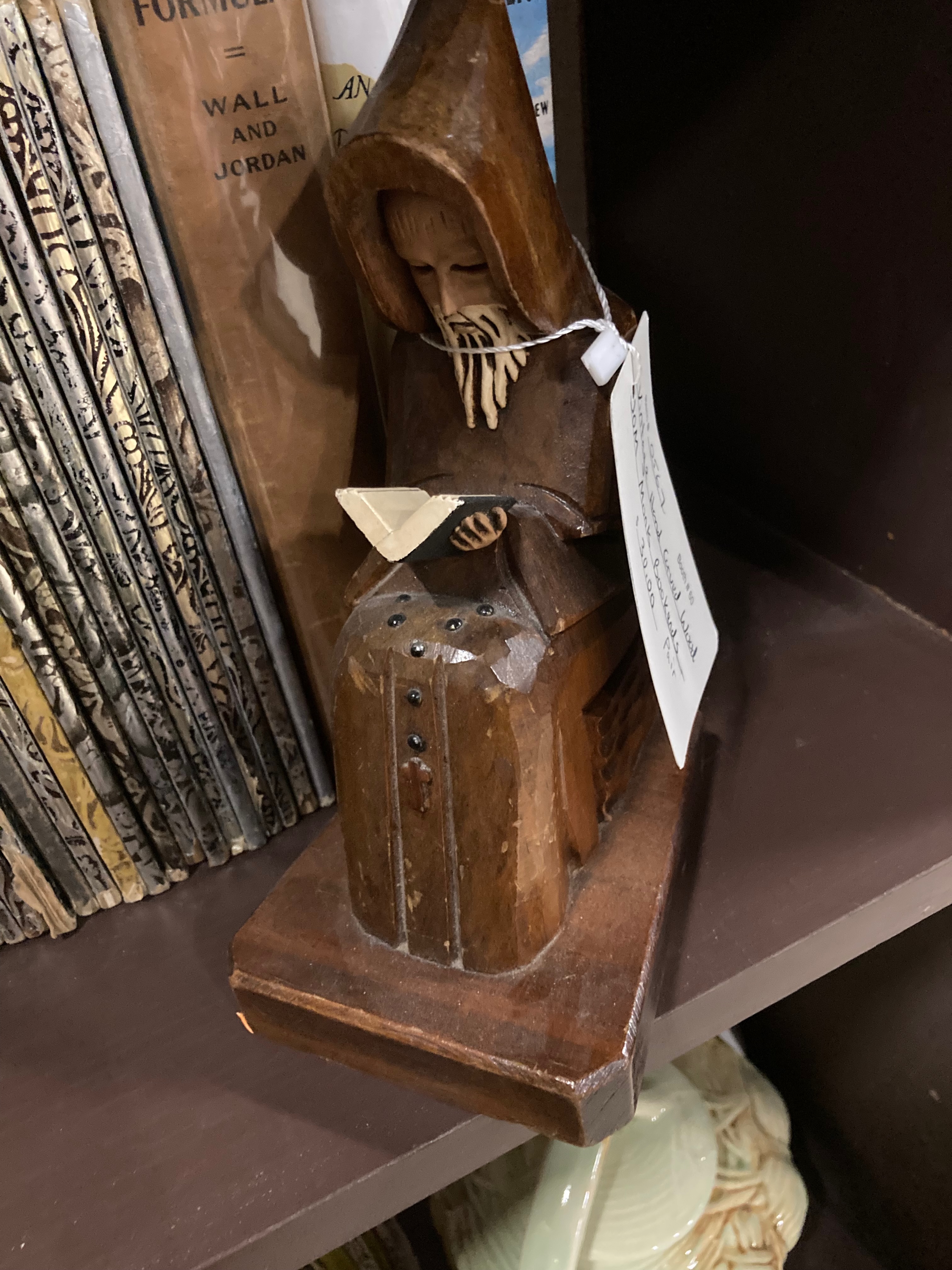
By the time I got back to the antique store the “bookends” were long gone.  What I was really curious about was whether there could be a connection with the Nashotah House curio I purchased nearly 35 years before.  There’s probably something I’m missing.  Was there a Platonic original somewhere?  When I failed to find them at the antique store, I did an online search and discovered a very similar one on Etsy, listed as being made in the 1970s.  I bought the one we have in 1992.  It was clearly handmade; the Nashotah House bookstore had a few of them on display at the time.  They no longer carried them after the inventory sold out.  I’d supposed they were made by a local Nashotah House person—which may be true—but where did they get the idea?

A bit more time on Etsy revealed another exemplar, this one listed as from the 1940s, specifically from Mexico.  One of the Etsy sellers is listed as being in Florida.  I bought mine in Wisconsin.  I found a pair in an antique store in Pennsylvania.  What is the missing link here?  This is the kind of rabbit hole academics are liable to tumble down.  Since I’m a dark academic, it strikes me as a research topic for someone without tenure worries to consider.  Or perhaps a detective who was raised Catholic.  All the five examples (two on Etsy, two in the antique store, and one from Nashotah House) follow the same plan and are stained and painted similarly.  This antique is curious about the origin story of those other antiques.

Non-Lending Library

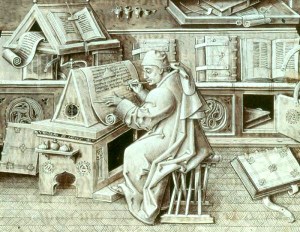
One of the hidden benefits of the coming societal collapse is the chance for the resurgence of print books. Since I’ve spent most of my life surrounding myself with volumes thick and thin, dense and light, I’ll have plenty to read between bouts of skulking out for food like a feral cat and clawing off those who follow me home, thinking that it’s edible stuff I’m stockpiling. Won’t they be surprised to learn it’s only books! My wife sent me an Atlas Obscura story the other day about book curses. The description of the life of a medieval scribe sounded oddly compelling to me—hunched all day over a writing desk, copying books by hand. Not having to worry about catching the bus before sunrise or being too tired to answer your personal email in the evening. The point of the piece, however, was the book curses.

I’ve been an avid reader since moving to a small town where the main occupation of kids my age was recreational drug use. I was one of the very few who didn’t inhale. Reading became my escape from the loneliness I felt. And I used to lend books to people who’d ask me. I quickly learned that others didn’t share the same care for books that I had. Lent books seldom made their way back to me. We were poor and there were no bookstores nearby and Amazon wasn’t even a meme in Jeff Bezos’ eye yet. Replacing books wasn’t easy. Once I lent out a book I’d already read (but you couldn’t tell it, I’d been so careful). The borrower actually did return it, but the spine was all creased and cracked so that you couldn’t even read the title anymore. I soon began to regard books like those medieval monks who put curses on them so nobody would steal them. I stopped lending them out.

The thing I’m banking on is that books will retain their barter value when society implodes. Of all possible universes only in that one will I be considered wealthy. Those who visit our little apartment inevitably comment on the number of books. What they don’t realize is that there’s a strategy involved here. Like those medieval monks, I have a suspicion that knowledge—including facts that don’t have alternatives—will one day in our dystopian future be valued above all the tweets and lies Washington seems to suggest we follow blindly. And blindness will make a great curse, now that I think about it, to protect these books from being stolen. Or “anathema-maranatha,” as my medieval mentors used to say. Or as Sarah Laskow ends her piece, “May whoever steals or alienates this book, or mutilates it, be cut off from the body of the church and held as a thing accursed.” Maybe this isn’t so strange for a guy whose first academic appointment was at a school that reminds many of The Name of the Rose. (Which was the last book I lent out, for the record.)


Viking Trail

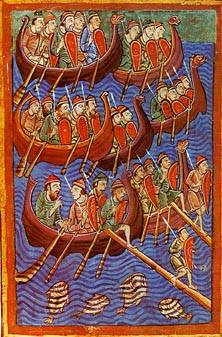
History is a powerful elixir, capable of transforming sinners to saints with the mere passage of time. Well, calling Vikings saints may be a bit of a stretch, but still, they have become some of the sexy bad boys of the Middle Ages, and with the finding of a Viking horde in Scotland last month, they are in the news once again. Vikings and monks were kind of like medieval dogs and cats. Monasteries, located in lonely regions, often amassed wealth and Vikings, looking for loot and less scrupulous about bloodshed, were eager to take it. The give and take (literally) of this violent lifestyle involving seafaring, battles, and churches, makes for good ancient drama and much of it took place along the coasts of Scotland. Our Scandinavian scourge, however, didn’t stop there. It is well established that the Vikings made it to North America well before Columbus. Those who don’t dismiss the Kensington Rune Stone also claim that the Vikings reached Minnesota long before football ever did. Whatever the reason, we are fascinated with Vikings.

Wikinger

Perhaps they are the ultimate autonomous self-promoters. We all would secretly, at least, enjoy being able to set our own standards so that they favored us and our loved ones. The Vikings represent the flaunting of the rule of law, traveling far to take what they want by force. And, perchance, leaving a bit of treasure behind as well. The Vikings became Christianized and the slave trade (long before the New World caught hold of the idea) was effaced to the point of becoming uneconomical to them. Nobody is certain why, but the Vikings, probably for a variety of causes, ceased to be the terror of the seas. Now the Scandinavians are considered among some of the most literate peoples of the world.

Along with the decline of the Vikings, however, also came the fading of the monastic cultural hegemony. To be sure, there are monks and nuns still today, but the force with which they gripped the medieval imagination began to decline with the Protestant Reformation and the recognition that vast wealth, even if cloaked in poverty, is still vast wealth. Now the finds from both monasteries and Viking sites constitute historical treasure. Information about a world long gone. The underlying idea, however, is never very far from the surface. We may lay claim to post-colonialism, but powerful economies have a way of getting what they want in the way of trade treaties and tariffs in any case. When a Scot finds a Viking these days, it is a cause for celebration as we let bygones be bygones and cut the humanities curricula nevertheless. The Vikings never really disappeared.