Be Careful Little Hands

“Time is always against us,” Morpheus informs Neo in The Matrix. Of course, this is a paradigm for life spinning out of control, an allegory of having been taken over by forces against which there is no defense. It surprises no one that as time continues its inexorable march there will be generations that see the same phenomenon in very different ways. In last week’s Time, Nancy Gibbs’ essay addresses the differences between the millennial generation and those of us who are, well, not to put too fine a point on it, older. Her observation on their religious sensitivities is worth noting: “millennials” are just as religious but less conventional, with 1 in 4 having no religious affiliation. They nevertheless remain a deeply spiritual bunch.

Neurologists continue to study the “hardwired” aspect of religious belief, finding that human brains possess a genuine need to believe in something. Why not god? It is, after all, our cultural matrix. As I read this I reflected on ancient religion. Often students ask me what ancients believed. We don’t really know. Religion as a belief system only arises when monotheism emerges: if only one religion is correct, then it is possible to believe in the wrong one. There is no empirical way to test religious claims (yet) and so modern people equate religions with belief systems.

Ancient folk were much more practical. Religion was a matter of praxis, not belief. If you did what your local gods demanded, you’d get along for another day. Modern people peer deeply into the divine realm and make long-term plans based on the assurance of correct belief. Neither method, however, ultimately works. The millennial generation may be on the right track back to that old time religion. According to Gibbs what they’ve lost is faith “in the institutions that claim to speak for [God].” The idea of an all-powerful guy out there purposefully keeping us guessing while refusing to demonstrate the truth plainly for all to see is strangely outmoded. Religion becomes a matter of correct practice, as the old children’s song goes, “Be careful little hands, what you do – for the father up above is looking down in love, be careful little hands, what you do.” Millennials may rightfully wonder who this “father” is, but there is no question that there is someone out there watching what they do. Or else our own neurons conspire against us. The more we learn about the nature of religion, the less we know.

Syncretism Synchronicity

By strange coincidence I had two friends ask about syncretism over the last few days. As generally understood, syncretism refers to the blending of religions. In the ancient world when one culture came into contact with another inevitable sharing resulted. Since all religions at the time were polytheistic, there was no concern about sharing deities too. Ancient people wanted to assure their good fortunes and survival just like modern folk do, and so the safest course of action when you become aware of a new deity is to placate her or him. There are few risks at worshipping additional gods in a polytheistic system, since all deities thrive on adoration. Some ancient societies, such as that of the Mesopotamians, realized that the number of gods could grow well beyond reasonable proportions. After all, many kinds of phenomena had gods, including the natural world, human inventions, and the cosmos. Recognizing overlap between the roles or functions of certain deities they began to draft up lists equating the various gods. Some of these lists are quite extensive.

This is the practice of syncretism. Your Yarikh is my Sin, and why offer two sacrifices when one will suffice? Ancient worshippers did not worry about the endless confusion that this would cause for future monotheistic scholars rediscovering their lost civilization. James Frazer, of Golden Bough fame, was a Victorian scholar who saw syncretism everywhere. Ancient cultures became a melting pot with countless variations on every theme. With more sophisticated anthropological methods Frazier’s work eventually fell into disfavor, and syncretism with it. Each ancient culture was distinct, with nuances and subtleties unguessed by rampant blending and blurring of the lines. Some scholars today shy away from the word syncretism since it has such unholy associations.

Fallen Saint James George Frazer

Part of the issue is where our culture stands. We are not the final word in discovery or understanding of our world, and yet monotheistic religions, the majority position in the western hemisphere, make absolute claims. Those of us who examine ancient religions are born into these outlooks, assured that modern-day religion is the true religion and that it, unlike other aspects of culture, will cease to evolve. Religion, however, changes as soon as it leaves its founder’s mouth or hand. The multiplicity of human perceptions and outlooks assures us that each believers’ religion is unique. We may be ashamed by the implications, but syncretism, it seems, will always have the last laugh.


Tale of Two Anarchies

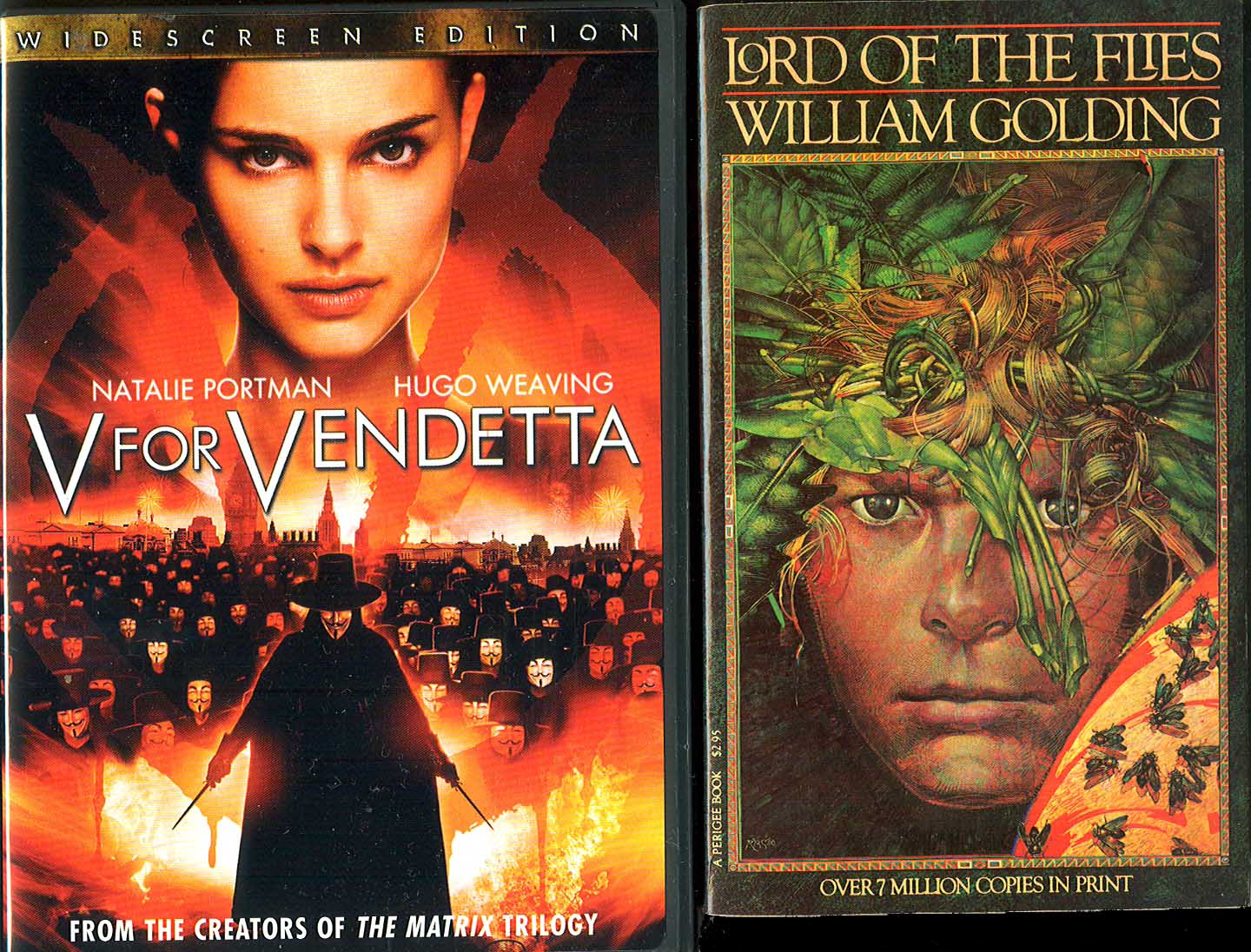
While snowbound over the weekend, I reread William Golding’s Lord of the Flies. I recalled a profound sense of awe from when I read it the first time in college, when students are invincible and optimistic. The second reading was still rewarding, but the message seemed darker, more true-to-life. Children on an isolated island devising their own schemes of democracy cannot repress the deep urge for self-advancement. When it comes to working together for the common good or promoting one’s own will, the latter wins out and seeks to destroy all dissenters. Anarchy becomes their natural state.

A few weekends ago I finally got around to watching V for Vendetta, the Wachowski Brothers’ dim and hopeful dystopia where individual conviction wears away at a conformity that benefits the privileged class. Recasting Guy Fawkes as a hero, albeit a tragic one, is a bold move in the post 9/11 world. The anarchy here leads to a rule by consent, the oppressed rising up as one to say “no more.” Even V is dead so there is no one to lead.

Better together?

Anarchy is a frightening prospect. Most people feel more comfort in the rule of law. One time I joined a discussion my brother-in-law was having with some friends on the rule of law. They were suggesting that if rule of law could be brought to bear on the Middle East then the seemingly continual crisis there might terminate. I disagreed from the far end of the table, not close enough to hear the whole conversation. My rationale is that the utter conviction of religion trumps the rule of law. Rule of law assumes all are equal, but religion in a monotheistic theater always assumes only one is right, and therefore superior. All others must submit. Problem is, many monotheistic religions feel the same way. We see it in the extreme power structure of the Religious Right in this country. Who is willing to say maybe the rule of law is superior to the rule of God? Watching the graceful anarchy of V, and reading the disturbing anarchy of Lord of the Flies, sometimes even the most stalwart free-thinker wishes everyone would bow to the rule of law.


Demoted Angels

One of the questions frequently surrounding monotheism is that of angels. Surveys indicate that even non-religious North Americans, by far, believe in angels. So, where do they come from? In a monotheistic context where God is considered omnipotent what role could angels possibly fill?

Angels appear in ancient religions in medias res. Going back to the earliest attested religion, that of the Sumerians, we find winged divine assistants called apkallu. In a polytheistic world, gods could always use a little help. These divine beings, portrayed with wings, are sometimes called “angels” by modern commentators, and they do serve some of the basic functions of an angel, such as doing errands.

Other ancient polytheistic religions knew of differing classes of deities; not all gods were created equal! There were primordial deities, often old and retiring, and there were active ruling deities who received their authority from the primordials but who in fact ruled by might. Below the ruling gods were skilled-labor gods and messengers. It is from this class of messenger gods that angels eventually evolved. We don’t know that messenger deities were portrayed with wings, but in ancient times wings indicated speed — uninterrupted movement — so you could do worse than have wings if you were a messenger. The English word “angel” derives from the Greek term indicating a messenger. Indeed, by the time we reach the Hebrew Bible angels are often indistinguishable from humans.

The problem is that when monotheism developed during the Exilic Period, the Israelites had already become quite accustomed to having angels around. Before prophets showed up angels were often the means of learning the divine will. If there is only one god, what do you do with this tier of messenger deities? Demote them to angels! They are still supernatural, but not as powerful as God.

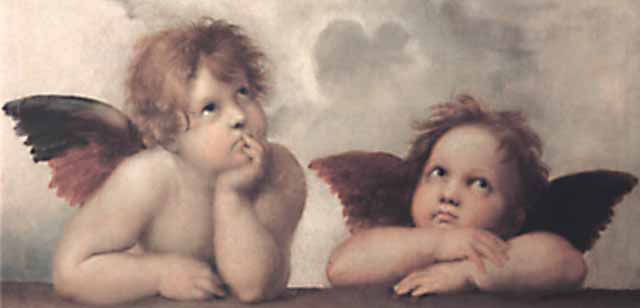
Probably under the influence of Greek Hermes, angels regained their wings to become the winged humans we know so well today. It is a mistake, however, to call all winged humans from the ancient world “angels.” Angels are the result of the religious evolution from polytheism to monotheism, and their ancient predecessors were truly gods.

Remember when we used to be gods?


Neo-Canaanites

The world of religious studies is full of surprises. Since people are forever seeking new forms of fulfillment, the endless variety of religions itself comes as no surprise, but the results of religious experimentation sometimes lead into uncharted waters. One of my students at Rutgers recently pointed me to a new religion called Natib Qadish, “the sacred path” in potentially vocalized Ugaritic. (Ugaritic, like most ancient Semitic languages, was written without vowels. Some modern scholars, basing their reconstructions on likely vocalizations known from other Semitic tongues, have tried to give voice to this dead language.) I have no idea how large a following this religion has, but it does maintain a substantial website explaining its core beliefs — the modern worship of the Ugaritic/Canaanite gods.

Unsatisfied with the tradition monotheism that eventually drowned out polytheistic voices in western religions, followers of these reconstructed religions are looking back to something more ancient, more primal, and perhaps, more human. What strikes me as odd concerning all of this is that religions such as Natib Qadish are based on extremely fragmentary understandings of ancient religions. We have perhaps a 101-level understanding of Ugaritic religion; some parts are very well attested, but there are huge lacunae that confuse the overall aspect. As I tell my students, ancient religion was based less on belief than it was on practice. Belief-centered religion is a relative newcomer on the historic scene. Ancients inherited their “religions” without question, based on where they were born. Tess Dawson, the founder of Natib Qadish, writes: “I have yet to find any word that means ‘religion’ in any of the ancient texts.” I would argue that it is because the concept of religion itself is a modern one.

Humans seem to have believed in gods from very early times. If gods are there, they must be placated. This is not religion; it is commonsense. Not to placate gods is to invite disaster. In Ugarit these gods included Hadad (Baal), El, Asherah, and Anat, among a host of others. These were the gods people “discovered” as they tried to fumble their way through a difficult existence. And gods like to eat meat, they learned. Sacrifice was born. What is a feast without ceremony? Ritual must emerge. I know this is overly simplistic, but belief doesn’t really enter into this scenario until late in the game. Heterodox belief was normative until Christianity assigned eternal consequences to correct belief, and now we are free to believe whatever we will.

As far as I can tell, Natib Qadish does not actually involve animal sacrifice to the gods (although it is based in Chicago, long known for its slaughterhouses). Like many modern Christians, the followers of this religion wish to reach back to a more pure form of ancient belief. It is an exercise in futility, however, in many respects. The framework has changed beyond recognition and we have no way of knowing what any ancient god would require of us in an internet age.

SAWHadad

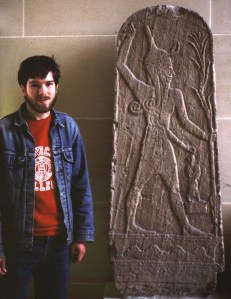
A young Dr. Wiggins meets Hadad in Paris