Middle Age Demons

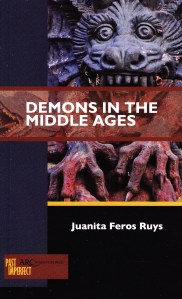
One of the consequences of watching horror movies is the interest in the origins of various monsters. Since many such films feature demons, their backgrounds and origin stories have always been a point of curiosity. Time is always an issue and Juanita Feros Ruys obliges that hurried sense by packing a lot of information into her short book Demons in the Middle Ages. Covering the basics in the introduction, she moves on to discuss demons in the desert—the bane of the early monastic, and demons in the monasteries of populous Europe. A chapter on the Scholastics describes how early science was applied to incorporeal beings, and a final chapter on learned magic, i.e., raising demons via magic books, finishes off this brief study.

What is particularly striking here is that the Bible says surprisingly little on the topic. It says, however, just enough to kickstart the Late Antique and Medieval interest in the subject. Vast amounts of speculation were raised in the Middle Ages concerning what exactly demons were and what they were made of and what they could or couldn’t do. Ruys points out the trajectory of the male necromancer giving way to the female witch just as early modernity was getting started. The results, we all know, were horrific. Throughout it is remarkably clear that belief in demons was strong. People took them very seriously—the Bible says they’re there, so there. Belief, as always, has consequences. Beginning with the Scholastics, however, a reasoned understanding of the spiritual world was deeply desired.

Reason and faith aren’t really the strangers they’re often portrayed to be. Medieval monks could be quite clever and scientific in their outlook. Human mental faculties, created, as they believed, by God, were necessarily good. Something I’d never considered, but which Ruys explores, is the belief that God cannot experience emotions. Being an “unmoved mover” meant not experiencing emotion (which, she points out, includes a noun of movement). This also meant that demons, according to some, had no feelings. This is a very cold spiritual world, particularly when it’s put into conflict with the human one. Spiritual, rational beings subjected to emotions, we’re the ones at the mercy of supernatural beings more powerful than us, yet incapable of the warmth we crave. About a millennium and a half of shifting beliefs in demons crowd this tiny book. Although not intended to be especially profound, it gives the reader plenty to ponder. Including why some of us watch horror movies at all when religion can do the trick all by itself.

Someone to Blame

There’s many ways to look at monsters. A friend recently sent me an Atlas Obscura article “The Modern Lives of Medieval Monster Scholars” by Cara Giaimo. It seems that some professors of medieval studies have taken to monsters to help explain societal problems. The Middle Ages in the western world, of course, were the days before the Enlightenment began. Belief in monsters was nearly universal. Much of the world was unexplored and inaccessible. In those unknown places, there were monsters. The article goes on to explain that monsters thus provide a natural way to deal with uncomfortable issues such as racism and religious discrimination. Monsters are those who don’t look like we do, or behave (therefore believe) like we do. It’s okay to kill monsters.

This is a mentality that we see reemerging in the twenty-first century. Despite the fact that you can easily reach nearly any part of the globe and enroll in university classes to learn what other religions actually believe, instead we prefer to see others as monsters. People see monsters because they’re afraid. They’re afraid because they’re not educated. And the political system in which many of us live is designed to keep the average person down while the wealthy reap the benefits. It serves the interests of such an unbalanced society to send people on monster hunts. The enemy is anyone who is different—not the one who owns the company that owns the company that you work for. The owner’s just like you, only he has so much money he doesn’t know what to do with it.

I once asked one of my students why he was interested in a certain topic. His answer has stayed with me all this years: “who can say why they’re interested in anything?” While I was in seminary—before the days of the J. R. R. Tolkien movies—I was very interested in medieval studies. My thought process, however, goes back to origins. The origins of medieval thought were the Bible, the ideas of the Bible (for Christians) come from the New Testament. The New Testament comes from the Hebrew Bible. Where did the Hebrew Bible come from? And that journey led me back to monsters. Like my student, I can’t say why I’m interested. It may be that I’m afraid. And in such times as these fears seem to be entirely justified. In the eyes of some future, truly enlightened society, ours will be the New Middle Ages with all its monsters.


After Dark

So many spooky things happen at night. If you’ve read much on this blog you’ll know I blushingly confess to a horror movie addiction. So much so that I wrote a book about it. Friends occasionally feed this fear by sending me stories of strange, nocturnal happenings that are frequently posted on the internet. All kinds of odd creatures roam the night: dog-men, goat-men, lizard-men (and they mostly seem to be male, for whatever reason). It’s enough to keep you inside once the sun sets. Of course, if you read this blog you know that I’m an extreme morning person. Sleeping in, for me, means getting out of bed at 4 a.m. instead of 3:00. Yes, it’s often dark at that time of day, and horror movies teach us that demons are particularly active around 3 o’clock. But then the sun comes up, and everything’s okay. Until the next twilight.

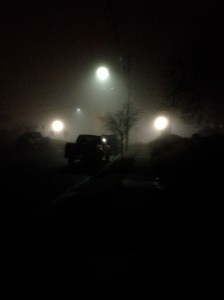
Now that December’s here, I find myself out in the dark more than usually occurs for a guy who gets up so early. After the time change—for which there exists no logical reason—it’s dark by the time I climb off the bus from my day job in New York City. The other day I was compelled to drive after dark. It was only just after 6 p.m., but that’s getting late for me. I scan the road looking for deer. A thought occurred to me—what if I see something weird cross the road? What would I do? A few moments later I was startled to see a woman and child beside the street. I was prepared to stop since—and this is apparently an unknown fact—it is the law in New Jersey to stop for pedestrians in a crosswalk. The young boy then made a dash in front of my car. The woman grabbed him and yelled. They weren’t crossing as they struggled at the roadside, so I slowed down but drove on. “That was weird,” my wife said, “that boy was in his bare feet.”

It was 40 degrees (Fahrenheit) outside. This wasn’t one of New Jersey’s famed haunted roads, even. It was a comfortably affluent suburban street. The image stayed in my mind. There’s only so much you can do when driving in traffic. Yes, it was night, but this is New Jersey—there’s always traffic. Did anybody else see what we saw? What was happening here? Why was I so afraid? Fear is the most honest of our emotions. Without it no organism could long survive in this hostile world. After nightfall even governments are at their worst.


Some Bible Lovers

I’m on a train heading to Boston. If you notice a dearth of religion scholars in your neighborhood this weekend, it’s because it’s time for the American Academy of Religion and Society of Biblical Literature annual meeting. If a religious emergency comes up, take two of your favorite scripture and call the office next week. Viewed from the outside, this must be one of the stranger scholarly gatherings. A few thousand people get together in posh hotels and convention centers to exchange ideas about which the larger world cares very little. Ironically, the vast majority of people in the world are religious, but as a society if we know enough about the Bible to get us through the most recent indiscretion, so we’re good. Let the scholars have their fun.

This year there’ll be a session on monsters and monster theory that I helped to organize. That doesn’t mean I’ll get to attend it—the conference is a very different beast for those on the exhibit hall floor—but I’ll have the satisfaction of knowing that it’s happening. Years ago I discovered that many of my colleagues who are teaching shared an interest in monsters. Many of us weren’t aware of the others because this isn’t the kind of thing you talk about in polite company. One thing an editor may be is a vector. We hear what widely separated people are working on. Every great once in a while we’re able to put the pieces together. So it was with monsters. There seemed to be a critical mass, and two or three colleagues took the idea and ran with it. Or ran from it, whichever you do with monsters.

For me Boston will be a series of meetings that will blend into one another until I’ll have to consult my notes to remember anything at all. If I could feel this wanted outside the conference I’d never have to dream of being a rock star. You see, editors are the gatekeepers of academic publication. For those lucky enough to have teaching jobs, it’s publish or perish, so the editor is a vital link. The rest of the year we fall into the background. Emails go ignored. Reminders are forgotten. Requests unanswered. But here, out on that carpeted concrete, we’re the ones they’ve come to see. What we do in the conference matters very little to the world at large. But we do it anyway. We gather together just before Thanksgiving, thankful to be reminded that there are others like us.


Gendered Lupines

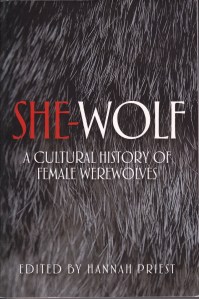
No doubt an excuse isn’t required for reading about werewolves this time of year. Something about October encourages that sort of thing. Hannah Priest edited a collection of essays from various scholars titled She-Wolf: A Cultural History of Female Werewolves. As is to be expected among academics, there are several interpretations wrapped together here and the book covers female werewolves from the Middle Ages—where they are sometimes associated with witches—up through modern cinema. A number of literary sources and a few television representations, and even an RPG, are also part of the mix. The problem with multi-contributor books is that it’s difficult to draw any overarching conclusions, but some observations do come up repeatedly here, and they are worth pondering.

The connection of the female with the animal nature of human beings is stressed for the female werewolf. As might be expected in a patriarchal culture that is becoming more so daily, this is considered an aspect of inferiority. The connection between lunar cycles and werewolves as an inherent feminization of the monster is also brought up more than once. The bodily transformations of puberty also play a role. What we can clearly see amid all of this is that although male werewolves outnumber females in literature and film, and, with a few exceptions, in folklore, the very nature of the werewolf is coded as feminine. This is something that isn’t obvious until a book like this points it out.

Given my own idiosyncratic interests, I was surprised how much religion came into the discussion. Among classic monsters, werewolves tend toward the secular end of the spectrum. There was, however, from the Medieval Period up through early modernity, an ecclesiastical fascination with werewolves. This fascination often came in the form of recriminations against women—attempts to subject them to the wills of men. The church often blamed werewolves on women out of the control of menfolk. And of course, you may kill a monster with no need to feel guilt. More modern views of female werewolves—particularly in movies—are more, well, humanizing. Recognizing that wildness is part of being an evolved animal means that we’re more sympathetic (or had been until November of last year) to the woman who is able to let go of convention and become truly liberated. Now that we experience the poignant lengthening of nights that stir our primal fears, werewolves come naturally to mind. If only we could learn what they have to teach, we might all howl at the harvest moon.


Warnings Ahead

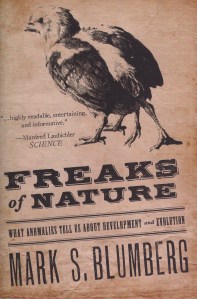
As a noun, “freak” is akin to a swear word. To refer to another person in such terms is often considered derogatory and degrading. Still, we all know what it means—an individual who doesn’t conform to expected models. I was a little worried about Mark S. Blumberg’s Freaks of Nature: What Anomalies Tell Us about Development and Evolution, then. It had the word “evolution” in the subtitle, and that sounded scientific enough. Besides, those of us interested in monsters know, deep down, that they are essentially freaky things. Indeed, Blumberg starts his book with teratology, the study of monsters. And monsters come from religious backgrounds. Their name is related to the root “to warn.” I’m a squeamish sort, though, and reading about freaks of nature requires a constitution I sometimes lack. Especially when it comes to science.

Yet I couldn’t put the book down. To begin with, the concept of developmental evolution (devo evo, for those in the know) is utterly fascinating. If you grew up, like I did, being taught that genes govern evolution solely, this book will surprise you. Evolution can happen at the level of the phenotype, based on environmental pressures. This is well documented and hardly a matter of dispute. Bodies can change according to what they need. Blumberg offers case after case where this dynamic may be seen. The idea that we are “programmed” falls, ironically, at the feet of biology itself. We, and all animals, are adaptive creatures. Humans may not be able to regenerate lost limbs, but many amphibians can. Sometimes it’s a matter of age, and sometimes it’s a matter of matter. I found such a quantity of astonishing stuff here that I overcame my queasiness to see what the next page might reveal. When I hit the chapter on reproduction I realized once again that nature does not agree that “man plus woman equals marriage.”

This must be one of the most threatening areas of science to Fundamentalists. The sheer variety of ways that “genders” interact in nature, and appear in human bodies, will have purists calling out for heavenly clarification. Reproduction, in other words, isn’t in the service of conservatism. Fish, for example, that change “genders” instantaneously after mating, taking turns being female and male with a mating partner, must surely call for theological justification of some sort. And female lizards that don’t require males to reproduce, but are helped along by being mounted by another female so as to jog some ancient reptilian memory, require us to rethink our rather simplistic terms of endearment. Not for the the faint-hearted, but amazing for those who dare, this book takes our appreciation for “life finding a way” to a whole new level. Even if it’s a little freaky.


No Place to Hyde

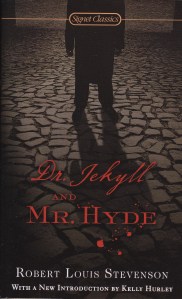
“I was driven to reflect deeply and inveterately on that hard law of life, which lies at the root of religion and is one of the most plentiful springs of distress.” These words occur near the beginning of Dr. Henry Jekyll’s confession, the very manuscript that closes Robert Louis Stevenson’s The Strange Case of Dr. Jekyll and Mr. Hyde. Upon reading the book, along with the preface and afterword clearly meant to pad out the thin volume, I realized that I was not alone in having known the story all my life but never having read it. Western culture is steeped in the idea like so much strong English tea. The story of the divided self. The eternal question of who I really am. Like Frankenstein’s creature, Jekyll and Hyde found immediate resonance in the pantheon of monsters. Here was something with which we could all identify, but which we all would deny. Or would we?

Jekyll notes that the root of religion—proper behavior, moral living—is a source of distress. And this before the era of Nones and non-believers. Religion has that reputation. “Be good or else!” Or fire insurance, as some call it. Religion, in the popular imagination, isn’t so much about sublimity any more. Or transcendence. Somewhere along the way it got fixated at about the level of our genitals and what we should never, ever do with them. Hyde’s sins, as commentators frequently note, are anything but explicit. He tramples a young girl and kills an old man. Beyond that we know nothing of his monstrosity. Is it so hard to believe the restraint concerns his sexuality? After all, his friend Utterson—well, Jekyll’s friend Utterson—enjoys his wine. Both respectable men seem to have hearty appetites. Apart from violence, what other dissipation is there?

Like many first-time readers I can’t recall how I first learned of the mad scientist and even madder thug that make up the namesake of this story. For some reason I never made—even remotely—a religious connection with it. It was a monster story, after all. Innocent fun for a Saturday afternoon. The experience of reading the book was a bit more jarring than that. Jekyll’s confession isn’t exactly easy to read. It is like going to the confessional with the curtain drawn and all the lights on. And yes, the implications are religious after all. It is a little book with a big point to make.


The Unliving

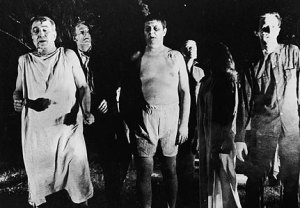
Western Pennsylvania, from which I hail, has few claims to fame. One, still largely forgotten, is that it was the birthplace of the petroleum industry. Remains of the early exploitation of the fossil fuel still lie scattered carelessly in the woods. Another claim to fame is that the region was the adopted home of George Romero and served as the setting for his groundbreaking film, Night of the Living Dead. Unintentionally, Romero created what continues to shamble on in the form of the modern zombie. Although the movie doesn’t call the living dead “zombies,” it established the trope of their endless hunger for human flesh and their rabid bite. So it was with sadness that I read of Romero’s death a couple of days ago. Although he wasn’t from Pittsburgh, he established the city as zombie central. It’s nice that he gave something back.

Zombies have, due to their protean nature, become a fixture among the monster constellations. They represent the worst of what people can be—selfish and brainless, without empathy, their own cravings being the only matters of importance to them. Sounds kind of like the Republican Party. The rest of the world calls them monsters. Night of the Living Dead shocked audiences of the late 1960s with its graphic portrayal of cannibalism and thoughtless destruction. Interestingly, the choice of a strong African American lead for the movie was, according to interviews with Romero, simply a matter of his being the best actor, not an intentional racial statement. (That too reminded me of western Pennsylvania; there were racial tensions where I grew up, but many of us befriended those who were “different” without any clue that it should matter at all.) Duane Jones carried off the role of Ben with conviction and energy. He died young but he never became a zombie.

To make an impact intention need not be present. While Romero denied for the rest of his life that the movie was “about” the Vietnam War, and that his choice of a black lead was a racial statement, both of these factors became facts about the film. Concepts, in other words, like zombies, may rise from the dead. Beyond the shock and gore, the movie made a powerful, if unintentional, statement. It helped to define Romero’s future career. A success in a difficult industry may indeed decide one’s fate. George Romero would go on to make many other monster movies. Western Pennsylvania would become a zombie haven. You never know what you might find scattered about in those forgotten woods of your childhood home.


Living Challenged

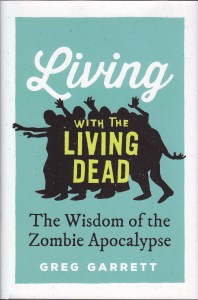
One of the surest signs of hope for the world is that academics are beginning to notice monsters. A trickle began some time ago and it’s probably best to call it a trickle still, nevertheless, the quality of the trickle is improving. Some serious publishers are now counted among the mix of those who pay attention to the lovable unlovable. Greg Garrett’s Living with the Living Dead: The Wisdom of the Zombie Apocalypse is one of the more recent approaches to the undead that looks for religious themes among them. They’ve been there from the beginning with zombies, of course, but few with tenured positions bothered to look. It’s an open question how long the current fascination with the undead might last, but Garrett’s treatment finds them useful sources of theological thought.

Perhaps the aspect of my own fascination that I feel most often compelled to explain is why fear has such an appeal. Garrett makes the point that fear often causes people to make bad choices, and I would have to agree. It is, however, the fear of fear that takes a greater toll. You see, fear is a survival instinct. Without fight or flight we’re all zombie food. Some of us learn this harsh lesson early in life, and if we manage to survive long enough we might even become nostalgic for it. It’s not that I like be afraid, but I do know that if we fear fear—if we avoid looking at what scares us—we put ourselves in danger that the flight response might well prevent.

Garrett’s treatment is helpful in demonstrating that there is a reason for such stories. In fact, according to his analysis zombies can leave you with a profound sense of hope. He uses the living dead as a means of thinking about community, ethics, and apocalypse. Not all end of the world scenarios are that bad. How we treat the living dead may tell us quite a bit about our own rectitude or lack thereof. In other words, zombies are more than their puerile thrills might suggest. There’s something of substance here. I don’t agree with all of Garrett’s conclusions, but he offers a stimulating tour of the current media frenzy around the living challenged and is surely correct that there is more going on with monsters than many of our parents would like to have a religion expert admit. Those childhood years might not have been wasted on monsters after all.


Revisiting Frankenstein

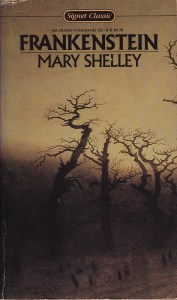
There’s nothing like going back to the classics. Many people don’t realize that one of the best-selling books of the nineteenth century was Mary Shelley’s Frankenstein. It has never been out of print. As a novel it has its issues, but the tale strikes something deeply responsive in readers. And the story may not be what you think. You see, the movies have made Frankenstein’s monster into something Shelley never intended. Indeed, today’s Frankenstein monster is pieced together from various monster images, just like the mad doctor’s original creation.

After a lapse of many decades, I decided to read Frankenstein again. It must’ve been in my tweenage years that I’d last done so. I recall putting the book down thinking how sad it was. Something happens, however, when you return to a book after a span of many years. This time I was looking for the mad doctor and hoping to determine if the monster deserved that title at all. The story won’t let any easy answers come. Victor Frankenstein is a young, impulsive man carried away by an idea. He doesn’t contemplate the consequences of what he’s doing. It’s like buying a dog without considering that you’ve just realigned your priorities for several years. Not noticing that his growing creation is hideous to the eyes until it’s too late, he simply abandons the creature without a word. (The parallels with an absentee father should be obvious.)

The creature—monster is a bit harsh—wants acceptance. He isn’t a mute brute with bolts in his neck. He’s not a robot. He is Adam kicked out of the garden with no Eve. He doesn’t start out evil. The rejection of his creator forces him to murder in a desire for revenge. Shelley’s world was deeply influenced by the Bible as well as Milton. Religious concepts are constantly under evaluation. The child of radical parents—her mother was one of the first feminists on record—Shelley questions everything here. No doubt in Victor’s mind he’s created a demon. Or has the monster created Frankenstein? Until the very final pages nobody else actually sees his monster, or at least hasn’t seen him and lived to tell about it. What fuels the creature’s fury is rejection. Evil doesn’t just happen in the world of the mad doctor.

Sympathies are divided in Frankenstein. We feel for the monster. His creator never apologizes. Never reflects that he somehow shares (or completely owns) the blame for the sad fate of that which he’s created. Living under a Frankenstein presidency, these unanswered questions hang thickly in the air. Lack of foresight seldom ends well. The monster isn’t always who you assume it to be.


Crossing Beowulf

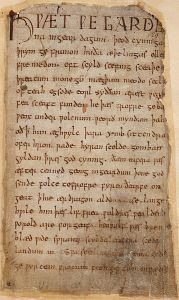
Beowulf, from Wikimedia Commons.

Slaying dragons is costly. In much of the western hemisphere the ultimate metaphor for the perils that await humanity in a world imperfectly understood, dragons were the bane of the medieval imagination. And earlier. Dragons are mentioned in the Bible and were stock creatures in the bestiaries of the Mesopotamian imagination. And, of course, it is a dragon that causes Beowulf’s fall. Almost a type of a latter-day Gilgamesh, Beowulf likewise holds an early, if non-negotiable place in the western canon. In this month’s Atlantic, James Parker discusses the dynamic of this pre-Christian poem in our post-Christian context. Specifically he addresses how modern renditions, perhaps inadvertently, Christianize the story. A popular subject for movies and graphic novels, Beowulf is a monster-hunting story that begs for baptism.

The story itself is familiar to most alumni of American high schools. Perhaps before we’re ready to be exposed to Old English, we find ourselves assigned a story of drinking, rage, and violence. Make no mistake—Beowulf is a hero. A deliverer like the judges of old. Grendel, after all, is the spawn of Cain, the evil seed that continues into a moody world of stygian nights and dismal swamps. Parker’s brief article demonstrates the reception history of the poem nicely. It also raises the question of what’s going on when heroes fight monsters. When the Christian imagery that’s deeply embedded in our culture comes to play Beowulf can’t help but become a Christian monster slayer just as Grendel becomes the enemy of God. All of this may be quite unintentional. What we see, however, isn’t imaginary. That’s the way reception history works.

Parker suggests that, although Beowulf is a pre-Christian poem, the cosmic order laid out in the tale is a Christian one. Even today in a post-Christian America it’s vital to understand how important religion remains. It’s not so much that churches are overflowing (unless they’re mega-churches stating that you can get rich by attending) as it is a recognition that centuries of Christian identity can’t help but leave their mark on culture. We see crosses in the handles of swords. Or even in the grid patterns laid out in city streets. Telephone poles. What’s so remarkable is that we see such things naturally and think nothing of it as we go on our secular way. There may be monsters out there. What may not be so obvious is that in slaying them we’re engaging in a religious activity as old as Gilgamesh, if not as obvious as a crucifix held up to a vampire in the present day.


Dreaming Reality

The problem with monsters is that they’re not easily reduced to a lowest common denominator. This becomes clear in an article about the under explored (from a western perspective) monsters of Australia. Christine Judith Nicholls, in “‘Dreamings’ and place – Aboriginal monsters and their meanings” (sent by a friend), describes many of the scary creatures of the outback. The article title references Dreamtime, a kind of aboriginal journey that ties into indigenous Australian religion. The division between imagination and reality isn’t as wide as we’re sometimes taught. (More on this is a moment.) Nicholls’ article demonstrates that many of these monsters impress on children the dangers of wandering away from parents. Indeed, that is clearly part of the socializing function of monsters. The question, however, is whether that’s all there is to monsters or not. (Nicholls doesn’t use reductionistic language—she does note this is a psychological explanation.)

In an unrelated article in The Guardian, by Richard Lea—“Fictional characters make ‘experiential crossings’ into real life, study finds”—researchers suggest that fictional characters seem to appear in “real life” from time to time. All those who read fiction know this phenomenon to a degree. Just because someone is completely made up doesn’t mean that s/he doesn’t exist. Since our minds are the ultimate arbiters of reality, fictional characters and monsters may indeed be “real.” This isn’t to suggest that physical, flesh-and-blood imaginary beasts lurk in the dark, but it isn’t to suggest that they don’t either. Reality is something we haven’t quite figured out yet. The more we think about it, the more it appears that both hemispheres of our brains contribute to it.

monster

When the morning newspaper raises alarm after alarm about the frightening tactics of the Trump administration the temptation is to give up to despair. That’s not necessary, actually. Reality requires our consent. Imagination can be a powerful antidote to the poison spewed by politicians. What fictional character—or monster—might step into a situation such as this to make it right? If the power of millions of smart minds were concentrated on such a being, would it not become real? Friends have suggested over the past four months that the arts—creativity—are going to be especially important in the coming years. If we are to survive evil we’ll have to use our imaginations. That’s something that the aboriginal peoples can teach us, if only we’re willing to believe.


Know Your Monsters

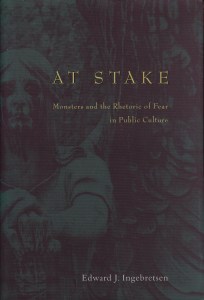
at-stakeEdward J. Ingebretsen is one of the most intelligent analysts of monsters about. That may seem like a small order, but it’s not—many people write about monsters, and Ingebretsen is one to whom attention is owed. At Stake: Monsters and the Rhetoric of Fear in Popular Culture is not an easy book to read. Narratively sophisticated, it takes on some issues we’d rather not have addressed. One of the great myths about monsters is that they’re all for fun. The current understanding of monsters gives the lie to that worn adage. Monsters tell us something extremely troubling about ourselves and we don’t like to have someone pointing it out. When hearing that some of the monsters considered are Jeffrey Dahmer and Susan Smith, the prospective reader might wrongly assume why. The monster may not be whom one expects. Indeed, Bill Clinton makes his way into the discussion, as do Andrew Cunanan, O. J. Simpson, and Matthew Shepard. Be not quick to judge, however; you must pay attention.

As most writers on monsters recognize, religion often fuels them. Without belief monsters have no power to scare. We’ve probably all seen horror films that underscore this point. If a creature is unbelievable it loses its ability to be frightening. The movie invariably ends up in the B category and is appropriated for laughs or for an example of how not to make a film. Ingebretsen knows that to understand monsters we must understand ourselves. We too often allow unspoken prejudices (which are sometimes nevertheless shouted aloud) to inform our opinions of what is deviant or evil. Just look to Washington and see if you can disagree. The more we tease these monsters apart, the less they conform to expectations.

As implicated by his title, a great deal is at stake in coming to grips with monsters. They aren’t just for childhood Saturday afternoons anymore. It may be that they are one of the healthiest means for dealing with the steady stream of fear flowing from the District of Columbia. Without our metaphors, we are lost. Those set on destroying monsters have no concept of just how terribly helpful they are. You can’t be sure who the beast is, they are so very protean. They will, however, get you through some dark nights. Not without scars, but wiser, if a touch more melancholy, in dawn’s cold light. Take monsters seriously. It’s the only way to survive them.


Made of Clay

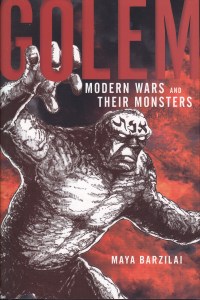
golemInvestigating a new field, at least on an academic level, involves a little disorientation. Part of this derives from the fact that academics didn’t use to write about monsters. Another part of it, however, is that those who do such writing have been doing so while my attention was elsewhere. It’s not easy to learn dead languages reasonably well. I didn’t pay much mind to the golem, being as it is, a “modern” monster. Probably responding to early modern pogroms, the golem was considered a defender of persecuted Jews. He was, however, a mindless defender. Made of animated clay, the golem was brought to life by magic and could only be killed in the same kind. Maya Barzilai has written a masterful account of how this monster relates to war. Golem: Modern Wars and Their Monsters explores how modern golem stories (and there are many) tend to relate to situations of conflict.

I had read about the golem before, and had trouble locating many academic resources on the creature. Barzilai demonstrates how much there is to ponder. It seemed, prior to reading her book, that the golem was mostly obscure, but it turns out that many writers, artists, and filmmakers have appropriated the clay giant over the years. Those who trace the history of comic books suggest that Superman was originally a kind of golem figure. I hadn’t realized that the golem had his own short-lived comic book series. When a people are persecuted repeatedly, having a secret weapon may not seem a bad thing. But the golem is difficult to control. It rampages. It can kill the innocent. Barzilai raises the question of whether a people with an unstoppable weapon are ever justified in using violence.

That question hangs pregnantly over the present day. The rich white men that run this country feel that they’ve been oppressed. Not willing to admit that it’s morally reprehensible to treat women as objects (they’re “hosts,” we’re told), blacks as inferiors, or hispanics as illegal, they bluster away about family values that aren’t consistent with anything other than threatening those who are “different” into submission. And yes, the Jews are among those these white men scorn. I wonder where the golems have gone. It could be that, like those of us self-identified as pacifists, that those who know how to make golems simply can’t justify violence. Barzilai didn’t intend for this in her book, I’m sure. Still, each new era brings new perspectives to these monsters made of clay.


Hopeful Horror

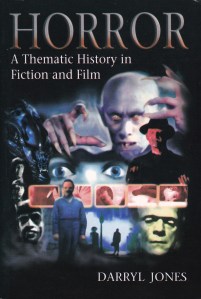
joneshorrorI don’t make New Year’s resolutions. To my way of thinking, if I’m aware I’m doing something wrong, I try to change it at that point, rather than waiting. Needless to say, then, I’m up to my old habits of reading about horror movies. Actually, Darryl Jones’ Horror: A Thematic History in Fiction and Film goes a bit broader than just the cinema. As the subtitle indicates, this charming book also addresses narrative fiction as well and the result is quite engaging. Divided thematically, Jones considers the various types of horror without delving into pretentious theorists to give him academic credibility. Here is a true fan who’s capable to sharing the excitement of the genre. Along the way, accompanying the usual observation that horror and religion share considerable conceptual space, he makes the point that in movies horror is one genre that makes use of academics as characters of authority. Sure, there are others, but in this realm to be educated is a benefit, whether the plan is to take over the world or to stop some evil force from doing the same.

I’ve been watching movies that can be broadly classified as horror since I was young. And I had admired—emulated to some extent—the professors and scientists I saw in those presentations. When a monster was on the loose, you went to find an expert to learn what to do. At the risk of contradicting myself, theorists have been suggesting that one of the problems with post-truth is the death of expertise. Anyone can be an expert these days. The question, “Why should I listen to you?” is on every self-appointed smarty’s lips. Earning a doctorate, the horror world tells us, gives you access to some kinds of knowledge that others don’t have. Problem is, zombies don’t respect such learning. They only want brains to consume.

It never seemed to me that watching horror was a means of learning. As a kid escapism is part of everyday life—taking things seriously is for adults. Growing up, however, I kept my love of scary movies in reserve. Little did I realize that it was a form of training. Now university-affiliated academics are finally able to begin admitting that they find monsters compelling. More than that, they actually learn something from them. Although not a resolution, I see myself reading further books about horror movies this year. It may be a naive hope, but it would be wonderful if they were all as insightful as this one has been.