Creating Light

I spend a lot of time awake when it’s dark out.  I try to limit the number of lights on, both for the environment and not to wake family members who sleep on a more normal timetable.  But this schedule makes me reflect a lot about light.  For example, the other day I glanced at a mirror that happened to be reflecting a light.  By reflecting light you create more light.  Think of the moon.  A full moon on a clear night can make a massive difference in how well you can see.  Farmers used to know this as harvest moons gave the possibilities for longer light-time hours to get seasonal work done.  And that light reflecting in my eye in an early morning mirror made me wonder what would happen if you set up a mirror facing a mirror with a light in the middle.  Wouldn’t you have just created more light in the world?

I’m almost always awake before sunrise.  I don’t recollect the last time I awoke to find the sun in the sky.  There are so many subtleties to morning light.  You can see it coming a long way off.  I try to jog at first light, when it’s just light enough to see where I’m going.  It’s important to seek light in the dark.  There’s a kind of spirituality to it.  Often when I’m jogging I’m amazed at how far even a small light carries.  When I see the stars at night and think how terribly, terribly far away they are, I marvel that their light still reaches us.  Light can be blocked out, but unless it is, it stops at nothing.  Light persists.  

Bioluminescence fascinates me.  We now know that our very genes have the ability to create their own light.  Fireflies and deep-sea creatures have figured out how to do it, and, I suspect, scientists could engineer a glowing person.  We have it within ourselves to create our own light.  Science wouldn’t disagree.  Sometimes such things are best seen by walking around in the dark.  The contrast helps that inner light show through more clearly.  Those who are afraid of the dark haven’t spent the time to truly become acquainted with it.  The dark is a very capable teacher and the rhetoric that it’s evil is based on mistaking, as the Buddha said, the finger pointing at the moon for the moon itself.  But it’s starting to get light out—time for me to go for a jog to seek even more of it in the semi-dark.

Eclipsed

Shooting the moon.  It’s such a simple thing.  Or it should be.  I don’t go out of my way to see lunar eclipses, but I had a front row seat to yesterday’s [I forgot to post this yesterday and nobody apparently noticed…].  I could see the full moon out my office window, and I’m already well awake and into my personal work before 5:00 a.m.  When it was time I went into the chilly morning air and tried to shoot the moon with my phone.  It’s pitiful to watch technology struggle.  The poor camera is programmed to average the incoming light and although the moon was the only source of light in the frame, it kept blurring it up, thinking, in its Artificial Intelligence way, “this guy is freezing his fingers off to take a blurred image of the semi-darkness.  Yes, that’s what he’s trying to do.”  

Frustrated, I went back inside for our digital camera.  It wasn’t charged up and it would take quite some time to do so.  Back outside I tried snapping photos as the phone tried to decide what I wanted.  Yes, it focused the moon beautifully, for a half second, then decided for the fuzzy look.  I had to try to shoot before it had its say.  Now this wouldn’t have been a problem if my old Pentax K-1000 had some 400 ASI film in it.  But it doesn’t, alas.  And so I had to settle for what passes for AI appreciation of the beauty of the moon.

Artificial Intelligence can’t understand the concept of beauty, partially because it differs between individuals.  Many of us think the moon lovely, that beacon of hope in an ichor sky.  But why?  How do we explain this in zeros and ones?  Do we trust programmers’ sense of beauty?  Will it define everyone else’s?  No, I don’t want the ambient light averaged out.  The fact that my phone camera zoomed in to sharp focus before ultimately deciding against it shows that it wasn’t a mechanical incapability.  Sure, there may be instructions for photographing in the dark, but they’re not obvious standing out here and my freezing fingers can’t quite manipulate the screen with the nimbleness of the well warmed.  There were definite benefits to having manual control over the photographic process.  Of course, now that closet full of prints and slides awaits that mythic some day when I’ll have time to digitize them all.  Why do I get the feeling that the moon isn’t the only thing being eclipsed?


Zones of Twilight

The other day I saw a beautiful twilight moon.  This was in the morning twilight.  I suspect many people don’t realize that twilight comes twice a day.  Twilight is when dayglow either begins or ends but either before or after the sun itself is visible.  Most people are familiar with evening twilight since they stay awake until after dark.  Morning twilight, so full of hope, is beautiful to the point of being painful.  The other day it was twilight as work was starting—the days are beginning to lengthen since I’ve been starting work in the dark for months now.  A waning gibbous moon shown through a gauzy cloud cover in an indigo sky.  It was very cold outside, so I went to the window to take a picture with my phone.

The modern phone camera often misses the point.  I zoomed in on the moon—phone cameras are wide-angle, by default—and it kept sliding in and out of focus.  The sky was getting lighter by the second, and I was losing the opportune moment.  I tried moving the phone closer to the glass, then back a little.  Still out of focus.  Then I realized what was happening.  My phone was focusing on the dirt specks on the window.  (Hey, it’s winter, hardly the time to be out with the squeegee.)  It occurred to me that a life lesson was being offered.

Thich Nhat Hanh recently died.  He was a Zen Buddhist master, and his passing reminded me of the old Buddhist saying that the Buddha is not the moon but rather the hand pointing at the moon.  Religions often confuse the hand pointing for the truly sublime realm to which it points.  Worshipping the person instead of following her or his teachings is a standard feature of religions worldwide.  It is the reason for much of religious conflict.  Those who worship the figure soon come up with their own teachings that are unrecognizable when held up next to those of the departed leader.  They focus on the window, not the glowing moon beyond.  The sky was growing too light to capture the image that had struck me.  The moon was blurry in a way that my eye hadn’t experienced it.  The moment of teaching was past.  The lesson was over.  The best that I could do was spend  a long day working then try to recapture a moment that had occurred in twilight.


Moon Base

Late last year scientists announced that a tunnel they’d found on the moon (remotely, of course) would make an ideal location for a human colony. The moon, you see, is quite cold and, lacking an atmosphere, constantly exposed to naked solar radiation. It’s a tough sell, even for first-time buyers. Still, with a little hole to crawl into, and some homey touches, this might be the future of humanity. Of course, offshore relocation has been a staple of science fiction from the beginning. Technically encumbered by the whole speed of light thing, we’re left with neighboring planets and moons that are either too hot or too cold, our species having evolved on the Goldilocks of solar system real estate. Moving to the moon might sound like a good idea right about now, but it’s going to take more than Two Guys and a Truck to get us there.

Fantasies of moving abroad come in two varieties—those of optimism and those of pessimism. Either things are going so well that we want to spread the evangel of our soaring success to the universe or things are looking so terribly Republican that even the dark side of the moon seems enlightened. There’s no question which phase we’re in at the moment. The moon is relatively close after all. It has been a fairly quiet neighbor over the millennia. We’ll want some good insulation, however, and despite the Weir version of Martians, we’ll depend on those back earth-side to send us some grub every now and again.

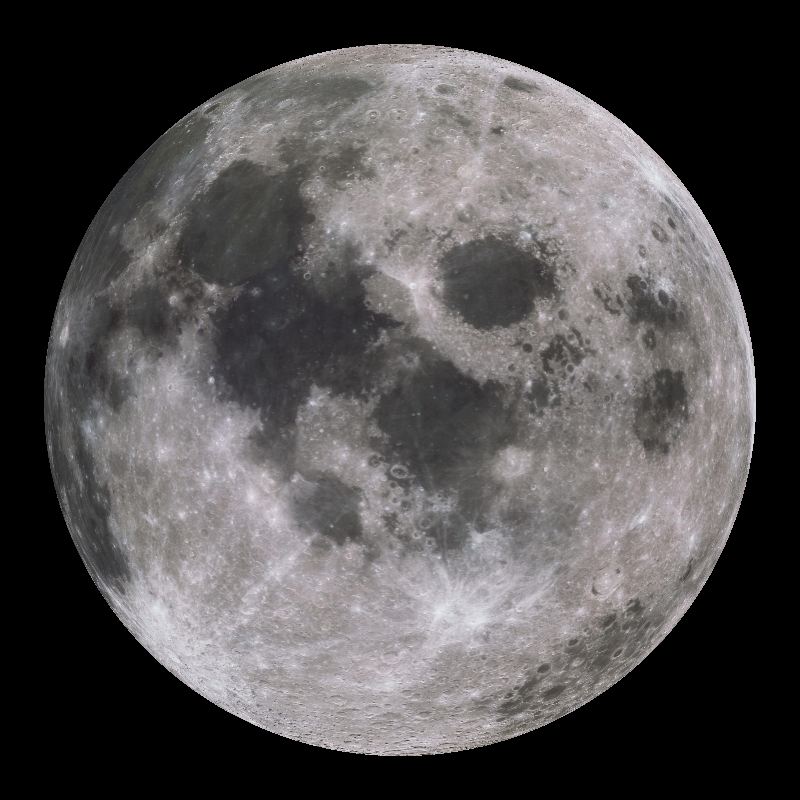
In ancient times the moon was frequently a goddess. Some ancient cultures pegged our satellite as masculine, but many saw her gentle light as more befitting a powerful female. Heading outside in the predawn hours with a full moon overhead is a pleasant, if chilly, reminder of just how bright our constant companion can be. Light without heat. Ancient desert-dwellers found the moon more benevolent than the sun, for night was relief from the fierce heat of day. Still, moving to the moon would meaning making a new world in our own image. Nothing, I suspect, would defile a goddess quicker. Our costly detritus already litters the once untouched face of Luna, and our size-nine-and-a-half prints are permanently left behind there. Heaven has always been that undiscovered country somewhere over our heads. The discovery of tunnels on the moon where we might snuggle down and be free may sound great. But we need to get things settled out on the ground first, otherwise our one and only satellite will merely become our next victim to exploit.


Lamp of the Gods

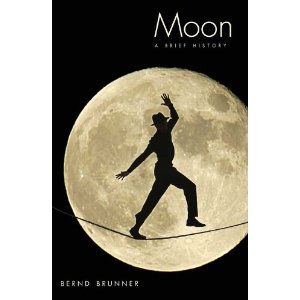
Long venerated as a god, the moon has fallen to such a declination that it scarcely attracts the notice of most people anymore. While some governments are busy making plans to reach the moon—notably those with the largest populations—the rest of the developed world looks to the nighttime sky and lets out a yawn. The poignant little book called Moon: A Brief History, by Bernd Brunner, offers a moving tribute that is part science, part history, and part whimsy. Very few heavenly bodies have undergone the dramatic plummet in interest as our familiar old moon. It remains the proximate cause for werewolves and the occasional harvest-season horror movie, but since the Cold War has ended and we no longer need to prove ourselves to anybody, attention has shifted toward more distant and abstract targets. Maybe Mars, or one of Jupiter’s moons holds the fascination we so long for. The moon, apart from a brief flare of interest when water was discovered there, has died a slow death in the human imagination.

In ancient times, the moon was often considered superior to the sun. Sure, it’s not as warm—downright cold at times—but its light is more gentle, more forgiving. The traveler’s companion, the moon illuminated the way before headlights were invented. The god of the moon (its gender was slippery in parts of the ancient Near East) sometimes topped the pantheon. Even today in Islam, the memory of the high god’s crescent moon can be found atop mosques throughout the world.

What happened to the moon? Famously Carl Sagan, himself an astronomer, wrote about The Demon-Haunted World. In this book he decried the human tendency to look for supernatural causation; the universe is entirely natural. Many have used his reasoning as a nail in the coffin of God. Clearly he was right in many cases, but, as Brunner shows, science can rob even a deity of its shine. Writes Brunner: “Its significance and roles have always varied across cultures and eras—from heavenly god to symbolic guardian or judge, to the scene or stage of spectacular visions and visits, to being ‘just’ and object of scientific investigation.” Once we’ve been to bed with the moon and look at it scientifically, its luster is lost. “Maybe we should try sometimes to un-think our scientific knowledge of the moon,” Brunner opines.

I was one of those thousands planted before the television on 21 June 1969 to watch the first men on the moon. Amid the turmoil of earth, it was a sublime, even a religious moment. In the end a dozen men walked on the moon before it was forgotten. Like the dozen disciples, they alone have been near the truly sublime. With Brunner I too would suggest that we not be too quick to forget our constant companion.


Inspired Lunacy

The moon is too easily ignored. Perhaps we fill our nights with too many other diversions that we easily overlook the millions of tons of rock high over our heads. When I introduce students to the importance of the moon in ancient religions they often seem surprised by the fact. The moon? It gives no heat, it is constantly changing, and sometimes it disappears altogether. Rather wimpy god to worship, don’t you think? Tonight the moon is back in the public eye because it is in perigee, its closest approach to earth in 18 years. In the facile language of the media, it is an “extreme super moon” (sounds like something you could buy at Wal-Mart). As with most ancient Near Eastern religions, modern perceptions, often vaguely scientific, do not encompass the enormity of phenomena before we became masters of the night.

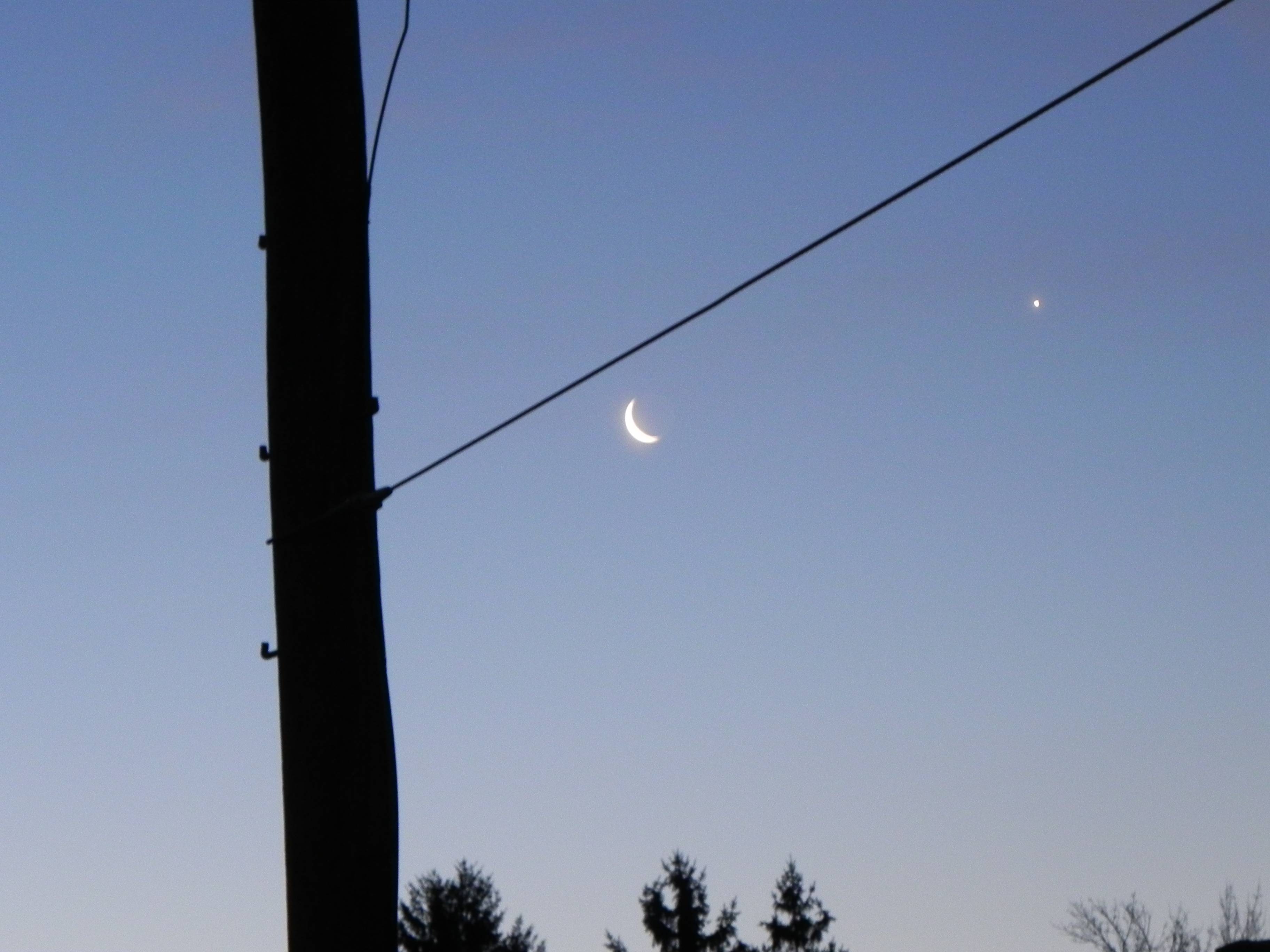
The moon races Venus to perigee

In some ancient Near Eastern religions the moon was superior to the sun. We know that the moon’s light is reflected from the sun – something that did not fit their cosmology. Instead, in those regions often brutalized by a hot sun, the moon appeared kinder, gentler. It’s light helps to make many nights less intense and it never burns you. Since it is easier to stare directly at the moon, it makes an effective timepiece as well. Its changes are periodic and predictable. For a world without electricity, where nights were only infrequently shortened with oil lamps, and where daylight savings time would have made no sense, the moon ruled.

Actually, the moon played a role in developing the concept of the Trinity. Three great luminaries regularly appear in our skies: the sun, moon, and Venus. These days when most people have difficulty locating Venus, and generally no interest to do so, it goes without recognition that it is the third brightest natural object in the sky. In fact, Venus is bright enough regularly to stimulate UFO reports. A celestial triad thus ruled the skies of antiquity, and in many of those cultures the moon was the greatest of the three. So give the moon a few minutes of your time tonight as it gets closer to the earth than it will be again for many, many years. Perhaps it may give us a bit of understanding on the origins of some of our religious ideas that persist to this day.


The Ides of March

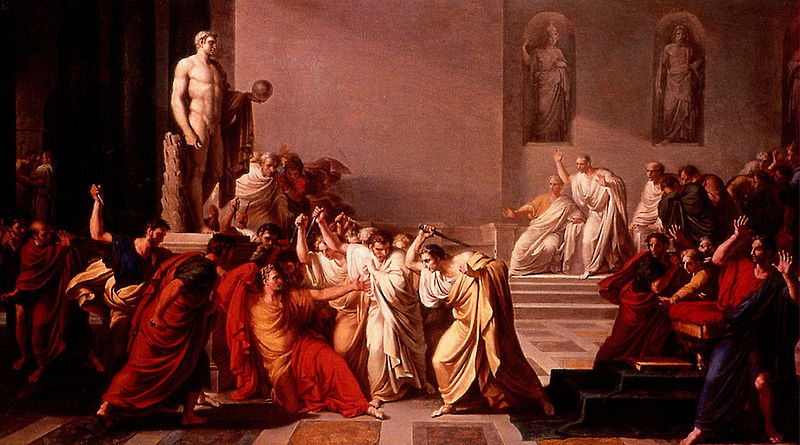
In the days of ancient Rome, politicians as well as plebeians feared the interference of the gods. Auspicious days were ignored, even by emperors, at their own peril. In my Mythology class the concept of hubris frequently emerges. Generally thought to be excessive pride, hubris can take many forms. Whenever a mere mortal strives for godhood, however innocently, it must be punished. Julius Caesar, declaring himself emperor, had to face the wrath of the gods. The ides of March kept in check the ambitions of the powerful. In a world where the political become too powerful, the very phases of the moon step in to restore balance.

The ides seem to have their origin in the date of the full moon. The month of March, named after the god Mars, featured a military parade on the ides. Then, as now, political power is simply the form of government backed by the military. The history of human unrest, especially notable since the American and French revolutions when the common people shouted, “Enough!”, is where might is shown not to equal right. Pontiffs and presidents, enamored of firepower and its blandishments, appear like Caesar before their populaces, confident in their wealth and military backing.

The concept of hubris might once again be meaningful to a culture under siege. As pundits and politicians make bids for places of abusive power, confident that there is no one above them, ethics are reformed in their own images. Have they not become their own gods? We the people bow to their vision of what should be. How many political leaders retire to uncertain futures because their own pensions have been slashed and healthcare diminished? Those who care for them in their dotage are the very children whose educational funds they’ve slashed. Hubris? It behooves all of us to beware the ides of March. Most, like Caesar, will ignore the warning and don the purple. Those who read, however, will not anger the gods.

Et tu, Brutus?


Sinful Moonsters

Wednesday night a student asked me about the moon god Sin. The name “Sin” has nothing etymologically in common with the usual English word for wrongdoing; they are simply homonyms. Nevertheless, when students first encounter this odd juxtaposition they often think that there must be something to it. This particular student pointed out that many activities classified as sinful take place at night, under the moon. Could they be connected? Linguistically, no; but it did get me thinking about the idea of the moon’s baleful influence on various creatures of the night.

Serious academic works seldom take vampires, werewolves and witches, some of the moon’s most infamously unholy acolytes, to be worthy of valuable research time. Meanwhile Stephanie Meyer and company are laughing all the way to the blood bank. Popular culture gives credence to the children of the night that the academic world ignores. I tried to do a little research on the moon and its mythology only to find that most moon books deal either with serious attempts at astronomy or serious attempts at astrology, neither of which I was seeking. I wanted to know when the moon had slipped from being the gentle god/goddess of the night into its role as the overseer of evil.

Evidence was scant, but it seems that in the Middle Ages, maybe influenced by late Roman ideas, scholars began to recognize the moon’s potential as a dismal influence. The moon has long been popular in folklore as a source of lunacy and luck. Lovers crave the moonlight, but so do teenage vampires and raging werewolves. This is, apparently, a concept of no great ancient pedigree. In any case, the moon here has nothing to do with sin.


In the Light of the Moon (Sin)

While teaching at the University of Wisconsin Oshkosh I was assigned a course whimsically entitled “Myth and Mystery.” With little more than an old syllabus and some Agatha Christie reading experience to go on, I set about building an academic study of the unknown. (Ironically, in the years since then it has mostly been students from this course who have contacted me later to follow up on classroom material.) One of the mysteries I addressed was the werewolf legend (also see the previous post).

The earliest known record of a man becoming a wolf derives from ancient Greece. An Olympic athlete named Lycaon reputedly turned into a wolf (not during the games, I suspect, or he would had to have been put in the dog races). I would contend, however, that werewolves are at least biblical and likely older yet. The tale of Nebuchadrezzar transforming into an animal in Daniel 2 is widely known. Less recognized is that this story likely originated earlier than the book of Daniel, and it was associated with Babylonian king Nabonidus. Nabonidus was a devoted worshiper of Sin, the god in charge of the moon, and was rumored to have struggled with an “evil ulcer” (the mind reels) instead of having transformed into a beast. Rumors that he’d gone insane abounded, which, for lunatics, must count for something! How far back the moon’s transformational powers go is not known, but the marauding beasts of the night were known and feared long ago, along with the occasional insane king.

Not Nabonidus, but maybe one of his kids?

Not Nabonidus, but maybe one of his kids?

Unfortunately only after my Oshkosh course ended, I struck up correspondence with Linda Godfrey, a journalist who lived almost close enough to be a neighbor. Linda is an avid researcher of the Beast of Bray Road, Wisconsin’s own home-grown version of the werewolf. The closest I ever came to experiencing the beast was being awoken one midnight by a pack of coyotes howling through the yard, but I read Linda’s books with wonder. Are ancient fears really present realities? I suppose only time will tell, but our ancient ancestors sometimes had more keen eyesight than their modern day beneficiaries do. Their advice was to love the moon with caution since it could cause insanity in select cases!